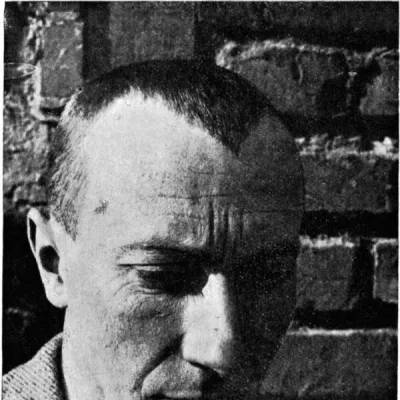
Hans Arp
Human Design Chart
Biography
Arp grew up speaking German, French and the Alsatian dialect of his birthplace. To avoid the German draft in WW I, he fled Alsace for Switzerland where he became a leading member of the original dada group centered around Zurich's Cafe Voltaire, protesting the idiocy of the war and bourgeois values in general. As a dadaist in Zurich in 1916-18, he and Taeuber made geometrical abstract art, always allowing a happy relaxation, a formal gaiety into the composition. He was denied Swiss citizenship when officials decided that his poetry proved him mentally deranged, and left staid Switzerland for Paris, where he became a citizen after Alsace was declared French.
Eventually he became part of a cutting edge that included Kandinsky, Picasso and Mondrian, an acknowledged bulwark of modernism, a founder of dadaism as far back as 1916. His exceptional collages were widely imitated and he also wrote experimental poetry. He and his wife Sophie Taeuber, married in 1921, were co-founders of the Abstraction-Creation group in 1931. She became known as a formidable talent in her own right. In life, she was completely subservient to his career, his major inspiration and deepest human love. She died in early 1943, at 54, suffocated by fumes from a gas heater while visiting a friend's house. Her death depressed him profoundly and his work became more conventional and less magical.
In his later years, Arp was an icon, revered and covered with honors. He died on 7 June 1966 in Basel, Switzerland.
Human Design Analysis: Hans Arp as Generator 1/3
Generator 1/3 — Design at a Glance
Hans Arp revealed himself as someone with immense endurance whose strength did not lie in self-initiated project launches but rather in the powerful response to what he encountered. His design as a Generator endowed him with high, enduring sacral energy – comparable to a workhorse that remains strong as long as it bears the right load and follows the correct path. This energy unfolded not through initiative but exclusively by responding to external impulses.
The central mechanics of his character were 'not initiating but reacting.' Hans Arp's success depended on waiting for signals from life before acting, only proceeding when his inner self – the sacral center – gave a clear 'yes.' This strategy of waiting and then taking action 'from the gut' led to deep fulfillment. If he initiated actively or suppressed the internal impulse, this resulted in frustration, energy loss, or burnout.
Two stumbling blocks shaped his dynamics: On one hand, the danger of wasting energy on things that did not genuinely interest him, which left him exhausted. On the other hand, being prevented from pursuing his heart's project when he was still full of power. If Hans Arp lived in harmony with this response to impulses, no one could stop him; if he lived against his design, persistent frustration would ensue. His energy served to materialize things but only through this specific way of responding.
Emotional Authority
Hans Arp displayed a decision-making stance that did not exhaust itself at the first impulse but found its final clarity after emotional waves subsided. His design carried emotional authority, meaning that the defined solar plexus center – here referred to as the Emotional Center – always served as the inner guiding point. This configuration was subject to constant fluctuation of feelings and moods; perception was always colored by the current emotional state. A moment of enthusiasm could quickly turn into a negative assessment of the same thing without reflecting deeper truth.
The mechanics of this authority established that spontaneous reactions were mere snapshots. Immediate action based on an initial feeling impulse risked misjudgments since the emotional wave had not yet run its natural course. For Hans Arp, it was essential to take time and 'sleep over' decisions multiple times. Only when intense feelings subsided and emotional distance was gained did a calm, comprehensive insight emerge. This process of delay was no obstacle but rather the necessary path to correct orientation. Emotional authority always took precedence over other defined centers; regardless of further configurations in the chart, this center determined ultimate decision-making. Through patience and waiting for the highs and lows of emotions, Hans Arp secured himself a well-founded, sustainable direction instead of succumbing to the short-term whims of mood.
The 1/3 Profile — Investigator / Martyr
Hans Arp lived his life as an ongoing shift between deep withdrawal and active experimentation. His design set a tendency to study insights not only theoretically but also by testing them through practical application at his own expense. This dynamic stemmed from his Profile 1/3, the Researcher and Experimenter. The Line 1 demanded phases of isolation from him to find clarity and inner renewal; this withdrawal was no escape but necessary regeneration before he turned outward again.
Simultaneously, the energy of Line 3 drove him to test his theories in social interactions and through trial and error. Here lay his central conflict: the desire for complete theoretical security clashed with the necessity of making mistakes to truly learn. Often, he felt compelled to explain himself or even confess, which could stir feelings of inadequacy. Yet precisely this process created his authenticity. When Hans Arp made a decision or rendered judgment, it was the result of double validation: intellectually penetrated and empirically tested. His life was a laboratory where theory and practice were integrated. Only through constant exposure and the courage to test limits could he uncover hidden connections that mattered to him. His judgments were deemed trustworthy because they emerged from both the depth of withdrawal and the breadth of practical experience.
Triple Split Definition — Defined & Open Centers
Hans Arp's Human Design configuration showed a tendency towards absolute mechanical independence: He was a closed system without any open centers. His system had permanent, unchangeable structures in all areas – from thinking (Head/Ajna) and expression (Throat) to identity (G-Center), willpower (Heart), life energy (Sacral), emotional authority (Solar Plexus), and stress processing (Root). This configuration meant that Hans Arp was not dependent on his environment to activate his core functions. His thinking, feeling, and actions were internal, constant processes that generated a massive presence.
His defined centers shaped him as someone who always operated under mental pressure (Head/Ajna) but had the energy to express this through his defined Throat. His emotional authority in Solar Plexus dictated the timing of all decisions, while his defined Sacral Motor provided the vital force for implementation – yet only upon correct reaction to external impulses, not by initiating action himself. His Heart Center ensured available willpower, and the G-Center gave him a firm identity and direction.
Although all centers were defined, his open Spleen Center (Status: open) carried a specific vulnerability. Here lay the risk of conditioning through external signals about health or well-being. Hans Arp tended to feel insecure or project survival fears when he did not trust his inner authority. His open Spleen Center could tempt him into spontaneous decisions to gain a false sense of security, or cling to people with defined Spleen energy even if they were not good for him. The challenge was to not interpret these external signals as truth and instead use the stability of his closed system to avoid resistance and efficiently utilize energy.
Channels for maturation, inspiration, intimacy, community and abstraction.
Hans Arp appeared as someone who through a mutative, creative individuality captured attention and inspired others. This stemmed from the Inspiration Channel 1-8, connecting G-Center with Throat Center. Gate 1 allowed for an individual expression of a creative perspective, while Gate 8 translated this into a public contribution. His impact did not rely on words or explanations but rather on living and demonstrating his unique identity. This required courage to stand out and resulted in an authentic presence that encouraged others to express their own uniqueness.
Simultaneously, Hans Arp generated deep, intense emotional and sexual intimacy through the Union Channel 59-6. This channel connected Sacral Center with Solar Plexus Center. Gate 59 brought in the energy of sexuality while Gate 6 steered an emotional wave of pleasure and pain. This combination created relationships that were personal, penetrating, and potentially fruitful. The mechanics of this channel required patience: waiting for the emotional wave was necessary to gain clarity and allow a real merging. Through this intimacy, Hans Arp could quickly penetrate into others' aura and ease confidentiality, paving the way for creative fertility.
The synthesis of these two energy flows defined his essence: A personality that touched through its unique, creative radiance while also binding through deep emotional connections. The inspiration came from inner truth and 'life' of identity; intimacy arose by allowing emotional clarity over time. This configuration shaped a lifestyle where public exemplification and private depth were inseparable.
Collective Circuitry — Circuit Signature
Hans Arp appeared as someone whose energy was flowing and strong, environment-dependent. As a Triple Defined individual, he did not have a consistent, continuous identity in the main areas of Knowledge or Meaning Finding. Instead, separate parallel forces worked: His groups connected Throat with Identity Center, Head with Ajna Center, and Heart, Solar Plexus, Sacral, and Root Centers – each isolated from one another.
In the Knowledge Circuit, the Inspiration Channel (1-8) activated a connection between Throat and Identity Center. This promoted the expression of unique ideas not as constant traits but as reactive abilities to transform and express new impulses.
The Meaning Finding Circuit worked in two separate strands: Abstraction (64-47) connected Head with Ajna Center for visual, past-insight patterns; Maturation (42-53) linked Sacral with Root Center. This generated cyclical emotional waves of past experience that were not tied to the cognitive level.
In the Ego Circuit, the Community Channel (37-40) created a direct bond between Heart and Solar Plexus Centers. This shaped dynamic giving and taking as well as mutual support in social contexts, dependent on emotional resonance.
The Protector Circuit connected through the Union Channel (6-59) Sacral with Solar Plexus Center. Here instinctive energies of protection and family worked. The Sun at Gate 6 intensified this primal dynamics of care and preservation but remained reactive due to the Triple Definition and not dominant as a personality structure.
Right Angle Cross of Eden 3
Hans Arps Human-Design legte eine Tendenz fest, die Spannung zwischen dem tiefen Wunsch nach individueller Freiheit und der Verantwortung gegenüber der Gemeinschaft zu navigieren. Sein Chart enthüllte das rechte Kreuz von Eden 3, eine Konfiguration, die nicht als bloßes Schicksal, sondern als spezifische psychologische Herausforderung wirkte. Dieser Aspekt beschrieb einen inneren Konflikt: Das Streben nach persönlichem Glück und Autonomie stand fortwährend im Widerspruch zur Pflicht oder dem Bedürfnis, sich in ein größeres Ganzes zu integrieren.
Für Hans Arp bedeutete dies, dass er nicht einfach zwischen „Ich“ und „Wir“ wählen konnte, sondern ständig einen Weg suchen musste, beides zu vereinen, ohne einen der Aspekte zu opfern. Die Mechanik dieses Kreuzes zeigte keine einfache Lösung vor, sondern präsentierte eine Lebensaufgabe: die Balance zu finden, bei der die individuelle Integrität gewahrt bleibt, während gleichzeitig eine sinnvolle Verbindung zur Außenwelt hergestellt wird. Es war kein Zustand des friedlichen Gleichgewichts von vornherein, sondern ein dynamischer Prozess der Aushandlung zwischen Eigenständigkeit und Zugehörigkeit. Hans Arp zeigte sich als jemand, dessen innere Struktur diesen Dualismus trug – den Drang nach Unabhängigkeit auf der einen Seite und die Notwendigkeit der Verbindung auf der anderen. Diese Konfiguration prägte seine Haltung dazu, wie er seine eigene Identität im Kontext anderer Menschen verstand, ohne dabei sein eigenes Wesen zu verlieren oder sich vollständig aufzulösen.
Saturn Return · Uranus Opposition · Chiron Return · 2nd Saturn Return — Life Cycles
Hans Arps Leben strukturierte sich durch drei Saturn-Rückkehr-Zyklen, die jeweils fundamentale Wendepunkte markierten. Der erste Zyklus um 1916 (Alter 30) zeigte sich als beruflicher Fundamentwechsel: Die Mitbegründung des Dadaismus in Zürich verdichtete jahrelange Vorarbeit zu einem neuen, tragfähigen Ausdruckssystem.
Der Chiron-Rückkehr-Zyklus um 1937 (Alter 51) fungierte als Prüfstein der künstlerischen Integrität. Hier trat die Beschlagnahme und Vernichtung einer Zeichnung durch die Nazis als „entartete Kunst“ auf. Dieser Zyklus ist kein Heilungsprozess alter Wunden, sondern ein Erfüllungszyklus: Er zwingt zur Verteidigung des eigenen Wesens gegen systematische Unterdrückung. Die äußere Krise diente dazu, den inneren Kern und das Inkarnationskreuz unter extremem Druck zu bewähren und sichtbar zu machen.
Der zweite Saturn-Rückkehr-Zyklus um 1943 (Alter 57) schloss eine Lebensphase endgültig ab. Der Tod seiner ersten Frau Sophie Taeuber-Arp markierte diesen strukturellen Einschnitt. Während der erste Zyklus das Fundament legte und der Chiron-Zyklus die Identität unter Druck verteidigte, beendete dieser Saturn-Zyklus ein Kapitel durch den Verlust des Partners. Diese drei Zyklen bildeten die Eckpfeiler seines Daseins: Aufbau, Verteidigung der Integrität im Konflikt und abschließende Transformation durch Tod.
Generator · Emotional Authority — Synthesis
Hans Arp lebte ein Leben, das von einem tiefen inneren Drang zur Reaktion und zyklischen Entwicklung geprägt war. Sein Design als Generator mit emotionaler Autorität deutet auf eine Energiequelle hin, die durch äußere Impulse aktiviert wurde – nicht durch Eigeninitiative. Diese Reaktionsfähigkeit, kombiniert mit der Fähigkeit, Gefühle über Zeit zu verarbeiten, führte zu einem fortwährenden Prozess des Lernens aus Erfahrung und der Transformation von Ideen. Der Fokus lag weniger auf dem Erschaffen um seiner selbst willen, sondern vielmehr darauf, auf das Leben zu reagieren und die daraus resultierenden Erfahrungen in neue kreative Ausdrucksformen einfließen zu lassen. Die Verbindung zwischen sakraler Welle und emotionaler Welle deutet darauf hin, dass er Energie fand, wenn er sich den natürlichen Zyklen hingab und nicht gegen sie ankämpfte.
Zentral für Hans Arp war das Spannungsfeld zwischen dem Bedürfnis nach Ausdruck und der inneren Notwendigkeit zur Reflexion. Sein definiertes Kopf- und Ajna-Zentrum generierte einen stetigen Strom an Inspiration und Fragen, während die emotionale Autorität ihn dazu zwang, diese Impulse nicht sofort auszuleben, sondern sie erst in der Tiefe seiner Gefühle zu prüfen. Diese Kombination führte zu einer kreativen Dynamik, die von einem inneren Druck zur Innovation geprägt war, aber gleichzeitig durch die Notwendigkeit des Abwartens und der emotionalen Reifung ausgeglichen wurde. Dieses Wechselspiel zwischen spontaner Inspiration und geduldiger Ausarbeitung bildete das Fundament seiner künstlerischen Arbeit.
5 Defined Channels
Incarnation Cross - Right Angle Cross of Eden 3
Solar Return
The Solar Return shows the moment when the sun returns to its exact birth position - your personal solar year.
Life Cycles
Discover the life cycles with a detailed triple view (birth chart, cycle chart, composite).
Human Design Profile
- Type
- Generator
- Strategy
- To respond - wait for something to respond to
- Authority
- Emotional Authority
- Profile
- 1/3 - Investigator / Martyr
- Definition
- Triple Split
- Incarnation Cross
- Right Angle Cross of Eden 3
- Date of Birth
- 16.09.1886 06:00
- Place of Birth
- Strasbourg, France
Frequently Asked Questions
What was Hans Arp's Human Design type?
What Profile did Hans Arp have?
Which Authority guided Hans Arp?
What incarnation cross did Hans Arp have?
When was Hans Arp born?
Discover your own Human Design
Are you also a Generator? Find out in a personal reading how to use your sacral energy correctly and discover deep satisfaction.
More Personalities
Back to overviewAaliyah

Alain-Fournier

Alexia

Angèle

Angeli

Anne-Marie