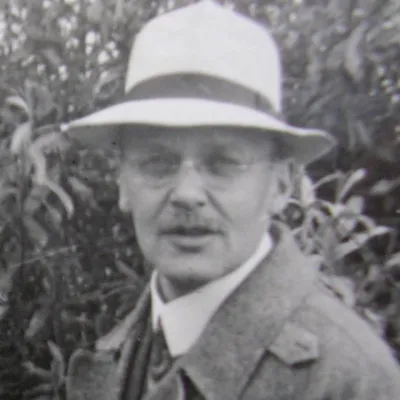
Hans Geiger
Human Design Chart
Biography
In 1907 he began work with Ernest Rutherford at the University of Manchester and in 1909, along with Ernest Marsden, conducted the famous Geiger-Marsden experiment called the "gold foil experiment". Together they created the Geiger counter.
Geiger died on 24 September 1945, Posdam.
.
Human Design Analysis: Hans Geiger as Generator 4/6
Generator 4/6 — Design at a Glance
Hans Geiger's design shows a tendency towards great endurance and inner drive. As a Generator, he had plenty of sacral energy, which made him extremely strong and resilient—provided he dedicated himself to tasks that mattered to him. His success depended crucially on not initiating things himself but instead reacting to signals from life. The strategy was to wait until the sacral center gave a clear "yes" signal and then respond with concrete action.
If Hans Geiger lived by this principle, he was rewarded with a deep sense of fulfillment; no one could stop him. However, if he deviated from this logic—by doing things that did not interest him or being prevented from pursuing his heart's project when he still had plenty of power—his energy would stagnate. Such deviations often led Generators to frustration or a lack of energy, in extreme cases even burnout. So the motto for his work was always: react, don't initiate—act from the gut when an inner impulse called for it.
Sacral Authority
Hans Geiger revealed himself as a Generator whose decision-making was marked by sacral authority. Since his emotional center remained open, this inner voice could clearly manifest. It did not express itself in the head but rather as physical reactions to external stimuli: grunting, humming, or an impulsive "mmh". Such signals marked moments when he felt vital and energized, ready to throw himself into his tasks with enthusiasm.
For Hans Geiger, this configuration significantly simplified the process of choice. The Generator's strategy – responding to life rather than initiating it – directly aligned with his authority. He did not act out of deliberate calculation but was guided by this immediate physical resonance. This allowed him to fully immerse in his tasks without a rigid sense of purpose taking precedence.
Additionally, his activated Spleen Center served as a supportive instance. In conjunction with the Sacral Center, it lent speed and spontaneity to his reactions. Hans Geiger thus had quick, instinctive access to his physical well-being. This combination allowed him to make decisions rapidly and reliably align himself with this deep, physical perception, making his actions authentic and direct.
The 4/6 Profile — Opportunist / Role Model
Hans Geiger's design set a tendency towards experimental behavior in the first three decades of his life. During this phase, his Profile Line 6 still appeared like a Line 3, which led him to try out a lot in relationships and friendships. Later on, an inner conflict between the desire for community belonging (Line 4) and the need to withdraw to contemplate the meaning of life (Line 6) became apparent. This contradiction from Heart and Head Center shaped his development. He was expected to act as a wise role model by standing out through cooperation with others. His big heart remained cautious, so he wouldn't open up to the wrong people and get hurt. Line 4 brought themes like inability, correction, and fear of failure; it was about suffering from uncorrectable flaws. At the same time, Line 6 aimed for peacefulness and inner calm. This spiritual dimension only came into full effect when he realized that the entire circuit was fulfilled. Neptune influences could have introduced self-deception as a substitute for true peace. Hans Geiger lived this tension between social engagement and the search for transcendent stillness, where Line 6 went beyond earthly logic to enable peace once the conditions were right.
Triple Split Definition — Defined & Open Centers
Hans Geiger was someone who constantly felt an internal pressure to ask questions and understand connections. His defined Head and Ajna centers created a permanent mental activity; he was always in the process of thinking, confronted with inspiration that initially appeared as a question or confusion. This state could lead to mental concern because understanding often did not come immediately. The challenge lay in not relieving this pressure through hasty actions but giving it space until clarity emerged.
His design had a reliable energy source: His defined Sacral center gave him deep vitality and endurance. Hans Geiger relied on reacting to life rather than initiating himself. Only through an affirming sacral response could he fully unleash his power and find satisfaction. Initiated actions without this inner confirmation led to resistance and exhaustion. This energy flowed into his defined Throat center, which served as a pivot point to transform thoughts and impulses into communication or action. His voice was an expression of his mental concepts and his sacral affirmation.
At the same time, Hans Geiger had a firm identity and direction through his defined G Center. He intuitively knew where he belonged and could offer orientation to others without needing to control their paths. His defined Spleen center provided sharp body awareness and intuition in the present moment, warning him of dangers and protecting his well-being.
In contrast, his vulnerability was revealed in emotional and willful areas. His open Heart Center did not make him naturally competitive by nature; he tended to want to prove his worth through promises or overperformance, which often ended in frustration because he lacked the constant energy for it. Additionally, his open Solar Plexus absorbed the emotions of his surroundings. Hans Geiger was prone to experiencing others' moods and feelings as his own, leading to emotional confusion if he did not consciously distance himself from these external influences.
Channels for rhythmic power, logic and abstract insight.
Hans Geiger's design inclined towards innovative direction-seeking paired with a sharp analytical eye. The Beat 14-2 channel connected his Sacral center with the G Center, giving him the power to forge new paths through trust in his generative reaction. This impulse for mutation was refined by the Judgment 58-18 channel: Here, the drive for vitality from the Root Center combined with the correcting logic of the Spleen to perfect patterns and identify errors.
His mental process was shown through the Structuring 43-23 channel, which translated insights from the Ajna center into clear expressions in the Throat center. This allowed him to efficiently communicate complex connections, provided he waited for the right timing. Parallel to this, the Abstraction 64-47 channel filtered experiences through mental images, often leading to confusion until an inspiring clarity suddenly emerged.
Additionally, specific gates were at work: Gate 17 promoted logical teaching and succession, while Gate 52 called for concentrated pattern correction. Gate 28 stood for decisions in the here and now, coupled with a readiness to take risks. Gate 50 ensured the protection of traditions and values, Gate 15 adapted to collective rhythms. In his design, Gate 33 fostered reflection and memory, Gate 59 genetic binding strategies, and Gate 35 change through interaction. Finally, Gate 8 propelled an individual contribution to the group forward. This configuration created a person who not only intuitively sensed new directions but also logically justified and structuredly communicated them.
Individual Circuitry — Circuit Signature
Hans Geiger's design showed a Triple Definition, meaning three separate, parallel functioning energetic focal points. These were not connected with each other but functioned as independent energy fields.
In the Knowledge Circuit, he linked the Ajna center to the Throat Center as well as the Identity center to the Sacral Center. This allowed him to clearly articulate structured thoughts and express his unique individuality through rhythmic energy. He sought new ways to bring about change by transforming knowledge and emotionally grounding it.
Parallel to this, the Understanding Circuit worked through the Spleen and Root Centers. Here, the focus was on logical judgment and strategy, free from emotions. Hans Geiger used this energy to improve things and develop rational insights for a better future. His perception was focused and goal-oriented.
A third, separate area formed in the Meaning-Finding Circuit between Head and Ajna Center. This circuit concerned the abstraction of past experiences. While the Understanding Circuit looked into the future, this part of his design reflected on the past to find hidden meanings and share these feelings with others.
These three separate systems – expression and identity, rational strategy as well as emotional reflection – shaped Hans Geiger's life as coexisting, non-fusing forces. Each area had its own logic: pulsing and creative, focused and logical or cyclical and reflective.
Right Angle Cross of Service 3
Hans Geiger's design carried the signature of the right cross of service. This configuration established a fundamental disposition characterized by deep engagement for the well-being of others. In Human Design, this pattern does not describe passive willingness to help but rather an active impulse to take responsibility and create structures in which service is lived as a central value. It was an energetic alignment that combined action with the goal of benefiting others without sacrificing one's own self-understanding.
For Hans Geiger, this meant that his work often revolved around the question of how he could most effectively contribute to the common good. The right cross of service implies a connection between personal integrity and social responsibility. Those who carry this configuration do not seek recognition in the conventional sense but find validation in knowing that their actions truly make a positive difference. It was less about the 'who' than the 'why'.
This energy form fostered an attitude of reliability and perseverance. Even when circumstances were difficult, there was a tendency to see commitments through to completion. Hans Geiger thus found himself in a role where service was not seen as a burden but rather as an expression of his own identity. The design supported him in setting clear boundaries so that this service could remain sustainable and not lead to self-exploitation. It was a path of engagement based on inner conviction.
Saturn Return · Uranus Opposition · Chiron Return · 2nd Saturn Return — Life Cycles
Hans Geiger's design showed a tendency towards structural anchoring and cyclical maturation. His journey was marked by clear milestones that linked internal development with external validation. In 1909, at the age of 27, he conducted the Geiger-Marsden experiment. This marked his first Saturn return, a time when years of groundwork often culminate in a solid result. The mechanical logic of this cycle supports the consolidation of earlier efforts into concrete successes.
Later, in 1924 at the age of 42, he habilitated in Berlin. This coincided with the Uranus opposition, a phase of upheaval and reorientation that often leads to new professional stations. The energy of this transit promoted the step towards academic consolidation.
In 1929, Hans Geiger moved to the Eberhard Karls University of Tübingen. He was 47 years old at the time. This corresponded to his Chiron return, a fulfillment cycle between ages 49 and 51 (here slightly advanced or considered in the context of life phase), during which one's incarnation cross unfolds and meaning becomes tangible. This move signaled the bloom of his specific life task.
Finally, he participated in the founding sessions of the Uranium Club in 1939 at age 57. This was his second Saturn return, a time of final validation and integration of the lived path into the community. The mechanics show here the completion of a long process of structural establishment.
Generator · Sacral Authority — Synthesis
He was a Generator whose life was marked by a deep-rooted drive to set energy in motion and materialize things. His sacral authority (Sacral Center) ensured that he responded to external stimuli with an immediate physical reaction—a rumble or surge of power—that guided him if he noticed it. This ability to live in the present moment and be led by the vital energy of the moment was central to his work style and seemed particularly evident when exploring new areas (Channel 14-2). The profile as a Networker/Role Model suggests that throughout his life, he oscillated between the desire for community and the necessity to withdraw and gain personal insights.
A central paradox lay in the tension between his defined Head Center—driving him to ask questions and understand things—and the mental pressure associated with it (Head/Ajna Centers). This constant search for knowledge created inspiration but could also lead to worry. At the same time, there was a conflict between the need for connection (Line 4) and the tendency towards isolated thinking (Line 6), which led him to continually find new ways to share his insights with others while still pursuing his own path. The cycles confirm this: successes followed phases of upheaval and reorientation.
4 Defined Channels
Incarnation Cross - Right Angle Cross of Service 3
Solar Return
The Solar Return shows the moment when the sun returns to its exact birth position - your personal solar year.
Life Cycles
Discover the life cycles with a detailed triple view (birth chart, cycle chart, composite).
Human Design Profile
- Type
- Generator
- Strategy
- To respond - wait for something to respond to
- Authority
- Sacral Authority
- Profile
- 4/6 - Opportunist / Role Model
- Definition
- Triple Split
- Incarnation Cross
- Right Angle Cross of Service 3
- Date of Birth
- 30.09.1882 08:30
- Place of Birth
- Neustadt an der Weinstrasse, Germany
Frequently Asked Questions
What was Hans Geiger's Human Design type?
What Profile did Hans Geiger have?
What Authority did Hans Geiger have?
What incarnation cross did Hans Geiger have?
When was Hans Geiger born?
Discover your own Human Design
Are you also a Generator? Find out in a personal reading how to use your sacral energy correctly and discover deep satisfaction.
More Personalities
Back to overviewAaliyah

Alexia

Angèle

Anne-Marie

Arcángel

Arno