Hans Jürgen Eysenck
Human Design Chart
Biography
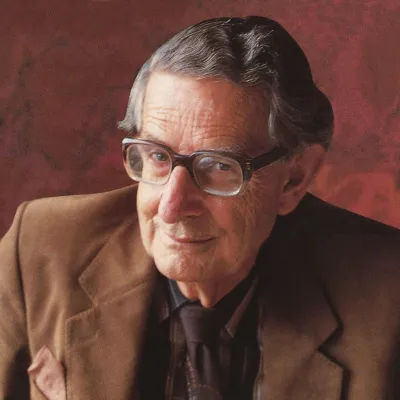
Eysenck established the new University of London Psychology Dept at Maudsley hospital. His work focused on personality and abnormal behavior, using the statistical method of factor analysis. Skeptical of the efficacy of psychoanalysis, he coined the term "behavior therapy."
He married and they had five kids. Eysenck died on 4 September 1997, London, England.
Hans Jürgen Eysenck as a Manifesting Generator 3/5 in Human Design
Manifesting Generator 3/5 — Design at a Glance
Hans Jürgen Eysenck was someone with a unique hybrid energy: He combined the constant power of a Generator with the lightning-fast projection of a Manifestor. His design inclined towards great speed, allowing him to skip steps and quickly draw things into his life. However, this ability was a double-edged sword. Acting too fast risked missing important stages, forcing him to backtrack later to fill gaps – a source of deep frustration when Non-Self appeared as he fought against his natural rhythm.
Furthermore, his system tended to pursue multiple impulses simultaneously. Instead of focusing on one project, he often started many things at once. This worked smoothly only if his inner authority and the Reacting strategy were in harmony. Without this alignment, his creative power quickly tipped into overextension.
The key to his satisfaction lay in reacting to life and acting only when his Sacral Center gave a clear “yes”. In this state, he fell into a playful mode where variety was not a distraction but fuel. Then he could work on various tasks simultaneously without getting distracted, drawing deep satisfaction from his efforts as long as the inner approval remained.
Sacral Authority
Hans Jürgen Eysenck showed a direct, physically anchored way of decision-making. As a Generator, his strategy was also his inner authority: sacral authority. This greatly simplified his process since he didn’t need to distinguish between strategic action and an internal compass. A prerequisite for this was his open Emotional Center, ensuring that decisions weren’t skewed by short-term moods. Instead, Hans Jürgen Eysenck reacted to external stimuli with a clear physical response – often as gut feeling or surge of energy. These signals manifested in vocalizations like grunts or an affirming “Mhm”. Feeling this inner drive made him vital and energized; he then tackled his work with great enthusiasm and without compulsive purpose. He lived for performing tasks with joy, fully immersing himself in them. Additionally, a supportive Spleen Center played a role: Since his Spleen Center was activated and possibly directly connected to the Sacral Center, Hans Jürgen Eysenck had quick, spontaneous reaction capability. This gave him immediate access to instinctive perception and physical well-being, which he could reliably trust. This configuration marked him as someone who didn’t need to weigh options for long but acted in the moment once his inner motor kicked in – quickly, intuitively, and carried by a fundamental joy of life.
The 3/5 Profile — Martyr / Heretic
Hans Jürgen Eysenck was someone who learned through personal experimentation. His Profile 3/5 marked him as an experimenter and hero: he initially believed nothing but had to test everything himself. This line of the adventurer drove him to ask questions and dive into things headfirst. Good questions led to good answers; questioning was crucial. Jupiter increased new beginnings with persistence based on well-established principles, even if doubts arose during interactions. Saturn pressed the need to clear doubts and find answers.
His Line 5 brought practical solutions in crisis times. He was projected as enlightened because he remained calm and recognized the hidden meaning of existence. Waiting could bring him joy and be an aspect of this enlightenment. The second generation gave him strength to find his own place in the flow. Hans Jürgen Eysenck learned from all his experiments and failures. With self-acquired knowledge, he then solved other people’s problems. This treasure trove of practical life experiences was very attractive to others who wanted to learn from them. This heroic role flattered him greatly but could also be painful when he had to try things in front of everyone and fail.
Single Definition — Defined & Open Centers
Hans Jürgen Eysenck was characterized by a design based on consistent inner alignment and reactive energy. His defined G Center gave him a reliable sense of self-identity and clarity about his direction; he knew who he was and where he stood without imposing this on others. This internal security was reinforced by his defined Sacral Center with vital life force. As a Generator, he had an enormous source of energy that only became effective when he reacted to life rather than initiating it. His strategy involved waiting and following the tones of his sacral response to avoid frustration and exhaustion.
At the same time, his open centers shaped his challenges. The open Head and Ajna Centers meant he lacked a consistent mental focus but was open to inspiration and ideas from the environment. He tended to absorb mental pressure waves or confusion from others without automatically identifying them as his own truth. His open Heart Center lacked assertive drive; he was not designed to make promises or prove his worth through competition, instead learning to release himself from the need to achieve something.
His open Solar Plexus Center made him a mirror of emotional currents. He absorbed the feelings and moods of his environment, which could lead to experiencing foreign emotions as his own or avoiding confrontation out of fear of emotional overload. His open Spleen Center carried a fundamental fear of non-survival; he was prone to clinging to things or people that gave him false security rather than trusting his intuitive health. Finally, his open Root Center took on external stress and adrenal impact, which he amplified but could not sustain. Hans Jürgen Eysenck's mechanics challenged him not to take these external influences as his own burden but to align with his inner authority and reactive energy.
Channels for rhythm, extremes, listening and withdrawal.
Hans Jürgen Eysenck was marked by internal routines and a deep connection to the natural flow of life, resulting from Channel Rhythm 5-15 linking the Sacral Center to the G Center. Gate 5 held fast to fixed habits while Gate 15 integrated the diversity of society into the general flow. This mechanism gave him his own sense of timing; when aligned with this inner rhythm, his actions were effortless and magnetically drew others into his energy flow.
Parallel to this, Hans Jürgen Eysenck processed experiences through reflection and patience. The Lost Son Channel 13-33 connected the G Center to the Throat Center. Here Gate 13 gathered information and secrets while Gate 33 withdrew to reflect on them. This process required time: he patiently waited for deeper truths to surface before articulating them, allowing him to understand complex connections and witness his own development without hasty conclusions.
In the mental realm, Gate 63 drove him to understand things and resolve doubts through logical analysis. This drive for security and improvement aligned with Gate 64, which interpreted past experiences to form clear concepts. Additionally, Gate 35 promoted his readiness to interact and change through new experiences. On the design level, Gate 9 supported his ability to work on details and perfect patterns through repeated corrections. Gate 29 gave him persistence in facing challenges with a life-affirming attitude, while Gate 31 enabled the transmission of his strengths to others. Together these elements formed a profile that united structure, patient reflection, and analytical clarity.
Collective Circuitry — Circuit Signature
Hans Jürgen Eysenck was characterized by a simple, coherent energetic structure linking the Sacral, Identity, and Throat Centers into one flow. This created a direct line from inner authority through personal identity to expressive capability.
The Understanding Circuit in him was active via the Rhythm Channel connecting the Identity with the Sacral Center. This connection allowed not only thinking of logical strategies and future-oriented structures but also implementing them rhythmically and consistently from his own life energy. It was an emotionless ratio driven by a will for improvement.
Parallel to this, the Meaning Circuit worked through the Lost Son Channel linking the Throat with the Identity Center. Here it was less about cool logic but rather reflecting emotional waves and experiences from the past. These felt insights were directly translated into language to share with others. Since all three centers lay in a group, these two aspects – strategic future shaping and sharing past emotional insights – flowed seamlessly together. Hans Jürgen Eysenck could thus connect rational concepts with the power of personal experience and articulate this clearly without internal contradictions or separated energies hindering the process.
Right Angle Cross of Consciousness 1
Hans Jürgen Eysenck was someone who sought a clear, logical structure. His design was marked by the right cross of consciousness. This configuration combined the power of will with intellect. It was a dynamic unit of goal-setting and intellectual analysis.
The right cross of consciousness occurs when certain channels are active. They connect the Root Center to the Head Center. At the same time, connections between the G Center and the Sacral Center come into play. This mechanism promoted a direct link between intuition and logical thinking. Hans Jürgen Eysenck could immediately transform inner impulses into clear thoughts. He possessed the ability to quickly grasp complex relationships and present them precisely.
This structure supported an efficient work style. Decisions were not only made emotionally but also rationally reviewed. The right cross of consciousness helped him pursue his goals consistently. It gave him the necessary energy to turn ideas into concrete results. Hans Jürgen Eysenck used these gifts to clearly express his visions. His way of communicating was determined and factual. He avoided unnecessary detours and went straight to the point. This characteristic shaped his entire life path, allowing him to assert himself in his environment and effectively represent his perspectives.
Saturn Return · Uranus Opposition · Chiron Return · 2nd Saturn Return — Life Cycles
Hans Jürgen Eysenck showed a structure oriented towards consistent review and structural clarity. His design suggested that he distinguished himself through systematic questioning and building robust frameworks. This attitude became visible in 1955, at the age of 39, when he became Professor of Psychology at the Institute of Psychiatry (IOP). This step marked the peak of a phase of expansion and realignment typical for the Uranus cycle, where new role profiles establish themselves and old structures often need to be questioned.
Later, in 1973 at the age of 57, he published the book “The Inequality of Man”. This fell exactly during his second Saturn return, a cycle marking maturity and consolidation for his design. Here, years of insights condensed into a final, weighty position. The mechanics of his chart showed that he did not act on quick impulses but presented results only after thorough review over time. This combination of expansive curiosity in the middle of life and later definitive establishment shaped his path as a thinker who consistently defended his convictions to the end.
Manifesting Generator · Sacral Authority — Synthesis
Hans Jürgen Eysenck lived a life marked by a constant interplay between initiation and reaction. As a Manifesting Generator (MG), he had the ability to quickly initiate things and draw them into his life – a tendency amplified by the connection of his Sacral Center to his Throat Center. At the same time, his sacral authority challenged him primarily to react to external stimuli rather than initiating independently. This dynamic was evident in his career: he used his inner drive and the energy of the Rhythm Channel (Gate 5/15) to advance projects while also responding to the demands and opportunities of the outer world. The profile as an experimenter/hero and rescuer underscored this tendency, gathering knowledge through personal experiences and then making it accessible to others.
A central paradox in his design lay in the combination of a need for rapid progress and the necessity to wait on inner impulses. The manifestor component of the MG type indicated some impatience, while sacral authority required dwelling in the present moment. This may have led to phases of accelerated activity followed by necessary realignment steps – such as re-examining his theories after a quick publication (documented event 1973). This tension between wanting and reacting shaped his approach to complex issues.
2 Defined Channels
Incarnation Cross - Right Angle Cross of Consciousness 1
Solar Return
The Solar Return shows the moment when the sun returns to its exact birth position - your personal solar year.
Life Cycles
Discover the life cycles with a detailed triple view (birth chart, cycle chart, composite).
Human Design Profile
- Strategy
- To respond - wait for something to respond to
- Authority
- Sacral Authority
- Profile
- 3/5 - Martyr / Heretic
- Definition
- Single Definition
- Incarnation Cross
- Right Angle Cross of Consciousness 1
- Date of Birth
- 04.03.1916 05:00
- Place of Birth
- Berlin, Germany
Frequently Asked Questions
What was Hans Jürgen Eysenck's Human Design type?
What profile did Hans Jürgen Eysenck have in Human Design?
What authority guided Hans Jürgen Eysenck?
Which incarnation cross was active for Hans Jürgen Eysenck?
When was Hans Jürgen Eysenck born?
Discover your own Human Design
Are you also a Manifesting Generator? Find out in a personal reading how to unfold your multi-talents and direct your energy wisely.
More Personalities
Back to overviewAldair

Alizée

Angeli

Arletty
Artus
Balthus