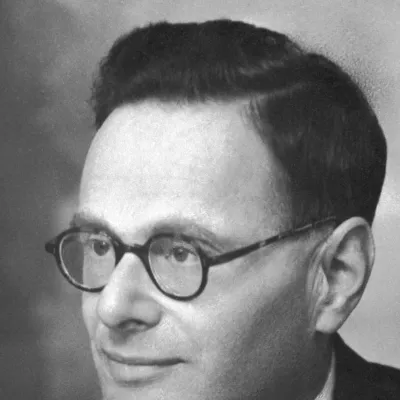
Hans Krebs
Human Design Chart
Biography
He is best known for his discoveries of two important sequences of chemical reactions that take place in the cells of nearly all organisms, including humans, other than anaerobic microorganisms, namely the citric acid cycle and the urea cycle.
Krebs became a naturalised British citizen in 1939. He was elected Fellow of Trinity College, Oxford, 1954–1967. He was elected to the Royal Society in 1947.
In 1953, he received the Nobel Prize in Physiology or Medicine for his "discovery of the citric acid cycle." (He shared the Nobel Prize with Fritz Lipmann.) His autobiography, "Reminiscences and Reflections," was published in 1982.
Krebs died on 22 November 1981 in Oxford, England, aged 81.
Hans Krebs as a Manifesting Generator 2/4 in Human Design
Manifesting Generator 2/4 — Design at a Glance
Hans Krebs revealed himself as someone marked by a hybrid energy constellation: He possessed the constant power of a Generator but also had the ability to accelerate processes and skip steps. His design allowed him to quickly pull things into his life, distinguishing him from pure Generators. This speed brought specific challenges with it. Often he tended to overlook important stages or handle multiple projects simultaneously by reacting to various impulses at once. Without internal confirmation, his creative drive could quickly turn into frustration – his typical non-self theme.
To remain effective, the strategy of reaction was key for him: He had to wait until a clear impulse came and then check if his Sacral Center responded with a clear “yes”. Only when this inner authority agreed could he use his energy meaningfully. When this was given, Hans Krebs found deep satisfaction in his work. He did not thrive through linear task completion but rather in the „play mode“, where variety and parallel working served as sources of his creative power instead of overwhelming him. His energy functioned optimally when he learned to consciously control his speed and regularly check if the paths he had started still aligned with his inner rhythm.
Emotional Authority
Hans Krebs showed a basic attitude of emotional patience: He did not trust the first impulse but waited until his feelings clarified themselves. His inner authority lay in the defined Emotional Center – a mechanism that takes precedence for every type except Reflectors, regardless of other definitions in the chart.
This center subjected him to a constant wave of ups and downs. The world appeared colored by his current mood; enthusiasm could turn into deep skepticism within moments. This emotional fluctuation did not mean that the first impression was true. Quick, spontaneous decisions from such a situation often proved negative and misleading for him.
Instead, his design required time. The longer he let a decision mature, the deeper and more comprehensive he could understand the situation. Concretely: Practicing patience, letting decisions „sleep“ multiple times, and hesitating were necessary. Only when intense feelings subsided did he gain the needed emotional distance. Then clarity and calmness set in – the sign that the inner process was complete. This mechanism particularly shaped long-term decisions that significantly influenced his life course. Hans Krebs learned not to fight this emotional wave but to use it as a necessary filter for his truth.
The 2/4 Profile — Hermit / Opportunist
Hans Krebs revealed himself as someone oscillating between a deep need for withdrawal and the urge towards community. His design tended to first go inward to gain clarity before seeking contact again. This tension resulted from his Profile 2/4: Line 2 promoted shyness and building inner walls as protective strategies. He often waited for the right invitation to intimacy, unable to dissolve these barriers himself. Only when the need for alone time was fulfilled did he emerge from his „cave“. Then line 4 activated, stirring a desire to spend time with familiar people. In this phase, he used his network to gather impressions and reflect on them. Additionally, Gate 20 in the fourth line contributed to development. Here it was about transpersonal consciousness and conveying knowledge through concrete practice. Hans Krebs learned best by doing and encouraging others. His intuition grew when he applied experiences not just theoretically but practically. This combination of reserved observation in solitude and practical knowledge distribution among peers created a unique dynamic: He condensed external impulses into clear insights during his isolation, which he then shared with his surroundings.
Split Definition — Defined & Open Centers
Hans Krebs revealed himself through a consistent inner identity and a clear sense of his life direction, carried by a defined G Center. This reliable self-love allowed him to lead others without needing their consent. His energy source lay in the defined Sacral Center; he possessed an enormous vital force that was only available through correct reactions to external questions. Initiated actions often led to frustration and exhaustion for him, as they interrupted this sacral connection.
His emotional authority in the defined Solar Plexus Center required patience: truth revealed itself to him only after going through the emotional wave. Impulsive decisions at the peaks or troughs of these waves created chaos; only awaited clarity led to correct judgments. The also defined Root Center provided a constant, adrenaline-driven pressure for forward movement, while the defined Throat Center transmuted his messages with ease and honesty into the world – always emanating from his inner source.
In contrast, his open Head Center revealed a vulnerability to mental confusion and the pressure to immediately answer foreign questions. He tended to get caught in intellectual whirlpools that were not his own. The open Ajna Center made his mind flexible but also vulnerable to adopting other people's concepts as his own truth or compensating for uncertainty with feigned certainty. His open Heart Center lacked consistent willpower; he was conditioned to prove himself through promises and competition, which ended in spirals of failure because he could not sustain this energy. Finally, the undefined Spleen Center revealed a deep survival fear and the danger of clinging to unhealthy situations just to gain an illusory sense of security. Spontaneous decisions were risky for him as they often stemmed from conditioned fear rather than healthy intuition.
Channels for emotional depth, presence and powerful action.
Hans Krebs showed a fundamental attitude of radical self-acceptance that drove him to live his own identity independently of external expectations. This attitude was shaped by the Awakening Channel 10-20: He used every moment to recognize principles and translate individual knowledge into correct action. His survival depended on making decisions as himself; simply being who he was inspired others unconsciously to be authentic.
This self-love was reinforced by the Exploration Channel 34-10, infused with sacral energy. Here Hans Krebs found inner strength to hold onto his personal convictions even if they were unusual. His reaction to life served as an example of complete self-love; he did not push this attitude on others but demonstrated through his own behavior the benefits of independence.
At the same time, Hans Krebs possessed the ability for quick, charismatic impact, mediated by the Charisma Channel 34-20. The drive to manifest was here guided by his sacral reaction: He acted not out of whim but as a response to external stimuli. This gave him an impressive presence and the strength to remain active over longer periods if he engaged in things that truly fulfilled him. Without this inner guidance, however, his energy would have become chaotic; it needed reacting to be correctly directed.
Emotionally, Hans Krebs moved in a pulsating wave between joy and melancholy, determined by the Channel of Emotions Freeing 39-55. He was not designed to rationalize moods but to accept the alchemy of these swings. His provocation helped him perceive others' minds; he learned to interact or work only when he was in the right mood. This emotional depth allowed him to radiate a spiritual passion for life, provided he allowed himself the necessary solitude to process his inner truth.
Individual Circuitry — Circuit Signature
Hans Krebs revealed himself as someone who emphasized inner strength and individual conviction strongly. His design was marked by a Split Definition, meaning two separate energy streams existed parallel without directly merging: one stream from Identity-, Heart- and Throat Center and another from Solar Plexus- and Root Center. This separation created no unified experience but rather adjacent power fields.
The Projector Circuit connected his Sacral with the Identity Center through the Exploration Channel. This promoted a strengthened, courageous personality with strong inner convictions. However, without connection to the Throat Center, these firm stances often remained unspoken or hard to verbalize.
The Manifestor Circuit worked through the Emotions Freeing Channel, connecting Solar Plexus and Root Centers. This generated pulsating emotional waves aimed at individual transformation but acting isolated from the rest of his design.
Furthermore, he integrated power from reacting to life (Gate 34) with intuitive knowledge (Gate 57) and the moment of now (Gate 20). This integration connected Throat-, Sacral- and Identity Centers in a separate flow that enabled self-reinforcement through correct behavior here and now. Hans Krebs thus lived with separated but each strong inner dynamics: on one hand, silent deep convictions, on the other hand, emotional impulses for change that did not communicate directly with each other.
Right Angle Cross of the Sleeping Phoenix 3
Hans Krebs exhibited a fundamental orientation towards profound transformation and the revelation of hidden truths. His design was marked by the right cross of the sleeping Phoenix 3, a configuration that did not seek superficial adaptation to external circumstances but rather aimed for radical renewal from within. This mechanism described a process where outdated, no longer sustainable material was consciously released to make room for new insights. It was not about passively accepting fate but engaging in an active yet often quiet work on personal development and understanding complex interconnections. The energy of this cross promoted the ability to find courage in seemingly hopeless situations or deep crises to break through old structures. Hans Krebs lived this dynamic by not being guided by external expectations, but following an inner logic aimed at making hidden patterns visible and transforming them into a new form. This was not a one-time event but a continuous thread of his existence: the will to wake up from sleep and clear the path for a more authentic expression through letting go of the old. His lifestyle demonstrated the power of this specific configuration, understanding change not as loss but as a necessary step towards true self-realization.
Saturn Return · Uranus Opposition · Chiron Return · 2nd Saturn Return — Life Cycles
Hans Krebs' design showed a tendency toward structured building and institutional anchoring, evident in clear career steps. This dynamic was reinforced by his first Saturn return around age 30, a cycle often leading to the condensation of previous work. In fact, he worked as an assistant physician in Hamburg-Altona in 1930 at the age of 30 – a step that solidified his professional foundation and typical for this phase of consolidation.
Later changes and new connections shaped his life, reflected in the Uranus opposition around age 38. This cycle often brings unexpected turns or new partnerships. In 1938, Krebs married Margaret Fieldhouse and was appointed Lecturer in Biochemistry – a dual development showing how personal bonds and professional realignment interacted during this phase.
His second Saturn return around age 54 marked another stage of affirmation and authority. Here the ability to take responsibility at the highest level became evident. In 1954, Krebs succeeded Rudolph Albert Peters as Whitley Chair of Biochemistry at Oxford University and was appointed Fellow of Trinity College – appointments underscoring his design's capacity for long-term, recognized leadership roles within established structures.
Manifesting Generator · Emotional Authority — Synthesis
He was a Manifesting Generator whose life was marked by a continuous interplay between the drive for quick implementation (sacral center, Channel Awakening) and the need for emotional maturation (emotional authority). This interplay was evident in a work style characterized by rapid insights and initiatives – evidenced by career steps he took at age 30 – but also required careful deliberation to avoid hasty conclusions. His nature talent component (Profile 2/4) further reinforced this inner rhythm, eliciting phases of intense self-reflection as well as the desire for exchange and community.
A central paradox lay in his ability to quickly initiate things combined with a deep emotional wave that every decision had to go through. Thus, he lived a tension between the impulsive action of a Manifestor and the thorough examination of a Generator. This led to a life marked by creative energy (knowledge circuit) but also repeatedly requiring pauses to process insights and integrate them into a larger context – an interplay evident throughout his life cycles.
4 Defined Channels
Incarnation Cross - Right Angle Cross of the Sleeping Phoenix 3
Solar Return
The Solar Return shows the moment when the sun returns to its exact birth position - your personal solar year.
Life Cycles
Discover the life cycles with a detailed triple view (birth chart, cycle chart, composite).
Human Design Profile
- Strategy
- To respond - wait for something to respond to
- Authority
- Emotional Authority
- Profile
- 2/4 - Hermit / Opportunist
- Definition
- Split Definition
- Incarnation Cross
- Right Angle Cross of the Sleeping Phoenix 3
- Date of Birth
- 25.08.1900 03:00
- Place of Birth
- Hildesheim, Germany
Frequently Asked Questions
What was Hans Krebs' Human Design type?
What Profile did Hans Krebs have in Human Design?
Which Authority did Hans Krebs possess?
What incarnation cross did Hans Krebs have?
When was Hans Krebs born?
Discover your own Human Design
Are you also a Manifesting Generator? Find out in a personal reading how to unfold your multi-talents and direct your energy wisely.
More Personalities
Back to overviewAldair

Alizée

Angeli

Arletty
Artus
Balthus