
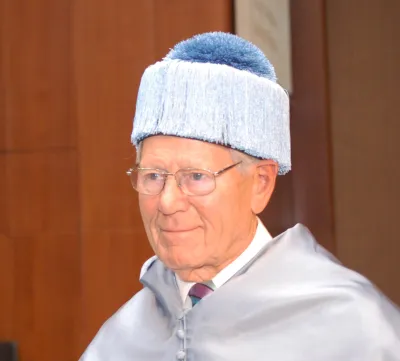
Hans Küng
Human Design Chart
Biography
Küng began attending the Pontifical Gregorian University in Rome in 1948, receiving a Licentiate in Philosophy in 1951. From 1951-1955, he pursued theological studies at Gregorian. He obtained his Doctorate in Theology after completing his studies at the Sorbonne and the Institut Catholique in Paris in 1957. He taught at the University of Münster in West Germany from 1959-1960, and in 1960, he became a Full Professor of Fundamental Theology at the University of Tübingen, a position he held until 1963.
Küng attended the Second Vatican Council, after being appointed a theological consultant, 1962-1965, by Pope John XIII, but he was considered a dangerous foe to Roman Catholicism and termed a ‘rebel.’
From 1963-1980, he was a Full Professor of Dogmatic and Ecumenical Theology and Director of the Institute for Ecumenical Research at the University. He received the Oskar Pfister Award from the American-Psychiatric Association in 1986, and was made an Honorary Doctor of Divinity by the University of Dublin, Ireland in 1995.
Conferences and studies held by Küng led to the formation of a group committed to changing world culture and promoting peace; the agreed-upon principles include nonviolence, solidarity, tolerance and equal rights between men and women. These goals were endorsed in 1993 by a group called the "Parliament of the World’s Religions" and in 1995, he became president of the Foundation for a Global Ethic.
Human Design Analysis: Hans Küng as Manifesting Generator 1/3
Manifesting Generator 1/3 — Design at a Glance
Hans Küng's Design laid a tendency towards hybrid working: He combined the constant energy of a Generator with the lightning-fast implementation power of a Manifestor. As a manifesting generator, he had defined sacral energy, which allowed him to draw things into his life by skipping steps. This speed shaped his approach but also carries specific risks.
The mechanics show two central challenges for this type. First, manifesting generators tend to skip important stages due to their speed. This often forced them to backtrack and make up missed steps, quickly leading to frustration – the classic Not-Self theme of this configuration. Second, Hans Küng tended to pursue multiple projects simultaneously as he responded to many different impulses. Without strict adherence to strategy, this creative drive could turn into its opposite.
The correct application of his energy required him not to initiate himself but to respond to external impulses. Only when the sacral center gave a clear "yes" and inner authority agreed should he act. Regular checks to see if ongoing projects still aligned with this internal approval were crucial. With proper alignment, Hans Küng drew deep satisfaction from his work. Parallel work was no obstacle for him but necessary to remain in "play mode" and sustain his creative power through variety.
Emotional Authority
Hans Küng's inner authority was emotionally influenced. His design featured a defined emotional center, which in Human-Design mechanics automatically becomes the inner authority—regardless of all other definitions in the chart. This configuration was subject to a constant wave motion of feelings: moods swung between enthusiasm and rejection, with the current emotion always only a temporary coloring of perception, not the final truth.
Quick decisions made from an emotional high or low proved risky for Hans Küng, as they were based on a fleeting moment. The mechanics of his inner authority therefore required time to mature judgments. By consciously delaying and reconsidering important questions multiple times, the initial emotional heat could subside. Only when this wave motion calmed did clarity and composure emerge. This process of emotional distancing was essential for long-term life decisions, as it ensured that not just the first impulse but a deeper, more comprehensive understanding became the basis. Thus, Hans Küng showed himself to be someone whose judgment depended on the ability to give space to his feelings without immediately following them.
The 1/3 Profile — Investigator / Martyr
Hans Küng was marked by a Profile 1/3: as both a researcher and an experimenter. His design indicated a tendency to not only collect knowledge theoretically but also to test it practically on heart and gut. This configuration combined the need of Line 1 to always learn more and understand fundamentals with the drive of Line 3 to advance through trial and error. Often, this created tension: The energy of learning could lead him to feel that he was not adequately prepared to move into implementation. Yet precisely this practical testing was central to his judgment. When Hans Küng deemed something valid, it had passed both intellectual and existential tests; this process lent special credibility to his conclusions.
Additionally, themes such as selflessness and spontaneous action (Gate 25) as well as the dynamics of adaptation and attention (Line 3) were at play. Here it was shown that true insights often only emerged through personal hurdles and uncovering hidden connections. His path was not pure study but active experimentation with ideas, where he learned that a life often does not suffice to see profound transformations completed. Instead, it was about finding truths tested by personal experience and passing them on in such a way that others could take them up. Thus, his authority rested not solely on theory but on the combination of thorough research and lived practice.
Split Definition — Defined & Open Centers
Hans Küng was characterized by a design marked by persistent willpower and clear inner direction. His defined Heart Center endowed him with the ability to keep promises and use his own resources in a self-determined manner, while the defined G Center provided a reliable identity and a sense of personal mission. This combination allowed him to act from a stable inner core without being dependent on external expectations.
At the same time, Hans Küng had a defined Throat Center, serving as a pivot point to translate messages from other energy sources into clear communication and action. His voice was thus not a random product of the mind but an expression of his deep identity and will. This was complemented by a defined Sacral Center, which provided him with a vast source of vital energy that had to wait for correct answers from the world to be sustainably effective.
In contrast, his vulnerability to conditioned patterns in mental and existential areas was revealed. His open Head Center made him susceptible to the pressure to immediately answer mental questions despite lacking a consistent source of inspiration. He tended to get caught up in thought whirlpools or search for answers that belonged to others. The open Ajna Center amplified this: concepts and theories often appeared as absolute truths, leading to the risk of adopting other people's opinions unexamined as his own reality.
Additionally, his open Spleen Center harbored a fundamental survival fear. It tended to cling to persons or situations promising false feelings of security and well-being rather than trusting in intuitive clarity. Spontaneous decisions were risky for him since the Spleen Center did not serve as a reliable authority but rather acted as a mirror reflecting environmental fears. These open centers demanded patience from him, avoiding being swept away by mental or emotional impulses to clearly bring his defined strength in Heart and Throat to the fore.
Channels for emotional waves, rhythm, success, discovery and change.
Hans Küng's design showed a tendency towards profound persistence: he immersed himself in experiences to ultimately reveal new perspectives for the collective. This was the mechanics of Channel Discovery 29-46, which through Saying Yes (Gate 29) and the Self's Determination (Gate 46) demanded an unwavering commitment. His path was not a sudden course change but a long process where meaning only became clear in retrospect.
Parallel to this, a vital connection to the flow of nature was evident through Channel Rhythm 5-15. Here, fixed habits (Gate 5) united with love for extremes (Gate 15). Hans Küng lived within an internal timing that magnetically drew others into his energy flow. This channel is the cornerstone of biological life processes; it binds all forms of life together and directs them towards the future. When aligned with this flow, everything felt effortless and subtly supported the environment.
In the realm of willpower, Channel Money Line 21-45 was at work. It connected the Hunter (Gate 21) with the Gatherer (Gate 45). This created a tension between the need for control to maintain personal peace and an authoritative voice that has the final word on resources. Hans Küng had to learn to take responsibility without burning himself out; his success depended on finding balance between serving the community and maintaining independence.
Emotionally, he was driven by the search for new experiences through Channel Transience 36-35. The Gate of Crisis (36) and the Gate of Change (35) pushed him to test boundaries and gain wisdom through living emotional waves. His advice was based on this lived depth: using the moment and accepting transience.
Additionally, his way of provoking perception was shaped by Channel Emotion Release 39-55. Through the Gate of Provocation (39) and the Gate of Spirit (55), he explored moods between joy and melancholy. This mechanism helped him to evoke the right spirit in others and authentically handle his emotional wave, rather than rationalizing it.
Individual Gates like 10 (Integration), 25 (Innocence) or 30 (Feeling Awareness) added specific nuances of complexity and mystical attitude without overshadowing the dominant channel energies.
Collective Circuitry — Circuit Signature
Hans Küng's design featured separate, parallel operating energy fields due to his Split Definition. This meant that his energetic connections did not act as a continuous flow between all defined centers but existed in two isolated groups: on one side, the connection of Sacral and Identity Centers; on the other side, a complex network involving Heart, Throat, Solar Plexus, and Root Centers.
In the Understanding Circuit, he linked his Identity with his Sacral Center via Channel 'Rhythm'. This shaped a focused, rational approach to the future, supported by logical structures and strategic thinking, free from emotional influence.
The Knowledge Circuit connected his Solar Plexus with his Root Center through Channel 'Emotion Release'. Here, pulsating, acoustic energies were at work, serving to express new insights and individual identity through emotional waves and initiate change.
In the Meaning-Finding Circuit, a double structure was evident: on one side, he again linked Identity with Sacral (via the previously mentioned channel 'Rhythm'), while another separate part connected Throat with Solar Plexus via Channels 'Transience' and 'Discovery'. This allowed for cyclic reflection of past experiences and emotional wave-like transmission of felt insights to the collective.
Finally, his Ego Circuit connected his Throat with his Heart Center through Channel 'Money Line' (Channel 21-45). This promoted cooperation, exchange of resources and material well-being within a community based on a balanced relationship of giving and taking. These four circuits thus formed his specific fragmented energetic profile.
Right Angle Cross of the Vessel of Love 1
Hans Küng's design shows a tendency towards deep emotional devotion that often manifests as a central theme in his relationships and convictions. This orientation stems from the right cross of the Love Vessel 1, a configuration pointing to an intense, almost fateful bond with the heart and emotions.
In Human Design, this pattern describes a life task where the ability to love and be loved is not just a private feeling but an existential force. It's about being willing to open emotionally in a complete way and accept vulnerability. For Hans Küng, this meant that his intellectual or spiritual paths were always marked by a strong emotional component. He sought not only rational truth but also how it resonates with the heart and can be lived.
This configuration challenged him to use his own emotional depth as a resource to form connections beyond superficial interactions. It was a driving force that led him to engage in topics concerning human interaction and inner stance. The challenge lay in not wearing out this intense emotional energy or falling into dependencies, but rather using it as a source for authentic encounters. His path was thus closely tied to the experience of love in a broader sense – as an element connecting people and ideas.
Saturn Return · Uranus Opposition · Chiron Return · 2nd Saturn Return — Life Cycles
Hans Küng's design shows a tendency towards structural consolidation that crystallizes in clear milestones. In 1957, at age 29, he received his doctorate in theology – a classic expression of the first Saturn Return, where years of groundwork mature into a solid result and professional foundations are laid.
His path also showed an expansive phase of renewal. In 1971, at age 43, he proposed a memorandum for reforming church offices. This corresponds to the Uranus Opposition, a cycle often bringing deep changes and a desire for new order, questioning and adapting existing structures.
The Chiron Return marked from 1977 (age 49) a phase of fulfillment and bloom in his incarnation purpose. That year, the German Bishops' Conference published two statements on Küng's theological method. This conflict was not an obstacle but part of the unfolding of his life task: The confrontation served to make his specific contribution experiential and effective if he followed his strategy.
By the second Saturn Return in 1986 (age 58), the maturity of this development became evident. Receiving the Oskar Pfister Prize in Washington D.C. confirmed the lasting impact of his work. This cycle crystallizes long-term efforts into recognized achievement and firmly anchors what has been achieved in the person's life, as a sign of stability and gained authority.
Manifesting Generator · Emotional Authority — Synthesis
Hans Küng lived a life marked by a deeply rooted drive for knowledge and its practical application. As an Manifesting Generator (with defined Sacral Center), he had a constant energy source driving him to initiate things – yet always connected with the need to trust the flow of life rather than forcing it. This dynamic was evident in his Researcher-Experimentor Profile (1/3), where theoretical investigations were inseparable from practical experiments and readiness to learn from mistakes. The defined Communication Channel allowed him to transform messages from various inner sources and carry them outward, while the Rhythm Channel (5/15) signaled a deep connection with the natural world and its laws – a pulsing between persistence and adaptability.
Central for Hans Küng was the tension between the need for independent thinking and the emotional depth that shaped his decisions. The Knowledge Circuit challenged him to explore new paths and initiate changes, yet emotional authority required a mature confrontation with his feelings before acting. This led repeatedly to crises (as in 1977) but also to successes (e.g., 1986) – an interplay between the desire for innovation and the necessity of finding emotional truth. The cycles showed that he grew both through career steps and phases of confrontation with criticism.
5 Defined Channels
Incarnation Cross - Right Angle Cross of the Vessel of Love 1
Solar Return
The Solar Return shows the moment when the sun returns to its exact birth position - your personal solar year.
Life Cycles
Discover the life cycles with a detailed triple view (birth chart, cycle chart, composite).
Human Design Profile
- Strategy
- To respond - wait for something to respond to
- Authority
- Emotional Authority
- Profile
- 1/3 - Investigator / Martyr
- Definition
- Split Definition
- Incarnation Cross
- Right Angle Cross of the Vessel of Love 1
- Date of Birth
- 19.03.1928 17:45
- Place of Birth
- Sursee, Switzerland
Frequently Asked Questions
What was Hans Küng's Human Design type?
Which profile did Hans Küng have in Human Design?
What kind of authority did Hans Küng have in his design?
Which incarnation cross was active for Hans Kung?
When was Hans Küng born?
Discover your own Human Design
Are you also a Manifesting Generator? Find out in a personal reading how to unfold your multi-talents and direct your energy wisely.
More Personalities
Back to overviewAlain-Fournier

Aldair

Alizée

Angeli

Arletty

Artus
