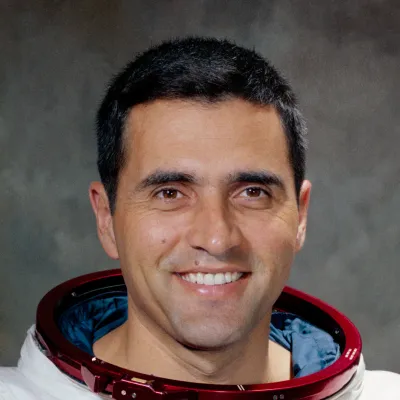
Harrison H. Schmitt
Human Design Chart
Biography
Retiring from NASA in 1975, he was elected U.S. Senator, Republican, from New Mexico, on 2 November 1976. He failed to get reelected in 1982. He and his wife Teresa live in New Mexico's Sandia Mountains, where he runs with his two dogs and brainstorms space projects for foundations and businesses.
Harrison H. Schmitt — Manifesting Generator with Profile 2/5
Manifesting Generator 2/5 — Design at a Glance
Harrison H. Schmitt's design shows a tendency towards hybrid dynamics: He had the constant energy source of a Generator but also the ability to accelerate processes through direct connection of Motor Centers to Throat. This configuration as an Manifesting Generator meant that he could not only react to impulses, but quickly turn these reactions into results.
The mechanics show here a specific tension field: The speed allowed him to skip steps and push multiple projects forward simultaneously. However, this was associated with risks. If he acted too fast or ignored the inner approval of the Sacral Center, frustration and the need to catch up on missed stages threatened. His design therefore required precise strategy: First react to life, then check if the sacral energy gave a clear „yes“. Only in this alignment could his creative power shift into a productive Play mode where variety and parallel work did not lead to overload but deep satisfaction. Without this internal validation, his system tended to block itself through multitasking and rushed actions rather than efficiently using available energy.
Emotional Authority
Harrison H. Schmitt's design shows a tendency towards emotional maturation. He appeared as someone who filtered perception through current mood – sometimes enthusiastic, then surprised by the same thing in a negative way. These fluctuations were not unreliability but expression of his inner authority: the defined Emotional Center.
In Human Design, an active Emotional Center always carries responsibility for decisions, regardless of other defined areas. Since feelings here form waves and show up-and-down movements, the first impulse is often just a snapshot, not the final truth. Quick, spontaneous reactions to these initial impressions could therefore be misleading.
The mechanics of his design required patience. Harrison H. Schmitt needed time for decisions to mature. By „sleeping on“ important questions, intense feelings gradually subsided. Only when this emotional distance was gained did clarity and calm set in. This process of distancing was crucial for long-term direction setting in his life. Only through this conscious delay could he ensure that his choice was not based on a passing wave but deeper insight.
The 2/5 Profile — Hermit / Heretic
Harrison H. Schmitt's design shows a tendency towards an ambivalent role: He acted as someone who both sought withdrawal and external impact. The Profile 2/5, which describes the Natural Talent and Hero, requires here clear prioritization. Harrison H. Schmitt had to carefully weigh where he invested his energy before agreeing or declining. Line 5 attracted others seeking solutions and expecting help. Simultaneously, Line 2, the Hermit, demanded intense phases of isolation. Harrison H. Schmitt used these withdrawal moments to gain inner clarity and set boundaries. This prevented him from losing himself in other's expectations.
His behavior also showed a capacity for provocation as means of self-preservation. The second line of Gate 39 acted nudgingly, clearing obstacles or forcing attention. Often this happened through creating discomfort followed by withdrawal. In crisis situations, Harrison H. Schmitt acted objectively. Gate 21 in Line 5 supported an impartial stance when guiding and leading. This distance from emotional influence allowed him to manage material challenges clearly and give others space for independent action.
Single Definition — Defined & Open Centers
Harrison H. Schmitt's design indicated a tendency towards constant physical expressiveness coupled with deep emotional reflection before action. His defined Throat Center served as a reliable channel for communication and action; he did not speak impulsively but from an anchored source. This voice was fueled by his defined Sacral Center, which provided him with a consistent vital energy. Harrison H. Schmitt had the power to fulfill commitments as long as he responded to his inner answer – a mechanical process of confirmation or rejection that prevented exhaustion.
At the same time, his design revealed specific emotional depth. The defined Solar Plexus Center served as an internal authority: truth did not reveal itself in the moment for him but only after experiencing the emotional wave. He tended to wait until clarity emerged before making decisions rather than reacting impulsively to highs or lows. His open Root Pressure provided the necessary impulse to move forward in the world and overcome existential challenges.
In contrast, his design revealed specific vulnerabilities. The open Head Center lacked consistent inspiration; Harrison H. Schmitt was susceptible to mental pressure and the temptation to take on foreign questions or confusion as his own. His open Ajna Center meant that he did not hold concepts as personal truth but accepted them flexibly – a strength that could lead to conditioning if he took answers for his identity. The open G Center showed dependency on external environments for direction and identity; Harrison H. Schmitt reflected the energy of his environment rather than generating it himself. False places or relationships might have caused feelings of being lost. Additionally, his open Heart Center made him vulnerable to the pressure of proving his worth through promises or competition – a trap he had to avoid by trusting his strategy instead of willpower. Finally, the open Spleen Center required vigilance against spontaneous decisions and absorbing foreign fears or health conditions; Harrison H. Schmitt learned to distinguish intuition from conditioning to protect his well-being.
Channels for change, emotional openness and feeling release.
Harrison H. Schmitt's design indicated a tendency towards evolutionary change that was not linear but pulsed in waves of chaos and order. This dynamic was shaped by the Channel of Mutation 60-3: It connected the unpredictable energy of the Root Center with the generative power of the Sacral Center. Gate 60 accepted limitation as necessary framework, while Gate 3 tried to realize new possibilities. This mechanism created an internal tension – often perceived as melancholy – that made Harrison H. Schmitt wait patiently for the right pulse rather than succumbing to the pressure to act immediately.
Additionally, the Channel of Openness 22-12 shaped his interpersonal presence. It connected the Solar Plexus Center with the Throat Center and enabled him to transform emotional moods into an articulated effect. Gate 22 brought passion and romance, while Gate 12 steered caution about who received this openness. Harrison H. Schmitt used not only the quality of his voice for information but also as a catalyst that emotionally touched others – yet always dependent on his current mood wave.
The Channel of Emotion Release 39-55 further deepened this emotional depth. Through Gate 39 (Provocation) and Gate 55 (Mind), it triggered unconscious reactions in others to reveal their true mind. This was not a conscious manipulation act but a mechanical effect of his emotional wave that swung between joy and sadness. Thus, Harrison H. Schmitt appeared as someone who through authentic experience of this moodiness encouraged others towards transformation by creating space for new awareness – always driven by the inner necessity to bring individuality into the world.
Individual Circuitry — Circuit Signature
Harrison H. Schmitt's design indicated a tendency towards independent, innovative expression based on internal emotional clarity. In him, the Knowledge Circuit worked as an integrated force connecting the Throat Center with the Solar Plexus, Root and Sacral Centers. This direct energetic line allowed not only to think new insights but also to physically and vocally carry them into the world through the body.
The specific channels of this circuit shaped his way of acquiring and conveying knowledge. The Channel 'Mutation' (Gates 3-60) promoted deviations from the known, so Harrison H. Schmitt tended to break established patterns and develop completely new perspectives. This was complemented by the Channel 'Openness' (Gates 12-22), which created a readiness to accept new things and integrate them flexibly into existing structures. Additionally, the Channel 'Emotions Release' (Gates 55-39) ensured that these intellectual and creative impulses were filtered through the emotional wave of the Solar Plexus before being articulated in the Throat Center. This guaranteed that his expression was authentic and driven by his individual identity rather than merely repeating superficial information.
As Harrison H. Schmitt had a simple definition, these centers formed one coherent flow. There were no internal energetic breaks or separate fields; instead, energy flowed from impulse generation in the Root and Sacral Centers through emotional processing directly into verbal expression. This configuration supported a lifestyle where recognizing the new and its bold articulation were inseparable.
Right Angle Cross of Tension 2
Harrison H. Schmitt's design indicates a tendency towards internal tension that needed to be resolved through external friction and resistance. His system was designed to transform energy not in quiet harmony but in conflict with the environment. This configuration, the right cross of tension 2, describes a process where pressure and challenges act as necessary catalysts. Without this frictional resistance, his inner dynamics remained untapped; only by confronting obstacles could latent energy be transformed into tangible results. Harrison H. Schmitt thus showed himself to be someone who found strength and clarity precisely where he encountered resistance. The mechanics of this cross require tension: it serves to shape raw material through friction. It is not a state of comfort but an active process of refinement through stress. Harrison H. Schmitt's inner compass indicated that difficulties were not to be understood as obstacles, but rather as essential tools for the development of his specific abilities. The tension was the engine driving transformation and turning raw potential into targeted action.
Saturn Return · Uranus Opposition · Chiron Return · 2nd Saturn Return — Life Cycles
Harrison H. Schmitt's design indicates a tendency towards profound intellectual condensation that manifested in concrete, solid results. In 1964, at age 29, he earned his doctorate from Harvard University – a typical moment for the first Saturn return. This cycle often marks the point where years of hard work and discipline mature into a stable foundation. For his chart, this was not just a graduation ceremony but the solidification of his professional identity, allowing him to understand complex relationships and also control them structurally.
Later in his design, another dynamic emerged: the drive for change and breaking established structures. In 1975, at age 40, Schmitt left NASA to run for Senate. This coincided with a Uranus opposition, an astrological transit that often initiates radical turning points by dissolving old bonds to make way for new freedoms. His step away from the established institution towards the political stage was not a sudden impulse but the logical consequence of this energetic opening. The design promoted the courage to leave the safe harbor when it restricted his own development. Both events underscore a life navigating between the necessity of structural anchoring and the need for expansive change.
Manifesting Generator · Emotional Authority — Synthesis
A central red thread in this design is the dynamic connection between initiation and reaction. The configuration as an Manifesting Generator (with sacral center) points to a constant energy source, but one that should not be used for autonomous initiation. Instead, it's about reacting to impulses – a process further slowed and deepened by emotional authority. This combination of potential speed (mutation channel) and inner need for emotional maturation shapes a lifestyle where recognizing the right moment is crucial. The profile as a natural talent and hero/rescuer reinforces this aspect by creating expectations for quick help, while simultaneously emphasizing the need for withdrawal and inner clarity (tension cross 2).
The central paradox lies in the tension between the desire for autonomy and the necessity of emotional validation. The defined throat center signals strong expressive power and a drive to convey messages – potential that is fueled by the knowledge circuit with creative energy. At the same time, however, emotional authority requires time for decision-making and waiting out the emotional wave. This leads to an internal conflict between quick action enabled by the design (as seen in events like his promotion) and the need to deeply examine one's impulses (as evident in career changes).
3 Defined Channels
Incarnation Cross - Right Angle Cross of Tension 2
Solar Return
The Solar Return shows the moment when the sun returns to its exact birth position - your personal solar year.
Life Cycles
Discover the life cycles with a detailed triple view (birth chart, cycle chart, composite).
Human Design Profile
- Strategy
- To respond - wait for something to respond to
- Authority
- Emotional Authority
- Profile
- 2/5 - Hermit / Heretic
- Definition
- Single Definition
- Incarnation Cross
- Right Angle Cross of Tension 2
- Date of Birth
- 03.07.1935 23:02
- Place of Birth
- Santa Rita, NM, United States
Frequently Asked Questions
What is Harrison H. Schmitt's Human Design type?
What Profile does Harrison H. Schmitt have in Human Design?
What authority does Harrison H. Schmitt possess?
What incarnation cross does Harrison H. Schmitt have?
When was Harrison H. Schmitt born?
Discover your own Human Design
Are you also a Manifesting Generator? Find out in a personal reading how to unfold your multi-talents and direct your energy wisely.
More Personalities
Back to overviewAldair

Alizée

Angeli

Arletty
Artus

Balthus