
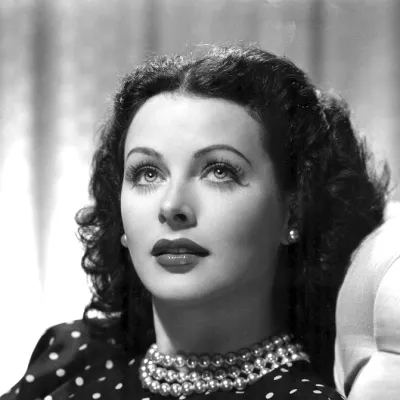
Hedy Lamarr
Human Design Chart
Biography
Lamarr was born in 1913, 1914, or 1915 depending on which bio you can believe (1914 has been the year most astrologers use) to a comfortably-fixed Viennese family, an only child. Permitted to appear in a few plays by her disapproving parents, she always wanted to be an actress.
At age 15, she ran away from school, went to the Sascha Film Studio and was hired as a script girl. A producer saw her, gave her a screen test, and after several insignificant parts she was given the lead in a movie that became known as "Ecstasy," which contained the famous scene in which she swam nude.
She came to the U.S. in 1937, not speaking English, with a film debut the following year in "Algiers." Movies that followed included "Lady of the Tropics" (1939), "I Take This Woman" (1940), "Boom Town" (1940), "Comrade X" (1940), "Ziegfield Girl" (1941), "Come Live with Me" (1941), "Tortilla Flat" (1942), "White Cargo" (1942), "Crossroads" (1942), and "The Heavenly Body" (1944).
Forming her own production company, Lamarr made two mediocre movies, "The Strange Woman" (1946), and "Dishonored Lady" (1947). Cecil B. DeMille cast her in the title role in "Sampson and Delilah" (1949), followed by "Copper Canyon" (1950), "My Favorite Spy" (1951), and an Italian flop, "The Face That Launched a Thousand Ships" (1954). She didn't appear in another production until 1957, "The Story of Mankind," which also flopped.
Lamarr's connection with technology first surfaced in 1940.
The Human Design of Hedy Lamarr: Generator 4/6
Generator 4/6 — Design at a Glance
Hedy Lamarr's Design inclined towards great endurance and inner drive. As a Generator, she had plenty of sacral energy that gave her the strength to persist for long periods – comparable to a workhorse that remains strong as long as it is fueled by its task. This energy was not released through self-initiative but rather in response to signals from the environment. Her strategy involved waiting for an impulse and then responding instinctively when her sacral center clearly said "yes."
This mechanism carried two essential risks. If she engaged in activities that did not bring her joy or went against her inner resistance, she wasted her energy and was prone to exhaustion. Conversely, she suffered if prevented from working on her heart project while still full of power. Successfully utilizing her design led to deep satisfaction and fulfillment. However, living contrary to this principle – for example, by constantly initiating rather than reacting – eventually resulted in frustration and a lack of energy. Her path involved responding to life and then acting upon it to effectively use her strength.
Emotional Authority
Hedy Lamarr's inner compass was the defined Solar Plexus Center, making her an emotional authority. This configuration was subject to a constant wave of ups and downs in feelings; her perception of the world was always colored by the current mood. What appeared inspiring at one moment could be felt as negative the next. However, this first impression was not the final truth but merely a snapshot. Quick, spontaneous decisions made from this emotional heat often had negative consequences because they were based on temporary waves.
The mechanics of her authority required patience and time. Only through repeatedly sleeping on decisions could intense feelings subside and emotional distance be gained. This process was essential for long-term steps that influenced the course of her life. Only when the waves had subsided did clarity and calm set in – a sign that the inner process was complete. Thus, Hedy Lamarr showed herself to be someone who did not make decisions instantly but allowed them to ripen until the emotional tide receded. This approach served to gain deeper insights and avoid superficial reactions.
The 4/6 Profile — Opportunist / Role Model
Hedy Lamarr's design suggests a tendency towards creative withdrawal and later role finding. In her first thirty years, her Profile Line 6 still appeared like a Line 3: She enjoyed experimenting, especially in relationships and friendships. Once Line 6 became active, she experienced the conflict between the desire for community (Line 4) and the urge to reflect on the meaning of life (Line 6). Her life revolved around this conflict between heart and head.
In her later years, it was expected that she would meet high standards as a wise role model through cooperation. The great heart of Line 4 was always cautious not to open up to the wrong people and get hurt. Gate 1 in Line 4 emphasized solitude as a medium for creativity. This creation had to arise independently from interference to enable successful mutations. Harmony was understood as a transpersonal process that lay beyond external influences.
At the same time, the ability to share power justly and delegate – the Delegating Line – came into focus. Instead of leading classically, it was about recognizing each person as a leader of themselves. This required a deep understanding of how leadership leads to a better future, which improves through constant repetition. Thus, Hedy Lamarr showed herself to be someone who cultivated creativity in solitude and later learned to exercise responsibility through just distribution rather than control.
Single Definition — Defined & Open Centers
Hedy Lamarr's design inclined towards a fixed, unshakable self-identity paired with immense inner vitality. She had a clear sense of her own direction and was secure in her love for herself, allowing her to love others without dependency. This stability came from her defined G Center, the seat of higher self.
Her energy source was her defined Sacral Center, the motor of a generator. She possessed constant vital power that unfolded correctly only through reaction to external impulses. Initiatives based on her own understanding often led to resistance and exhaustion; her strength lay in waiting until life asked before acting with full satisfaction.
Hedy Lamarr made decisions not in her Head but by waiting for her emotional wave. Her defined Solar Plexus functioned as inner authority: truth revealed itself only after traversing the highs and lows of emotions. Immediate judgments were misleading to her; clarity came later, revealing what was truly correct.
Simultaneously, her Heart Center was defined, giving her natural willpower and a desire to determine her own resources. She sought recognition for her contribution and preferred following her own rhythm of work and rest rather than submitting to others.
This stable inner life contrasted sharply with her vulnerability in open centers. Her open Head Center made her susceptible to mental pressure waves and the questions of others, lacking consistent inspiration herself. She tended to dwell on doubts that were not her own problem instead of trusting her inner authority.
Her open Ajna Center meant she absorbed concepts and opinions from the environment without anchoring them as personal truth. This could lead to feeling unsure or pretending certainty for acceptance, though her mind was actually open to new perspectives.
Her open Throat Center showed a fear of not being noticed. Rather than speaking spontaneously, her open throat naturally attracted attention when she waited. Attempting to actively be the center often led to unpredictable expressions and stress.
Finally, her open Root Center absorbed the adrenalized pressure from the environment. She was vulnerable to hyperactivity or burnout if trying to rid herself of this foreign stress through overwork instead of simply recognizing it as not hers and moving away.
Channels for rhythm, intimacy, emotional warmth and community.
Hedy Lamarr's design inclined towards deep innovation marked by a strong inner rhythm and the need for authentic connection. She showed herself as someone who did not just intellectually conceive new directions but transferred them into material reality with almost biological necessity.
This ability to mutate came from Channel Beat 14-2, connecting Gate of Power Competence (14) in Sacral Center with Gate of Higher Knowledge (2) in G Center. This configuration gave her access to essential resources to transform innovative impulses into a concrete direction. She could encourage others and open new perspectives simply by trusting her sacral reaction without needing to foresee the exact path.
Parallel, Channel Rhythm 5-15 connected Gate of Fixed Rhythms (5) with Gate of Extremes (15). This channel served as a pillar for her biological life processes, binding her closely to the natural flow of the world. Her timing was determined by this inner pulse, allowing her to move effortlessly and draw others into her energy flow if she did not resist her own reactions.
In interpersonal relationships, Channel Pairing 59-6 shaped her interactions. By connecting Gate of Sexuality (59) with Gate of Friction (6) in Solar Plexus Center, she sought intimacy and merging. Her emotional wave determined the timing for friendships or partnerships; she needed time to gain clarity and let real connections form.
Additionally, Channel Community 37-40 contributed to the structure of her social bonds. It connected Gate of Friendship (37) with Gate of Solitude (40), creating a tension between needing group recognition and maintaining personal boundaries. She sought fair agreements and a place within the whole, understanding that true community rested on mutual respect and clear agreements.
This picture was complemented by Gate 1, fostering unique creative expression without constraints, and Gate 7, projecting leadership in hierarchies. Gate 13 ensured continuity and reflection over time. In personality design, Gate 55 with its emotional mood swings worked alongside Gate 42's ability to complete processes and Gate 46's dedication to the physical body as a temple.
Tribal Circuitry — Circuit Signature
Hedy Lamarr's design showed a clear, coherent energetic structure. As a person with simple definition, her Identity, Sacral, Solar Plexus, and Heart Centers formed one continuous flow of power. This gave her a cohesive orientation where emotional impulses were directly woven into her life force and will.
Within this overall picture, four specific circuits worked. The Knowledge Circuit connected her Identity and Sacral Center via Channel 'The Beat', imprinting pulsating, acoustic creativity aimed at unique individual expression forms. Parallel, the Understanding Circuit also linked Identity with Sacral Center through Channel 'Rhythm'. Here, a focus on logical, rational thinking and strategic future visions free of emotional conditioning was evident.
A third aspect was the Ego Circuit, connecting Heart and Solar Plexus Centers via Channel 'Community', focusing on cooperation, mutual support, and skilled giving and taking within group structures for common resource building. Finally, the Archer Circuit connected Sacral and Solar Plexus Centers through Channel 'Pairing'. This brought ancient energies of protection, care, and preservation of genetic and family heritage into play. All these elements flowed in Hedy Lamarr's design not isolated but as integrated parts of her central energetic axis.
Right Angle Cross of the Sphinx 4
Hedy Lamarr's design carried the imprint of the right Sphinx 4 cross. This configuration set a tendency towards developing through profound inner transformations, often accompanied by a certain isolation or withdrawal from the general societal framework. It was a process of purification and disentanglement from external bindings to return to one's essence.
In Human Design, this cross describes a specific life dynamics: The path leads through experiencing intense internal crises or turning points that dissolve old structures. The energy of this configuration fostered the ability to emerge strengthened and clearer from such phases of change. It supported an attitude not based on external fame or constant social affirmation but rather on a deeper, often painful yet necessary self-discovery.
This mechanism acted as an inner compass guiding Hedy Lamarr through periods of transformation where she had to detach herself from earlier identities or environments. It was a process of cleansing, breaking down the old to make space for a more authentic expression. The energy of this cross helped anchor stability not in external circumstances but in one's own inner truth. This process required patience and the courage to face the deepest layers of oneself without clinging to superficial anchors.
Saturn Return · Uranus Opposition · Chiron Return · 2nd Saturn Return — Life Cycles
Hedy Lamarr's design set a tendency towards structural affirmation, condensing into clear milestones. Her first Saturn Return marked 1942 at age 28 as a decisive turning point: The patent office granted her long-awaited patent. This success was no coincidence but the typical expression of this cycle where years of groundwork and inner maturity lead to a tangible external result. Here, the structuring of her energy received its first major affirmation.
Later, the depth of her incarnation purpose manifested in her Chiron Return. This fulfillment cycle, active between ages 49 and 51, brings one's essence into bloom if followed. For Hedy Lamarr, this culminated in 1965 with her final divorce and end to her marriage career. This event signaled not loss but the completion of a life stage. The Chiron Return allowed her to break free from old bindings to walk her path more clearly. The separation was the necessary step towards unfolding her true purpose, free from external constraints. Through these phases, she learned to use her inner authority and connect structure with self-determination.
Generator · Emotional Authority — Synthesis
Hedy Lamarr was a Generator whose life was marked by deep sacral energy (Generator Type). This power, combined with emotional authority, guided her through a life of following internal impulses and letting decisions mature. Her defined G Center gave her clear direction and the ability to inspire others – a quality that intensified in later life (Networker/Role Model). The connection between Sacral Center and G Center via the Beat channel indicated readiness for new paths and movement through innovations, showing in skillful use of resources and initiating changes even if accompanied by melancholy (Knowledge Circuit).
A central paradox lay in the tension field between a desire for community (Line 4 in Profile) and the need for independent thinking and reflection (Line 6). This duality led to internal conflicts but also became the source of her unique perspective. The right Sphinx 4 cross pointed to someone who had to explore themselves to fully realize their potential – a process marked by both successes (patent granted) and relationships (divorce).
4 Defined Channels
Incarnation Cross - Right Angle Cross of the Sphinx 4
Solar Return
The Solar Return shows the moment when the sun returns to its exact birth position - your personal solar year.
Life Cycles
Discover the life cycles with a detailed triple view (birth chart, cycle chart, composite).
Human Design Profile
- Type
- Generator
- Strategy
- To respond - wait for something to respond to
- Authority
- Emotional Authority
- Profile
- 4/6 - Opportunist / Role Model
- Definition
- Single Definition
- Incarnation Cross
- Right Angle Cross of the Sphinx 4
- Date of Birth
- 09.11.1914 19:30
- Place of Birth
- Vienna, Australia
Frequently Asked Questions
What was Hedy Lamarr's Human Design type?
What Profile did Hedy Lamarr have in Human Design?
What Authority did Hedy Lamarr have?
What incarnation cross did Hedy Lamarr have?
When was Hedy Lamarr born?
Discover your own Human Design
Are you also a Generator? Find out in a personal reading how to use your sacral energy correctly and discover deep satisfaction.
More Personalities
Back to overviewSissy Spacek

Aaliyah

Alexia

Anémone

Angèle

Ann-Margret
