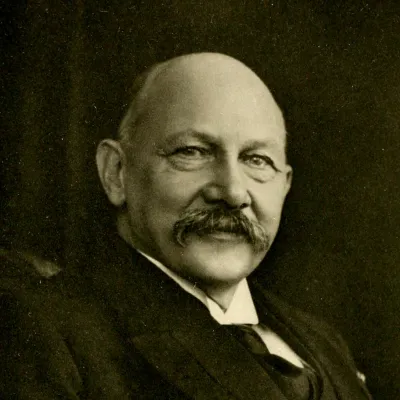
Heike Kamerlingh Onnes
Human Design Chart
Biography
He was the eldest son of Harm Kamerlingh Onnes (24 June 1819, Groningen), a brickworks owner. His mother, Anna Gerdina Coers (12 July 1829 12 AM Arnhem - 10 April 1899, Zoeterwoude), was the daughter of the carpenter and architect Jacob Koers. They married 25 November 1852 in Arnhem and got seven children. His sister Meisina (5 Sept 1885 - 3 June 1860, Groningen) died early. His brother Menso Kamerlingh Onnes (25 Feb 1860, Brussel - 29 June 1925, Oegstgeest) became a painter. His nephew Harm Henrick Kamerlingh Onnes (15 Feb 1893, Zoeterwoude - 20 May 1985, Leiden) became a portrait painter and ceramist, noted for his on physical laws based ceramic art and portraits of prominent physicists.
In 1870, Kamerlingh Onnes attended the University of Groningen. From 1871-73, he went to Heidelberg to to study under Robert Bunsen and Gustav Kirchhoff. He got his masters degree in 1878 in Groningen and graduated magna cum laude with "Nieuwe bewijzen voor de aswenteling der aarde" on 10 July 1879 2PM. His New proofs of the rotation of the earth, were based on experiments with the pendulum of Léon Foucault, a theme that inspired the philosopher Umberto Eco to write his famous book Il pendolo di Foucault. Gustav Kirchhoff stimulated Kamerlingh Onnes to write his thesis.
From 1878 to 1882 he was assistant to the physicist Johannes Bosscha Jr. the director of the Delft Polytechnic. On instigation of Lorentz, he became at age 28 professor of experimental physics at the University of Leiden (1882-1923). In his inaugural speech held on 11 November 1882, he pleaded for "Meten is weten" (The numbers tell the tale), which became a Dutch expression. He was also credited for coining the word "enthalpy".
In 1904, he founded the cryogenics laboratory, since 1932 named after him.
Heike Kamerlingh Onnes — Manifesting Generator with Profile 1/3
Manifesting Generator 1/3 — Design at a Glance
Heike Kamerlingh Onnes revealed himself as someone who possessed a hybrid energy structure: As an Manifesting Generator, he combined the constant power of a Generator with the lightning-fast effect of a Manifestor. His design suggested that he could skip steps and draw things quickly into his life once he responded to impulses. This speed was, however, a double-edged sword; if he tended to pursue multiple projects simultaneously or omit important stages, this quickly led to frustration – his specific Non-Self theme.
The mechanics of his type strictly required reaction rather than initiation. Only when his Sacral Center gave a clear "yes" to a life impulse and his inner authority agreed could he draw deep satisfaction from his creation. In this state, the parallel handling of various tasks was no obstacle but instead fostered his necessary play mode and variety that best fed his energy. If he did not live by this strategy of responding to impulses, his natural dynamism would stall. The challenge always lay in channeling his own speed through regular checks of inner resonance so that his creative power remained intact and did not turn into overload. His design thus marked him as someone who could work efficiently if he learned to align his hybrid nature through disciplined reactions to life.
Sacral Authority
Heike Kamerlingh Onnes revealed himself as someone whose decision-making process came directly from the body. His design simplified this process considerably: As a Generator, his strategy was also his inner authority. This sacral authority did not manifest through prolonged thought but reacted immediately to external stimuli. It announced itself as a physical response – a surge of energy or an internal signal like a grunt or a nodding "Mhm."
When he responded correctly to these impulses, he felt vital and alive. Then, almost inexhaustible energy was at his disposal, with which he accomplished his tasks with great enthusiasm. His life was marked by the joy of doing; he immersed himself in his activities without the need for external purpose. This inner guidance allowed him to walk through life with satisfaction and fully engage in what resonated with him.
Additionally, an active Spleen Center supported this sacral authority. Through this connection, he had a quick, spontaneous reaction capability. He made decisions rapidly and was guided by immediate instinctive perception as well as his physical wellbeing. This combination of sacral energy and spleen-supported intuition provided him with a reliable compass for his actions.
The 1/3 Profile — Investigator / Martyr
Heike Kamerlingh Onnes revealed himself as someone whose nature was marked by a deep drive to grasp knowledge not just theoretically but to validate it through direct action and experimentation. His design tended to blur the lines between pure research and practical application; he was a researcher who experimented.
This aligned with the mechanics of his Profile 1/3: Line 1 promoted the intensive gathering of foundational knowledge and the recognition of potentials in the hidden, while Line 3 dictated an imperative need for trial and error. For Heike Kamerlingh Onnes, learning was a process of surrendering to the background, where insights were often unexpectedly discovered. Yet he only found true truth when these theories were tested against heart and gut.
The dynamics between these lines meant that his judgments were only absolutely trustworthy if they were both intellectually grounded and practically tested. Line 3 pushed him to try extreme strategies to see what worked, learning through mistakes and recognition, with the danger of ego inflating upon success. His path was thus not pure contemplation but a constant oscillation between gathering information in the hidden and boldly, often erratically, experimenting in the real world.
Split Definition — Defined & Open Centers
Heike Kamerlingh Onnes was characterized by a design marked by consistent internal structure and clear expression. His defined G Center gave him a reliable sense of self-identity and a firm direction for his personal path, while the also defined Throat Center ensured that he could communicate this truth with ease and honesty. This connection allowed him to speak from his Higher Self without being dependent on external expectations.
As a Generator, Heike Kamerlingh Onnes had a defined Sacral Center, which provided him with an immense source of vital energy. His strategy was not to initiate but to respond to questions or situations in order to use his energy correctly and avoid frustration. This endurance was supported by his defined Spleen Center, which gave him spontaneous intuition and strong body awareness, as well as the defined Root Center, which provided the necessary pressure to move forward in the world and master existential challenges.
In contrast, his open Head and Ajna Centers revealed a vulnerability to mental confusion and the pressure to find answers to questions that were not his own. He tended to be influenced by others' doubts or to take on intellectual problems to make himself important. His open Heart Center lacked consistent willpower; he was vulnerable to trying to prove his worth through promises he could not keep. Additionally, his open Solar Plexus absorbed the emotions of the environment, causing him to experience foreign moods as his own and avoid confrontation out of fear of rejection. These open centers challenged him to break free from conditioned reactions and trust in his inner authority.
Channels for rituals, conscious presence and meaningful struggle.
Heike Kamerlingh Onnes was characterized by a deep biological rhythm. The Rhythm Channel 5-15 connected his Sacral Center with the G Center. Gate 5 held onto fixed habits, while Gate 15 integrated the diversity of society into the flow of life. This mechanism generated a natural sense of timing that propelled him forward and magnetically drew others into his energy flow.
His design also promoted awareness of the present moment. The Awakening Channel 10-20 connected his G Center with the Throat Center. Gate 10 ensured authentic presence, while Gate 20 transformed individual knowledge into proper action. This allowed him to act through self-love and acceptance in the here and now and serve as a model of awareness for others.
Simultaneously, he was driven by the search for meaning. The Life Struggle Channel 38-28 connected his Root Center with the Spleen Center. Gate 38 exerted pressure to maintain individual integrity against external forces, while Gate 28 recognized which struggles were worth it and worthwhile effort. This configuration gave him a stubborn determination to walk his own path and find meaning in life's challenges.
Additionally, gates like 46 (Devotion), 25 (Innocence), and 35 (Change through Interaction) influenced his personality. In the design, gates such as 45 (Tribe Level), 39 (Provocation for Mutation), and 8 (Contribution) supported his expression. This combination shaped a person who stood in the flow of life, remained true to himself, and fought purposefully for his values.
Individual Circuitry — Circuit Signature
Heike Kamerlingh Onnes was characterized by his design as someone who worked in two separate energetic areas. The Split Definition did not create an uninterrupted connection between all centers but formed parallel forces: on one side a coherent system of Sacral, Identity, and Throat Centers, on the other side an isolated connection between Spleen and Root Centers. This separation meant that his strategic orientation was not automatically fused with his intuitive perception.
In the Knowledge Circuit, he worked through the Life Struggle Channel (Gates 28-38). This connected his Spleen Center to his Root Center and gave an instinctive, efficiency-oriented perception a pressing, life-critical intensity. It was a pulsating energy that demanded immediate reactions but remained isolated from other circuits.
The Understanding Circuit activated the Rhythm Channel (Gates 15-5) in Heike Kamerlingh Onnes. This connected his Identity Center to his Sacral Center and allowed logical structures and rational insights to be shared in a focused, future-oriented way. Here lay the power to communicate ideas free from conditioning, supported by an emotionless ratio.
The Integration Circuit followed with the Awakening Channel (Gates 20-10) connecting Throat to Identity Centers. This enabled intuitive insights and powerful reactions to life to be directly translated into current presence and articulated verbally. Through this connection of Sacral, Identity, and Throat Centers, a closed flow emerged: strategies were developed that supported his own identity and were immediately articulated. The separate Spleen-Root energy acted as an independent impulse generator for quick, intuitive adjustments without directly steering the rational expression.
Right Angle Cross of the Vessel of Love 3
Heike Kamerlingh Onnes exhibited a fundamental disposition marked by the right cross of the Love Vessel 3. This configuration pointed to a deeply rooted ability to empathize with others, understanding their emotional needs without losing his own identity. It was a form of empathy that went beyond superficial interactions and delved into the heart of matters. Heike Kamerlingh Onnes lived this trait by building relationships based on mutual understanding and respect. His design promoted a natural inclination towards conflict resolution and fostering harmony, making him a stabilizing force in his environment. The mechanics of this cross emphasized the importance of authenticity and openness in interpersonal relationships. He used these strengths to build bridges between people who might never have found each other otherwise. His way of interacting was characterized by gentle firmness that offered both comfort and clarity. Through these qualities, he could form deep connections that went beyond superficial interactions and enabled a genuine emotional connection.
Saturn Return · Uranus Opposition · Chiron Return · 2nd Saturn Return — Life Cycles
Heike Kamerlingh Onnes lived a life structured around clear milestones where inner maturity met external validation. His design showed a tendency towards cyclical condensation: during Saturn Returns, years of groundwork often crystallized into substantial results.
In 1882, at the age of 29, he was appointed Professor for Experimental Physics at Leiden University. For his design, this was a typical moment of the first Saturn Return, where long-term efforts solidified and enabled a stable position. This phase marked the transition from education to established authority, supported by the inner security brought about by this cycle.
Another peak occurred during the Chiron Return, that fulfillment cycle between ages 49 and 51, when one's incarnation cross unfolds and meaning becomes tangible. In 1903, at age 50, Heike Kamerlingh Onnes served as Rector of Leiden University. This was not just a title change but the visible bloom of his life mission: bearing responsibility and leading an institution reflected the inner maturity fostered by this cycle.
The second Saturn Return around age 58 brought another deepening of this structure. In 1911, during experiments with liquid helium, he discovered superconductivity. This success was not a random discovery but the result of long-term focused work that found its logical and scientific conclusion in this maturity phase cycle. His design thus supported a life path where patience and structural clarity led to groundbreaking results.
Manifesting Generator · Sacral Authority — Synthesis
Heike Kamerlingh Onnes' life was marked by a steady flow of energy, fueled by a defined sacral center (centers) and the rhythm channel (channels/gates). This combination led to profound vitality and an urge to react immediately to external stimuli – a natural inclination towards action that was reinforced by his profile as a researcher and experimenter. Line 1 always sought fundamental knowledge, while line 3 tirelessly tested this knowledge in practice (profile role). This resulted in a work style characterized both by thorough preparation and spontaneous implementation, exemplified by events such as his appointment to professorship and the discovery of superconductivity.
A central tension lay in the nature of the Manifesting Generator (design view): the desire for rapid progress and the necessity to rely on inner sacral impulses. The ability to skip steps clashed with the realization that thorough testing and experimenting (profile role) were essential for sustainable results. This dynamic between speed and care shaped his path, where knowledge of his own rhythm (circuitry) played a central role in optimizing body energy.
3 Defined Channels
Incarnation Cross - Right Angle Cross of the Vessel of Love 3
Solar Return
The Solar Return shows the moment when the sun returns to its exact birth position - your personal solar year.
Life Cycles
Discover the life cycles with a detailed triple view (birth chart, cycle chart, composite).
Human Design Profile
- Strategy
- To respond - wait for something to respond to
- Authority
- Sacral Authority
- Profile
- 1/3 - Investigator / Martyr
- Definition
- Split Definition
- Incarnation Cross
- Right Angle Cross of the Vessel of Love 3
- Date of Birth
- 21.09.1853 19:00
- Place of Birth
- Groningen, Netherlands
Frequently Asked Questions
What was Heike Kamerlingh Onnes' Human Design type?
What profile did Heike Kamerlingh Onnes have?
What authority did Heike Kamerlingh Onnes possess?
What incarnation cross did Heike Kamerlingh Onnes have?
Discover your own Human Design
Are you also a Manifesting Generator? Find out in a personal reading how to unfold your multi-talents and direct your energy wisely.
More Personalities
Back to overviewAldair

Alizée

Angeli

Arletty
Artus
Balthus