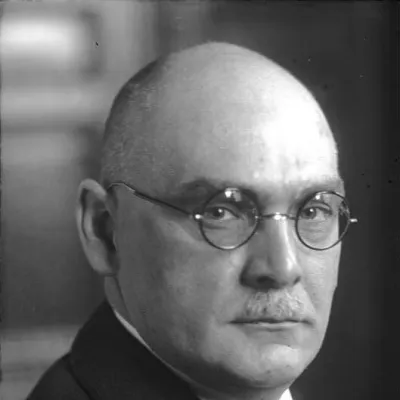
Heinrich Köhler
Human Design Chart
Biography
Köhler died at Karlsruhe on 6 February 1949.
Heinrich Köhler as a Manifesting Generator 3/5 in Human Design
Manifesting Generator 3/5 — Design at a Glance
Heinrich Köhler's design featured a tendency towards great dynamic power. As an Manifestor Generator, he had constant sacral energy that served as his motor. At the same time, however, he also possessed traits of a Manifestor, allowing him to skip steps and quickly draw results into his life. This hybrid nature created a specific tension: on one hand, like all Generators, his strategy was not to initiate himself but to react to external impulses. On the other hand, his inner acceleration pushed him to take on multiple projects simultaneously and charge ahead rapidly.
This profile carries a high risk of frustration, Heinrich Köhler's Non-Self theme. If he acted too quickly or skipped important intermediate steps, he often had to backtrack to fill in gaps. Pursuing many interests at once could also lead to exhaustion if his inner authority did not clearly agree. The key to his satisfaction lay in waiting for an impulse first and then checking whether his sacral center responded with a clear "yes." Only when this resonance existed could he use his speed without overburdening himself. In this state of playful engagement, he found deep fulfillment in his work and enjoyed the variety of multiple tasks rather than being overwhelmed by them. His success depended on maintaining this balance between reactive patience and explosive execution.
Sacral Authority
Heinrich Köhler was a Generator whose decision-making was shaped by sacral authority. This inner guidance defined his strategy and simplified his process, as he did not need to think but could react to physical signals. A prerequisite for this was his open emotional center, which ensured that he did not take impulsive emotional waves as truth.
His authority manifested in a direct gut feeling or surge of energy in response to external stimuli. He learned to pay attention to these bodily noises – often audible as grunts, hums, or simple "mmms". When his sacral motor engaged with something, he felt vital and alive. Then, he had seemingly inexhaustible energy at his disposal, enabling him to work with great enthusiasm.
Heinrich Köhler was born to walk through life with joy and contentment. He immersed himself fully in his activities without having to pursue a sense of purpose or results. The activity itself was the reward. Through this configuration, he could reliably guide himself by trusting his immediate access to physical well-being and instinctive perception. This gave him the ability to react particularly quickly and spontaneously and make decisions in the moment rather than delaying them through rational deliberation.
The 3/5 Profile — Martyr / Heretic
Heinrich Köhler's design set a tendency towards heroic adventure and humorous rebellion. As a person of Profile 3/5, he initially believed little in prefabricated truths; instead, he learned through his own experimentation and the analysis of his mistakes. This Line 3, that of the experimenter, drove him to break connections and dismantle old structures. Often this showed a fanatical zeal for cleaning up and correcting material circumstances, where he was willing to dissolve old forms to create order.
This self-acquired knowledge made him attractive in his environment. The Line 5, the Hero's Line, allowed him to clearly and precisely convey his practical insights. Especially during times of idleness or crisis, he could hold back, remain focused, and then act with concise effectiveness when it was really necessary. His work involved addressing other people’s problems with his experiential solutions. This role of the rescuer naturally flattered him, yet it also carried the risk of painful failure in public if his experiments did not succeed. So he moved between the necessity to test everything himself and the need to be perceived as a competent authority.
Split Definition — Defined & Open Centers
Heinrich Köhler's design inclined towards clear, authentic self-expression. His defined G Center gave him a reliable sense of his own identity and direction; he intuitively knew where he belonged without having to impose it on others. This inner security was bolstered by his defined Sacral Center, which as an engine provided a constant source of vital energy. Heinrich Köhler showed himself to be someone who did not exhaust his strength through initiatives but rather through reactions to life – he waited for the question or invitation before responding with full, satisfying energy. His defined Spleen Center ensured that these reactions always aligned with his current well-being and intuition; he acted spontaneously from the 'now', protected by a fine instinct for what was healthy. Additionally, his defined Throat Center allowed him to articulate these inner truths verbally or through action without wasting unnecessary energy.
At the same time, his design revealed specific vulnerabilities through his open centers. His open Head and Ajna Centers meant he did not have constant mental inspiration; instead, he tended to absorb others' mental pressure or get stuck in doubts when he didn't trust his physical authority. He was not designed to solve conceptual problems solely by thinking but had to learn to accept mental confusion as temporary. His open Heart Center lacked consistent willpower; Heinrich Köhler tended to question himself in a self-monologue about whether he possessed enough value or needed to make promises to find recognition – a trap that could plunge him into spirals of self-doubt and overcompensation. Furthermore, his open Solar Plexus absorbed the emotions of the environment, leading him to experience others' moods as personal crises if he did not consciously distance himself from emotional fields. This constellation challenged him to draw strength from the body and intuition rather than remaining in the head or ego's proof burden.
Channels for leadership, reflection, judgment and discovery.
Heinrich Köhler's design inclined towards logical, collective leadership based on trust and understanding of existing patterns. This attitude was shown through the Alpha Animal Channel 7-31, connecting his G Center with his Throat Center. Here Gate 7 acted as the rational role behind the throne together with Gate 31, the voice of the collective leader. Köhler did not seek absolute sole rule but rather to be invited by his community to lead them into the future based on tested logic. His authority arose from the ability to understand trends and be recognized as a trustworthy leader.
Parallel to this, he possessed a deep capacity for reflection and memory. The Lost Son Channel 13-33 also connected G and Throat Centers. Gate 13, the Listener's Gate, gathered information and secrets while Gate 33, the Withdrawal Gate, took time to process these experiences. Köhler showed himself as someone who exercised patience to uncover hidden truths before communicating them. This process served to bring continuity and stability into his environment by learning from past lessons rather than rushing to conclusions about the future.
His inner energy was marked by an insatiable drive for correction. The Judgment Channel 58-18 connected Root with Spleen Centers. Gate 58 drove a love of life and constancy, while Gate 18, the Correction Gate, ensured that patterns were reviewed and improved. Köhler sought solutions that worked for the collective and often questioned what was out of balance to strive for perfection.
Additionally, his life force was shaped by the Discovery Channel 29-46. It connected Sacral with G Center through Yes-Saying Gate 29 and Determination Gate 46. This allowed him to fully immerse himself in experiences and persistently be at the right place without needing control. Through this combination of logical leadership, patient reflection, correcting judgment, and persistent discovery, Köhler acted as a stabilizing force that provided both structure and revealed deeper truths.
Collective Circuitry — Circuit Signature
Heinrich Köhler's design showed a split structure that defined two independent, non-directly connected energetic poles. One pole united the Throat, Identity, and Sacral Centers (Group 1), while the other linked Spleen with Root Center (Group 2). This separation meant that rational future visions and emotional past reflections existed in parallel without forming a common flow.
The Understanding Circuit worked here divided: The connection between Throat and Identity Centers promoted sharing logical insights for shaping the future, free from emotional conditioning. Parallel to this, the link between Spleen and Root Center created an instinctive judgment capacity for inner security and structure. Both parts were isolated from each other.
The Meaning Circuit utilized the same Throat-Identity Channel but added the Sacral Center. This generated a cyclical process: Emotional waves from the past were reflected and shared through the throat to collectively learn. The energy flowed in wave-like patterns – with beginning, middle, and end – serving to translate past experiences into understandable narratives.
Together, this resulted in a profile that on one hand provided cool, strategic rationality for future improvements (Spleen-Root/Throat-Identity) and on the other enabled deep emotional processing of the past (Sacral-Throat-Identity). Since these circuits ran through separate centers, Heinrich Köhler had to distinguish between the impulse for logical future planning and the need for emotional past resolution. There was no automatic integration of both aspects; they remained as separate, side-by-side energy fields each requiring its own strategies.
Right Angle Cross of Service 3
Heinrich Köhlers design carried the imprint of the right cross of service. This configuration established a fundamental attitude that was less about individual self-presentation and more about a deep connection with the whole. His inner nature was designed to process impulses not in isolation but to weave them into a larger context beyond personal ego.
In Human Design, this cross marks a specific energetic alignment: it's about the ability to effect transformative change through dedication and service to others or to a cause. Heinrich Köhler did not seek power in the conventional sense; rather, his influence arose from his willingness to adapt to life's flow and take on a guiding role within it. His energy worked subtly yet enduringly by stabilizing structures without seeking the forefront.
This mechanism means that his actions were often guided by an inner authority that prioritized silence and observation over loud instructions. He conveyed security through his presence and listening, not through dominating words. The right cross of service challenged him to use his gifts selflessly, enabling him to be a central yet often unseen support in communities or projects. His path was marked by the realization that true strength lies in giving others space to grow while maintaining one's own integrity.
Saturn Return · Uranus Opposition · Chiron Return · 2nd Saturn Return — Life Cycles
Heinrich Köhlers design inclined towards structural upheavals and the assumption of high responsibility in later life stages. This configuration shaped his professional development, characterized by two decisive turning points that correlated directly with his astrological cycles.
In 1920, at age 42, he experienced a Uranus return – a phase often requiring sudden changes and breaking away from established structures. At this exact moment, Köhler became Minister of Finance in Baden as well as President of Baden. This event highlighted the mechanical effect of Uranus: the ability to rise quickly into high political offices through innovative or disruptive measures when inner maturity and external circumstances align. It was not a gradual ascent but a sudden role change typical of this planet's influence in Human Design.
Seven years later, in 1927 at age 49, Köhler reached his Chiron return. This cycle marks the blooming and fulfillment of one's incarnation purpose in Human Design – provided that strategy and authority were previously observed. In this year, he was appointed Reich Minister of Finance in the Marx IV cabinet. This appointment to the highest national financial authority demonstrated a concrete manifestation of this fulfillment cycle: years of work and previous positions culminated in the full realization of his life's mission on a national level. The Chiron return confirmed that Köhler at this point fulfilled his deepest purpose by taking responsibility for the financial stability of an entire state. Both events underscore a design that achieves its greatest impact during phases of transformation and later confirmation.
Manifesting Generator · Sacral Authority — Synthesis
Heinrich Köhler was a Manifestor Generator, whose life was marked by a constant interplay between the drive for rapid initiation and the necessity of sacral reaction. His defined sacral energy (Sacral Center) provided a consistent life force, yet through its connection to the Throat Center (Manifestor Generator), it led to an unusual acceleration of processes. This manifested in his ability to quickly initiate things but also carried the risk of skipping essential steps and needing corrective loops. The profile as an experimenter/hero (3/5 Profile) amplified this impulse towards direct experience followed by sharing insights – a pattern that repeated in professional turning points (1920, 1927).
Central to Heinrich Köhler was a paradox of logical leadership and deep meaning-seeking. The defined channel of the Alpha Animal (Gate 31/7) pointed to natural authority based on proven patterns and shaping collective decisions. Simultaneously, the focus in the Understanding Circuit lay on rational insight without emotional coloring. This tendency towards detached analysis contrasted with the Meaning Seeking Circuit's search for significance and deeper connections – a tension between cool logic and the desire for authentic life design.
4 Defined Channels
Incarnation Cross - Right Angle Cross of Service 3
Solar Return
The Solar Return shows the moment when the sun returns to its exact birth position - your personal solar year.
Life Cycles
Discover the life cycles with a detailed triple view (birth chart, cycle chart, composite).
Human Design Profile
- Strategy
- To respond - wait for something to respond to
- Authority
- Sacral Authority
- Profile
- 3/5 - Martyr / Heretic
- Definition
- Split Definition
- Incarnation Cross
- Right Angle Cross of Service 3
- Date of Birth
- 29.09.1878 16:00
- Place of Birth
- Karlsruhe, Germany
Frequently Asked Questions
What was Heinrich Köhler's Human Design type?
What Profile did Heinrich Köhler have in Human Design?
What Authority did Heinrich Köhler have?
What was Heinrich Köhlers incarnation cross?
When was Heinrich Köhler born?
Discover your own Human Design
Are you also a Manifesting Generator? Find out in a personal reading how to unfold your multi-talents and direct your energy wisely.
More Personalities
Back to overviewAldair

Alizée

Angeli

Arletty

Artus

Balthus