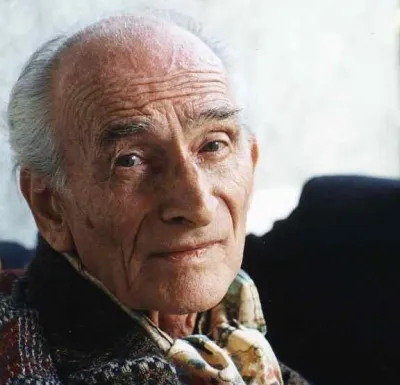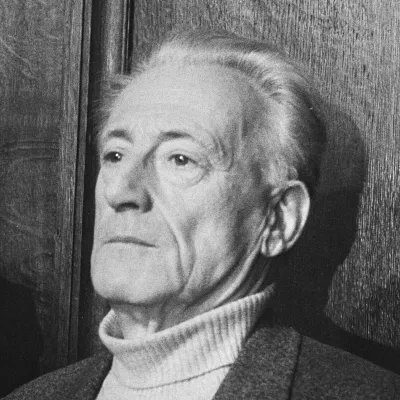
Henri Lefebvre
Human Design Chart
Biography
Henri Lefebvre — Manifesting Generator with Profile 3/5
Manifesting Generator 3/5 — Design at a Glance
Henri Lefebvre's Design set a tendency towards hybrid dynamics: He had the constant energy source of Generators but also possessed the ability to skip steps in action and quickly draw results into his life. As an Manifesting Generator, he showed himself as someone who not only reacted to impulses but combined this reaction with accelerated implementation. This configuration meant that while he had to wait for the Sacral Center to signal a clear "yes," once it did, he acted at a speed that pure Generators could not match.
This quickness was double-edged: It allowed him to pursue multiple projects in parallel and fall into a productive play mode when strategy and inner authority aligned. At the same time, it carried the risk of overlooking important intermediate steps, forcing him to backtrack and fill gaps—a potential source of frustration if he went against his nature. His creative power unfolded most deeply when he sought variety and was not forced to fixate on one thing before others had begun. The mechanics of his design thus marked him as an actor who found satisfaction through reactive but accelerated action, so long as he continuously checked the resonance of his inner energy and did not fight against the flow of life.
Emotional Authority
Henri Lefebvre's design indicated a tendency towards emotional depth and delayed clarity. He appeared as someone whose inner truth did not lie in the first impulse but developed through a wave-like rise and fall of emotions. His inner authority was Emotional Authority, carried by his defined Emotional Center. In Human Design mechanics: Whenever the Emotional Center is activated, it takes this role – regardless of which other Centers are also defined. This priority rule is central; it means that his emotional wave always took precedence over all other internal signals.
Lefebvre was subject to a constant change in moods. The world appeared colored by his current emotional state: A moment of enthusiasm could quickly shift into a negative view of the same topic. However, his immediate feeling was only a snapshot, an initial impression that did not necessarily reflect his deeper truth yet. Quick, spontaneous decisions from such an emotional place often had negative consequences.
Instead, his mechanics required patience and conscious hesitation. By taking time to let a decision mature – ideally by sleeping on it multiple times – he gained emotional distance. Intense feelings subsided over time, leading to clarity and calmness. Only then had he gone through the process. This mechanism was especially important for long-term decisions that could significantly shape his life course.
The 3/5 Profile — Martyr / Heretic
Henri Lefebvre's design laid a tendency towards being a heroic adventurer: he learned through personal experimentation and later presented these practical experiences to others. As someone with the Profile 3/5, he initially believed little in predetermined truths; instead, he had to test everything himself experimentally. This line of the experimenter (Line 3) was marked by trial and error, often accompanied by uncertainty in social contacts or a feeling of inadequacy when bonds did not match up. Yet from these failures, he gathered knowledge.
The second half of his profile, the Hero Line (Line 5), transformed this personal experience into a resource for others. Henri Lefebvre showed himself to be someone who could offer practical solutions in times of crisis – a companion in survival. His attractiveness lay in sharing his rich treasure trove of life experiences. Others saw him as the rescuer who solved problems they themselves couldn't handle. This role flattered his design but was painful when experiments failed in public. Nervousness could lead to self-deception, where he convinced himself of something that wasn't true. His path therefore was not a linear ascent but a process of self-analysis and crisis management, during which he developed the ability to help others in difficult moments from his own shortcomings.
Split Definition — Defined & Open Centers
Henri Lefebvre's design indicated a tendency towards consequent theoretical structuring and vital endurance. His defined Ajna Center ensured constant mental processes, while the connected Throat Center translated these concepts into clear communication. The defined G-Definition gave him a firm inner direction and identity. As a Generator with a defined Sacral Center, he possessed an enormous energy source that was activated through reaction. His defined Solar Plexus functioned as emotional authority, necessitating waiting for the emotional wave to gain clarity.
At the same time, Lefebvre was vulnerable to external conditioning in his open centers. The open Head Center tended to absorb mental pressure and doubt from the environment without generating it itself. His open Heart Center pulled him into spirals of wanting to prove and promise value – a trap since he lacked consistent willpower. The open Spleen Center made him sensitive to the well-being or illness of his surroundings; he tended to cling to unhealthy situations just to receive a sense of security from others. Additionally, his open Root Center absorbed external stress and adrenaline, which could lead to a cycle of perceived productivity and exhaustion if he did not recognize this foreign pressure as such. His mechanics thus showed themselves in the tension field between inner theoretical firmness and sensitivity towards outer emotional and stress-induced stimuli.
Channels for rhythm, insight and emotional transformation.
Henri Lefebvre's design indicated a tendency towards a deep, biological connection with the natural flow of life. This fundamental attitude was shown through the channel of Rhythm 5-15, connecting the Sacral Center to the G Center. Gate 5 held onto firm habits and rituals while Gate 15 integrated the diversity of society into this life stream. This mechanism generated an impersonal magnetism that drew others into his energy flow and determined a group's course without relying on intellectual arrogance or emotional waves.
Parallel to this, Henri Lefebvre shaped how he conveyed insights through the channel of Structuring 23-43. This channel connected the Ajna Center with the Throat Center. Spontaneous insights from Gate 43 were assimilated and clearly expressed by Gate 23. This configuration allowed him to formulate innovative perspectives that promoted efficiency and mutated others' thinking, provided his expression occurred at the right time and was not premature.
Another aspect was the emotional quest for experience driven by the channel of Transience 35-36 between Solar Plexus and Throat Center. Gate 36 perceived inexperience as inadequacy and sought crises or new adventures to set things in motion. Gate 35 manifested this drive towards change. Henri Lefebvre learned through this restless yearning for emotional depth and shared these experiences, which sometimes led him away from logic to enforce new states.
Additionally, individual gates influenced his perception: Gate 11 promoted situational assessment through visual memories before action. Gate 6 regulated growth through friction and emotional waves in the context of fertility. Gate 12 brought a mutative, poetic quality into communication, influenced by emotional mood. On a personality level, Gate 45 contributed to expressive strength rooted in tribal hierarchy and willpower. In his design, Gate 49 supported sensitive responsiveness to principles and sacrifice while Gate 37 emphasized organic community structures and friendship. Finally, Gate 29 stood for the persistence of saying yes in the face of challenges, securing reward for correct action.
Collective Circuitry — Circuit Signature
Henri Lefebvre's design indicated a tendency towards structured communication linked with deep rhythmic life energy and the ability to emotionally process past experiences. These three areas existed separately as parallel forces within him due to his Split Definition – the groups were not directly connected.
In the Knowledge Circuit, Henri Lefebvre connected Ajna Center (Intellect) with Throat Center (Expression) through the channel of Structuring. This allowed him to articulate mental concepts clearly and logically. His intelligence primarily served to put ideas into words without emotional waves or spontaneous creativity from other parts of this circuit playing a role.
Parallel to this, the Understanding Circuit worked through the connection between Identity and Sacral Center (Life Force) via the channel of Rhythm. Here, a constant reliable energy source was evident, fueling his actions from deep inner security. This connection involved cool logic and strategy; emotions played no part in this specific stream.
A third independent area was the Meaning Circuit. Here, Throat Center connected Solar Plexus (Emotions) via the channel of Transience. Henri Lefebvre could thus reflect emotional cycles from the past and share these experiences. Since this circuit was separate from intellectual expression in the Knowledge Circuit, his emotional processing remained an independent process not directly steered by his logical argumentation.
Right Angle Cross of Eden 2
Henri Lefebvre's Human Design indicated a tendency towards deep, often painful confrontations with his own essence. He was someone who did not merely endure the burden of existence but actively transformed it into an understanding of responsibility and meaning. This configuration, the right cross of Eden 2, describes a path that leads through suffering and trials to distill a clear, often solitary truth from them. It was not about passive martyrdom but active transformation: what he experienced became the foundation for a strong yet isolated self-understanding. The mechanics of this cross demand integrating pain into one's identity, thereby creating a specific kind of wisdom born out of direct confrontation with life's dark aspects. Henri Lefebvre lived this dynamic by not repressing his experiences but accepting and utilizing them as integral parts of his existence. This shaped an attitude of serious dedication to his inner processes, far from superficial adaptation. The energy of this configuration drove him to develop universal statement power from personal suffering, even if it came at the price of loneliness or misunderstanding by others. His path was marked by the necessity of asserting his own truth in a world that often did not recognize it.
Saturn Return · Uranus Opposition · Chiron Return · 2nd Saturn Return — Life Cycles
Henri Lefebvre's Human Design indicated a tendency towards profound structural disruptions that radically reordered his external life circumstances. This configuration does not appear as a random sequence of misfortunes but as mechanically induced phases of dissolution and reconstitution.
In 1940, at the age of 39, the Uranus opposition became active: Henri Lefebvre was dismissed from his philosophy teaching position, a direct act of destroying his established status due to his party affiliation. This cycle marks the point where old structures can no longer hold and must inevitably break down to make way for new reality. The crisis here was not an accident but the logical consequence of an energetic constellation that dissolves stability.
Later, in 1958 at the age of 57, this pattern repeated with his second Saturn return: Henri Lefebvre was expelled from the French Communist Party. The second Saturn cycle tests and solidifies inner identity through external pressure or loss. Both events – dismissal and expulsion – confirm that his design was programmed to prove itself in moments of extreme instability. Instead of continuous buildup, Henri Lefebvre's path was marked by a series of breaks forcing him to redefine his role in the world when previous conditions collapsed.
Manifesting Generator · Emotional Authority — Synthesis
Henri Lefebvre was a Manifestor Generator whose life was characterized by a constant interplay between the urge for rapid implementation and the necessity of emotional maturation. His defined Sacral Center provided a constant energy source, which through connection with the Throat Center (typical for Manifestor Generators) led to an impressive ability to set ideas in motion – often aimed at breaking existing structures and initiating new ones. This dynamic was evident in his pursuit of knowledge and willingness to challenge conventional thinking, repeatedly putting him into crisis situations (as evidenced by events at ages 39 and 57).
A central paradox lay in Lefebvre's design: he possessed the energy of a Generator to respond to impulses and push things forward, yet his emotional authority required time for weighing and maturing decisions. This tension between quick action and emotional depth led him repeatedly into situations where it was necessary first to act swiftly (Channel of Rhythm), then possibly backtrack and adjust course – a pattern further reinforced by the line 3/5 in his Profile as an Explorer and Hero.
3 Defined Channels
Incarnation Cross - Right Angle Cross of Eden 2
Solar Return
The Solar Return shows the moment when the sun returns to its exact birth position - your personal solar year.
Life Cycles
Discover the life cycles with a detailed triple view (birth chart, cycle chart, composite).
Human Design Profile
- Strategy
- To respond - wait for something to respond to
- Authority
- Emotional Authority
- Profile
- 3/5 - Martyr / Heretic
- Definition
- Split Definition
- Incarnation Cross
- Right Angle Cross of Eden 2
- Date of Birth
- 16.06.1901 11:00
- Place of Birth
- Hagetmau, France
Frequently Asked Questions
What was Henri Lefebvre's Human Design type?
What profile did Henri Lefebvre have in Human Design?
Which authority guided Henri Lefebvre's decisions?
What incarnation cross did Henri Lefebvre have?
When was Henri Lefebvre born?
Discover your own Human Design
Are you also a Manifesting Generator? Find out in a personal reading how to unfold your multi-talents and direct your energy wisely.
More Personalities
Back to overviewAldair

Alizée

Angeli

Arletty
Artus

Balthus