Photo: Wikimedia Commons
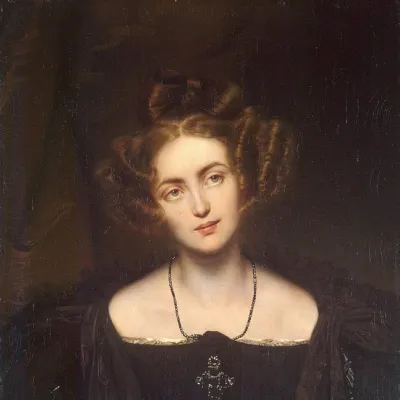
Henriette Sontag
Human Design Chart
Biography
She made her début at the age of 15. In 1823 she sang at Leipzig in Carl Maria von Weber's Der Freischütz and in December of that year created the title role in his Euryanthe. Her success was immediate, and in 1824 she went to the Königstädter Theater, Berlin.
She was invited to be the soprano soloist in the first performances of Beethoven's Symphony No. 9 and Missa Solemnis on 7 May 1824; she was only 18 years old at the time.
Two years later, she sang the part of Rosina in Rossini's Il barbiere di Siviglia, in which her charming personality and fleet coloratura skills granted her a distinct triumph over the reigning diva, Angelica Catalani.
In 1827, she was engaged at the Paris Italian Opera, and a year later married Count Carlo Rossi. She subsequently performed at all the major musical centres of Europe, and in 1852 visited the United States where, among other engagements, she performed in a concert with the violinist Camilla Urso.
She was hired by the Italian Opera in Mexico City, where on 17 May 1854, she intoned for the first time the words of the Mexican national anthem, written by poet Francisco González Bocanegra. One month later, she was stricken with cholera and died on 17 June 1854 at the age of 48.
What does Generator 3/6 mean for Henriette Sontag?
Generator 3/6 — Design at a Glance
Henriette Sontag possessed enormous inner endurance and strength, which carried her like a strong workhorse through her tasks. As a Generator, she had much sacral energy, but it did not serve for spontaneous initiative; instead, she waited for reactions from the environment. Her life strategy involved listening to signals and only acting when her inner self gave a clear "yes." This mechanism of reacting rather than initiating was crucial for her energy balance.
When she lived in harmony with this principle by following her impulses, she was rewarded with a deep sense of fulfillment. If, however, she tried to work against this internal compass or do things that did not resonate with her, her energy would stagnate. This often led to frustration and a lack of power, as Generators can only unleash their potential when they are not held back from their heart's project by external constraints. The danger always lay in either burning out on tasks without inner approval or blocking herself against the will to continue her true passion. Her design therefore required constant checking of her gut feelings to use available energy effectively and satisfyingly.
Sacral Authority
Henriette Sontag revealed herself as someone whose decision-making was based on a direct physical resonance. As a Generator, she possessed sacral authority, an inner guidance unique to her type, and its strategy was identical to her inner authority. This simplified her process: She did not react through prolonged thinking but responded immediately to external stimuli with gut feelings or bursts of energy.
Her design required an open emotional center, meaning she did not use emotions as a basis for decision-making but waited for physical reactions from her body. These manifested in sounds like grunts or hums and the feeling of vitality and inexhaustible energy when her sacral motor was engaged. Henriette Sontag lived with the ability to lose herself completely in activities, driven by joy and satisfaction without obsessive purposefulness.
Additionally, an activated spleen center worked as a supportive authority alongside the sacral center. This gave her the ability to react particularly quickly and spontaneously. She had direct access to her instinctive perception and physical well-being, which she could rely on for guidance. This configuration allowed Henriette Sontag to make decisions in the moment of contact, supported by deep intuitive certainty rather than intellectual analysis or emotional fluctuations.
The 3/6 Profile — Martyr / Role Model
Henriette Sontag revealed herself through her Profile 3/6 as someone who experienced their life in two clearly distinguishable phases. Until the age of about thirty years, Line 3 dominated: She learned primarily through trial and error. This early period was characterized by experimental action, where alliances often lasted only as long as a specific conflict existed. Henriette Sontag used this phase to maintain vitality through cooperation, even if it sometimes appeared that she placed selfish interests over collective harmony – a mechanism for preserving her own life force.
Only after the first Saturn return, around age thirty, did her inner orientation fundamentally change. Line 6 became active and demanded withdrawal as well as reflection. Henriette Sontag now began to sort through and deepen her accumulated experiences. The playful energy of youth received wise guidance; she sought intuitive clarity and self-realization. This process allowed her to develop deep inspirations that she later passed on to others.
In her later years, starting around age fifty, Henriette Sontag united both aspects: the playful liveliness of her younger self and the reflective wisdom of her older self. She thus became a natural role model for others. Her charm and ability to clearly recognize and share patterns helped others confirm the value of their own experiences. Henriette Sontag lived out the paradox of her design: always balancing between the urge to experiment and the need for deep, collective integration.
Single Definition — Defined & Open Centers
Henriette Sontag revealed herself as someone who possessed immense inner vitality. Her design indicated a tendency towards sustained power and persistence, which could only be activated through reactions to external impulses. With a defined Sacral Center, she had a constant motor; her energy was available when she instinctively responded with "yes." This combined with her also defined Spleen Center, which gave her spontaneous intuitive body intelligence. She could perceive in the moment what was healthy and correct without needing rational justification. Additionally, her defined Root Center provided a steady physical pressure that propelled her forward and nourished her existential awareness. This combination of sacral power, intuitive spleen intelligence, and rooting survival drive created a robust foundation for her actions.
At the same time, Henriette Sontag was open in several areas and thus vulnerable to conditioning by her environment. Her open Head Center meant she did not have consistent mental inspiration; she tended to engage with others' doubts or questions rather than trusting her own inner clarity. Similarly, her open Ajna Center: Her mental consciousness was flexible and took on many concepts but could not hold them as personal truth. This often led her to feel uncertain or seek answers that were not truly hers.
Her open Throat Center showed another vulnerability: She had no fixed way of manifesting through speech. Instead of consistently communicating, her open throat naturally attracted attention when she waited. Attempts to actively force attention often resulted in frustration or unpredictable statements. Furthermore, her G Center was open, meaning she did not have a set identity or life direction. She absorbed the directions and qualities of her environment; her identity crystallized only in correct relationships and at appropriate places. Her open Heart Center lacked consistent willpower; she was not geared towards making promises or proving her worth through competition. Finally, her open Solar Plexus absorbed others' emotions. She had to learn to distinguish between her own feelings and the moods taken on from her environment to avoid being emotionally overwhelmed. These opennesses made her a sensitive mirror of her world, needing protection through boundaries and trust in her defined centers.
Channels for ambition, continuity and individual intuition.
Henriette Sontag showed herself to be someone motivated by persistent effort to improve her position in life and be seen. This attitude stemmed from the Transformation Channel 54-32, which linked ambition with a fear of failure; she recognized the fragility of her existence and strove for advancement to support her clan through loyalty and hard work. Her energy was driven by social interactions that helped her recognize talents and rise above her origins.
At the same time, Henriette Sontag possessed sharp survival intelligence. The Power Channel 34-57 gave her the ability to intuitively react to dangers and make decisions in fractions of a second through sacral power. She was acoustically attentive and physically fit, relying on spontaneous reaction rather than mental deliberation to assert herself as an individualized being.
In the background, other energies were at work: Gate 48 enabled her to recognize deeper patterns and correct errors, often accompanied by frustration in the collective. Gate 21 helped her control material things and overcome obstacles through respect within the community. Gate 38 set boundaries for defending her individual integrity against harmful forces. Gate 39 used provocation and analysis to recognize spirit and trigger mutations. In the personality aspect, Gate 58 provided pressure and levity in perfecting processes, while Gate 52 called for concentration on pattern correction in silence. Gate 50 nourished her protective reflex through traditional values and clan rules. Finally, Gate 14 helped her handle power and wealth with grace and find a clear direction.
Individual Circuitry — Circuit Signature
Henriette Sontag lived with a simple, continuous energetic structure. Her defined centers – Spleen, Root, and Sacral – formed a connected flow that did not show any internal breaks or separate energy fields. This unity shaped her experiential world as a coherent whole.
Two circuits were active in this design. The Ego circuit linked her Spleen and Root Centers through the Transformation Channel (32-54). This channel promoted the ability to initiate or process changes through selective perception and intuition. Although this circuit is generally associated with cooperation, Henriette Sontag lacked a connection to her Sacral Center within this circuit; it was thus disconnected from her life force energy and required pauses for regeneration.
Parallel to this, the Integration circuit was active. It linked her Sacral to her Spleen Center via the Power Channel (34-57). This involved securing survival through transforming reactions to life into tangible power. The intuitive selection of the Spleen met with the constant energy of the Sacral, helping her anchor in the present and stabilize her individual existence through proper action. Both circuits utilized the Spleen Center as a common node, influencing her intuitive perception by both transformative impulses from the Root and survival-securing power from the Sacral.
Right Angle Cross of Tension 4
Henriette Sontag exhibited a fundamental disposition marked by profound inner tension. Her design carried the right cross of tension four within it. This configuration did not describe external restlessness but rather an intense, inwardly directed process. Henriette Sontag lived with a constant urge to question her own existence and role in life. It was a spiritual quest that sought not simple answers but a deep transformation of self.
The mechanics of this cross acted like an inner motor driving her to break old patterns. Henriette Sontag searched for higher meaning behind the mundane. This process was often painful and demanded much from her. She had to learn to live with this tension rather than fight against it. The energy of this design helped her release limiting beliefs. Henriette Sontag used this inner strength to find her own truth. It was a path of purification and becoming. Through engaging with this tension, she could establish a deeper connection to her essence. This process shaped her entire life and gave it special depth. Henriette Sontag continuously transformed through this inner work.
Saturn Return · Uranus Opposition — Life Cycles
Henriette Sontag received an aristocratic diploma from the Prussian king in 1831 at the age of twenty-five, henceforth calling herself Henriette von Klarstein. For her design, this marked the first Saturn return, a cycle often bringing years of hard work into a stable, socially recognized structure. The awarding of the aristocratic title acted as concrete evidence of an intense phase of inner consolidation and positioning. The first Saturn return typically demands that accumulated experiences be synthesized into a solid foundation supporting further life paths. In Henriette Sontag's case, this process was evident in formal recognition of her status, cementing her identity and place within the social hierarchy. This mechanism underscores how the Saturn cycle transforms temporary achievements into lasting realities, where external acknowledgment often mirrors an already completed inner maturation. Adopting the name “von Klarstein” symbolized not only a title change but also the integration of this new, solidified role in her self-conception.
Generator · Sacral Authority — Synthesis
Henriette Sontag lived deeply rooted in her sacral energy (Sacral Center), which endowed her with immense endurance. This power source shaped her life path as she constantly sought activities that ignited her energy and provided deep satisfaction. The focus was on experimentation (Line 3 in Profile) and continuous development of her skills – a process amplified by the Transformation Channel (54-32), as she persistently looked for ways to improve her position and utilize her talent. Her authority lay in intuition, in the immediate bodily reaction to external stimuli, establishing a direct connection to life force.
Simultaneously, there was a tension field between the urge to be active and use energy for heart projects and the necessity of taking breaks (Ego Circuit without Sacral Connection). The commitment to the clan and the drive towards cooperation contrasted with individual needs for rest and self-care. This paradox was intensified by the right cross of tension 4, pointing to an inner conflict between personal expression and societal expectations – a dynamic that shaped her life path until a documented career event.
2 Defined Channels
Incarnation Cross - Right Angle Cross of Tension 4
Solar Return
The Solar Return shows the moment when the sun returns to its exact birth position - your personal solar year.
Life Cycles
Discover the life cycles with a detailed triple view (birth chart, cycle chart, composite).
Human Design Profile
- Type
- Generator
- Strategy
- To respond - wait for something to respond to
- Authority
- Sacral Authority
- Profile
- 3/6 - Martyr / Role Model
- Definition
- Single Definition
- Incarnation Cross
- Right Angle Cross of Tension 4
- Date of Birth
- 03.01.1806 06:00
- Place of Birth
- Koblenz, GER
Frequently Asked Questions
What was Henriette Sontag's Human Design type?
What Profile did Henriette Sontag have?
What Authority did Henriette Sontag have?
What incarnation cross did Henriette Sontag have?
When was Henriette Sontag born?
Discover your own Human Design
Are you also a Generator? Find out in a personal reading how to use your sacral energy correctly and discover deep satisfaction.
More Personalities
Back to overviewAaliyah

Alexia

Alizée

Angèle

Anne-Marie

Arcángel