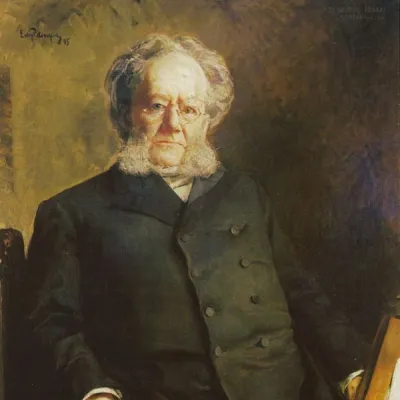
Henrik Ibsen
Human Design Chart
Biography
What does Generator 2/4 mean for Henrik Ibsen?
Generator 2/4 — Design at a Glance
Henrik Ibsen's Human Design indicated a tendency towards high endurance and vital strength. As a Generator, he had abundant sacral energy, which made him extremely strong and resilient – provided this energy was used for suitable tasks. However, his fundamental work approach did not rely on initiating actions but solely on reacting to internal impulses.
The central motto of his design was "React instead of Initiate." His sacral center's energy could be effectively released only when he responded to signals from his environment and followed his inner 'yes'. If he adhered to this strategy by responding to impulses and then acting, he was rewarded with a sense of deep fulfillment.
His design had two major pitfalls. The first occurred if he continuously did things that brought him no joy; in such cases, he wasted his energy and tended towards burnout. The second danger lay in being prevented from working despite still having an internal drive. If Henrik Ibsen did not live by this principle – especially through constant initiating against his inner compass – sooner or later he encountered persistent frustration and a lack of energy. His satisfaction thus directly depended on whether he reacted from the gut or was guided by external expectations.
Sacral Authority
Henrik Ibsen's Human Design indicated an inclination towards intuitive, body-based decision-making. As a Generator, his strategy was also his inner authority: sacral authority. This greatly simplified his orientation process as he did not need to distinguish between strategic approach and internal compass.
This mechanism manifested through clear physical signals in response to external stimuli. Ibsen reacted with what is called a gut feeling or a noticeable surge of energy. Crucial was the perception of specific body sounds like grunting, humming, or groaning. These acoustic cues marked his authentic impulse from his sacral motor.
Upon activation of this instance, a state of high vitality and inexhaustible energy ensued. The resulting activities were performed with great enthusiasm, free from purposefulness. Ibsen lived in the configuration that allowed him to immerse himself entirely in what motivated him, thereby generating joy and satisfaction.
Moreover, the spleen center acted as a supporting instance. It promoted quick, spontaneous reactions and immediate access to instinctive perception. This combination enabled him to reliably orientate himself based on his physical well-being and make decisions directly from the gut without lengthy deliberations.
The 2/4 Profile — Hermit / Opportunist
Henrik Ibsen's Human Design indicated a tendency towards a tension-filled pendulum swing between deep withdrawal and social exchange. He oscillated between the need for isolation to achieve inner clarity (Line 2) and the desire for time with chosen people (Line 4). This configuration required a secure environment to clearly communicate when company was desired and when solitude was needed.
Line 2 fostered an existential commitment to the here and now, free from intentions. In this solitude, Ibsen could recognize his true nature and distinguish it from collective projections. Recognition by the right people confirmed this authentic state. Simultaneously, Line 4 brought unpredictable fixations; he patiently waited for favorable opportunities for transformation. This did not mean passivity but rather acceptance of his behavior until the appropriate situation arose.
During his alone time, Ibsen processed the knowledge from his network. Line 2 allowed him to reflect and evaluate this information, leading to brilliant ideas. Once the need for peace was satisfied, he emerged again from his 'cave' to reconnect with the community. This cycle of withdrawal and re-emergence shaped how he translated inner processes into external actions, always contingent on whether circumstances permitted change or not.
Triple Split Definition — Defined & Open Centers
Henrik Ibsen's design indicated a tendency towards extremely high internal energy and clear identity. Seven of his nine centers were defined, suggesting a person with strong manifesting power. The connection between Head Center and Ajna Center created constant mental pressure for inspiration; however, these thoughts had to be communicated through the also defined Throat Center. The defined G Center provided a solid identity, while the Sacral Center supplied vital energy – under the compelling condition of waiting for an answer (Generator Strategy). The open Spleen and Root Centers ensured intuitive safety in the present moment and a persistent pressure towards material existence.
In contrast, Heart and Solar Plexus centers were open, the only points of receptivity. His open Heart Center meant he was not designed to be willfully strong; instead, he tended to question whether he had to prove himself valuable by having what others have – a typical non-self pattern for open centers. Similarly, his open Solar Plexus Center absorbed emotions from the environment. He was vulnerable to personalizing other people's feelings and avoiding confrontations out of fear of rejection. This openness required situational adaptation, while the massive definition in the rest of his design provided an unshakable internal structure.
Channels for inspiration, clarity, ambition and maturation.
Henrik Ibsen revealed himself as a figure whose mere presence and authentic life encouraged others to express their own uniqueness. His design inclined him to influence through exemplary living rather than pure words or explanations. This approach was rooted in the Channel of Inspiration 1-8, a personality configuration between the G Center and Throat Center. Here, Gate 1, which requires bold self-expression, connected with Gate 8, contributing to the group. Ibsen was programmed to draw attention by living his individual direction; this potentially inspired others to adopt new perspectives, much like virtuosic playing moves people to play the piano. This required inner authority and patience in timing, as this channel did not bring social adaptability but sought recognition for lived individuality.
Besides this public effect, the Channel of Awareness 61-24 worked as a mental background. It connected the Head Center (Gate 61) with the Ajna Center (Gate 24), describing a mind that did not work through logical patterns or discovery but waited for sudden moments of knowing ("Satori"). Ibsen's thinking was designed to transform inspiration from Gate 61 into rational answers once the mutation occurred – knowledge happened in his own time, often after phases of intense mental pressure or "white noise."
Further energetic streams shaped his inner world. The Channel of Transformation 54-32 drove ambition, motivated by a desire to be seen and improve social standing, supported by tribal loyalty. Parallel to this, the Channel of Maturation 53-42 fostered a cyclical experience process: Ibsen entered new cycles to complete them fully and draw wisdom from them, which was then reflected upon. Individual gates like Gate 25 (Innocence/Mystery), Gate 10 (Integration/Behaviour) and Gate 46 (Devotion/Bodily Love) rounded out this picture by supporting spiritual centring, genetically fixed behavioural rules, and full presence in the here and now.
Individual Circuitry — Circuit Signature
Henrik Ibsen's Design presented three separate, non-directly connected energetic poles.
In the Knowledge Circuit, two isolated segments operated: Head and Ajna Centers linked with creative flashes of insight, while Throat and Identity Centers articulated individuality acoustically. This pulsating energy stood for innovation and a unique path.
Parallel to this, in the Meaning-Making Circuit, a cyclical force flowed between Sacral and Root Centers. This channel of maturation processed emotional waves from the past to derive meaning and share insights with the collective. The energy here was reflective and followed a wave-like rhythm of beginning, middle, and end.
As a third independent block, in the Ego Circuit, there existed a connection between Spleen and Root Centers. This transformation channel concerned intuitive perception of resources and cooperation without direct attachment to the life force of the Sacral Center.
Since Henrik Ibsen had Triple Definition, these three systems were energetically separate from each other. There was no continuous flow between innovative identity, emotional past processing, and resource-oriented intuition. Instead, they existed as parallel, situationally activatable forces.
The tension lay in the coexistence of these different formats: the fast, acoustic creativity on one hand, the slow, visual emotional maturation on the other, and the tactile perception of resources as a third timeless aspect. Each of these energies required its own conditions for effectiveness without directly supporting or blocking each other.
Right Angle Cross of the Vessel of Love 1
Henrik Ibsen's design revealed a profound tendency towards dedication, understood as service through emotional availability. He did not primarily present himself as a self-seeker but rather as someone called to be a vessel for a greater, loving force. This archetypal essence of the 'Right Cross of the Vessel of Love' significantly shaped his unconscious motivation and life path.
The underlying mechanics describe the paradox between an intense desire for deep connection and the role of being a container that carries or transmits this love. For Henrik Ibsen, this meant that his identity was closely tied to his ability to emotionally support others. The challenge in this design lay in dedicating himself to this task without losing his own core. It was a life mission of service where he became an instrument for something greater.
This configuration created internal tension: on one hand, the need for genuine connection, and on the other, the function as a channel through which love flows. Henrik Ibsen lived out this dynamic by making himself available to others. His energy was directed towards creating space for emotional depth and passing it forward. The design challenged him to find grounding in this dedication without dissolving his own substance. It was a path of self-sacrifice that carried the risk of disappearing in service to others. Thus, the mechanics of the cross determined the framework of his emotional interactions and inner experience.
Saturn Return · Uranus Opposition · Chiron Return · 2nd Saturn Return — Life Cycles
Henrik Ibsen's professional journey followed a clear pattern of step-by-step establishment culminating in global recognition. In 1857, at age 29, he took over as director of Kristiania Norske Theater in Christiania. This marked his first Saturn Return, a cycle often used to structure years of groundwork and establish a solid professional foundation. For his design, this was a moment of consolidation where inner resources became outwardly effective.
Later, in 1879 at age 51, he gained worldwide attention for the works 'A Doll's House' and 'Ghosts'. This fell during his Chiron Return, an achievement cycle between ages 49 and 51. During this phase, one's Incarnation Cross increasingly unfolds in life; if lived according to strategy and authority, its purpose becomes experiential. Ibsen's international recognition was no coincidence but the visible bloom of his long-term alignment with his personal purpose. The mechanics here show the transition from local establishment to universal impact of his creation.
Generator · Sacral Authority — Synthesis
Henrik Ibsen lived a life path marked by a deep inner drive to set energy in motion – a typical trait of Generators (Design View). This sacral power (Authority) did not manifest as constant activity but pulsed and reacted to external stimuli. He needed triggers to release his seemingly inexhaustible energy and then found joy in the creative process itself (Centers). The profile as a natural talent and networker suggests he oscillated between the need for withdrawal into internal processes and the desire to exchange with a community. This dynamic allowed him to draw inspiration from isolation and express it through the channel of inspiration (Channels/Gates).
A central paradox lay in the tension between his knowledge circuit and the accompanying desire for innovation on one hand, and the necessity to withdraw repeatedly to gain clarity (Profile Role) on the other. He was destined to develop and express new perspectives but also needed phases of rest to process these impulses. A documented event at age 29 (Saturn Return) showed a phase of taking responsibility, while success with works at age 51 (Chiron Return) confirmed public recognition of his creative energy.
4 Defined Channels
Incarnation Cross - Right Angle Cross of the Vessel of Love 1
Solar Return
The Solar Return shows the moment when the sun returns to its exact birth position - your personal solar year.
Life Cycles
Discover the life cycles with a detailed triple view (birth chart, cycle chart, composite).
Human Design Profile
- Type
- Generator
- Strategy
- To respond - wait for something to respond to
- Authority
- Sacral Authority
- Profile
- 2/4 - Hermit / Opportunist
- Definition
- Triple Split
- Incarnation Cross
- Right Angle Cross of the Vessel of Love 1
- Date of Birth
- 20.03.1828 14:25
- Place of Birth
- Skien, Norway
Frequently Asked Questions
What is Henrik Ibsen's Human Design type?
What profile did Henrik Ibsen have in Human Design?
What authority guided Henrik Ibsen's decisions?
What incarnation cross did Henrik Ibsen have?
When was Henrik Ibsen born?
Discover your own Human Design
Are you also a Generator? Find out in a personal reading how to use your sacral energy correctly and discover deep satisfaction.
More Personalities
Back to overviewSissy Spacek

Aaliyah

Alexia

Anémone

Angèle

Ann-Margret