
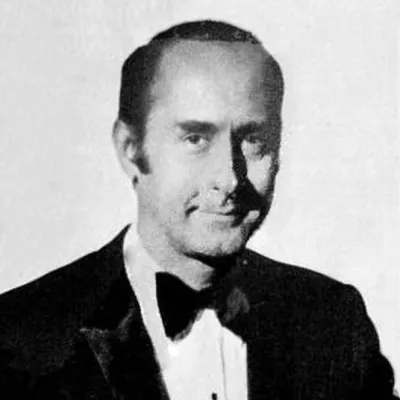
Henry Mancini
Human Design Chart
Biography
Proud of his Italian-American heritage, Mancini grew up in Aliquippa, Pennsylvania. His father worked in a steel mill and spent his leisure playing flute in the local Sons of Italy band. His dad encouraged Mancini to take up music but his son preferred playing football. Reluctantly, he tinkered with the piano, flute and piccolo while his dad badgered him to practice - until his dad introduced him to jazz, when he changed his mind about music. He joined the school band and played in a dance band. At 13, he was playing the saxophone choruses from his Artie Shaw records. As a teen, he idolized Glenn Miller. In 1937, he won the position of first flutist in the Pennsylvania All-State Band. He graduated from high school in 1942 and went to study classical music at the Carnegie Institute of Technology Music School and then went to the Juilliard School of Music in New York.
During WWII, he served in the Army Air Corps and infantry arranging big band music for the Army band. After the war, he played piano for Glenn Miller's band under the direction of Tex Beneke. With the demise in popularity for swing band music, Mancini came upon financial hardships.
What does Generator 1/3 mean for Henry Mancini?
Generator 1/3 — Design at a Glance
Henry Mancini possessed a Generator with immense, sacral energy, which endowed him with great endurance. His design suggested that he worked like a strong workhorse as long as he had energy for his tasks. However, the mechanics of his type were specific: His strength was not ignited by self-initiative but by reacting to signals from the environment. The strategy was to wait for impulses and only act when his inner center gave a clear 'yes'.
This mechanism protected him from two central risks. First, it prevented exhaustion from engaging in things that did not resonate internally. Second, it shielded him from frustration when he was prevented from pursuing his heart's project despite having full power. If he lived in harmony with this strategy – reacting from his gut – his system rewarded him with a deep sense of fulfillment. If he initiated too much or ignored the inner signals, this led to persistent frustration and a noticeable lack of energy sooner or later. His success thus depended directly on whether he allowed this rhythmic response to life impulses, rather than fighting against the natural flow of his energy.
Emotional Authority
Henry Mancini was someone who did not make decisions on impulse but patiently waited for their maturation. His design carried Emotional Authority, meaning his defined Emotional Center served as the inner authority – independent of all other defined centers in his chart. This configuration marked him by a constant emotional wave, a permanent up and down of feelings. The world appeared to him colored by his current mood: one moment totally excited, the next moment the same thing negatively evaluated. His immediate feeling was, however, only a snapshot, a first impression that did not necessarily represent his truth. Quick, spontaneous decisions based on such emotion could therefore have negative consequences. Instead, his mechanics required time to let a decision mature. The longer he waited, the deeper and more comprehensive he could perceive the situation. This required patience and multiple nights of sleep on the decision. He should take his time and ask himself multiple times. Over time, the intense feelings subsided, he gained emotional distance, and clarity and calmness set in. Only then had he completed the process. This mechanism was particularly important for long-term decisions that could have a significant impact on his life course.
The 1/3 Profile — Investigator / Martyr
Henry Mancini appeared as a person whose life revolved around the principle of trial and error. His Human Design Profile as a 1/3, the 'Researcher and Experimenter', established a fundamental attitude that combined theoretical knowledge with practical application. He was not just a thinker but someone who had to test insights through personal action. This configuration meant that true understanding for him could only arise through direct experience and overcoming obstacles.
His Line 1 brought a desire for learning and synthesis, while Line 3 dominated the process of testing and learning from mistakes. Often, this led to a tension: The desire to plan everything in advance and analyze it clashed with the urge to simply act. Henry Mancini had to learn to trust this inner confusion. His judgments were particularly valuable because they were not based on mere theory but on personally tested experiences. When he assessed something as good or right, he had already intensively researched and practically validated it. This path of mutation and synthesis required patience, as he often only recognized his own strength much later. His life task was to develop order from difficulties by embracing the process of experimentation rather than seeking perfect, error-free solutions.
Split Definition — Defined & Open Centers
Henry Mancini revealed himself as someone who lived under a constant, internal mental pressure. His defined Head and Ajna Centers created a perpetual source of inspiration, questions, and doubts. This pressure was not a disturbance but his natural state: a constant urging to understand and form consciousness. However, since these centers did not have their own energy to implement, struggling against this unresolved state often led to frustration or self-doubt. His task was to accept this mental pressure without hastily turning it into action, and instead inspire others with his questions.
At the same time, Henry Mancini possessed immense, vital energy through his defined Sacral Center. As a Generator, he relied on not initiating but reacting to life. His sacral energy was only fully available when he waited for an invitation and responded with an inner 'yes'. Any decision that came from the mind rather than this sacral reaction led to resistance and exhaustion. This physical endurance was supported by his defined Root Center, which gave him a firm, adrenalized push to move forward in the world and master existential challenges.
His defined G Center endowed him with a clear, reliable self-identity and a sense of his own direction. He intuitively knew where he belonged and could show others new paths without being dependent on them. However, he tended to lead others to follow his path, which could lead to conflicts if they could not follow.
In contrast, his Throat, Heart, and Spleen Centers were open. His open Throat Center made him vulnerable to the pressure to gain attention or open his mouth to not be overlooked. His open Heart Center drove him to prove himself through promises and competition, even though he did not have the constant energy for it. His open Spleen Center left him surrounded by fears and tended to hold onto unhealthy situations just to simulate a sense of security. These open centers challenged him not to act spontaneously or prove himself but to trust his inner authority.
Channels for change, logic, rhythm and emotional clarity.
Henry Mancini revealed himself as someone whose design carried a deep connection to the rhythm of life, paired with the ability to initiate new directions through mutative impulses. This configuration shaped his way of moving in the world: not through rigid planning but through a lively, often unexpected dynamic that radiated both innovation and emotional depth.
The Beat Channel 14-2 connected his Sacral Center with his G Center. Gate 14 provided the competence to handle material resources to drive mutation, while Gate 2 supplied the higher knowledge that directed movement through space and time. Together, they enabled Henry Mancini to bring innovative, supportive new directions by trusting the reaction from his sacral center. He was capable of sustaining creative efforts or materially supporting others simply by staying open and reacting to life.
Parallel to this, the Mutation Channel 60-3 between Root and Sacral Centers was at work. Gate 60, the pivot point of evolutionary possibilities, and Gate 3, which seeks order in a new beginning, generated a pulsing, often melancholic energy. This power influenced the way Henry Mancini lived out his design and deeply affected everyone around him. Mutation happened suddenly, like music, in the gaps between the pulses, demanding adaptation or change.
The Rhythm Channel 5-15 also connected Sacral and G Centers. Gate 5 held onto fixed habits, while Gate 15, with its love for extremes, integrated the diversity of society into the flow of life. This gave Henry Mancini a unique sense of timing, determined by his inner rhythm. When aligned with this flow, everything felt effortless and subtly benefited those around him by bringing them into their own rhythm.
The Logic Channel 63-4 connected Head and Ajna Centers. Gate 63 of doubt and Gate 4 of formulation created an active, logical mind that refined itself with healthy skepticism. Henry Mancini was good at asking questions, seeking patterns, and making well-founded predictions to serve the collective.
Finally, the Feelings Release Channel 39-55 between Root and Solar Plexus Centers was at work. Gate 39 of provocation and Gate 55 of the mind set a pulsing wave of moods in motion. Henry Mancini knew how to tease out and perceive the nature of the mind and could say through the interplay with others which people were right for him. His emotional depth, often expressed through music or art, conveyed a seductive warmth or passionate sadness.
Additionally, he carried Gates 56, 50, 64, 61, 22, 7, and 38. Gate 56 allowed the abstraction of mental processes into visual representations, important for collective stories. Gate 50 nourished the body awareness process and defended tribal values. Gate 64 interpreted past experiences to form concepts. Gate 61 stood for inner truth and the struggle for silence. Gate 22 represented openness and mutation in the social environment. Gate 7 projected patterns for the future and showed the need to lead. Gate 38 set boundaries and defended individual integrity.
Individual Circuitry — Circuit Signature
Henry Mancini revealed himself as someone who expressed his unique identity through pulsating, acoustic creativity. His design connected the Identity, Sacral, Root, and Solar Plexus Centers into a single, continuous flow in the Knowledge Circuit. This energy propelled him to transform new knowledge and initiate changes. Channels like 'The Beat' and 'Mutation' promoted innovative deviations from the known, while 'Feelings Release' ensured that these impulses were filtered emotionally through the Solar Plexus and articulated through the Throat Center. This created a rhythmic, melancholic quality that shaped his individual voice.
Parallel to this, a separate, unconnected power existed in the Understanding Circuit. Here, Head and Ajna Centers linked logical analysis with strategic orientation. The Logic Channel allowed the sharing of rational insights free from conditioning. At the same time, a separate channel in the same circuit connected the Identity with the Sacral Center, structuring the rhythm of personal expression. As Henry Mancini had a split definition, these two systems – the emotional, creative flow and the focused, visual logic – remained energetically isolated. They worked alongside each other: on one hand, the pulsating, transformative creativity, on the other, the clear, strategic intelligence that kept an eye on the future without merging directly with the emotional wave.
Right Angle Cross of Laws 1
Henry Mancini's design carried the signature of the right cross of the laws 1. This configuration established a specific energetic alignment characterized by a deep connection to the universal laws of life and nature. In Human Design, this cross symbolizes a power that does not swim against the current but recognizes and uses the natural flow of things. It is an energy that creates structure and order by orienting itself to the eternal principles that hold the universe together.
For Henry Mancini, this meant that his inner compass was set to harmony and balance. He showed a tendency to approach situations not through coercion or excessive will, but through a deep understanding of how things naturally unfold. This attitude allowed him to maintain clarity in complex environments and find solutions that aligned with the greater order. His design thus promoted not chaotic action but a calm, law-abiding presence that others often found stable and trustworthy. The energy of this cross acted like an anchor, centering him in turbulent times and helping him make the right decisions by orienting himself to the unchanging laws of life.
Saturn Return · Uranus Opposition · Chiron Return · 2nd Saturn Return — Life Cycles
Henry Mancini was someone whose life path was marked by clear, cyclical phases of structure formation and renewal. His design did not contain specific unique configurations pointing to an extraordinary or deviant life task, but followed the universal rhythms of planetary cycles. This meant that his development was not determined by rare, individual patterns but by regular engagement with the fundamental themes of responsibility, change, and fulfillment.
The first Saturn return marked the transition into a phase of consolidation, where earlier impulses were transformed into sustainable structures. The Uranus opposition brought a necessary, often disruptive renewal, breaking old bonds to create new space. The Chiron return represented the climax: in this period, when his incarnation cross unfolded, the meaning of his existence became experiential. It was not about healing but the blossoming of his own destiny. The second Saturn return completed this cycle with a final integration of lived experiences. Henry Mancini's design suggested that his strength lay in his ability to navigate these universal cycles and transform them into a coherent whole without being distracted by specific, individual patterns. His life course was thus a reflection of the natural, recurring orders available to every person.
Generator · Emotional Authority — Synthesis
Henry Mancini was a Generator whose life was marked by a deep-rooted drive for practical action and the search for new ways. The sacral energy driving him (Sacral Center defined) was evident in his tireless work as long as he received enthusiastic feedback for his task. His profile as a researcher and experimenter (1/3) underscored this tendency; he tested and refined his ideas through constant experimentation to gain self-discovered insights. Emotional authority, however, required that he not rush into decisions but give them time to solidify in his inner perception – a process that temporarily slowed the spontaneous impulse of the Generator.
A central paradox in his design lay in the combination of the pulsating knowledge circuit and the emotional wave. On one hand, he was destined to create and transform through inspiration and creative energy (Head and Ajna Centers defined). On the other hand, his emotional authority required a maturing phase where ideas had to be filtered and evaluated before implementation. This shift between the drive for innovation and the need for emotional clarity created a tension that shaped his work style and made him a profound but sometimes hesitant creator.
5 Defined Channels
Incarnation Cross - Right Angle Cross of Laws 1
Solar Return
The Solar Return shows the moment when the sun returns to its exact birth position - your personal solar year.
Life Cycles
Discover the life cycles with a detailed triple view (birth chart, cycle chart, composite).
Human Design Profile
- Type
- Generator
- Strategy
- To respond - wait for something to respond to
- Authority
- Emotional Authority
- Profile
- 1/3 - Investigator / Martyr
- Definition
- Split Definition
- Incarnation Cross
- Right Angle Cross of Laws 1
- Date of Birth
- 16.04.1924 11:10
- Place of Birth
- Cleveland, OH, United States
Frequently Asked Questions
What was Henry Mancini's Human Design type?
What profile did Henry Mancini have?
What authority did Henry Mancini have?
What incarnation cross did Henry Mancini have?
When was Henry Mancini born?
Discover your own Human Design
Are you also a Generator? Find out in a personal reading how to use your sacral energy correctly and discover deep satisfaction.
More Personalities
Back to overviewAaliyah

Alexia

Alizée

Angèle

Anne-Marie

Arcángel
