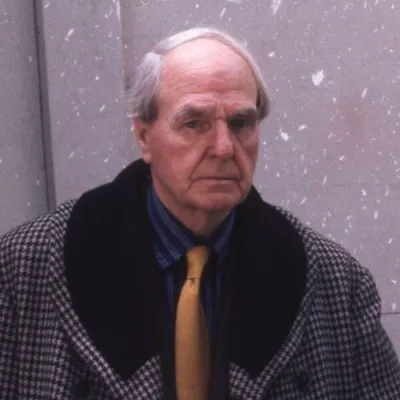
Henry Moore
Human Design Chart
Biography
His forms are usually abstractions of the human figure, typically depicting mother-and-child or reclining figures. Moore's works are usually suggestive of the female body, apart from a phase in the 1950s when he sculpted family groups. His forms are generally pierced or contain hollow spaces. Many interpreters liken the undulating form of his reclining figures to the landscape and hills of his Yorkshire birthplace.
Moore became well known through his carved marble and larger-scale abstract cast bronze sculptures, and was instrumental in introducing a particular form of modernism to the United Kingdom. His ability in later life to fulfil large-scale commissions made him exceptionally wealthy. Despite this, he lived frugally; most of the money he earned went towards endowing the Henry Moore Foundation, which continues to support education and promotion of the arts.
What does Projector 6/3 mean for Henry Moore?
Projector 6/3 — Design at a Glance
Henry Moore appeared as someone who seemed to have a dense, focusing aura – comparable to a bright flashlight that was directed precisely towards weaknesses in his surroundings. His Projector design endowed him with the ability to immediately recognize where systems or relationships were not functioning properly. However, this direct perception could be perceived as unpleasant if communicated without filters; it felt like light directly into another's face.
Henry Moore's optimal strategy involved waiting for a respectful and sincerely meant invitation from others. Instead of actively seeking recognition or addressing issues right away, his task was to attract people through his own harmonious actions. When he shone himself, others would come to him voluntarily to seek advice.
Since his Sacral Center was undefined, Henry Moore did not have constant intrinsic life energy. Instead, he experienced phases of high productivity and speed followed by necessary rest periods for regeneration. Ignoring this rhythm led to exhaustion. Living according to this design rewarded him with success; deviating from it resulted in the non-self theme of bitterness. His path was thus defined not by constant activity but by targeted shining and waiting for the right invitation.
Splenic Authority
Henry Moore appeared as someone who did not seek his orientation through emotional waves or strategic planning, but rather trusted a subtle, immediate physical signal. His design placed authority in the Spleen – a configuration only Projectors and Manifestors with open Emotional and Sacral Centers can possess. This Spleen Authority served as a highly sensitive health and alarm system. It gave him an intuitive survival intelligence: A spontaneous impulse in the present moment clearly signaled whether a situation or environment was beneficial or harmful. This first instinct directly served his well-being, allowing him to rigorously set boundaries and protect himself from negative influences.
Since this impulse was very subtle and only existed momentarily, his perception required high vigilance. Other voices or external expectations could easily drown out this fine signal. Therefore, Henry Moore often withdrew during important decisions to achieve the inner silence in which the Spleen voice became audible. Because the right thing was always known only in the concrete moment, long-term plans for his design were difficult and often counterproductive. Instead of rigid commitments, he preferred flexibility and freedom. This spontaneity was not a lack of reliability but a necessary adaptation to his inner mechanics: Only by relying on the current impulse could he optimally protect himself and stay healthy.
The 6/3 Profile — Role Model / Martyr
Henry Moore lived as a 6/3 profile, embodying the role of the Role Model and Experimenter. His first three decades were marked by numerous self-experiments; he acted like an adventurer who learned through mistakes. After his Saturn return at around thirty years old, this phase did not fully slow down, as the experimental line 3 remained present throughout his life. Internally, he showed restlessness, as if he was always searching for something extraordinary beyond everyday standards. This search for perfection never ended because it did not aim for ordinary completion.
His sixth line demanded absolute certainty and alignment of word and deed. Without assurance of support, he withdrew; leadership he rejected when the future was unclear. At the same time, this line protected him from superficiality by demanding genuine trust in the process. The third line in Gate 24 drove him towards trial and error. It allowed him to overcome setbacks through new conceptualizations or expose false knowledge. Henry Moore used his unusual experiences to become a wise and far-sighted role model with age. Humor and responsibility became natural for him as he challenged irrational patterns of old habits, moving closer to a deeper truth.
Single Definition — Defined & Open Centers
Henry Moore was characterized by a defined Spleen Center, which endowed him with spontaneous and intuitive bodily intelligence. He relied on momentary well-being and instinctive judgments that kept him in the present. His also defined Root Center provided a steady, adrenalized pressure supporting his existential impulse, helping him to survive materially and move forward. This combination created a solid foundation of physical vitality and spontaneous responsiveness.
At the same time, his design revealed several sensitive areas. The open Head Center made him susceptible to mental confusion; he tended to get entangled in other people's issues or seek inspiration that wasn't from himself instead of listening to his inner authority. His open Ajna Center meant conceptual thinking was unstable – he could take on and reflect ideas but lacked a firm personal theory. The open Throat Center led to feeling the pressure to force attention through speaking, though his true communication was spontaneous and only effective at the right time.
The open G Center showed that Henry Moore did not have a fixed identity or direction. He didn't actively seek out his path; rather, he was initiated by places and people; he felt lost in the wrong place but bloomed in the right one. His open Heart Center freed him from needing to prove willpower or make promises to demonstrate value. Instead, he learned to perceive others' egos without having to be competitive himself. The open Sacral Center meant unstable energy; he had to learn to separate from excessive work energy around him and take breaks rather than exhaust himself through borrowed vitality. Finally, his open Solar Plexus absorbed the emotions of others, making him vulnerable to foreign moods but also allowing him to observe the emotional climate objectively once he didn't personalize these feelings.
Channels for critical judgment.
Henry Moore's design inclined towards constant review and correction of patterns. This attitude was shown by the Judgment Channel 58-18 connecting the Root Center with the Spleen Center. Gate 58, Vitality, drove an insatiable impulse to 'better and more', while Gate 18, Correction, moderated this flow to recognize imbalances. Together they formed an inner sentry assessing whether something was harmonious for the collective or needed adjustment. Henry Moore sought perfection not as a static state but as a continuous process of questioning and improving. His logic demanded proof for the best answer; he challenged established structures until they were functional.
Alongside this correcting impulse, other energies acted. Gate 31 brought a pure transmission of forces, with leadership through passing on these energies. Gate 41 steered evolutionary development through specific experiences and crises, fostering an appropriate desire to maintain clarity despite emotional fluctuations. Gate 24 caused mental mutations in the rhythm of the pulse by integrating new knowledge not yet formulated into fixed concepts. Gate 44 enabled transformation through mindful acceptance and storing experiences in cellular memory. Additionally, Gate 54 linked worldly success with mystical insight while Gate 53 marked the start of new developmental cycles and freedom for pioneering work. Henry Moore lived this mechanism as a combination of critical scrutiny, energetic transmission, and cyclical renewal.
Collective Circuitry — Circuit Signature
Henry Moore's design inclined towards structured, rational analysis. He was someone who used logical insights to improve things and lead society toward a better future. Ideally, this happened free from conditioning since the Solar Plexus Center wasn't involved; it was 'emotionless ratio'.
This attitude resulted from the Understanding Circuit. In Henry Moore's case, this circuit exclusively connected Spleen with Root Center via the Judgment Channel (Gates 18 and 58). As he had a Simple Definition, these two centers formed one continuous energetic flow. The Spleen provided intuitive perception of essentials while the Root contributed necessary energy and urgency. This connection allowed him to process visual information focusedly and make strategic judgments. The focus was on using form-energy to explain complex relationships. Through this configuration, Henry Moore was able to share rational insights based on a clear distinction between what is important and unimportant. His energy thus consistently directed towards future-oriented solutions shaped by logical structuring.
Left Angle Cross of the Alpha 1
Henry Moore's design established a tendency towards a deep, almost fateful connection with life. This configuration, the left cross of Alpha 1, marked him as someone whose existence was driven by a strong impulse: the joy of living itself and the willingness to fully immerse oneself in the flow of experience. It wasn't an intellectual analysis but rather a visceral experience that encouraged him to savor the intensity of the moment.
In Human Design, this cross describes a specific energy distribution that creates a natural affinity for vitality and physical existence. Henry Moore was someone who did not shy away from the weight or challenges of life but embraced them as necessary parts of a fulfilled existence. The mechanics of this pattern fostered an attitude of acceptance and going with the flow rather than fighting against it.
This inner alignment meant that true contentment wasn't achieved through detachment or abstraction, but through deep immersion in the here and now. His design supported a way of life that demanded courage to surrender to life itself, coupled with the understanding that pain and joy are inseparably intertwined. Henry Moore lived this dynamic as an ongoing dive into reality without evaluating or changing it, simply experiencing it intensely.
Saturn Return · Uranus Opposition · Chiron Return · 2nd Saturn Return — Life Cycles
Henry Moore's design established a tendency towards long-term structural condensation, which manifested in clear phases of professional anchoring. In 1924, at the age of 26, he received a six-month travel scholarship to Northern Italy to study Michelangelo and other masters. This marked his first Saturn Return: a mechanical knot point where years of groundwork often culminate in a solid, public result. The journey was not just a vacation but the concrete formation of his artistic identity through direct engagement with tradition.
Later, in 1946 at the age of 48, his daughter Mary was born. This time coincided with his Chiron Return, a fulfillment cycle where one's incarnation cross unfolds and meaning becomes tangible if lived according to strategy and authority. It was a phase of bloom where personal life purpose rooted deeper not as healing old wounds but as realization of inner purpose through family ties.
In 1957 at the age of 59, he created a monumental sculpture for the forecourt of UNESCO's building in Paris. This corresponded to his second Saturn Return, often symbolizing the final solidification of life work. The work represented the cumulative power of all previous development now visible and permanently anchored in public space. These three moments illustrate how cyclical mechanics shaped his career and private sphere: from education through personal rooting to monumental confirmation of his creation.
Projector · Splenic Authority — Synthesis
Henry Moore lived a life marked by a deep drive for understanding and correction. His design showed a constant flow of energy from the body consciousness (Spleen Center), which was strengthened by the ability to recognize and improve patterns (Channel of Judgment). This combination led him always to feel connected with the
1 Defined Channel
Incarnation Cross - Left Angle Cross of the Alpha 1
Solar Return
The Solar Return shows the moment when the sun returns to its exact birth position - your personal solar year.
Life Cycles
Discover the life cycles with a detailed triple view (birth chart, cycle chart, composite).
Human Design Profile
- Type
- Projector
- Strategy
- Wait for the respectful invitation
- Authority
- Splenic Authority
- Profile
- 6/3 - Role Model / Martyr
- Definition
- Single Definition
- Incarnation Cross
- Left Angle Cross of the Alpha 1
- Date of Birth
- 30.07.1898 20:00
- Place of Birth
- Castleford, England, United Kingdom
Frequently Asked Questions
What was Henry Moore's Human Design type?
What profile did Henry Moore have?
What authority did Henry Moore possess?
Which incarnation cross was active for Henry Moore?
When was Henry Moore born?
Discover your own Human Design
Are you also a Projector? Find out in a personal reading how to unfold your leadership qualities and recognize the right invitations.
More Personalities
Back to overviewSissy Spacek

Alain-Fournier

Anémone

Ann-Margret

Baekhyun

Balthus