Herbert Adamski
Human Design Chart
Biography
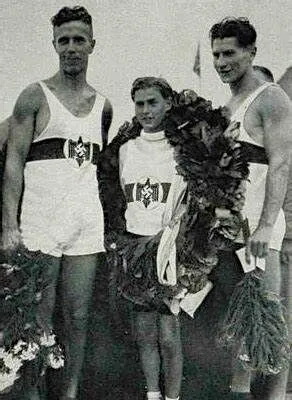
Between 1936 and 1939 he became a German Champion. In 1937 he achieved European Champion status, reaching runner-up the following year. In 1939 Adamski also won the German coxed fours championship.
Herbert Adamski was killed during World War II at age 31, on 11 August 1941 while serving on the Eastern Front.
Herbert Adamski — Manifesting Generator with Profile 2/5
Manifesting Generator 2/5 — Design at a Glance
Herbert Adamski was known for his quick actions and often bypassed conventional processes. His design combined the constant energy of a generator with the direct impact of a manifestor, allowing him to swiftly bring things into his life by skipping steps. However, this speed carried risks: sometimes he ignored necessary intermediate steps, leading to later backtracking to fill gaps. Such detours caused frustration, the central non-self-experience for this type. Additionally, he tended to pursue multiple projects simultaneously as he reacted to many impulses at once. Without internal confirmation, his creative drive quickly turned into overload. The solution lay in responding rather than initiating. He waited for a clear 'yes' from his sacrum before acting or continuing a project. Regular checks of this inner authority ensured that his energy remained flowing. By maintaining this balance and letting playful curiosity guide him instead of adhering to constraints, he found deep satisfaction in his work. For him, variety was not an obstacle but the source of his strength as long as the internal signal was correct.
Sacral Authority
Herbert Adamski made decisions not through analytical deliberation in his head but by immediately reacting to external stimuli with physical resonance. His generator design linked strategy and inner authority: the sacral authority served as a direct compass. This mechanism manifested in a physical impulse - often a soft grunt, an 'mm-hm', or a noticeable surge of power in the lower abdomen - responding to environmental stimuli.
As long as his emotional center remained open, this reaction was clear and unfiltered. When Adamski's sacral motor kicked in, he felt vital and energized; the resulting activity trained him without needing an external goal. He acted out of pure enthusiasm. If his spleen center was activated or connected with the sacral center, it enhanced his ability for spontaneous, instinctive reactions. This immediate access to physical well-being allowed quick judgments about health and safety, which he could reliably use as additional orientation aids. Thus, Herbert Adamski developed a natural joy in decision-making: He followed the energetic signal of his body that showed him where his life force came from instead of blocking or delaying it through mental deliberations.
The 2/5 Profile — Hermit / Heretic
Herbert Adamski was marked by an internal tension: the urgent need for withdrawal to self-reflection clashed with the external projection as an immediate problem solver in crisis times. His design, the Profile 2/5, established this dynamic. The Line 2, the Hermit Line, demanded from him intense phases of isolation and inner work. Only through this conscious retreat could he gain clarity and understand where he truly wanted to invest his energy. Without this 'alone time', there was a risk that he would forget himself.
At the same time, others projected expectations onto him due to Line 5, the Hero or Illusions Line. They sought solutions from him and expected spontaneous help in emergencies. This projection could lead to conflicts if it occurred without internal reflection or was misunderstood as personal achievement. The challenge lay in not blindly fulfilling these external demands. Herbert Adamski had to learn to set clear boundaries. He should only help when it aligned with his inner strategy and he had the capacity for it. Profile 2/5 thus required a conscious appropriation of time for himself, so that he would not be exhausted by others' expectations. Only then could he fulfill his role as savior or advisor authentically and sustainably without sacrificing himself or falling into condescension. The balance between the monk in the cave and the hero at the door was his central theme.
Split Definition — Defined & Open Centers
Herbert Adamski revealed himself as someone with a clear inner structure: constant mental pressure drove him to ask questions and understand connections. This inspiration came from the connection between Head Center and Ajna Center. However, since these centers do not have direct action power, attempting to implement thoughts immediately often led to frustration. Instead, his defined Throat Center served as a pivot point for communication; he spoke out what his mental processing had produced.
The actual source of strength lay in his defined Sacral Center. As a Generator, Herbert Adamski possessed constant vital energy that could only be correctly utilized through reaction to external impulses. Initiated actions without prior questioning led to resistance and exhaustion. His defined Spleen Center complemented this with spontaneous intuition in the here and now, while the defined Root Center provided a steady adrenergic pressure to maintain the life impulse.
In contrast to this inner stability, his open centers shaped situational flexibility. His open G Center meant that identity and direction were not set but reflected by the right environment and people. At the wrong place, he felt lost; at the right one, he flourished. The open Heart Center indicated that willpower and keeping promises were not his constant energy. Attempting to prove himself or exert control often led to self-esteem issues. Finally, his open Solar Plexus absorbed the emotions of the environment like a barometer. He was no emotional origin but mirrored the climate. The challenge lay in not personalizing these taken-on feelings as one's own and instead waiting for the correct reaction from his Sacral Center to avoid energy depletion through false initiations or emotional identification.
Channels for change, action, clarity and care.
Herbert Adamski revealed himself through a dynamic tension between impulsive change and calm care. His design leaned towards evolutionary change, which however had to be patiently awaited rather than planned. The Mutation Channel 60-3 connected the Root Center with the Sacral Center; it required accepting limitation and melancholy as natural phases before new inspiration. Instead of intellectually rationalizing these moods, it was necessary to remain in silence until the mutation revealed itself on its own.
This waiting period contrasted with the pressing energy of the Charisma Channel 34-20. This channel connected the Sacral Center with the Throat Center and functioned as a motor for charismatic action capability in the present moment. Here, sacral reaction directed manifesting power; self-reinforcement through engagement in satisfying activities was crucial, as this energy should not be available to others but serve one's own vitality.
Mentally, Herbert Adamski processed inspiration into rational knowledge via the Awareness Channel 61-24. This channel connected the Head Center with the Ajna Center and generated moments of sudden knowing ('Satori'). Thinking here did not serve prediction but surrendering to inner truth; knowledge entered when it was ready, often supported by silence or music.
Social responsibility was shaped by the Preservation Channel 27-50. This channel connected the Sacral Center with the Spleen Center and ensured tribal support based on care and values. The principle of 'enlightened self-interest' applied: he had to take care of himself first in order to be able to stand confidently beside others. This mechanism attracted trust but demanded clear boundaries, as care could only occur through sacral reaction.
Individual Circuitry — Circuit Signature
Herbert Adamski showed a tendency to go his own unique path through creative deviation. His design connected Head and Ajna Centers with Channel 24-61 (Awareness), which fostered innovative flashes of insight. Parallel to this, the Channel 3-60 (Mutation) between Sacral and Root Center supported deviations from the existing norm. These two segments of the Knowledge Circuit were energetically separate: on one hand, mental inspiration; on the other, vital energy for transformation. The expression of this new identity occurred pulsing and acoustically through the Throat Center, steered by emotional waves.
Additionally, the Archer Circuit shaped his essence. Here, Channel 27-50 (Preservation) connected Sacral and Spleen Centers. This gave him a primordial basis for protection and preservation, particularly in the realm of genetics and family. This energy was timeless and instinctive.
The integration of these forces occurred through Channel 20-34 (Charisma), which linked Throat and Sacral Centers. This enabled Herbert Adamski to express intuitive power and life energy in the present moment. Through this configuration, his unique individuality became audible and palpable, as he not only thought but carried new insights into the world with emotional authenticity. The separate groups of his definition ensured that mental innovation and vital preservation worked as parallel, independent forces that only converged through expression in the Throat Center.
Right Angle Cross of the Four Ways 1
Herbert Adamski's design carried the structure of the right cross of the four paths. This configuration established a specific life dynamics characterized by clear phases and turning points. The right cross signals in Human Design a path often associated with a certain fate or an inevitable progress. It describes not a linear development but a process where certain themes keep recurring until they are integrated.
For Herbert Adamski, this meant that his life did not proceed randomly but was steered by an inner logic. The energy of this cross promoted a stance of determination and perseverance, even when circumstances seemed difficult. It was about following one's own path without being distracted by external expectations.
The mechanics of this design show that Herbert Adamski was enabled to see challenges as necessary steps on his personal journey. Every event contributed to the overall development. This structure offered stability and direction by helping him recognize and live his own truth. This path required patience and trust in one's process, which shaped Herbert Adamski's character.
Saturn Return — Life Cycles
In this phase of life, Herbert Adamski revealed himself as someone who tested his individual talents and ambitions for their real feasibility within the social context. His design indicated a tendency towards consolidation marked by the first Saturn return. This cycle signalled the transition from youth to adult responsibility and identity formation. It was a period of review in which internal structures were tested against external stability.
In 1938, at age 28, Herbert Adamski became Vice European Champion in Two-man with Helmsman. This event served as concrete evidence for the mechanics of the first Saturn return: Years of groundwork condensed into a recognized result in public. The success not only confirmed athletic abilities but also the ability to align personal goals with societal demands. His vice-champion placement made clear that the test was passed – individual resources proved stable and effective in competition. This moment solidified his identity beyond youth and established a new level of self-confidence based on proven capability.
Manifesting Generator · Sacral Authority — Synthesis
Herbert Adamski lived a life marked by an internal dynamic between reaction and manifestation. His design as a Manifesting Generator, coupled with sacral authority, points to a person whose energy springs from the present moment. He reacted to impulses yet possessed the ability to quickly initiate and realize things – a combination that propelled him but could also lead to impatience and skipping important steps. This tendency towards quick reaction was amplified by his defined Root Center, which generated constant pressure to act while his connection to Throat Center gave him the opportunity to express his impulses. He was a person who stayed in motion and was guided by the energy of the moment, always seeking new experiences and possibilities.
Central for Herbert Adamski, however, was the tension field between inner response and outer expression. His open Heart and Solar Plexus Centers indicated that he was susceptible to others' energies while his defined Head and Ajna Centers created a strong internal world of thoughts and concepts. This led to a paradox: He could be influenced by external factors but also possessed the ability to process these into original, innovative ideas. This interaction between receptivity and creative power shaped his path and gave him a special depth.
4 Defined Channels
Incarnation Cross - Right Angle Cross of the Four Ways 1
Solar Return
The Solar Return shows the moment when the sun returns to its exact birth position - your personal solar year.
Life Cycles
Discover the life cycles with a detailed triple view (birth chart, cycle chart, composite).
Human Design Profile
- Strategy
- To respond - wait for something to respond to
- Authority
- Sacral Authority
- Profile
- 2/5 - Hermit / Heretic
- Definition
- Split Definition
- Incarnation Cross
- Right Angle Cross of the Four Ways 1
- Date of Birth
- 30.04.1910 17:30
- Place of Birth
- Berlin, Germany
Frequently Asked Questions
What was Herbert Adamski's Human Design type?
What profile did Herbert Adamski have in Human Design?
Which authority guided Herbert Adamski?
What incarnation cross did Herbert Adamski have?
When was Herbert Adamski born?
Discover your own Human Design
Are you also a Manifesting Generator? Find out in a personal reading how to unfold your multi-talents and direct your energy wisely.
More Personalities
Back to overviewAldair

Alizée

Angeli

Arletty

Artus

Balthus