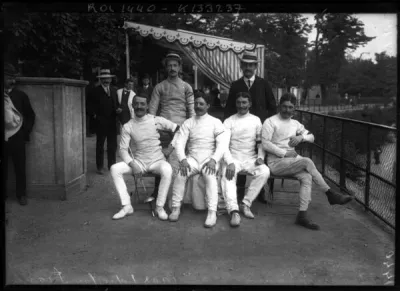
Herman Georges Berger
Human Design Chart
Biography
Herman Georges Berger died on 13 January 1924 in Nice at age 48.
Herman Georges Berger — Manifestor with Profile 1/4
Manifestor 1/4 — Design at a Glance
Herman Georges Bergers design pointed towards a leading role. He showed himself as a pioneer and visionary whose task was to guide others into a new future. This profile resembled the metaphor of Roman emperors: Berger had the vision of a great whole but did not fight battles on the field himself. Instead, he gave impulses and sent others out to implement his plans.
This kind of leadership often polarized people. As Bergers perspectives reached further than those around him, he was frequently misunderstood. Some loved and followed him for these big dreams, while others rejected or even hated him because of them. This misunderstanding pain point was a central aspect of his design.
To find the right followership and minimize friction, his design required a clear strategy: informing others in advance about his intentions and visions. If Herman Georges Berger followed this strategy and adhered to his inner authority, he was rewarded with a feeling of inner peace. Living against this design, however, led him to experience persistent deep anger within himself. His path was thus marked by the tension between his leading power and the need to communicate it clearly for harmony.
Emotional Authority
Herman Georges Berger showed an internal decision-making structure that required patience and temporal distance. His inner authority lay in the defined Emotional Center, meaning his perception of the world was always shaped by a wave movement of emotions. This emotional wave caused constant ups and downs: at one moment he could be enthusiastic about something, then see the same situation negatively.
For Herman Georges Berger, therefore, immediate feeling was only a snapshot, not yet his deeper truth. Quick, spontaneous decisions based on this first emotional impulse often had negative consequences as they were based on temporary mood swings rather than clarity.
The mechanics of his authority required him to let decisions mature. He needed time for the intense feelings to subside before acting. 'Sleeping over' important questions and consciously delaying created the necessary emotional distance. Only when this wave movement subsided did calmness set in, revealing true clarity. This process of differentiating between transient emotion and deeper insight was central to him, especially regarding long-term life decisions that profoundly influenced his path.
The 1/4 Profile — Investigator / Opportunist
Herman Georges Berger was marked by a rarer profile: 1/4. This design combined the deep desire for individual knowledge with the drive to share insights within a familiar network. Line 1 drove him towards thorough research while line 4, the line of great hearts, sought out a group of trusted individuals to convey this knowledge.
This constellation created specific tension. Herman Georges Berger often suffered from the fear of being exposed as lacking complete knowledge before his loved ones. Such failure would have caused him immense heart pain. Therefore, he frequently withdrew to preserve his integrity and expand his knowledge in solitude. Line 1 taught him the necessity of withdrawal for survival and meaning-making; unreflective courage was seen as risky. Only after thorough inner reflection was he ready to express himself.
A loving environment with a deep trust base was essential for Herman Georges Berger. Only within this protected framework could his abilities come into play. Line 4 allowed him to externalize his profound knowledge slowly and conditionally within a close circle of trusted individuals. Through this testing in the network, he likely developed into an authority on heart matters. The tendency towards fantasy worlds served not only as illusion but also self-deception as a protective mechanism until inner clarity was established. His path thus led from isolated researcher to recognized networker, always dependent on the quality of interpersonal bonds.
Split Definition — Defined & Open Centers
Herman Georges Berger revealed himself as someone with a clear, self-determined presence and firm will. His defined G Center gave him a reliable identity and inner direction, while the defined Heart Center strengthened his determination and self-worth. This combination allowed him to keep promises and act from an internal conviction. His defined Throat ensured that he communicated this truth along with his emotional depth – shaped by the defined Solar Plexus – clearly. The Solar Plexus required patience: it waited for the emotional wave to pass before making decisions, ensuring clarity over impulsiveness. This was complemented by the spontaneous intuition of the defined Spleen Center and the healthy handling of pressure provided by the defined Root Center.
In contrast, Head, Ajna, and Sacral Centers were open. The open Head Center meant that Herman Georges Berger did not have a constant mental inspiration; he tended to get stuck in mental monologues or seek answers for others' questions. The open Ajna Center made him receptive to concepts from the environment without holding them as his own truth. Especially the open Sacral Center signaled that generative energy was not continuously available. Here, there was a risk of overloading himself with 'borrowed' energy from others and experiencing exhaustion rather than trusting in his fluctuating energy flow and taking breaks. This openness required a conscious detachment from conditioned work compulsion.
Channels for intuitive leadership, synthesis and devoted strength.
Herman Georges Berger revealed a tension between the need for collective recognition for his leadership and deep, intuitive self-assurance. His design was marked by the Channel of Perfect Form 57-10, which fostered an authentic, self-referential way of survival. This configuration allowed him to act through spontaneous, intuitive action in the here and now, independent of external validation. In the personality realm, the Channel of Alpha Animal 7-31 was at work, demanding logical, collective leadership. However, this channel required the invitation and trust of the community; Herman Georges Berger could only exercise his leadership role if he was chosen by the majority, as his authority was based on shared patterns.
Additionally, the Channel of Synthesis 19-49 shaped his social interaction through emotional waves of claim and principle. This mechanism served as glue for tribal bonds, with loyalty and the protection of common resources taking precedence. Parallel to this, the Channel of Initiation 25-51 was at work in his design, driving him through shock moments towards individualization and giving him the ability to connect universal love with competitive ego. This promoted his development from collective to unique individual.
The Juxta-Channel of Devotion 44-26 added a business component. As an instinctive seller, Herman Georges Berger had the ability to manipulate the tribe through persuasive offers and acquire resources based on a deep, unconscious assessment of what others needed. This combination of collective leadership duty, intuitive authenticity, and business instinct defined his unique way of interacting with his environment.
Individual Circuitry — Circuit Signature
Herman Georges Berger revealed himself through strong inner focus and individualistic energy. His design connected the Identity Center with the Heart Center (Centering Circuit), creating solid convictions and courage for his own individuality. Since the Throat Center was missing here, these firm positions often remained unspoken.
Parallel to this, the Understanding Circuit worked: The connection of Throat and Identity Centers promoted logical, rational future perspectives separate from emotions. This allowed him to structure insights strategically and view them free from conditioning.
In the realm of social interaction, Channels 26-44 (Heart-Spleen) and 49-19 (Solar Plexus-Root) shaped the Ego Circuit. These separated segments focused on cooperation, resource management, and give/take in the tribe. Without a direct Sacral connection, this cooperative exchange required necessary rest periods for energy regeneration.
Additionally, the Integration (Channel 10-57 between Identity and Spleen) secured his survival through intuition and reactive action in the present moment. As a person with Split Definition, Herman Georges Berger consisted of two not directly connected energetic groups: a central axis from Heart, Throat, and Spleen as well as a second group from Root and Solar Plexus. This separation meant that he integrated parallel existing forces – one for identity and cooperation, the other for emotional impulses and endurance – without a continuous flow between both poles.
Right Angle Cross of the Four Ways 2
Herman Georges Berger carried the Right Cross of Four Paths in his design. This configuration shaped his strategic orientation through an archetypal dynamic aimed at clear life strategies. The cross connected specific energetic patterns that helped him structure complex situations and find a way through conflicting demands. It was not about arbitrary decisions, but rather about a deeper order linking actions with a larger context of meaning.
The mechanics of this cross promoted the ability to integrate different perspectives and derive coherent strategies from them. Herman Georges Berger utilized this inner structure to align himself purposefully in his life. The energy of the cross supported him in understanding obstacles not as mere barriers, but as part of a greater path. This gave his decisions a particular depth and stability.
Without specific biographical events in the raw content, the description is limited to this fundamental energetic alignment. The Four Paths symbolize different approaches or phases that are connected through the cross. Herman Georges Berger demonstrated the consequences of this inner logic by aligning his steps with these archetypal patterns. This formed the foundation for his actions and perception of the world around him.
Saturn Return · Uranus Opposition — Life Cycles
At the age of 25, Herman Georges Berger faced a harsh test of his personal limits. This occurred concretely in the year 1900 when he was eliminated early from both the foil and saber individual events at the Olympic Games in Paris. This premature exit marked for his design the beginning of the first Saturn Return cycle (approximately 25–29 years). During this phase, serious confrontation with external obstacles to define one's character stood front and center. Instead of immediate confirmation, Herman Georges Berger experienced the necessity to strengthen himself through setbacks and experiencing limits. The influence of Saturn demanded patience and structure; his sporting failure was not an end but a catalytic moment to build inner stability. This period served to sharpen his identity not through external fame, but by persisting on his own path despite resistance. The mechanics of this cycle show how early major life tests lay the groundwork for long-term integrity. Herman Georges Berger had to learn that true strength often arises from the ability to accept setbacks as part of a process and develop a sustainable inner stance from them.
Manifestor · Emotional Authority — Synthesis
Herman Georges Berger lived a life marked by profound inner clarity and a drive towards connection. His design as a Manifestor with emotional authority points to a pioneer who could develop visions but had to validate these through careful engagement with his emotions. The combination of defined centers for identity, love, and communication along with an open Head Center suggests that he possessed strong self-confidence yet was also open to new information and perspectives. The profile as Researcher/Networker underscores this inclination towards deep insight and the desire to share this knowledge in a familiar environment.
A central paradox in Herman Georges Berger's design lies in the interplay of initiatory power and emotional maturity. As a Manifestor, he was destined to initiate things and bring about change, yet his emotional authority required patience and waiting for an inner wave before decisions could be made. This tension between the need for action and the necessity of reflection created a dynamic process in which he could both develop innovative ideas and carefully weigh their consequences.
5 Defined Channels
Incarnation Cross - Right Angle Cross of the Four Ways 2
Solar Return
The Solar Return shows the moment when the sun returns to its exact birth position - your personal solar year.
Life Cycles
Discover the life cycles with a detailed triple view (birth chart, cycle chart, composite).
Human Design Profile
- Type
- Manifestor
- Strategy
- To inform others before acting
- Authority
- Emotional Authority
- Profile
- 1/4 - Investigator / Opportunist
- Definition
- Split Definition
- Incarnation Cross
- Right Angle Cross of the Four Ways 2
- Date of Birth
- 01.08.1875 04:30
- Place of Birth
- Bassens, France
Frequently Asked Questions
What was Herman Georges Berger's Human Design type?
What profile did Herman Georges Berger have?
What authority did Herman Georges Berger have?
What incarnation cross was assigned to Herman Georges Berger?
When was Herman Georges Berger born?
Discover your own Human Design
Are you also a Manifestor? Find out in a personal reading how to use your initiation power peacefully and dissolve resistance.
More Personalities
Back to overviewAldair

Cafu

Christian-Jaque
Joelinton

Kaká

Kesha