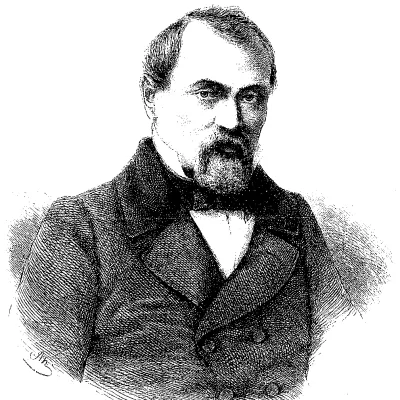
Hermann Schulze-Delitzsch
Human Design Chart
Biography
He studied law at Leipzig and Halle universities and, when thirty, he became an assessor in the court of justice at Berlin, and three years later was appointed patrimonialrichter at Delitzsch. Entering the parliament of 1848, he joined the Left Centre, and, acting as president of the commission of inquiry into the condition of the labourers and artisans, became impressed with the necessity of co-operation to enable the smaller tradespeople to hold their own against the capitalists. He was a member of the Second Chamber in 1848-1849; but as matters ceased to run smoothly between himself and the high legal officials, he threw up his public appointments in October 1851, and withdrew to Delitzsch. Here he devoted himself to the organization and development of co-operation in Germany, and to the foundation of Vorschussvereine (people's banks), of which he had established the first at Delitzsch in 1850. In 1859 he promoted the first Genossenschaftstag, or co-operative meeting, in Weimar, and founded a central bureau of co-operative societies. In 1861 he again entered the Prussian Chamber, and became a prominent member of the Progressist party. In 1863 he devoted the chief portion of a testimonial, amounting to £7500, to the maintenance of his co-operative institutions and offices. This, however, was only to meet an exceptional outlay, for he always insisted that they must be self-supporting. The next three or four years were given to the formation of local centres, and the establishment of the Deutsche Genossenschafts-Bank, 1865.
The spread of these organizations naturally led to legislation on the subject, and this too was chiefly the work of Schulze-Delitzsch.
What does Projector 6/2 mean for Hermann Schulze-Delitzsch?
Projector 6/2 — Design at a Glance
Hermann Schulze-Delitzsch's design tends towards precise system analysis. As a projector, he had a dense, focused aura that allowed him to immediately spot weaknesses in structures. This ability acted like a bright flashlight, shining directly on dark, inefficient areas. However, he risked making others feel attacked and defensive during direct confrontation. A more effective strategy was to attract others through his own harmonious presence, so that they would seek his advice. His undefined Sacral Center also meant that he did not have constant life energy. Instead, he worked in intense phases followed by necessary rest periods to avoid exhaustion. The conventional work model did not fit this rhythm. Living by this strategy and waiting for honest invitations rewarded him with success. Ignoring his design led to bitterness sooner or later. His energy was thus not a continuous flow but a pulsating light that only had a lasting effect when he allowed others to seek it out.
Self-Projected Authority
Hermann Schulze-Delitzsch's design tends towards extreme openness, coupled with the risk of being distracted by external motoric energies. As a projector with the rare authority in Self, his inner truth was anchored in his identity. This configuration required vigilant discernment between the spontaneous expression of his true essence and the thoughts of the mind.
His decision-making occurred in two ways. Either through self-dialogue or through conversations with others, if invited. Crucial was that he listened to himself. What he spontaneously and without thought expressed revealed his uniqueness and made him recognizable to others. The second way was a physical feeling that drew him geographically or thematically in a specific direction. By following this inner pull, he could become a guide for others. There lay his specific potential for success. The greatest trap was losing himself in his openness and constantly chasing energy, rather than waiting for the invitation. His design was thus not shown through active pushing forward, but through loud, authentic speaking and following physical attraction once he had space for it.
The 6/2 Profile — Role Model / Hermit
Hermann Schulze-Delitzsch's design is characterized by a two-phase life development. In the first three decades, he acted like an experimenter, learning through trial and error. This phase of Line 6 before the age of 30 promoted openness and the recognition of the consequences of connections and unions. He sought experiences to understand whether connections were lasting or temporary.
After the age of 30, his attitude fundamentally changed. The activation of the 6-line led him into a phase of distance and reflection. He metaphorically withdrew to analyze his past experiments with a clear eye. This period served healing and deep self-knowledge. Parallel to this, Line 2 of Gate 16 worked, promoting selectivity and cynicism when necessary energy was lacking. Without sufficient reserves, he judged objectively but often skeptically about the feasibility of ideas.
Only after this intensive introspective phase did he emerge as a wise advisor. Others sought him out to learn from his life wisdom and ability for deep self-reflection. His path from experimental openness to selective, far-reaching judgment shaped his interaction with the world. It showed how distance and withdrawal are necessary to learn from past mistakes and later offer grounded, trustworthy perspectives.
Single Definition — Defined & Open Centers
Hermann Schulze-Delitzsch was someone who constantly struggled with mental pressure to ask questions and find answers. His defined Head and Ajna Centers created a trustworthy, specific form of conceptual thinking. However, this constant inspirational pressure was not an energy source for direct implementation; it was meant to inspire others to think deeply. Through his defined Throat Center, he could reliably communicate these concepts, while his defined G Center gave him a firm sense of self-identity and a clear sense of direction. He knew who he was and where he belonged, without needing to force others to follow his path.
At the same time, Hermann Schulze-Delitzsch was vulnerable to external conditioning through his open centers. His open Heart Center lacked constant willpower; he tended to question whether he needed to do more or prove himself to demonstrate his worth, which could spiral into self-doubt. His open Sacral Center allowed him to absorb and amplify the vitality of others, leading to overexertion as he did not have a constant energy source for sustained work. Additionally, his open Solar Plexus absorbed the emotions of his surroundings, making him emotionally vulnerable and causing him to avoid confrontation to avoid creating waves. His open Spleen Center drove him to cling to people who radiated a sense of security, even if these bonds were unhealthy, driven by the fear of not surviving. Finally, his open Root Center absorbed the stress of others, causing him to rush and complete tasks that were not his own, hoping to alleviate the unpleasant pressure.
Channels for inspiration, logical doubt and structured insight.
Hermann Schulze-Delitzsch was someone who drew attention to himself through his mere existence and authentic expression. His design inclined him towards individual, exemplary leadership. The Channel of Inspiration 1-8 connected his G Center with his Throat Center. This meant that he did not influence through lengthy explanations but through the bold living of his own creative identity. He was designed to serve as a role model and inspire others to live out their unique qualities. However, this effect required patience and waiting for the right timing, as social adaptability was not innate to him.
Parallel to this, he possessed a sharp, skeptical mind. The Channel of Logic 63-4 connected his Head Center with his Ajna Center. Here, doubt played a central role. He constantly filtered patterns to check if they were consistent and verifiable. For him, logic was only valid if it worked practically; unfounded belief had no place. This channel drove him to ask questions and seek consistent answers that could serve the collective.
Furthermore, he had the ability to efficiently structure complex insights. The Channel of Structuring 23-43 connected his Ajna Center with his Throat Center. He received spontaneous breakthroughs and processed them into clear, understandable language. His thinking often felt light-years ahead. To be accepted, he had to learn to let go of control and allow his mind to process knowledge at its own pace. When he articulated his innovative perspectives at the right time and in simple form, he could elevate entire organizations to a higher level of efficiency.
Additionally, Gates in the Sacral Center promoted genetic strategies for bonding (Gate 59) and detail-oriented perfection (Gate 9). In the emotional center, Gate 55 shaped extreme mood swings and a deep emotional awareness. In his personality, Gates that enabled receptivity to new directions (Gate 2), interpretation of past experiences (Gate 64), and abstract narration of mental processes (Gate 56) were present. Gate 62 in his design underscored his ability for logical pattern recognition and naming.
Individual Circuitry — Circuit Signature
Hermann Schulze-Delitzsch's design inclined him towards structured, individual knowledge transmission. His simple definition connected Head, Ajna, Identity, and Throat Centers into a single, coherent flow. This created a direct line from inspiration through mental structuring to verbal expression.
The Understanding Circuit worked through the Logic Channel (Gates 63-4). It connected the Head Center with the Ajna Center. This promoted focused, rational knowledge acquisition, free from emotional coloring. Hermann Schulze-Delitzsch used this energy to develop logical strategies and articulate them clearly.
The Knowledge Circuit complemented this through two segments. The Inspiration Channel (Gates 8-1) connected the Ajna with the Throat Center. This allowed him to directly express innovative insights in words. Parallel to this, the Structuring Channel (Gates 43-23) connected the Ajna with the Identity Center. This strengthened the expression of his unique individuality. Both channels flowed together, as Ajna served as a central node. Thus, Hermann Schulze-Delitzsch developed the ability to not only think about new knowledge but to bring it into the world with personal conviction and a clear voice. The combination of rational logic and inspired, individual voice shaped his way of initiating change through targeted communication.
Left Angle Cross of Spirit 2
Hermann Schulze-Delitzsch's design indicated a tendency towards inner conflict, manifesting as a constant tug-of-war between two opposing poles. This configuration, the left cross of Spirit 2, described a psychological structure where consciousness oscillated between the search for absolute truth and the need for practical application. It was not a simple indecision but a deep, structural tension: one pole pulled him towards contemplative distance and analysis, while the other urged him to active participation and action. This duality shaped his inner stance; he lived in constant confrontation with the question of whether to withdraw to gain clarity or to intervene to effect change. The design challenged him to see these two forces not as contradictions but as necessary opposites that together enabled a holistic perspective. The challenge was to avoid getting stuck in either extreme and to maintain the dynamics between reflection and action. This inner tension was not a flaw but the engine of his development, driving him to always consider both perspectives before taking a stance.
Saturn Return · Uranus Opposition · Chiron Return · 2nd Saturn Return — Life Cycles
Hermann Schulze-Delitzsch's design was characterized by a clear ability to structure and to increasingly take responsibility over time. This trait was evident early on: in 1838, at the age of 30, he was appointed as an assessor at the higher regional court. This first Saturn return marked the transition from education to a stable professional anchoring, a moment when years of groundwork condensed into a solid result.
At 40 years old, in 1848, the Uranus opposition came into effect. This cycle often brings sudden changes and a drive for freedom or reform. Schulze-Delitzsch was elected as a left-liberal member of the Prussian National Assembly. Here, the typical dynamics of this aspect were evident: questioning existing structures and actively shaping new political orders.
The Chiron return around the 50th year is a fulfillment cycle in which the personal life purpose unfolds. In 1858, at 50 years old, Schulze-Delitzsch was one of the speakers at the first congress of German economists in Gotha. This was not a moment of healing but of bloom: his ideas and work now hit the core of his incarnation task and became publicly effective.
The second Saturn return around the 57th year deepened this structuring. In 1865, he established the German Cooperative Bank. This was the peak of his structural work, where he not only laid theoretical but also institutional foundations for sustainability. His design thus promoted a development from individual competence to systemic responsibility and lasting institutional anchoring.
Projector · Self-Projected Authority — Synthesis
Hermann Schulze-Delitzsch lived a life path marked by a profound inner drive towards inspiration and pattern recognition (defined Head Center, Channel 1-8). He projected these insights onto his environment, quickly recognizing what was not working for others and identifying the flaw in the system (Projector Type). This ability, combined with natural authority in self, led him to express his observations and bring
3 Defined Channels
Incarnation Cross - Left Angle Cross of Spirit 2
Solar Return
The Solar Return shows the moment when the sun returns to its exact birth position - your personal solar year.
Life Cycles
Discover the life cycles with a detailed triple view (birth chart, cycle chart, composite).
Human Design Profile
- Type
- Projector
- Strategy
- Wait for the respectful invitation
- Authority
- Self-Projected Authority
- Profile
- 6/2 - Role Model / Hermit
- Definition
- Single Definition
- Incarnation Cross
- Left Angle Cross of Spirit 2
- Date of Birth
- 29.08.1808 06:00
- Place of Birth
- Delitzsch, GER
Frequently Asked Questions
What was Hermann Schulze-Delitzsch's Human Design type?
What Profile did Hermann Schulze-Delitzsch have in Human Design?
What Authority did Hermann Schulze-Delitzsch have?
When was Hermann Schulze-Delitzsch born?
Discover your own Human Design
Are you also a Projector? Find out in a personal reading how to unfold your leadership qualities and recognize the right invitations.
More Personalities
Back to overviewSissy Spacek
Alain-Fournier

Anémone

Ann-Margret
Bourvil
Christian-Jaque