
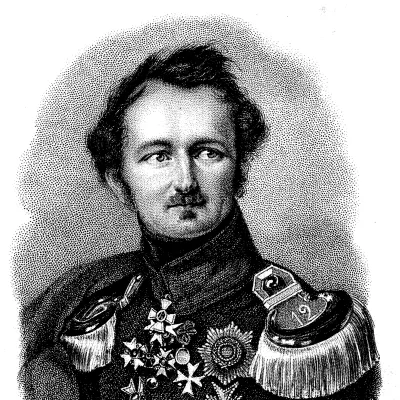
Hermann Von Pückler-Muskau
Human Design Chart
Biography
He died 4 February 1871, Branitz.
What does Generator 6/2 mean for Hermann Von Pückler-Muskau?
Generator 6/2 — Design at a Glance
Hermann Von Pückler-Muskau was someone with immense endurance who used his strength most effectively when responding to concrete life impulses. As a Generator, he had abundant sacral energy that drove him like a strong workhorse – provided he acted in harmony with his inner compass. His motto wasn't 'initiate,' but rather 'react.' This mechanism meant waiting for an environmental signal and ensuring his sacral center gave a clear 'yes' before becoming active.
This design offered him the chance of deep fulfillment if he adhered to this rhythm. If this state didn’t occur – perhaps due to constant initiative-taking against gut feelings or ignoring inner approval – frustration and energy depletion were likely. Two specific pitfalls shaped his potential: one, wasting energy on tasks where he felt no intrinsic joy, which could lead to long-term exhaustion; two, being held back from his heart project despite still having power and wanting to continue working. His path to satisfaction thus lay in disciplined reactions to inner confirmation, not blind pushing forward.
Sacral Authority
Hermann Von Pückler-Muskau followed the Generator strategy: he reacted to external stimuli rather than actively initiating. His decision-making process was simplified by sacral authority, which served as his internal guidance and also formed his life strategy. This configuration required an open emotional center so impulses weren’t prematurely emotionally distorted.
His responses to the environment were physical: a 'gut feeling' or surge of energy. He learned to pay attention to these signals – often audible as grunts, hums, or affirming 'mm-hmms.' When such reactions occurred, he felt vital and alive. Then seemingly inexhaustible energy was available for him to enthusiastically tackle his tasks. This design predisposed him to joyfully go through life and immerse himself in activities without the need for rigid goal-oriented focus.
Additionally, his activated spleen center acted as a supportive instance to sacral authority. This allowed him quick, spontaneous reactions and decisions. He had immediate access to his physical well-being and instinctive perception. This combination enabled him to reliably be guided by these deep bodily signals, which shaped and structured his actions in daily life.
The 6/2 Profile — Role Model / Hermit
Hermann Von Pückler-Muskau was someone whose early years were marked by intense experimental enthusiasm. Before the Saturn return, his 6/2 line functioned like a 3-line: trial and error characterized his actions, followed by necessary withdrawals for processing. This phase served to gather many personal life experiences and learn through failure.
Around thirty years later, the sixth line fully activated. Hermann Von Pückler-Muskau metaphorically retreated into a 'cave' to view his earlier experiments with great distance. This period was not passive but one of intense reflection and healing. Through Gate 28 (Line 6), he showed willingness to take extreme risks – driven by the desire for glory and the will to win at any cost rather than succumbing to decline. Simultaneously, Gate 33 (Line 2) called for withdrawal to reflect on experiences and develop inner strength through surrendering to superior forces.
From this deep introspection, he later emerged as a wise figure. Others sought his counsel to partake in his life wisdom and learn the ability of profound self-reflection. His design described a path from risk-taking experimentation over a phase of isolated insight acquisition to the role of an exemplar combining natural talent with acquired wisdom.
Split Definition — Defined & Open Centers
Hermann Von Pückler-Muskau was someone whose inner architecture relied on a constant, mechanical energy source. His defined Sacral Center provided him with a daily supply of vital energy that could only be effectively utilized in response to external impulses; initiating actions without prior questioning led to frustration and exhaustion as the sacral energy wasn't available then. This reactive nature was complemented by his defined Ajna Center, which endowed him with a consistent, specific form of conceptual thinking. He processed data and creativity in exactly the same way, protecting him from mental influence but also making him prone to clinging to unfinished concepts when the mind took over.
His defined Throat functioned as a reliable pivot point for communication and manifestation. It transmuted information from his mind or energy into clear expressions and actions if he trusted his strategy. Simultaneously, his defined Spleen Center offered spontaneous intuitive authority in the present moment. It provided non-verbal warning signals and health instincts that he had to follow without rational justification to achieve well-being.
In contrast to this stable inner structure stood his vulnerability in open areas. His open Head Center made him susceptible to mental pressure and inspiration from others; he tended to engage with questions that weren't his, leading to confusion if he didn't trust his internal authority. The open G Center meant a lack of firm identity and direction; he adapted to the environment and often sought 'borrowed' security in relationships or places rather than having an own unchanging orientation. Additionally, his open Heart Center absorbed the pressure of proving worth through willpower, which could entangle him in cycles of promise and failure. Finally, he took on emotions from his surroundings via his open Solar Plexus Center, amplified them, and risked personalizing them as his own, leading to emotional instability if he didn't distance himself from the emotional field.
Channels for logical order, care and traditional values.
Hermann Von Pückler-Muskau was someone who organized information mentally and translated detailed visual patterns into language. This ability stemmed from Channel Accepting 17-62. Through Gate of Opinions (17), he visualized connections, while Gate of Details (62) named and structured these through words. He understood only what logically fit his inner image; everything else remained incomprehensible. This created a constant pressure in the Throat Center to precisely explain opinions or resolve misunderstandings. Timing was crucial: Only when invited to speak were his communications clear and effective, minimizing resistance.
Parallel to this, Channel Preservation 27-50 operated. It connected the care of Gate 27 with traditional values of Gate 50. Hermann Von Pückler-Muskau automatically attracted trust and assumed responsibility for the well-being of his community. His aura signaled reliability, yet he had to learn to carry only those burdens that his own energy allowed – a form of 'enlightened self-interest'. Only through proper self-care could he sustainably nourish and protect others.
Additionally, further Gates shaped his design: Gate 28 demanded decisions in the here and now considering personal risks, while Gate 19 sought security in resources and territory. Gate 33 required calm for reflection to process experiences. In the correction area, Gate 18 discriminated between necessary and insignificant changes without taking authority conflicts personally. Gate 35 aimed at change through interaction, Gate 57 offered intuitive clarity in survival instinct. In his design, Gate 12 supported creative restraint and emotional poetry, Gate 4 formulated logical formulas for future security, and Gate 48 recognized deep patterns even if their implementation often remained frustrating.
Collective Circuitry — Circuit Signature
Hermann Von Pückler-Muskau was characterized by two separate yet parallel functioning energetic poles. One pole connected the Ajna Center with the Throat Center via Channel Accepting (Gates 17-62). This shaped a capacity for focused perception and clear expression of logical insights. It involved a rational, emotionless structuring of future vision that should act free from conditioning. The second pole linked the Sacral Center with the Spleen Center through Channel Preservation (Gates 27-50). Here instinctive survival energies worked together with stable life force. This area cared for protection, preservation, and nourishment of one's genetics and familial environment. As Hermann Von Pückler-Muskau had a Split Definition, these two systems – rational future thinking and instinctive protection – existed as independent energy fields side by side. They did not flow into each other but formed separate focal points: on the one hand strategic communication of visual concepts, on the other hand ancient tangible care for essentials. This separation meant that logical strategies and emotional or instinctive protective needs were not automatically synchronized but existed as autonomous timeless forces within him.
Left Angle Cross of Alignment 2
Hermann Von Pückler-Muskau showed a fundamental attitude aimed at inner clarity and the search for his own path. His design suggested that he did not let himself be guided by external pressure or societal expectations, but rather waited until a direction became clear to him. This configuration describes a life task of finding one's orientation and then consistently following it.
The left cross of Alignment 2 in Human Design mechanics is associated with the necessity of defining oneself before acting. It involves not blindly following the currents of time or others' expectations, but listening to an inner voice and trusting it. For Hermann Von Pückler-Muskau, this likely meant that he went through periods of uncertainty where he questioned whether he was on the right path. Yet, precisely this phase of self-reflection was crucial for his development.
Without a specific event in the raw content, one cannot say when this process became particularly clear to him. However, it can be assumed that there were moments when he made a clear decision or embarked on a new path based on his inner conviction. This ability to orient himself was an essential part of his design and significantly shaped his life.
Saturn Return · Uranus Opposition · Chiron Return · 2nd Saturn Return — Life Cycles
Hermann Von Pückler-Muskau showed himself as someone who purposefully used his external circumstances to translate inner visions into tangible structures, thereby gaining societal recognition through meaningful actions in the physical realm.
In 1816, at age 31, he began designing a landscape park in Muskau after traveling through English gardens. This marked his first Saturn Return, a cycle where years of groundwork often culminates in a solid result and strengthens one's identity. The journey served as a catalyst for concrete implementation in his professional context.
Six years later, in 1822 at age 37, Pückler was elevated to the rank of prince. This event fell on his Uranus Opposition, a time when possibilities expand and unexpected promotions or status changes often occur. The elevation was not coincidental but aligned with the mechanical dynamics of this cycle, opening new horizons.
The peak of this development occurred in 1834 when he published "Hints on Landscape Gardening" at age 49. This was his Chiron Return, a fulfillment cycle or bloom period. At this age, one's incarnation cross increasingly unfolds in life; meaning and purpose become experiential. The publication was concrete proof that his strategy up to that point had been effective: His life task was not only lived but also theoretically grounded and shared, marking the pinnacle of his personal development.
Generator · Sacral Authority — Synthesis
He was a Generator whose life was marked by deep sacral energy (sacral authority). This driving force showed in an unwavering engagement for projects that truly fulfilled him – a tendency reinforced by the Profile as Role Model and Natural Talent. The early years were characterized by experimentation and exploring various paths (6/2 Line), followed by a phase of intense reflection and wisdom-seeking. His ability to self-observe and analyze, fueled by a defined Ajna Center and the Channel of Accepting (Gate 17/62), enabled him to recognize patterns and translate them into concrete, detailed concepts. Repeated successes in design confirmed his capacity to share logical insights and shape a future vision (Understanding Circuit).
A central paradox lay in the combination of this creative energy and the need for deep withdrawal. While he was destined by his sacral authority to be active and engaged, he sought phases of isolation to process experiences and gain wisdom (6/2 Line). This tension between engagement and detachment shaped his life path – a constant interplay between creating new forms and reflecting on what had already been created. The left cross of Alignment 2 underscored this dynamic by emphasizing the necessity of constantly reorienting oneself and finding one's own way.
2 Defined Channels
Incarnation Cross - Left Angle Cross of Alignment 2
Solar Return
The Solar Return shows the moment when the sun returns to its exact birth position - your personal solar year.
Life Cycles
Discover the life cycles with a detailed triple view (birth chart, cycle chart, composite).
Human Design Profile
- Type
- Generator
- Strategy
- To respond - wait for something to respond to
- Authority
- Sacral Authority
- Profile
- 6/2 - Role Model / Hermit
- Definition
- Split Definition
- Incarnation Cross
- Left Angle Cross of Alignment 2
- Date of Birth
- 30.10.1785 11:45
- Place of Birth
- Bad Muskau, GER
Frequently Asked Questions
What was Hermann Von Pükler-Muskau's Human Design type?
What Profile did Hermann Von Pükler-Muskau have?
What Authority did Hermann Von Pükler-Muskau have?
Which incarnation cross was active for Hermann von Pükler-Muskau?
When was Hermann von Pükler-Muskau born?
Discover your own Human Design
Are you also a Generator? Find out in a personal reading how to use your sacral energy correctly and discover deep satisfaction.
More Personalities
Back to overviewAaliyah

Alain-Fournier

Alexia

Angèle

Angeli
Anne-Marie
