
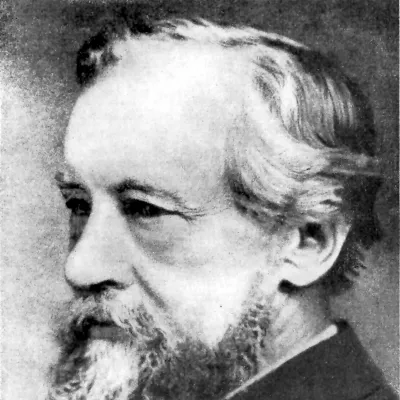
Hugo De Vries
Human Design Chart
Biography
De Vries attended the University of Leiden, receiving his Ph.D. in 1870. He went on to the University of Heidelberg where he worked with the German plant physiologist, Julius von Sachs. In 1877, he became a professor of botany at the University of Amsterdam, where he continued his research on plant cells. De Vries became increasingly interested in the controversy about plant heredity during the late 1880s and began the hybridization experiments that ultimately led to his confirmation of the laws of heredity presented by Gregor Mendel.
He died on 21 May 1935.
What does Generator 3/5 mean for Hugo De Vries?
Generator 3/5 — Design at a Glance
Hugo De Vries revealed himself as someone with tremendous inner endurance, whose work was based on the ability to generate and sustainably contribute energy. His design laid a foundational structure that made him appear like a workhorse: strong and durable, yet only effective when he had energy for his specific task. As a Generator, he possessed abundant sacral energy, which was released not through self-initiative but by responding to impulses from the environment. The crucial mechanism of his design consisted in not initiating action himself, but waiting until life sent a signal that his inner self responded to with a clear "yes." Only then could he react with action and thus optimally utilize his strength.
This path led him to deep satisfaction and a sense of fulfillment. However, when he contradicted this principle—by doing things he had no desire for or constantly initiating himself—he inevitably encountered persistent frustration and a lack of energy. Even holding back from his heart project while still full of power presented a significant stumbling block. His success therefore depended on whether he allowed this inner resonance and acted upon it rather than fighting against the current of his own nature.
Sacral Authority
Hugo De Vries revealed himself as a person whose decision-making was characterized by direct, physical resonance. As a Generator, he possessed sacral authority that also served as his strategy and simplified his process of choice. This inner leadership manifested not in the Head Center but through an immediate gut feeling or a surge of energy in response to external stimuli.
His responses to life often resembled short sounds like grunts or affirming "Mhm." Such physical signals were crucial for him: they indicated whether his sacral motor had started up. When this happened, he felt vital and alive. Then, it seemed as though an inexhaustible energy was available to him, enabling him to carry out his work with great enthusiasm.
This design predisposed him to move through life with joy and satisfaction. He could immerse himself entirely in his tasks without having to pursue a rigid goal-oriented purpose externally. The energy came from the activity itself. Additionally, his activated Spleen Center acted as supportive authority for the Sacral Center. This gave him the ability to react particularly quickly and spontaneously. He had an immediate access to his physical well-being and instinctive perception, which he could rely on to guide himself reliably. This combination of sacral confirmation and spleen-supported intuition formed the foundation of his capacity for action.
The 3/5 Profile — Martyr / Heretic
Hugo De Vries revealed himself as a person who learned through personal experimentation and later used this knowledge to solve other people's problems. His Profile 3/5 combined the adventurous Line of the Explorer with the heroic Line of the Hero. Initially, he believed in nothing predetermined; instead, he gathered practical experiences, even through failures, to find his own truth. This process was characterized by a deep acceptance of fate. Gate 30 on the third line described his life as a wave without lasting fulfillment, accompanied by temporary relief. Here it was not about positive or negative evaluation but rather accepting what happened as it was – a form of resignation through learning processes.
As these experimental results matured, he took on the role of Helper. The fifth Line gave him natural authority and dignity that attracted others. People sought him out to learn from his accumulated experiences. However, this projection could also be misunderstood as arrogance; overconfidence often served only as a protective mechanism to maintain this hero's role. When he publicly failed in trying new paths, the pain was particularly intense for him because his self-worth was strongly tied to his ability to help others through personal example. His design dictated: first take on personal risk, then share the wisdom gathered.
Single Definition — Defined & Open Centers
Hugo De Vries revealed himself as someone with a fixed, reliable self-identity and a clear sense of direction. His defined G Center gave him the ability to love others without becoming dependent on them, along with a deep sense of being part of evolution. Simultaneously, he possessed strong willpower through his defined Heart Center; he determined his life himself, kept promises, and enjoyed success as long as he followed his inner guidance. This structure was driven by an enormous source of vital energy: his defined Sacral Center. As a Generator, his strategy was not to initiate but to wait until life asked him, then respond with full force and persistence. His defined Root Center provided the necessary pressure to move forward in the world and master existential challenges.
In contrast, his design revealed specific vulnerabilities through his open centers. The open Head and Ajna Centers meant that he did not have a consistent way of processing mental information; he tended to be overwhelmed by others' doubts and confusion or avoid intellectual engagement rather than holding answers for his own truth. His open Throat Center led him to feel the pressure to get attention instead of waiting for spontaneous invitations to speak. The open Solar Plexus Center made him sensitive to the emotions of his environment; he absorbed these moods and risked personalizing them, which could lead to emotional instability. Finally, his open Spleen Center carried a fundamental fear of survival problems; he tended to hold onto things that were not good for him to generate a false sense of security and well-being rather than facing his fears directly.
Channels for pioneering spirit, endurance, rhythm and maturation.
Hugo De Vries revealed himself as someone who worked through persistent detail work and the courage to take new directions. His design laid a tendency to think about innovation but also materialize it. The Channel of Beat 14-2 connected competence in handling power (Gate 14) with higher knowledge about direction and identity (Gate 2). This gave him the strength to translate innovative impulses into a concrete life path through his pure generative energy from the Sacral Center. He was able to encourage himself and others in their creative destiny by trusting the reactions of his body rather than striving for a predetermined plan.
Parallel to this, the Channel of Discovery 29-46 worked through saying yes (Gate 29) and the determination of self (Gate 46). This process required patience and letting go of expectations; only at the end of a long cycle did the meaning of his work reveal itself. His ability to be in the right place at the right time enabled discoveries that changed collective understanding.
The Channel of Initiation 51-25 added a competitive dynamic to his personality. The energy of shock (Gate 51) met with self spirit and universal love (Gate 25). This drove him to cross boundaries and inspire others towards individualization through personal breakthroughs. Initiation happened for him not through targeted seeking but as a mystical process that caught up with authentic living.
Additionally, individual Gates shaped his essence: Gate 9 fostered precise detail work and perfection through repetition, while Gate 3 marked the necessity of mutation to overcome confusion. Gate 30 brought an awareness of deeper feelings and acceptance of limitations as fate. These configurations together formed a person who transformed experience into wisdom and created new orders.
Individual Circuitry — Circuit Signature
Hugo De Vries revealed himself through a deeply rooted, pulsating life energy that directly connected his actions and self-understanding. His simple definition created a continuous flow between identity, Sacral, Heart, and Root Centers, giving him inner stability.
The Knowledge Circuit activated the Channel 'The Beat' (Gates 2-14) in him, connecting the Sacral with the Identity Center. This promoted rhythmic, acoustically influenced creativity and the ability to go through mutations on his unique path – that is, daring deviations from the known.
Parallelly, the Centering Circuit worked through the Channel 'Initiation' (Gates 25-51), linking Identity and Heart Centers. This strengthened his self-esteem and fortified bold, individual convictions. However, without a connection to the Throat Center, these deep convictions often remained internally held or difficult to verbalize.
The Purpose Circuit rounded out the picture. With the Channels 'Discovery' (46-29) and 'Maturation' (42-53), it cyclically connected Identity, Sacral, and Root Centers. This allowed him to emotionally process past experiences, reflect on their meaning, and draw collectively shareable insights from them. The energy flowed in wave-like patterns: from inspiration through emotional condensation to shared wisdom. Overall, this configuration shaped a person who formed his unique identity through inner rhythms and past learning effects less through external expression than through deep, felt transformation.
Right Angle Cross of Contagion 1
Hugo De Vries exhibited a fundamental disposition marked by the necessity to integrate into existing structures and authorities. His design suggested that he found strength not through assertive imposition but rather through loyalty and adaptation to given orders. This configuration, known as the right cross of infection, described a life task centered on placing his values in service of larger systems. Hugo De Vries sought stability through belonging and often saw himself as part of a whole whose rules he accepted. This did not mean blind obedience but rather a conscious embedding into established hierarchies or communities to be effective there. His energy was directed towards maintaining the integrity of these structures and building trust through his reliability. He learned that his influence was greatest when he did not go against the flow, but moved with it. This attitude shaped his interactions: he sought allies within existing frameworks and strengthened them through his presence. For Hugo De Vries, the question was not how to change the system but rather how to find a meaningful place in it and fill this role responsibly. His path led him to respect authority and adapt to it so as to be able to act sustainably. This strategy of integration over resistance defined his way of being present in the world.
Saturn Return · Uranus Opposition · Chiron Return · 2nd Saturn Return — Life Cycles
Hugo De Vries was characterized by a structure that combined long phases of internal condensation with clear, outwardly impactful milestones. His design indicated a tendency towards cyclical developments where groundwork often crystallized into sustainable results over years.
In 1875, at age 27, he received a two-year scholarship in Würzburg. This marked his first Saturn return, a time when years of preparation often solidified into a stable foundation for further career development. The energy of this cycle promoted the consolidation of knowledge and positioning.
This mechanism was evident again in 1905, at age 57, when he was elected to the Royal Society and received the Darwin Medal. His second Saturn return underscored the confirmation of his professional authority by established institutions, a process of maturation and recognition built on earlier achievements.
Between these structural points lay 1900 with his Chiron return marked by the publication of his 'rediscovery' of Mendel's rules. This cycle represented a phase of bloom where his incarnation purpose – if lived according to his strategy – increasingly unfolded in life and became experientially meaningful. The publication was not an isolated event but rather an expression of inner fulfillment that brought his previous work to a point.
Generator · Sacral Authority — Synthesis
Hugo De Vries was a Generator whose life was marked by deep sacral energy. This power, combined with the profile of an experimenter and hero (3/5), drove him constantly to explore new paths and learn from experiences – both his own and others'. The defined G Center gave him clear direction and identity as he navigated through life, while Channel Beat (14/2) enabled him to advance innovations and initiate changes. Repeated Saturn returns, coupled with professional successes and recognition, showed a capacity for growth from experience and application of knowledge.
Central to Hugo De Vries was a paradox between the drive for constant renewal and the necessity to use his energy meaningfully. The Generator sought activities that filled him with joy (Sacral Authority), yet the experimenting profile also required trying things that did not immediately lead to success. This tension between the need for activation through the Sacral Center and the adventurous spirit of the 3/5 profile created a dynamic process of mutation, learning, and sharing this knowledge with others.
4 Defined Channels
Incarnation Cross - Right Angle Cross of Contagion 1
Solar Return
The Solar Return shows the moment when the sun returns to its exact birth position - your personal solar year.
Life Cycles
Discover the life cycles with a detailed triple view (birth chart, cycle chart, composite).
Human Design Profile
- Type
- Generator
- Strategy
- To respond - wait for something to respond to
- Authority
- Sacral Authority
- Profile
- 3/5 - Martyr / Heretic
- Definition
- Single Definition
- Incarnation Cross
- Right Angle Cross of Contagion 1
- Date of Birth
- 16.02.1848 01:00
- Place of Birth
- Haarlem, Netherlands
Frequently Asked Questions
What is Hugo De Vries' Human Design type?
Which Profile did Hugo De Vries have?
What Authority did Hugo De Vries have?
What incarnation cross did Hugo De Vries have?
When was Hugo De Vries born?
Discover your own Human Design
Are you also a Generator? Find out in a personal reading how to use your sacral energy correctly and discover deep satisfaction.
More Personalities
Back to overviewAaliyah

Alexia

Angèle

Anne-Marie

Arcángel

Arno
