Hugo von Reischach
Human Design Chart
Biography
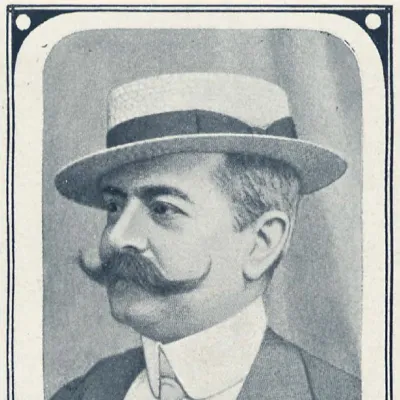
In 1925, Reischach published his memoirs under the title Unter Drei Kaisern, which were widely read at the time and were also translated into English.
He died on 12 August 1934 in Berlin, aged 79.
The Human Design of Hugo von Reischach: Manifesting Generator 4/6
Manifesting Generator 4/6 — Design at a Glance
Hugo von Reischach revealed himself as someone with hybrid energy: the constant power of a Generator combined with the lightning-fast alignment of a Manifestor. His design inclined him to quickly draw things into his life by skipping steps. This speed, however, was a double-edged sword. If Hugo von Reischach moved too quickly, he risked missing important stages, forcing him to backtrack and make up for lost time. Such setbacks often led to frustration, the specific non-self theme of his type. Additionally, he tended to pursue multiple projects simultaneously, driven by responding to various impulses. Without internal alignment, his creative drive quickly turned into exhaustion.
The mechanics of his design as a Manifesting Generator required a clear strategy: not initiating but responding to impulses. Only when his sacral center gave a clear “yes” should he act. Regular checks to see if the projects were still enjoyable were essential. With the correct application of this strategy – responding rather than pushing forward – Hugo von Reischach found deep satisfaction. He could then work on different tasks simultaneously without becoming frustrated. His creativity flourished in a “play mode,” where variety and joy took precedence over the rigid requirement to complete one thing after another. His energy was only beneficial when he maintained this rhythmic balance between quick execution and conscious reaction.
Emotional Authority
Hugo von Reischach revealed himself as someone who did not make decisions based on the first emotional wave. His design carried emotional authority, meaning his defined emotional center took over as internal guidance. This held true regardless of which other centers were defined in his chart; emotional authority always took precedence.
This configuration generated a permanent rhythm of emotional waves. Hugo von Reischach saw the world colored by his current mood. What excited him in one moment could appear negative in the next. His immediate feeling was, however, only a snapshot, not necessarily the deeper truth. Quick, spontaneous decisions based on this first emotion often risked negative consequences.
Instead of acting impulsively, his design required patience. He took time to let decisions mature. This meant hesitating and asking himself several times. By sleeping on an issue multiple times, intense feelings subsided. With this temporal distance, he gained emotional distance. Only then did clarity and calm set in. This process was central for long-term, life-defining decisions. Only through this delay could he see the true depth of a situation and make a well-founded choice that went beyond the first, often misleading emotional reaction.
The 4/6 Profile — Opportunist / Role Model
Hugo von Reischach showed himself in the first three decades of his life as an experimental network builder, acting opportunistically, similar to a pure Three. His design as Profile 4/6 established this early phase on spontaneous interaction and testing social dynamics. With the return of Saturn, this attitude fundamentally changed. The internal conflict between the deep need for belonging (Line 4) and the growing urge to withdraw to reflect on the meaning (Line 6) shaped his further development. He faced the task of balancing the heart against the head, which often led to confusion.
In his later years, he was expected to act as a wise role model. This required a high skill in dealing with others, as he was prone to gullibility and had to learn to accurately assess the intentions and expressive power of his environment. His network was always marked by a cautious selection; he opened his heart only to those who proved trustworthy to avoid being hurt. At the same time, he had to learn to integrate quiet phases to prevent burnout from overexertion. The quality of his connections always stood above the quantity, as he otherwise fell into depression when his high ideals were not met. His life was a constant process of finding the right balance between social cooperation and individual wisdom to achieve a sustainable, almost immortal impact in his environment.
Split Definition — Defined & Open Centers
Hugo von Reischach revealed himself as someone with a clear, consistent identity and a strong will. His defined G Center gave him a deep sense of self-love and an inner direction, while the defined Heart Center provided him with the willpower to keep promises and determine his own resources. This combination created a person who knew who they were and what they wanted.
His energy source came from the defined Sacral Center, generating a constant vital force. However, this energy required him to respond to questions rather than initiate actions. Only through an affirmative response could he fully unleash his power and avoid frustration. His defined Throat Center served as a pivot point to bring this energy, as well as his thoughts and feelings, into the world. It allowed him to express himself reliably and honestly, provided he listened to his inner authority.
This inner stability contrasted with his open centers. The open Head Center made him vulnerable to mental pressure and the temptation to seek answers to questions that were not his own. He tended to get stuck in doubts if he did not trust his emotional clarity. His open Ajna Center meant that his conceptual thinking was flexible but not a fixed truth. He could take in and reflect on ideas without adhering to them as personal dogmas.
The open Spleen Center was his greatest challenge. It left him vulnerable to fears and the need for external security. He was conditioned to cling to people or situations that gave a false sense of well-being rather than trusting his own intuition. Spontaneous decisions were risky for him, often stemming from fear or conditioning. Instead, he had to learn to observe his fears and be guided by his emotional authority to set healthy boundaries and avoid unhealthy dependencies.
Channels for community, rhythm, change, presence, self-expression and charisma.
Hugo von Reischach inspired others through his authenticity and trust in his inner convictions, without actively teaching them. His design carried the energy of self-reinforcement and the ability to open new directions.
The Channel of Exploration 34-10 connected his sacral power with self-behavior. This gave him the inner strength to hold onto his own beliefs and accept himself. Through his authentic actions, he demonstrated to others the benefit of full self-love and encouraged them to live their unique individuality.
The Channel of Charisma 34-20 endowed him with a powerful, manifesting energy guided by sacral reactions. This allowed him to sustain activity over longer periods and act in the moment. His vitality was spontaneous when he focused on satisfying tasks and naturally inspired others.
The Channel of Awakening 10-20 connected his identity with expression in the present. He lived the wisdom of loving and trusting himself to survive and thrive. Through his clear, alert presence, he inspired people around him to be themselves, often without his conscious control.
The Channel of the Beat 14-2 linked his generative energy with higher knowledge. As a keyholder, he had access to resources to transform mutative impulses into material direction. He could bring innovative, reinforcing new directions simply by trusting his sacral reaction, even if the goal was unclear.
The Channel of Mutation 60-3 connected the Root and Sacral Centers. It brought the potential for evolutionary change through the acceptance of limitation and the endurance of confusion. His energy was pulsing and melancholic, and he brought change by patiently waiting for the reaction from his Sacral, rather than forcing the process.
The Channel of Community 37-40 connected emotional clarity with willpower. He sought recognition and his place in the whole while being ready to work for those he loved. He understood the importance of good deals and built bridges between individuals to create harmonious communities where everyone had an honorable place.
Individual Circuitry — Circuit Signature
Hugo von Reischach's design was characterized by separate, parallel functioning energetic poles: on the one hand, a strong individual expression capability, on the other hand, an emotional level focused on cooperation and resources. This separation shaped his experiences as coexisting, not directly connected energy fields.
In the first area, the Knowledge, Centering, and Integration Circuits connected the Identity, Sacral, Root, and Throat Centers. Here, the energy of the 'Beat' (Channel 2-14) worked together with the 'Mutation' (Channel 3-60), fostering a tendency to create new, individual paths. The 'Exploration' Channel (10-34) in the Centering Circuit strengthened self-esteem and inner conviction, while the Integration Channels 'Awakening' (20-10) and 'Charisma' (20-34) helped channel this power in the 'Now'. This resulted in a pulsing, creative expression that, however, proceeded without direct connection to the emotional center.
Independently acting, the Ego Circuit connected the Heart and Solar Plexus Centers. Through the 'Community' Channel (37-40), this was about giving and taking as well as creating resources together. Since this field was separated from the Sacral Center, it required conscious pauses for regeneration. Hugo von Reischach thus moved between the urge to express his unique identity and the need to find emotional stability and support in the community.
Right Angle Cross of Planning 3
Hugo von Reischach's design indicated a tendency towards strategic, long-term action. He was someone who did not react impulsively but took the time to plan the right steps in the right order. This approach stemmed from the configuration of the right cross of Planning 3.
This structure in the Human Design chart describes a specific way of decision-making and action. Unlike impulsive or purely guided actions, Hugo von Reischach prioritized conscious preparation. The right cross of Planning 3 links aspects of strategic overview with the ability to plan concrete steps. It was not about rigid control but a thoughtful approach to challenges.
Hugo von Reischach used this mechanism to navigate complex situations. Before acting, he weighed options and created an internal or external plan. This allowed him to pursue a clear path even in uncertain times. The energy of this cross promoted the patience needed to develop plans without being distracted by external pressure or inner restlessness.
For Hugo von Reischach, this planning ability was a central aspect of his life's approach. It helped him achieve goals that extended beyond the immediate horizon. Through this structured approach, he could use his energy efficiently and avoid falling into chaotic or contradictory actions. His design supported him in acting as a strategic thinker who carefully weighed his steps before taking them.
Saturn Return · Uranus Opposition · Chiron Return · 2nd Saturn Return — Life Cycles
Hugo von Reischach's design indicated a tendency towards structural anchoring and the assumption of responsibility, which intensified in phases of life maturity. The second Saturn return, which occurs around the age of 59, often marks the peak of one's authority and the consolidation of life's work. This was evident in Reischach in 1913 at the age of 59: He organized the wedding of Princess Victoria Louise with Ernst August. This event represented the pinnacle of his influence at the Berlin Imperial Court, where his ability to create order and durability fully came into play.
Prior to this, during the Chiron return between the ages of 49 and 51, a phase of fulfillment occurred. In this cycle, the individual's incarnation cross unfolds if one has followed the strategy and authority. For Reischach, this meant in 1905 at the age of 51 the transition to the service of Wilhelm II. As the successor to Count Ernst von Wedel, he took over the position of Oberstallmeister and head of the Mars stable. This career move was not just a change but the concrete realization of his life purpose. The mechanism of the Chiron return described here was not a healing but the blossoming of his destiny. Reischach found in this role the structure his design required and could unfold his competencies in a high-ranking, representative framework. The connection of personal maturity and external recognition shaped these years decisively.
Manifesting Generator · Emotional Authority — Synthesis
Hugo von Reischach lived a life characterized by the dynamic connection of energy and reflection. As a Manifesting Generator (MG), he possessed a constant sacral energy that propelled him to act quickly and initiate things (Channel 14-2). This ability to seize opportunities swiftly was complemented by his emotional authority, which compelled him to let decisions mature and endure the emotional wave before acting. The profile as a Networker/Role Model suggests that throughout his life, he oscillated between the desire for community and the necessity to act from a distance and share wisdom.
A central paradox in his design lay in the tension between the impulsive action of the Manifesting Generator and the emotional depth that required careful consideration. While he tended to seize opportunities and set things in motion, he also had to find time to process his feelings and understand the consequences of his actions. This inner conflict, between the desire for rapid progress and the necessity of emotional clarity, shaped his path and was evident in key moments – from career turning points to significant relationships.
6 Defined Channels
Incarnation Cross - Right Angle Cross of Planning 3
Solar Return
The Solar Return shows the moment when the sun returns to its exact birth position - your personal solar year.
Life Cycles
Discover the life cycles with a detailed triple view (birth chart, cycle chart, composite).
Human Design Profile
- Strategy
- To respond - wait for something to respond to
- Authority
- Emotional Authority
- Profile
- 4/6 - Opportunist / Role Model
- Definition
- Split Definition
- Incarnation Cross
- Right Angle Cross of Planning 3
- Date of Birth
- 01.09.1854 21:00
- Place of Birth
- Frankfurt am Main, GER
Frequently Asked Questions
What was Hugo von Reischach's Human Design type?
What profile did Hugo von Reischach have in Human Design?
What authority did Hugo von Reischach have?
What incarnation cross did Hugo von Reischach have?
When was Hugo von Reischach born?
Discover your own Human Design
Are you also a Manifesting Generator? Find out in a personal reading how to unfold your multi-talents and direct your energy wisely.
More Personalities
Back to overviewAlain-Fournier

Aldair

Alizée

Angeli

Arletty
Artus