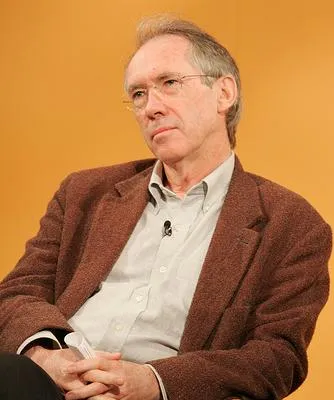
Ian McEwan
Human Design Chart
Biography
Born into an army family, McEwan read English and joined the hippy trail in a dayglow camper van in the '70s. He was married to Penny Allen (then a journalist who later became a healer) from 1982 to 1995.
Fascinated by the phenomenology of evil and by innocence and regeneration through the recovery of childhood, he writes with brilliance, wit, clarity of vision and originality. The stark immediacy of his realism is sometimes shocking as he portrays nihilism, death and the sexual decay of betrayal, to the renewal of the human spirit through its journey.
Ian McEwan as a Generator 2/4 in Human Design
Generator 2/4 — Design at a Glance
Ian McEwan's design tends towards sustained, powerful endurance if the activity is accompanied by inner confirmation. As a Generator, he had a large sacral energy, which made him extremely strong and enduring like a workhorse – provided he had energy for his task. However, this configuration brought two specific pitfalls. The first was persistently doing things he actually didn't enjoy, which wasted his energy and could lead to burnout despite high productivity potential. The second danger was being prevented from working on his heart project, even though he still wanted to continue with full power.
His design required him not to initiate but to react. His sacral center's energy was primarily released when it could respond to impulses from life. The most successful strategy for him was to wait for a signal and then, when the sacral center clearly said, "Yes! Let's get started!", to act accordingly. Living in harmony with this reaction, no one could stop him and he was rewarded with a feeling of deep fulfillment. If he constantly initiated against this inner rhythm, he was likely to encounter persistent frustration or a lack of energy sooner or later. His path was thus characterized by waiting for the right impulse to then act from the gut.
Sacral Authority
Ian McEwan's design tends towards immediate, physical reactions to external stimuli. His inner authority was the Sacral Authority, carried by the defined sacral center. As a Generator, this was also his strategy, simplifying the decision-making process: He did not act through planned thinking but through spontaneous response. A prerequisite for this was an open emotional center, preventing quick judgments and allowing space for this physical voice.
This authority showed as a gut feeling or surge of power – audible as grunting, humming, or a simple "Hmm". When this reaction occurred, he felt vital and energized. The work was then done with great enthusiasm, without the need for an external purpose. The joy in the act itself was the motivation. Additionally, the activated spleen center acted as a supportive instance. It connected with the sacral center and enabled quick, spontaneous decisions. Ian McEwan thus had an immediate access to his instinctive perception and physical well-being. This combination allowed him to reliably be guided by these inner signals, rather than getting lost in intellectual deliberations. The energy was available as soon as the right trigger came, and he could fully immerse himself in the activity.
The 2/4 Profile — Hermit / Opportunist
Ian McEwan's design tends towards a dynamic balance between extreme withdrawal and a deep need for community. As a natural talent and networker (Profile 2/4), an inner tension was evident: Line 2, the Hermit, demanded intensive phases of isolation to dive into internal processes and gain clarity. Simultaneously, Line 4, the Community, drew him into the circle of his closest confidants.
This profile thrives on change. In the "cave" of solitude, he could reflect on his network's knowledge, evaluate it, and develop brilliant ideas. Once this need for peace was fulfilled, the need for company came to the forefront again. Clear communication was crucial: He had to signal externally when he sought company and when he needed to be undisturbed.
Line 2 brings a certain susceptibility and vulnerability, often extreme in its rhythms, which can be perceived as bizarre from the outside. These extremes are valuable, as they create a wide range of rhythms. Line 4 addresses the survival of innocence and develops transpersonally. It recognizes the ego as a challenge and preserves innocence, similar to a rose on a garbage dump, upholding the highest principles. This combination allows him to exert social influence through an infectious nature while simultaneously maintaining his own integrity and humility in his own rhythm.
Single Definition — Defined & Open Centers
Ian McEwan's design points towards a tendency towards a fixed, reliable self-identity and a clear sense of life direction. With a defined G Center, he had the ability to love others without becoming dependent on them, and naturally showed others new directions. This inner security contrasted with his energetic orientation: The defined Sacral Center generated a tremendous vital force that expressed itself as a constant hum or restlessness. His strategy was not to initiate but to wait for questions or invitations, to check from the gut whether energy was available with an immediate yes or no response. This protected him from exhaustion and frustration that arise when mental decisions override the sacral reaction.
At the same time, Ian McEwan was vulnerable to conditioning through several open centers. The open Head Center tended to get stuck in mental pressure and doubts by trying to answer questions that were not its own. The open Ajna Center could take in concepts and theories without identifying them as personal truth, which could lead to uncertainty when it tried to prove itself intellectually. The open Heart Center lacked consistent willpower, leading to the temptation to make promises to prove one's worth – a cycle that often ended in self-disapproval. Additionally, the open Solar Plexus Center absorbed the emotions of the environment, which could lead to personalizing others' moods and making emotional decisions that were later regretted. The open Spleen Center carried a fundamental fear of survival, which could lead to clinging to unhealthy situations to gain a false sense of security. Finally, the open Root Center amplified external stress, leading to a cycle of hyperactivity and trying to relieve pressure through overwork. Ian McEwan thus showed himself as someone who had to use his firm inner direction and sacral energy to avoid being drawn into a whirlpool of mental confusion, emotional ups and downs, and external pressure.
Channels for persistent discovery and resolute self.
Ian McEwan's design points towards a tendency towards deep, persistent discovery. The Discovery Channel 29-46 connects his Sacral Center with the G Center. Gate 29, 'Depth within the Depth', offers access to the well of endurance only through positive reaction. Gate 46, the Self's Resolve, links him to the direction of his Higher Self to be in the right place at the right time. This configuration required letting go of expectations and full commitment. Only through correct yes-saying could he remain persistent without being swayed by others. The experience had to be lived through before its meaning was revealed at the end.
Additionally, other gates were at work. Gate 15 represents collective behavior and establishes logical flow in societies through adaptation to natural rhythms. Gate 10, the most complex gate in the G Center, feeds the integration process and supports one's own convictions. It shapes life through genetically predetermined behaviors that contribute to survival through proper action at the right time. Gate 25 allows access to unconditional love through mystical paths and tests innocence in the spiritual process. Gate 2 defines receptivity as the basis for every reaction and transforms external changes into new evolutionary directions. Gate 1 emphasizes uniqueness and creative mutation in the here and now, with creative expression occurring at the right time. Gate 7 projects patterns for the future and shows the need to test hierarchies through experiments. Together, these elements create a profile aligned with deep immersion, patience, and later sharing of insights with the collective.
Collective Circuitry — Circuit Signature
Ian McEwan's design points towards emotional wave movements that cyclically repeat and always have a beginning, a middle, and an end. This structure shaped his way of processing past experiences: Instead of cool, future-oriented logic, reflecting on the past to find hidden meaning was prioritized.
This mechanism results from the Meaning-making Circuit. Unlike the Understanding Circuit, which relies on reason, this circuit focuses on emotions and intuitive insights that often feel inexplicable or illogical. In Ian McEwan, this circuit was active through the Discovery Channel (Gates 46 and 29). This channel specifically connects the Identity Center with the Sacral Center. Since both centers lie in the same energetic group, energy flowed directly between them: The deep, felt insights from the Identity Center were translated into concrete actions or expressions of form by the creative power of the Sacral Center.
The goal of this configuration was not only to carry the emotional insights gained from the past individually but to share them with the collective. Through this exchange, lessons were to be learned from history together. The energy worked in waves – it rose, reached a peak, and fell again, guiding Ian McEwan to wait for his insights until the emotional wave reached its natural conclusion before passing them on.
Right Angle Cross of the Vessel of Love 2
Ian McEwans Human Design shows a tendency towards emotional penetration that is less about open display and more about the subtle, often unspoken intensity of interpersonal bonds. This configuration, known as the right cross of the Love Vessel 2, describes a specific kind of connection where feelings are not primarily conveyed through words but through a deep, almost intuitive resonance. It is an energy that anchors relationships on a level of silent dedication and inner engagement, far from theatrical gestures.
For Ian McEwan, this meant that his way of engaging with others was marked by a certain restraint, which is not to be understood as distance, but as a protective space for sensitive emotional currents. The mechanics of this cross work like an invisible thread that connects people on a very personal, often painful level. It is not about superficial sympathy, but about carrying shared burdens and understanding weaknesses without judging them.
This structure shaped an attitude where love and pain are intricately intertwined, with the true strength lying in enduring and diving into this vulnerability. Ian McEwan showed himself to be someone who valued this deep emotional work not because it was easy, but because it was authentic. The energy of this cross demands a dedication that often happens in the shadows, but still forms the foundation for the most meaningful connections. It is a force that works through silence and presence, not through noise.
Saturn Return · Uranus Opposition · Chiron Return · 2nd Saturn Return — Life Cycles
Ian McEwans Human Design shows a clear structure where external recognition and internal shifts coincide at specific cyclical points. In 1976, at the age of 28, he received the Somerset Maugham Award for „First Love, Last Rites“. This first Saturn Return often marks the moment when years of silent hard work condenses into a tangible, publicly visible result. The mechanics describe here the transition from the learning phase to an established position, where ones work gains structure and weight.
Another crucial point occurred in 1995 when he divorced Penny Allen. At 47, he was in the realm of the Chiron Return. In Human Design mechanics, this is not a healing process in a therapeutic sense, but a fulfillment cycle. Here, the incarnation cross unfolds increasingly; old, no longer useful structures dissolve to make way for the true life task. The divorce was part of this necessary cleanup phase that clears the path for the next developmental stage.
Confirmation of this path came in 2004 with the Santiago Prize for „Atonement“. At 56, Ian McEwan went through his second Saturn Return. This cycle cements the achievements of the first return and establishes them permanently. The award was no coincidence, but the logical consequence of a strategy that relied on long-term consistency and the integration of earlier experiences. The design thus shows a path from the first confirmation through a deep inner reorganization to the final establishment.
Generator · Sacral Authority — Synthesis
A central red thread in this design is the deep connection to sacral energy and the accompanying life force. The sacral authority, paired with the Generator type, points to a person who makes authentic decisions through immediate reaction to stimuli and an inner „power surge“ (Sacral Center). This energy is not unbound; it is channeled through the Discovery Channel (Sacral-G Center), indicating a deep, physical connection to ones direction and destiny. The repeated successes (1976, 2004) that accompany creative work and the ability to guide others into new directions (defined G Center) underscore this energetic alignment towards generating and sharing life energy.
The design reveals a central paradox between the need for inner depth and the desire for community. The profile as a Natural Talent/Networker (Lines 2/4) describes a swing between withdrawing into ones own world for clarification (Line 2) and seeking connection and exchange with others (Line 4). This pendulum is reinforced by the right cross of the Love Vessel, which points to a deep emotional sensitivity and the need to share experiences – a need that is repeatedly interrupted by the desire for autonomy. The placement of Saturn and Chiron return cycles with both successes and relationship experiences underscores the cyclical nature of this inner tension.
1 Defined Channel
Incarnation Cross - Right Angle Cross of the Vessel of Love 2
Solar Return
The Solar Return shows the moment when the sun returns to its exact birth position - your personal solar year.
Life Cycles
Discover the life cycles with a detailed triple view (birth chart, cycle chart, composite).
Human Design Profile
- Type
- Generator
- Strategy
- To respond - wait for something to respond to
- Authority
- Sacral Authority
- Profile
- 2/4 - Hermit / Opportunist
- Definition
- Single Definition
- Incarnation Cross
- Right Angle Cross of the Vessel of Love 2
- Date of Birth
- 21.06.1948 08:30
- Place of Birth
- Ash, United Kingdom
Frequently Asked Questions
What is Ian McEwan's Human Design type?
What Profile does Ian McEwan have in Human Design?
What Authority determines Ian McEwan's decisions?
What is Ian McEwan's incarnation cross?
When was Ian McEwan born?
Discover your own Human Design
Are you also a Generator? Find out in a personal reading how to use your sacral energy correctly and discover deep satisfaction.
More Personalities
Back to overviewAaliyah

Alain-Fournier

Alexia

Angèle

Angeli

Anne-Marie