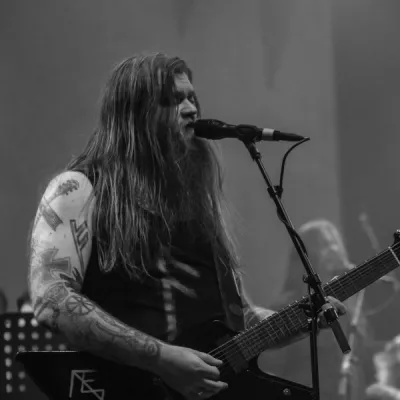
Ivar Bjørnson
Human Design Chart
Biography
Bjørnson and Grutle Kjellson performed in a death metal band called Phobia in 1989. The two decided that they wanted to form a new band in a more black metal style, and their shared fascination with Norse mythology laid the groundwork for Enslaved. Beyond his duties on guitar, Bjørnson writes almost all of the music for Enslaved as well as much of the lyrics. He contributed keyboard/synth work to Borknagar's first three albums and synth/piano work on the Gorgoroth albums Incipit Satan and Destroyer under the name "Daimonion"; and also produced the first demo from black metal band Orcustus.
In 2014, the Norwegian government commissioned Ivar and Einar Selvik (Wardruna) to create a musical piece in celebration of the 200th anniversary of the Norwegian constitution. The arrangement, titled 'Skuggsjá', was performed by Enslaved and Wardruna as a concert piece at the Eidsivablot festival in Eidsvoll, Norway on 13 September 2014. The music drew on the history, culture, and language of Norway and its Norse tradition, telling the story of Norway and contextualising the past in Norway's present. The pair later decided that the project should be expanded upon, and further shows followed, including one at the popular Roadburn festival in 2015. They used the project's name and released the project as a full-length studio album on 11 March 2016.
Ivar Bjørnson — Manifesting Generator with Profile 6/2
Manifesting Generator 6/2 — Design at a Glance
Ivar Bjørnson's design was characterized by a hybrid dynamism: the constant energy of a Generator paired with the ability to skip steps and achieve results quickly. This configuration created a tension between natural speed in multitasking and the risk of skipping important stages or getting frustrated with parallel projects.
As an Manifesting Generator, he had a defined sacral energy source, which made it necessary for him to respond to impulses rather than initiate independently. His design allowed him to bring things into life quickly but also presented two specific challenges: the danger of neglecting necessary intermediate steps due to haste – often leading to backtracking and thus frustration about the lack of self-mastery – as well as a tendency towards multitasking.
Success and deep satisfaction came only through strict adherence to his strategy: responding to life impulses and always checking for sacral approval ("Yes!"). Regular reviews of ongoing projects ensured that his authority continued to support the endeavor. Under these conditions, his drive for variety transformed into a productive play mode where parallel work was not seen as a distraction but rather as a source of creativity and fulfillment.
Emotional Authority
Ivar Bjørnson's design showed a tendency towards emotional delay in decision-making. His chart displays emotional authority, meaning that the defined Solar Plexus Center takes over his inner guidance. This applies regardless of which other centers are also defined; the emotional wave always has priority over other impulses.
This mechanism generates a permanent rhythm of emotional highs and lows. The perception of the world is strongly colored by the current mood: A project can appear absolutely brilliant in one moment, yet completely worthless in the next. These fluctuations are not contradictions but natural waves of the system. An immediate reaction to such an impulse would be unreliable as it only reflects a fleeting snapshot and not the deeper truth.
Quick, spontaneous decisions based on emotion could therefore lead to misjudgments. Ivar Bjørnson's strategy was to take time. By consciously "sleeping" on important questions, he gained emotional distance. Intense feelings subsided, allowing for clarity and calmness. This process of maturation is essential, especially in long-term life decisions that shape his path. Patience replaced impulsive action to ensure that the chosen decision truly aligned with inner truth rather than a passing mood.
The 6/2 Profile — Role Model / Hermit
Ivar Bjørnson's design was marked by a clear two-phase life journey. In the first three decades, experimentation dominated: trial and error characterized his early years, driven by the need to gather personal experiences. This phase was less about strategic planning than direct immersion into situations to learn from them.
After turning 30, this dynamic fundamentally shifted. The focus moved towards withdrawal and intensive reflection. Ivar Bjørnson showed a tendency to withdraw – metaphorically speaking, into a "cave" – to integrate the previously gathered experiences. This process of distancing was crucial for his development. It allowed him to establish common sense as a guiding principle and recognize that pure power or will alone is insufficient.
Line 6 in his profile promoted this ability to integrate and let go of old patterns. Authenticity arose not through constant dominance but through reflective distance. The second line, representing decisiveness and solitude, required these quiet phases for the recovery of willpower. Without this preparation, it risked appearing as a "paper tiger"; with it, Ivar Bjørnson developed deep self-awareness.
This path culminated in the role of a wise mentor. Through his authentic distance and wisdom gained from personal experience, he became attractive to others seeking to learn from his ability for deep introspection. His design thus described a transformation from an experimenting beginner to a role model that influences through common sense rather than mere authority.
Single Definition — Defined & Open Centers
Ivar Bjørnson's Human Design profile indicated a tendency towards immense energetic density and constant activity. Seven defined centers created a permanently running mind (Ajna Center), generating concepts continuously, coupled with reliable expression through the defined throat center. This allowed him to translate thoughts directly into words or actions. His firm identity and direction came from the defined G-Center, while the Heart Center provided available willpower and ego strength. The engine for this endurance was the Sacral Center, flanked by the emotional depth of the Solar Plexus as inner authority. Additionally, the defined Spleen Center offered an instinctive protection mechanism in the present moment.
In contrast, the Head and Root Centers were open. The open Head Center meant that inspiration wasn't generated internally but had to be taken situatively from outside; Ivar Bjørnson tended to question whether he had found the right answer or inspiration when external stimuli were lacking. The open Root Center absorbed stress from the environment rather than producing it, often leading him to try and rid himself of this foreign pressure through hyperactivity, which only generated an endless cycle of exhaustion since the stress wasn't his own and thus couldn’t be eliminated by his actions alone. This mechanism showed a person who constantly conceptualized, spoke, and acted, filtered through intuitive Spleen instincts but vulnerable to external mental confusion and absorbed stress.
Channels for intuitive action, rhythm, curiosity and community.
Ivar Bjørnson's Human Design profile indicated a tendency towards charismatic, spontaneous vitality when he responded to inner resonance. This power came from Channel of Charisma 34-20: The raw life energy of the Power Gate (34) in the Sacral Center flowed directly into the Now Gate (20) in the Throat Center. This allowed sustained activity over longer periods and effective action in the moment – provided that the energy was used only for things that truly brought joy. When this inner guidance was replaced by mental 'shoulds', the energy became chaotic or obsessive; with correct alignment, it naturally inspired others without Ivar Bjørnson having to actively engage them.
This dynamic manifestation power was refined through Channel of Flash of Insight 57-20. Here, intuitive insight from Gate 57 (Spleen) connected with the same Now Gate (20). This gave him the ability to clearly express spontaneous truths or existential insights in the moment. His verbal outbursts often hit the core of a matter faster than deliberate thought, as they were based on deeply rooted survival instincts rather than mental analysis.
Simultaneously, Channel of Rhythm 5-15 and Channel of Curiosity 11-56 shaped his essence. The Rhythm Channel linked firm habits (Gate 5) with a love for extremes and diversity (Gate 15), integrating him into a natural, universal life flow. His own timing ability magnetically drew others as long as he followed this inner pulse. Parallel to this, Channel of Curiosity 11-56 drove his role as storyteller: it connected abstract ideas (Gate 11) with constant stimulation-seeking (Gate 56), weaving stories that entertained or taught others. This combination of charismatic action, intuitive clarity, and rhythmic storytelling formed the foundation of his energetic presence.
Individual Circuitry — Circuit Signature
Ivar Bjørnson's Human Design profile indicated a tendency towards impulsive, intuitive power. His energy didn't work through long-term planning but as an immediate reaction to the present moment. This is reflected in his simple definition: all defined centers – Sacral, G-Center, Throat, Ajna, Spleen, Heart and Solar Plexus – are directly connected via channels, forming a single, continuous energetic flow.
This flow manifests through several circuits. The Integration Circuit linked his Throat, Sacral, and Spleen Centers. Here, Gates 34 (power from reaction), 57 (intuition) and 20 (the present moment) worked together. His driving force was individual transformation guided by correct behavior and intuitive knowledge that became effective in the moment of occurrence.
Parallel to this, the Knowledge Circuit linked his Throat with Spleen Center via Channel 20-57 (Flash of Insight). This promoted innovative insights and creative expression immediately expressed. The Understanding Circuit connected Identity and Sacral Centers (Channel 15-5), providing focused strategy and rhythmic endurance.
The Meaning-Finding Circuit linked Ajna and Throat Centers (Channel 11-56). This allowed reflecting on past experiences and sharing these insights with others. Finally, the Ego Circuit linked his Throat, Heart, and Solar Plexus Centers (Channels 45-21 and 40-37), focusing on cooperation, resource exchange, and emotional support within a community.
All these energies worked in Ivar Bjørnson not isolated but as an integrated system. His intuition, his power, and his mind flowed together, driven by the need to act in the present moment and strengthen himself and others.
Left Angle Cross of Duality 2
The raw content for the left cross of duality does not provide a descriptive basis. The substantive content is missing to derive a specific character trait or behavior from Ivar Bjørnson. Without this mechanical definition, it is impossible to make a personality assessment derived from the chart. Characterization here would rely on unfounded assumptions and would violate the requirement to orient solely towards delivered facts. Therefore, this aspect of the design remains excluded in the analysis as no reliable translation into human behavior or inner dynamics occurs. Neither an event nor a general tendency is described, since the underlying mechanics are not defined in the given material. This prevents any emphasis or interpretation of this specific element. The analysis focuses therefore on other clearly described aspects of the design to ensure a precise and fact-based representation.
Saturn Return · Uranus Opposition — Life Cycles
Ivar Bjørnson's design showed a pronounced readiness to break established structures to give space for new impulses. This tendency towards disruptive change became tangible in 2016: At age 39, he released the studio album 'Skuggsjá'. This success marked a clear break with the familiar and aligned with the mechanics of the Uranus opposition. This astrological aspect often acts as a catalyst for sudden turns that dissolve old patterns and create liberation. For Ivar Bjørnson, this moment was not an arbitrary decision but a natural consequence of his inner dynamics, which strive towards renewal and innovation. The Uranus opposition fosters exactly this energy: It does not only force adaptation but enables breaking free from outdated conditions. In this case, the process led directly to a creative peak. The album 'Skuggsjá' thus represented the result of a profound transformation where the old had to give way for new creation. Ivar Bjørnson effectively utilized this energetic push to steer his musical vision into a new direction. The mechanics here show how external events can mirror inner necessities. The success in 2016 was less an isolated event than rather the visible effect of a long-lasting inner development, accelerated and focused by Uranus influence. It was about freeing himself from artistic conventions towards a more authentic expression.
Manifesting Generator · Emotional Authority — Synthesis
Ivar Bjørnson seems to be marked by a deeply rooted inner drive that manifests through the combination of manifesting generator energy and emotional authority. The ability to quickly react to impulses (Sacral Center) is complemented by a need for reflection and waiting for emotional clarity (Solar Plexus). This interplay points towards someone who is both dynamic and profound, capable of quick action but always mindful of making decisions from a position of inner certainty. The connection between creativity and strategic thinking (Channel 20-57) as well as the ability to amplify energy through community (Ego Circuit), underscore a complex personality that is both individually and collectively oriented.
A central tension field lies in the combination of quick reaction and emotional wave. The tendency to tackle things swiftly (manifesting generator) stands in contrast to the need to make decisions only after a phase of emotional maturation. This creates a paradox between the impulse for immediate action and the inner demand for clarity and deliberation, which constantly forces Ivar Bjørnson to find ways to effectively channel his energy while maintaining inner balance.
7 Defined Channels
Incarnation Cross - Left Angle Cross of Duality 2
Solar Return
The Solar Return shows the moment when the sun returns to its exact birth position - your personal solar year.
Life Cycles
Discover the life cycles with a detailed triple view (birth chart, cycle chart, composite).
Human Design Profile
- Strategy
- To respond - wait for something to respond to
- Authority
- Emotional Authority
- Profile
- 6/2 - Role Model / Hermit
- Definition
- Single Definition
- Incarnation Cross
- Left Angle Cross of Duality 2
- Date of Birth
- 27.11.1977 05:30
- Place of Birth
- Bergen, Norway
Frequently Asked Questions
What is Ivar Bjørnson's Human Design type?
What Profile does Ivar Bjørnson have in Human Design?
What authority does Ivar Bjørnson have?
What is Ivar Bjørson's incarnation cross?
When was Ivar Bjørnson born?
Discover your own Human Design
Are you also a Manifesting Generator? Find out in a personal reading how to unfold your multi-talents and direct your energy wisely.
More Personalities
Back to overviewAaliyah

Aldair
Alexia

Alizée

Angèle

Angeli