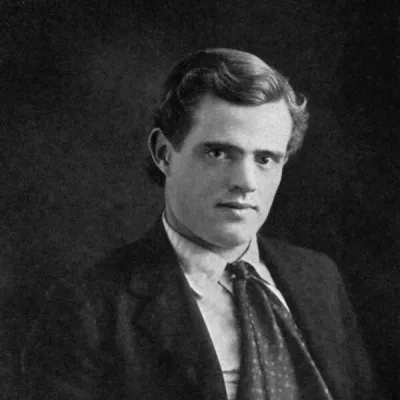
Jack London
Human Design Chart
Biography
London was part of the radical literary group "The Crowd" in San Francisco and a passionate advocate of animal welfare, workers' rights and socialism. London wrote several works dealing with these topics, such as his dystopian novel The Iron Heel, his non-fiction exposé The People of the Abyss, War of the Classes, and Before Adam.
His most famous works include The Call of the Wild and White Fang, both set in Alaska and the Yukon during the Klondike Gold Rush, as well as the short stories "To Build a Fire", "An Odyssey of the North", and "Love of Life". He also wrote about the South Pacific in stories such as "The Pearls of Parlay" and "The Heathen".
What does Projector 2/4 mean for Jack London?
Projector 2/4 — Design at a Glance
Jack London revealed himself as someone who appeared with an intense, focused presence. His Human-Design Type Projector described an aura similar to a bright flashlight: It directed its beam precisely onto areas in the environment that were still dark or not functioning properly. This configuration gave him the ability to immediately recognize systemic errors and weaknesses in others.
However, this sharp vision carried a risk within it. When he addressed these deficiencies directly, it often felt like glaring light to his surroundings, causing rejection. The mechanics of his design indicated that direct confrontation was ineffective. Instead, his architecture showed that an indirect approach was more effective: By radiating harmony and clarity himself, he attracted others who then asked about his insights on their own initiative.
His strategy involved waiting for a sincere and appreciative invitation before bringing in his knowledge or leadership. Since Projectors do not have a defined Sacral Center, they lack constant life energy. Jack London therefore went through phases of high activity followed by necessary rest periods for regeneration. If he ignored this need for recovery, burnout was imminent. Living according to the pattern of invitation and rhythm, however, rewarded his path with success; deviating from it led to his Non-Self theme: Bitterness.
No Inner Authority
Jack London did not have inner authority, a configuration that set him apart from most people. As a mental projector, he lacked defined centers below the throat. This openness allowed him not to make decisions from a fixed internal source but rather found his orientation through intense exchanges with other humans. In these dialogues, energetic interactions activated dormant potentials in his open centers, enabling him to view and express issues from numerous perspectives. This high resonance ability served him in identifying the right environment and conversation partners.
The evaluation of collected information was a complex process requiring time and solitude. Jack London needed these quiet phases to recognize the red thread in the flood of information and distinguish what made sense and belonged to him. Through this filtering, he developed his specific intelligence: the ability to distill the essential from a mass of data, meaningfully organize it, and structure it. This formed his central capital for success. A key element in his life was being in an environment where he felt comfortable. There, he could discuss decision-making processes with trustworthy people, deepening his sense of what is right over time. His strength did not lie in quick intuition but rather in the careful synthesis of external impulses.
The 2/4 Profile — Hermit / Opportunist
Jack London showed a clear tension between the need for withdrawal and the desire for community. His design as Profile 2/4 established that he constantly oscillated between these poles: On one hand, it drew him into solitude to gain clarity; on the other hand, he sought exchange with familiar people. This dynamic required clear communication of his needs – when he wanted company and when he needed to be left alone.
During his “Me-Time,” London immersed himself in internal processes. This withdrawal served to find peace and order himself internally. Only once this inner balance was restored did he emerge from his
Single Definition — Defined & Open Centers
Jack London's design indicated a tendency towards consequent, unswayed conceptualization. His defined Ajna Center created a consistent mental function; he thought constantly and processed data as well as creativity in specific ways that were hard to change from the outside. This mental structure flowed directly into his defined Throat Center, allowing him to articulate what he conceptualized. His voice served as an anchor point to transform these inner processes into communication and action, often with a stubborn tendency to make decisions based on reason.
At the same time, Jack London was vulnerable to external conditioning through several open centers. His open Head Center meant that he did not have consistent access to inspiration; instead, he tended to absorb mental pressure and get entangled in questions that were not his own. He might seek answers or focal points from others to escape this confusion. His open G Center left him without a fixed identity; he adapted to the environment and gathered directions through interaction with others rather than owning them himself. This made him vulnerable regarding relationships and location, as he often received his direction from outside.
Furthermore, lacking in an open Heart Center, he lacked consistent energy for willpower; he tended to want to prove his worth by making promises that he could not keep, leading to a vicious cycle of self-disapproval. His open Sacral Center made him sensitive to the vital energies of others, causing him to easily become overwhelmed and struggle with setting boundaries or knowing when enough was enough. He absorbed these energies rather than generating them himself. The open Solar Plexus Center amplified foreign emotions within him, leading him to oscillate between happiness and depression while avoiding confrontation to avoid being rejected. Finally, his open Root Center took stress from the environment, driving him into cycles of hyperactivity and burnout as he tried to shed this non-self-owned pressure.
Channels for logical order and mental clarity.
Jack London showed himself to be someone whose mind was intent on making complex realities comprehensible through logical structuring. His design indicated a tendency not only to passively absorb information but actively integrate it into a coherent mental system before articulation.
This attitude was significantly shaped by the Accepting Channel 17-62. This channel connects the Ajna Center with the Throat Center and links visual pattern recognition (Gate 17) with linguistic translation of details (Gate 62). For Jack London, this meant that understanding only occurred when he logically integrated new impressions into his existing worldview. Anything that escaped this internal organization remained incomprehensible to him. Simultaneously, this center exerted a constant pressure on the Throat Center to communicate these structured opinions and detailed explanations. The ability to translate visual patterns into formulas or theories formed a foundation for conveying knowledge to others, provided the timing of communication matched the recipient's receptivity.
Furthermore, additional gates contributed to the specific manifestation of his perception. Gate 32 sought continuity and material success for the tribe while simultaneously initiating radical changes when stability was threatened. Gate 42 emphasized that experience is key to growth and that completing processes is necessary to take on new commitments; blockages arose here due to lack of decisions. In the realm of inner knowledge, Gate 61 acted as a pressure for individual insight, a struggle for silence amidst mental noise to recognize one's truth. Gate 20 promoted awareness in the present moment and access to authentic self through proper action. Finally, Gate 4 supported the formulation of logical processes for future security by clarifying suspicious patterns while Gate 23 enabled the translation of inner sounds into language to explain anomalies and mutations within the collective.
Collective Circuitry — Circuit Signature
Jack London showed himself as someone who brought logical insights into clear, understandable forms. His design was marked by a simple definition, meaning his energetic forces were not scattered but formed a coherent flow. This focus lay in the Understanding Circuit, an area dealing with strategy, structure, and rational improvement of society. Important here was the distinction from emotions; it involved an 'emotionless ratio' meant to remain free from conditioning.
The concrete connection for Jack London existed between the Ajna Center (the center of thought, focus, and visual imagination) and the Throat Center (the center of expression and action). This linkage occurred through the Accepting Channel. This channel allowed him to directly translate inner thoughts and strategic considerations into words or actions. He shared his rational insights not only privately but made them accessible for others.
As his design featured a simple definition, this connection existed as one large energetic unit. There were no separate parallel running energy fields that he had to balance simultaneously. Instead, his energy focused on carrying the thought outward through acceptance and communication. This served the overarching goal of the circuit: improving things and guiding society towards a better future by clearly communicating logical connections. His way of acting was thus directly determined by this connection between inner focus and outer expression.
Right Angle Cross of Maya 4
Jack London's Human Design profile featured the right-hand cross of Maya Four. This configuration established a foundational disposition characterized by a profound connection to Earth and material life. It was an energetic blueprint that prioritized stability, nourishment, and understanding the physical reality.
In Human Design, this cross signifies the ability to grasp and appreciate life in its concrete, tangible form. It's not about abstract theories or spiritual detachment but rather about the here and now. Jack London demonstrated through this mechanism someone who recognized the value of the everyday. His energy was directed towards utilizing resources, understanding the physical world, and being grounded in the material realm.
This orientation fostered a pragmatic worldview. It helped him to address challenges not just intellectually but with hands-on effort and bodily engagement. The connection to Earth acted as a stabilizing factor that allowed him to find footing even in difficult environments. This design demanded respect for nature and its laws. Jack London lived this interconnectedness by focusing on the physical aspects of his existence. His strength lay in drawing meaning from material reality and using it as a foundation for his actions. This grounding gave him exceptional endurance and a clear understanding of how life truly works.
Saturn Return · Uranus Opposition — Life Cycles
Jack London exhibited relentless urgency that drove him into direct conflicts with external structures. This attitude was evident in 1904, at the age of 28, when he attempted to travel secretly as a war correspondent to Korea but got arrested, marking his first Saturn Return. This cycle often condenses years of internal work into a sharp reality check; here it presented London's design confronting authority limits that tested his resolve.
Later, in 1915 at the age of 39, he experienced a Uranus Opposition. This event coincided with Hawaii being mentioned again, a place where valuable short stories had emerged earlier. The Uranus Opposition often breaks old bonds or patterns to allow new perspectives. In Jack London's case, this astrological impulse was linked to reflecting on past creative sources. It wasn't mere nostalgia but a moment of breaking free from previous relationship patterns in favor of a more liberated alignment of his creative energy. His design challenged him to reassess the roots of his creation and place them within an expanded context beyond initial experiences.
Projector · No Inner Authority — Synthesis
Jack London, as a Projector, seemed marked by a constant oscillation between the need for isolation and the search for connection (Profile 2/4). This dynamic was reflected in his ability to recognize patterns and grasp details (Acceptance Channel: Gates 17 & 62), then articulate them precisely—a process that granted him inner understanding. He was designed to bring 'light into darkness' for others by pointing out weaknesses, though this wasn't always well-received. His defined mental authority (Ajna Center) suggests a persistent thought process and the ability to develop concepts and influence others through his ideas—an analytical approach to improving the world rooted in the Mind Circuit.
A central paradox in his design lay in the combination of this mental clarity with the absence of physical authority. He had the capacity to analyze situations and offer solutions but was dependent on external validation for his decisions, which might have led to internal conflict, especially during the Saturn Return (1904) and relationship dynamics shown in the Uranus cycle (1915). Thus, he lived in a tension between the urge to articulate his visions and the necessity of finding resonance with others.
1 Defined Channel
Incarnation Cross - Right Angle Cross of Maya 4
Solar Return
The Solar Return shows the moment when the sun returns to its exact birth position - your personal solar year.
Life Cycles
Discover the life cycles with a detailed triple view (birth chart, cycle chart, composite).
Human Design Profile
- Type
- Projector
- Strategy
- Wait for the respectful invitation
- Authority
- No inner authority - learn more
- Profile
- 2/4 - Hermit / Opportunist
- Definition
- Single Definition
- Incarnation Cross
- Right Angle Cross of Maya 4
- Date of Birth
- 12.01.1876 14:00
- Place of Birth
- San Francisco, California, United States
Frequently Asked Questions
What was Jack London's Human Design type?
What profile did Jack London have?
What authority did Jack London have?
What incarnation cross did Jack London have?
When was Jack London born?
Discover your own Human Design
Are you also a Projector? Find out in a personal reading how to unfold your leadership qualities and recognize the right invitations.
More Personalities
Back to overviewSissy Spacek

Alain-Fournier
Anémone

Angeli

Ann-Margret

Bourvil