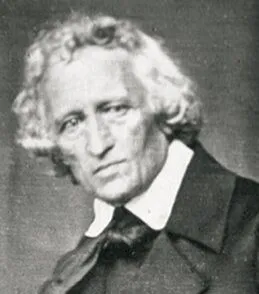
Jacob Grimm
Human Design Chart
Biography
Jacob Grimm — Projector with Profile 6/3
Projector 6/3 — Design at a Glance
Jacob Grimm was someone with a dense, focused aura that illuminated systems. His design inclined him to immediately recognize where in his environment something wasn't functioning or operating in the dark. As a projector, he acted like a bright flashlight, directing light towards weaknesses and guiding others. However, this ability to identify flaws instantly came with a specific challenge: directly addressing these issues risked irritating others, similar to shining a light directly into someone's eyes.
Jacob Grimm's effective strategy therefore wasn't to point out errors without restraint but rather to wait until people honestly and respectfully asked for his advice. Through this patient approach, he could convey his insights in a way that was accepted instead of triggering resistance. Since projectors do not have an undefined Sacral Center, they lack a constant intrinsic energy source. Jacob Grimm experienced phases of high activity and rapid productivity followed by necessary rest periods to prevent burnout. Respecting his own energy balance was crucial for avoiding the typical non-self trap of bitterness and instead finding the success intended by his design.
Emotional Authority
Jacob Grimms' design inclined him towards emotional wave motion, often clouding spontaneous judgments. His inner authority came from the defined Solar Plexus Center – emotional authority. This center ensured that his perception was always colored by current moods: enthusiastic in one moment, negatively surprised about the same thing in another. Since these feelings were mere snapshots and not necessarily reflective of his deeper truth, quick, impulsive decisions were risky and often disadvantageous for him.
The mechanics of his authority therefore required a time gap. Jacob Grimm had to let emotional waves subside before clarity emerged. Practically speaking, this meant he did not make important decisions immediately but rather 'slept on them.' Through waiting, he gained emotional distance; the initial intensity of feelings subsided, and calmness set in. Only then could he comprehensively understand the situation and make a well-founded choice. This process was particularly crucial for long-term life decisions that shaped his entire life path. Emotional authority always took precedence over other defined centers in his design; its cycle logic significantly determined how he interacted with himself and the world.
The 6/3 Profile — Role Model / Martyr
Jacob Grimms' design inclined him towards intense experimentation, which later transformed into wise authority. In the first three decades of his life, he lived as a 3/3, characterized by numerous self-experiments and adaptation processes. This phase was marked by the line of adventure, leading through trial and error to the perfection of intuition.
After about thirty years, this dynamic experimentation slowed down but never fully ceased. The development shifted towards unbendingness and role modeling. Jacob Grimm exhibited inner restlessness driven by a search for extraordinary perfection far from common standards. This internal conflict between striving for an ideal and accepting misunderstandings was characteristic of his line 6.
This line went through three phases: initially trial and error, followed by distancing, and finally the role as an example. The associated misunderstandings required an unbending stance that ultimately led to a mutation. This development allowed Jacob Grimm to transform his unusual experiences into far-sighted insights. He became a humorous role model who saw responsibility and wisdom as self-evident. His life task was to influence through this transformation and inspire others with his example, without completely abandoning the experimental nature of line 3.
Single Definition — Defined & Open Centers
Jacob Grimm exhibited a fundamental disposition rooted in inner emotional clarity and intuitive certainty while leaving mental and identity-related questions to the environment. His design was marked by three defined centers: Solar Plexus, Spleen Center, and Root Center. The defined Solar Plexus served as his internal authority; Jacob Grimm learned to wait for the wave movement of his emotions before making decisions. Truth revealed itself to him not in the moment but over time. This patience protected him from impulsive reactions and allowed for deep, sensitive judgments.
The defined Spleen Center provided him with a spontaneous survival instinct in the present moment. He trusted this immediate intuition for health and well-being without needing to rationalize it. In conjunction with the defined Root Center, his design generated constant pressure for existential flourishing and material stability. This pressure drove him forward in the world while the Spleen connection ensured that this drive was based on a healthy, intuitive foundation.
In contrast, five centers were open: Head, Ajna, Throat, G, Heart, and Sacral Center. The open Head Center meant Jacob Grimm did not have consistent mental inspiration; he tended to engage with questions that were not his own when he did not trust in his emotional authority. His Ajna Center was also open, making him receptive to concepts and theories from the environment without these forming his personal truth.
The open G Center indicated a lack of fixed identity or direction. Jacob Grimm gathered directions through interaction with others and places; he did not actively seek a life purpose but allowed himself to be initiated. The open Heart Center made him vulnerable to the pressure to prove his worth, despite lacking consistent willpower. Instead, he had to learn to avoid promises based on conditioning.
The open Sacral Center meant an unstable energy flow. Jacob Grimm was not designed to provide continuous generative energy; he tended to overextend himself through borrowed energy from others and suffered exhaustion when ignoring the need for rest. His wisdom lay in protecting his defined emotional and intuitive authority from the conditioning influences of these open centers by waiting on inner clarity and distancing himself from external expectations.
Channels for finding meaning, emotional clarity and inner synthesis.
Jacob Grimm was marked by a fundamental tension: deep emotional anchoring within the collective fabric, yet a stubborn impulse towards individualization. This dynamic resulted from two defined channels in the Root Center. The Synthesis Channel 19-49 connected the Gate of Claims with the Gate of Principles and generated an intuitive sensitivity to clan membership. It functioned as an emotional glue securing loyalty through the code “Love, Honor, and Obedience” and demanded a clear understanding of belief systems and resource protection. Jacob Grimm was programmed to find meaning in confirmation by his clan and maintain his position within this network.
Parallel to this, the Life Struggle Channel 38-28 drove his will towards separation with adrenalinized energy. Through the Gate of Fighter and the Gate of Player, he sought purpose through resistance against external forces threatening his integrity. This channel endowed him with a stubborn determination to follow his own path, even if it caused conflicts with the status quo or community. He found fulfillment in fighting for values he deemed personally significant and used this struggle to preserve his uniqueness.
The combination of these mechanisms created a personality constantly oscillating between harmonious belonging and mutative separation. While Channel 19-49 bound him to clan traditions and rituals, Channel 38-28 challenged him to individualize through stubborn resistance. Jacob Grimm lived in this tension: he needed the emotional security of the group but had to fight against it to define his own identity and life purpose. This duality shaped his actions, driven both by a need for acceptance and a drive towards independent mastery.
Individual Circuitry — Circuit Signature
Jacob Grimms design connected Spleen, Solar Plexus, and Root Center into one continuous energy flow. This configuration generated a specific dynamic: The intuitive perception of the Spleen (Channel 28-38 “Life Struggle”) directly influenced emotional processing in the Solar Plexus (Channels 30-41 “Recognition” and 49-19 “Synthesis”), which in turn was linked to survival impulses in the Root Center.
In the Knowledge Circuit, the channel between Spleen and Root created a pulsing energy aimed at intuition and finding one’s path without cognitive filtering. Parallel to this, the Meaning-Finding Circuit connected Solar Plexus and Root. This allowed Jacob Grimm to cyclically experience emotional waves from the past and gain insights that directly flowed into his action potential. The Ego Circuit completed this chain by also connecting Solar Plexus and Root. Here it was about timeless cooperation and giving and taking within a community. Since there was no connection to the Sacral Center, constant life force was lacking; instead, rest periods were necessary to create resources for the clan.
All three circuits did not operate in isolation but as an integrated system: Intuitive impulses from Spleen triggered emotional processes in Solar Plexus, which in turn steered survival behavior in Root Center. This marked Jacob Grimm as someone who acted through intuitive insights and emotional learning from the past, always serving a larger community, yet dependent on rhythmic rest since no inexhaustible energy source was present.
Left Angle Cross of Individualism 2
Jacob Grimms Design showed a tendency towards strict self-determination. He lived his uniqueness from inner conviction without relying on external validation or societal approval. This attitude stemmed from his configuration as the left cross of Individualism 2.
This specific Human-Design configuration describes a deeply rooted life task: expressing one's uniqueness without feeling compelled to justify it to others. It is not about rebellion for its own sake, but about the authentic unfolding of the individual as an end in itself. Jacob Grimm carried this energy within him, which predisposed him to walk his path because he was meant to, and not because others praised or expected him to do so.
The mechanics of this cross emphasize independence from environmental judgment. For Jacob Grimm, this meant inner stability that allowed him to remain true to himself even when his actions were misunderstood or did not receive immediate recognition from the outside world. His individuality was not a means to an end but the foundation of his existence. He lived this self-determination as a given, which enabled him to make decisions from his own center, free from the pressure to conform to existing structures. This configuration created a space where his personal truth took precedence over collective norms.
Saturn Return · Uranus Opposition · Chiron Return · 2nd Saturn Return — Life Cycles
Jacob Grimm's professional path revealed itself as a result of structural adaptations to external constraints, followed by profound scientific breakthroughs. His first Saturn return around 1813 marked a crisis: After the restoration of the Electorate of Hesse, he lost his position as a private librarian and was transferred into diplomatic service. This cycle forces confrontation with reality and loss of structure, which here led to the loss of his old status.
The Uranus opposition in 1822 brought about an internal rebellion against established norms. At age 37, he formulated the first sound law for Germanic languages. This mechanism promotes breaking away from the Old in favor of new, individual truths, which here manifested as a scientific breakthrough.
The Chiron return around 1835 represented the flowering and unfolding of his life's purpose. At 50 years old, he published "Deutsche Mythologie." This cycle confirms that years of work according to one’s nature have now matured and made the core of incarnation visible.
His second Saturn return in 1841 solidified his achievements institutionally. Jacob Grimm followed the call of King Frederick William IV of Prussia to Berlin, where he became a member of the Prussian Academy of Sciences. This cycle condenses previous work into sustainable results, which here culminated in final establishment. The four cycles thus structured the path from crisis through breakthrough to institutional anchoring.
Projector · Emotional Authority — Synthesis
He was a Projector whose life seemed to be shaped by a deep need to recognize patterns and make them accessible to others (Synthesis Channel). The ability to identify what is missing or malfunctioning in the system went hand in hand with an emotional depth (defined Solar Plexus) that did not allow for immediate decisions but required a maturing period. This combination of sharp perception and inner wave motion led him to work on topics over long periods and only make them public once he had fully grasped their full significance – a process that was reinforced by recurring cycles (Saturn Return, Uranus Opposition).
A central paradox in his design lay in the tension between the drive for innovation and the need for belonging (Knowledge Circuit). On one hand, he strove to gain new insights and challenge existing systems – an expression of his Line 3 as an experimenter. On the other hand, he was sensitive to the needs of his tribe and valued principles and ideals (Synthesis Channel). This duality led him to both pursue unconventional paths and seek validation and recognition within established structures, which is reflected in documented events.
3 Defined Channels
Incarnation Cross - Left Angle Cross of Individualism 2
Solar Return
The Solar Return shows the moment when the sun returns to its exact birth position - your personal solar year.
Life Cycles
Discover the life cycles with a detailed triple view (birth chart, cycle chart, composite).
Human Design Profile
- Type
- Projector
- Strategy
- Wait for the respectful invitation
- Authority
- Emotional Authority
- Profile
- 6/3 - Role Model / Martyr
- Definition
- Single Definition
- Incarnation Cross
- Left Angle Cross of Individualism 2
- Date of Birth
- 04.01.1785 22:30
- Place of Birth
- Hanau, Germany
Frequently Asked Questions
What is Jacob Grimm's Human Design type?
What Profile did Jacob Grimm have in Human Design?
What Authority did Jacob Grimm possess?
What incarnation cross did Jacob Grimm have?
When was Jacob Grimm born?
Discover your own Human Design
Are you also a Projector? Find out in a personal reading how to unfold your leadership qualities and recognize the right invitations.
More Personalities
Back to overviewSissy Spacek

Alain-Fournier

Anémone

Ann-Margret

Bourvil

Hergé