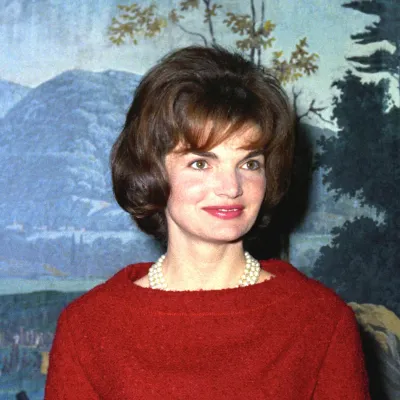
Jacqueline Kennedy Onassis
Human Design Chart
Biography
Raised with advantage and culture, she became a journalist. She married the young Senator, John F. Kennedy on 12 September 1953. In 1955 she had a miscarriage and in 1956, a still-born baby. On 3 August 1957 her beloved dad died, Black Jack Bouvier. On 27 November 1957, their daughter Caroline was born, and son John on 25 November 1960. On 7 August 1963, their son Patrick was born and lived 39 hours; three months later her husband was assassinated, 22 November 1963 in Dallas, TX.
Mrs. Kennedy's primary concern was now the welfare of her two children. In early 1964 she moved to New York. She was conversant in four languages and familiar with world travel.
On 20 October 1968 she married Aristotle Onassis, the world's richest man. The American public were critical, feeling that she should remain an icon of the grieving widow, but she had her children away from the feeding frenzy of the press, with a future that was financially secure. However, she and Onassis had different tastes and drifted apart. He died on 15 March 1975.
Returned to New York, JKO cast about to find fulfilling work, and located in September 1975 with Viking Press for two years as an Assistant Editor. She then moved to Doubleday where she conscientiously brought in prestigious writers, working three days a week.
In approximately 1977 she began a long term, discreet relationship with financier Maurice Tempelsman, who later moved into her 15-room apartment overlooking Central Park.
JKO was diagnosed with lymphoma cancer in January, 1994 and began chemotherapy. Her days were filled with yoga in the morning, walks, family, cultural and philanthropic interests. Unpretentious and private, she was noted for charm, graciousness, kindness and in a word, class.
Jacqueline Kennedy Onassis as a Manifesting Generator 4/6 in Human Design
Manifesting Generator 4/6 — Design at a Glance
Jacqueline Kennedy Onassis was someone who could quickly draw things into her life. Her Manifesting Generator design combined the constant sacral energy of a Generator with the active traits of a Manifestor, allowing her to skip steps and move forward at great speed. However, this quickness also carried the risk of missing important stages or starting multiple projects simultaneously. If she acted initiatively instead of responding to her inner impulses, it could quickly lead to frustration – her specific Non-Self theme. Her strategy was first to react to life and then proceed only when her sacral center gave a clear 'yes'. Only through this response to internal signals could she effectively utilize her creative power. When correctly applying this strategy, Jacqueline Kennedy Onassis derived deep satisfaction from her actions. For her, it was important to fall into a play mode and seek variety; the advice to finish one thing before starting another contradicted her nature; instead, she thrived through parallel activities as long as her inner authority agreed. Her design thus tended towards quick action while simultaneously relying on resonance to avoid frustration and experience fulfillment.
Sacral Authority
Jacqueline Kennedy Onassis made decisions not through intellectual analysis but through immediate physical resonance. Her design inclined toward spontaneous reactions that came from the gut – often audible as a short grunt or an agreeing 'Mhm'. This sacral authority was her inner guideline and strategy: she reacted to external stimuli rather than actively seeking them.
With her Emotional Center open, there was no constant emotional wave movement as a basis for decision-making. Instead, she relied on the surge of energy in the lower abdomen. When this motor kicked in, she felt vital and energized; then she could dive into activities with great enthusiasm without needing a specific goal. The joy of doing itself was the driving force.
Additionally, her activated Spleen acted as supporting authority. This connection allowed her to act particularly quickly and instinctively. She had direct access to her physical well-being and could sense dangers or opportunities immediately. This combination of sacral power and spleen speed shaped how she designed her life: she followed what felt alive in the moment and let this inner truth guide her, independent of external expectations or logical considerations.
The 4/6 Profile — Opportunist / Role Model
Jacqueline Kennedy Onassis was someone whose early years were marked by intense experimental freedom. Her Profile 4/6 worked similarly to a Line 3 during the first three decades of life; she actively sought connections and tested various roles in relationships and friendships. This phase served to gather necessary experiences before her inner compass solidified.
With the activation of Line 6, a characteristic conflict emerged: the desire for community belonging (Line 4) stood in tension with the need to withdraw and reflect on the meaning of life (Line 6). Following this internal dynamic was an evolution path called 'The Success', where motivation strongly depended on external perception. She learned that her influence would be differently valued by others – some felt it positively, others critically. Criticism was not seen as a personal attack but as a necessary part of the improvement process.
Parallel to this, she developed an attitude of care and altruism (Gate 27). This line protected against the misuse of her generosity and promoted fairness. To be productive in helping, she had to trust herself and others. In her later years, it was expected that she would meet the high standards of a wise role model. The large heart of Line 4 remained cautious; it only opened to those deemed trustworthy to avoid being hurt by false people.
Split Definition — Defined & Open Centers
Jacqueline Kennedy Onassis had a design with an enormous inner power source: her defined Sacral Center generated constant vital energy that she used for work and activities. However, this energy was only available when responding correctly to external impulses; initiatives from the mind often led to resistance or exhaustion. Parallel to this, she possessed a defined Heart Center, which gave her strong willpower. She preferred to define her own resources and value, keep promises, and seek recognition for her contribution. Her mental structure was marked by a defined Ajna Center, generating consistent concepts that were hard to influence. This flowed into her defined Throat Center, allowing her to reliably express her thoughts. The defined Root Pressure also provided the necessary tension to move forward and master existential challenges.
In contrast, her design revealed specific vulnerabilities. Her open G Center meant no fixed identity; she tended to blend with her environment and seek direction from others, which could lead to uncertainty about being in the right place or who she truly was. Her open Solar Plexus absorbed foreign emotions, making her vulnerable to emotional waves of others; she risked personalizing these as her own and feeling overwhelmed by them. The open Spleen Center brought a fundamental survival fear that made her cling to people or situations offering false feelings of security rather than trusting her intuition. Finally, her Head Center was open, making it difficult for her to filter mental inspiration; she tended to get stuck in others' doubts and questions instead of relying on her inner authority.
Channels for willpower, clear structuring and organic maturation.
Jacqueline Kennedy Onassis exhibited a fundamental disposition towards logical order and structural clarity. Her design inclined towards detailed analysis combined with the need to linguistically translate complex connections precisely. This configuration shaped how she received and conveyed information: not as mere opinion, but as an organized, understandable structure.
The Accepting Channel 17-62 connected her Thinking Center with her Expression Center. Gate 17 visualized patterns while Gate 62 articulated them in words. This created an internal process of constant review: only what logically fit into her mental system could she truly understand and convey. She had the gift to transform visual impressions into clear theories or explanations, making her a natural teacher – provided she waited for the right timing to speak.
Parallel to this, the Channel of Structuring 23-43 was active. Here spontaneous insight (Gate 43) flowed into an assimilated, contemplative expression form (Gate 23). Her thinking often appeared years ahead, but her challenge lay in communicating this innovative knowledge so that it could be accepted by the collective. Without patience and correct timing, she risked being perceived as an outsider; with the right strategy, her unique perspective became a source of efficiency and change.
On the level of will, the Channel of the Money Line 21-45 showed a strong drive for control and material mastery. Gate 21, the Hunter, urged active leadership while Gate 45, the Gatherer, claimed authority over resources. This channel pushed her to take responsibility to protect and provide for the 'tribe' – her family or organization. Success came when she maintained independence and set her own rhythm rather than being controlled by others. The tension between a desire to serve the whole and the need for personal autonomy was a central theme of her life.
Additionally, Gates like 31 (Transference of Identity) and 27 (Caring Role) shaped how she positioned herself in the collective: as someone who achieved impact through care and clear leadership, always mindful of the balance between self-interest and others' well-being.
Collective Circuitry — Circuit Signature
Jacqueline Kennedy Onassis was revealed by her design to be someone who combined structural clarity with strategic communication. Her chart featured a Split Definition, meaning that her energetic forces worked in two separate groups that did not flow directly into each other.
The first group linked the Ajna and Throat Centers through the Knowledge Circuit (Channel 43-23) as well as the Understanding Circuit (Channel 17-62). This shaped a capacity to express innovative ideas and logical strategies directly in words. She could structure abstract concepts both creatively and rationally, articulating these insights clearly.
Parallel to this existed the second group of Sacral and Root Centers connected by the Meaning Circuit (Channel 42-53). Here a cyclical energy of maturation allowed reflecting on past experiences and drawing emotional significance from them. However, this power was energetically isolated from the intellectual expression group.
A third aspect was active in the Ego Circuit (Channel 45-21) between Throat and Heart Centers. This promoted the accumulation of material resources through communication based on a principle of giving and taking. As part of the first group, it supported her ability to generate wealth through words but remained separate from emotional processing in the Sacral-Root area.
Right Angle Cross of the Unexpected 2
Jacqueline Kennedy Onassis suffered from the pressure to always do the right thing, which is described in her design as the 'Cross of the Unexpected Right'. This configuration created a constant inner tension: she felt obligated to be perfect to receive recognition and love. As soon as she failed or made a mistake, her self-esteem plummeted rapidly.
This mechanism does not mean that she was objectively bad but rather that her internal evaluation system worked extremely strictly. She sought validation from others to suppress her own doubts. Without this external validation, she fell into deep self-criticism and feelings of guilt. Life became an ongoing test of whether she was 'good enough'.
The energy of this cross forced her to constantly prove herself. Every failure was taken personally and interpreted as a sign of failure. She could not relax or make mistakes without shaking her entire identity. This burden shaped her daily life: a constant struggle between the desire for perfection and the fear of rejection. It was no choice, but a deeply rooted energetic structure that guided her actions and endangered her emotional stability.
Saturn Return · Uranus Opposition · Chiron Return · 2nd Saturn Return — Life Cycles
Jacqueline Kennedy Onassis showed herself to be someone whose life was marked by cyclical turning points where internal structures met external realities. Her design indicated a tendency to experience profound reorientations at certain age phases, which were not arbitrary but expressions of her energetic architecture.
In 1957, at the age of 28, her father Black Jack Bouvier passed away. This marked her first Saturn Return, a phase in which years of groundwork and early life plans often condensed into tangible results or, as here, had to be redefined through the loss of a central figure. The Saturn cycle demands confrontation with structure and responsibility; this pain was a catalytic moment of maturation.
Later, in 1968 at age 39, she married Aristotle Onassis. This fell within the period of Uranus Opposition, a phase of sudden change and liberation from old bonds. The marriage was not mere coincidence but an expression of this pressing need for change and breaking with established patterns, typical of the destabilizing yet liberating power of this cycle.
In 1977, at age 48, her relationship with Maurice Tempelsman began. This corresponded to her Chiron Return, a fulfillment cycle of bloom. Here it was shown that her own incarnation cross – if lived according to strategy – increasingly became experienced as meaningful and purposeful. This discreet connection expressed a personal unfolding and finding resonance in the second half of life, far from mere compensation but as confirmation of her inner truth.
Manifesting Generator · Sacral Authority — Synthesis
Jacqueline Kennedy Onassis' life was marked by a deep internal dynamic between the urge for rapid implementation and the necessity to heed inner impulses. As an Manifesting Generator (MG), she possessed the ability to quickly initiate things – an impulse that was strengthened through the connection of sacral energy to the Throat Center – yet simultaneously, her sacral authority required waiting for an authentic response from the gut. This combination led to a lifestyle in which initiatives could arise quickly but always needed to be accompanied by an inner 'yes' to truly be sustainable.
A central paradox lay in her profile as Networker/Role Model (4/6). Line 4 sought belonging and validation through others, while line 6 preferred a distant, philosophical view of life. This led to a tension between the desire for social connection and the necessity to withdraw and find one's own truths. The recurring turning points in relationships (documented by events in Saturn and Uranus cycles) showed this inner conflict, the pendulum swing between closeness and distance that accompanied her life.
4 Defined Channels
Incarnation Cross - Right Angle Cross of the Unexpected 2
Solar Return
The Solar Return shows the moment when the sun returns to its exact birth position - your personal solar year.
Life Cycles
Discover the life cycles with a detailed triple view (birth chart, cycle chart, composite).
Human Design Profile
- Strategy
- To respond - wait for something to respond to
- Authority
- Sacral Authority
- Profile
- 4/6 - Opportunist / Role Model
- Definition
- Split Definition
- Incarnation Cross
- Right Angle Cross of the Unexpected 2
- Date of Birth
- 28.07.1929 14:30
- Place of Birth
- Southampton, NY, United States
Frequently Asked Questions
What was Jacqueline Kennedy Onassis' Human Design type?
What were Jacqueline Kennedy Onassis' Profiles?
What authority did Jacqueline Kennedy Onassis have?
What incarnation cross did Jacqueline Kennedy Onassis carry?
When was Jacqueline Kennedy Onassis born?
Discover your own Human Design
Are you also a Manifesting Generator? Find out in a personal reading how to unfold your multi-talents and direct your energy wisely.
More Personalities
Back to overviewAlain-Fournier

Aldair

Alizée

Angeli

Arletty
Artus