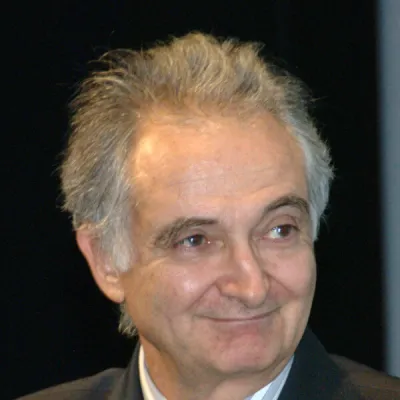
Jacques Attali
Human Design Chart
Biography
Human Design Analysis: Jacques Attali as Manifesting Generator 1/3
Manifesting Generator 1/3 — Design at a Glance
Jacques Attali was someone who possessed constant energy but, unlike pure reactors, also had the ability to skip steps and achieve rapid results. His design combined the endurance of a Generator with the assertiveness of a Manifestor – a hybrid configuration.
This anatomy allowed him to achieve a 'play mode' when applied correctly. When he reacted to impulses and his inner authority (the Sacral Center) agreed, he drew deep satisfaction from his work. In this state, he could effectively manage multiple projects simultaneously without becoming frustrated. The variety here was not an obstacle but fuel for his creativity.
However, the danger lay in his own speed. Without this internal confirmation, Jacques Attali tended to skip important steps or become overwhelmed by multitasking. This quickly led to frustration – the specific non-self theme of this type. To sustainably use his creative power, it was crucial not only to react to impulses but also regularly check if his inner authority still agreed with ongoing projects. Only then did energy flow productively rather than ending in overload or withdrawal.
Sacral Authority
Jacques Attali showed a decision-making structure that did not rely on intellectual analysis but on immediate physical resonance. His design dictated that his sacral authority served as the primary instance – a mechanism exclusive to the Generator type and aligned with its strategy of inner guidance. This simplified his process: instead of planning, he waited for external stimuli.
The answer came from the defined Sacral Center in the form of gut sounds like grunts or a palpable surge of energy. These signals served as clear yes-or-no criteria. With positive resonance, a state of vital energy and enthusiasm ensued, allowing him to engage in activities with great joy and without rigid purposefulness. He was inclined to dissolve into his tasks, driven by this inner satisfaction.
Additionally, the active Spleen Center acted as a supportive instance. It gave him the ability for quick, instinctive reactions and direct access to physical well-being. This combination allowed Jacques Attali to trust his internal perception spontaneously and reliably without lengthy deliberations. The mechanics involved waiting for an external impulse and using the associated physical feedback as a source of correct alignment.
The 1/3 Profile — Investigator / Martyr
Jacques Attali was marked by Profile 1/3: a blend of deep research drive and the need to practically validate insights. His Sun in Gate 44 endowed this stance with a dominant quality, focusing on establishing hierarchies and economic success. It wasn't just about pure knowledge but creating agreements through pattern recognition that would impact the collective.
This design described an internal tension between Line 1, which called for withdrawal to learn and plan, and Line 3, which urged experimental implementation. The challenge lay in not letting fear of incomplete knowledge turn into a paralyzing perfectionism trap. Instead, he had to translate theoretical zeal into tangible results through the courage of experimentation.
His authority stemmed from this rigorous process: insights were both theoretically and practically tested on heart and gut level. When Jacques Attali deemed something good, it was the result of this double validation. Gate 44 required clear rules and hierarchies to ensure lasting harmony and make power over the collective enforceable. The mechanics thus showed a person who solidified their position through self-earned, tested, and economically viable insights.
Single Definition — Defined & Open Centers
Jacques Attali revealed himself through a design that combined consistent expressiveness with a clear inner identity. His defined Throat Center provided a reliable voice that spoke not from fleeting thoughts or emotions but directly from his personal direction and Higher Self, guided by the also defined G Center. This gave him a stable compass: he knew who he was and where he was going without being swayed by external expectations.
This communicative clarity was reinforced by his defined Sacral Center with vital energy. As the motor for his actions, this center generated a constant power source that only worked effectively when Attali responded rather than initiated. His strategy involved waiting on life and answering questions with an inner yes or no to avoid frustration and exhaustion. Only through this correct reaction could he sustainably use his energy for work and satisfaction.
At the same time, Attali was marked by several open centers, making him vulnerable to external conditioning. His open Head Center led to taking mental pressure and inspiration from the environment without owning it as his own truth. He tended to get entangled in others' doubts or questions rather than solving them as his own problems. Similarly, his open Ajna Center allowed him to flexibly take on concepts and ideas but carried the risk of holding transient thoughts as absolute certainties or feeling uncertain when no clear answer was present.
His open Heart Center meant he wasn't designed to exercise willpower in terms of competition or promises. Instead, he often sought validation of his worth through external success, which could lead into a cycle of overcompensation and disappointment if he tried to prove himself against others. Additionally, his open Solar Plexus absorbed the emotions of his environment, causing him to fluctuate between moods that weren't his own and avoiding confrontation to dampen emotional waves. Likewise, his open Spleen Center made him vulnerable to fears about survival or well-being, leading him to cling to unhealthy situations just to maintain a sense of security. Finally, his open Root Center took on the stress from the environment, resulting in a cycle of adrenalized pressure and attempts to escape it through hyperactivity rather than recognizing it as an external influence.
Channels for leadership, reflection and persistent discovery.
Jacques Attalis Design points to a tendency towards collective, logical leadership that relies on invitation and trust rather than authoritarian enforcement. This is primarily shown through the Channel of the Alpha Animal 7-31. This channel connects the G Center with the Throat Center, giving speech an influence that only becomes effective when the community acknowledges and invites the leader's competence. It’s not about absolute power but rather acting as a "power behind the throne" or manager who understands existing patterns and guides others into a secure future through logical argumentation. Success comes from focusing on his own areas of influence and showing the way without taking it away from others.
Parallel to this, the Channel of the Lost Son 13-33 shaped his nature through reflective wisdom. Through the Gate of the Listener (13), he gathered information, secrets, and life stories, while the Gate of Withdrawal (33) gave him the necessary distance to digest these experiences. This process requires patience: He withdrew to distill deeper truths from the collected memories before sharing them. The combination of listening and thinking served his maturation and allowed him to bring continuity into idea development by making past lessons accessible for the collective.
Additionally, other energetic streams were at work: Discovery 29-46 promoted a persistent dedication to processes where expectations were laid aside in order to find new perspectives through sheer endurance. This was complemented by the themes of prioritized gates: Awareness and resource management (Gate 44), cyclical renewal and inner stillness (Gate 24) as well as seeking safety and spiritual connection within communities (Gate 19). In his personality aspect, tribal hierarchy and material expression (Gate 45) were present, while on the Design level, receptivity to evolutionary directions (Gate 2), emotional restraint in creative mutations (Gate 12) as well as collective experimentation towards mastery (Gate 16) played a role. Overall, Jacques Attali is characterized by a Profile that understands leadership as service to the collective, supported by patient reflection and persistent experience collection.
Collective Circuitry — Circuit Signature
Jacques Attalis Design sets a tendency towards internal tension: between the cool, strategic logic of the future and the emotional reflection on the past. Both energies aim to share insights with the collective, but from different sources.
His Understanding Circuit connects his Throat Center and Identity Center through Channel "The Alpha Animal." This creates a direct line for formulating rational, structured concepts. The energy on this left chart side is forward-looking and strives for societal improvement through focused intellect, free of emotional conditioning. It’s about sharing clear, logical strategies.
Parallel to this, the Meaning Circuit also comes into play. It too connects Throat Center and Identity Center but additionally draws in the cyclical energy of the Sacral Center (Channels "The Lost Son" and "Discovery"). This right chart side is past-oriented. Here it's not about cold reason, but rather the wave-like nature of emotions and finding meaning in past experiences. The resulting insights should also be shared to learn collectively from history.
Although both circuits use the same Expression and Identity Centers, their impulses come from opposite directions: once the visual, strategic planning for what’s ahead, and once the emotional processing of the past. Jacques Attali shows through this configuration as someone who brings both rational future visions and felt interpretations of the past into his communication.
Right Angle Cross of the Four Ways 3
Jacques Attalis Human Design reveals a tendency towards a profound, archetypal structure: the 'Right Cross of Four Paths'. This configuration shaped his existence independently of specific external manifestations or biographical details. It describes not a single ability but a fundamental pattern of strategic orientation and life-path intuition.
In Human Design, this cross marks a rare energetic signature that points to a particular way of perceiving one's path. It is not about linear planning in the conventional sense, but rather an intuitive connection between different aspects of life into a coherent whole. The four paths symbolically represent various dimensions of experience - often material, emotional, mental and spiritual - which in this design do not operate separately but as an integrated system.
For Jacques Attali, this meant an inner compass needle that always pointed towards this holistic alignment. The mechanics of the Right Cross ensure that decisions and developments are not random but part of a larger, often unconscious strategy. It is less a tool for active control than a passive yet powerful imprinting that forms the background to all actions. This structure requires no conscious effort to be effective; it simply is there like the foundation of a house upon which everything else rests. The intuition of the life path emerges from the synthesis of these four levels, allowing a unique perspective on one's role in the world.
Saturn Return · Uranus Opposition · Chiron Return · 2nd Saturn Return — Life Cycles
Jacques Attali showed himself in 1972 at the age of 29 as someone who solidified his intellectual identity through the publication of his first two books. This marked for his design the transition into a phase of established responsibility. The first Saturn Return cycle here does not function merely as an astrological date but as a structural moment where years of internal groundwork condenses into a visible, robust external form. At this age, identity begins to take its final contours; what was previously experimental or searching becomes now the foundation for future actions. For Jacques Attali, this meant that his thoughts and analyses no longer remained private but were published in a form that assigned him a certain role in societal discourse. The mechanics of this cycle show how inner maturity turns outward: one takes responsibility for what one is and says. The books served as the concrete anchor point where this new stage of self-determination became tangible. It was less about commercial success than taking a position that would henceforth shape his actions and perceptions through others. This step anchored him in a role based on substance and credibility - exactly what the first Saturn Return describes as a process of identity consolidation.
Manifesting Generator · Sacral Authority — Synthesis
Jacques Attalis design reveals a central thread of dynamic adaptation. As an Manifesting Generator with a defined G Center and Sacral Center, he possesses the ability to quickly respond to impulses (Sacral) while filtering and directing them through strong self-understanding (G Center). The open definition of many centers - particularly Head, Ajna, Heart, and Root - indicates high sensitivity to the environment combined with the ability to absorb and transform information rather than holding onto it. This allows for continuous learning and experimentation (Profile 1/3), while sacral authority serves as an anchor to ensure that energy is used correctly.
A central paradox lies in the tension between the need for action and the necessity of reflection. The Manifesting component in his design drives him to initiate things and push forward quickly, while open centers and the Lost Son Channel (13/33) require a deep engagement with experiences and gathering wisdom. This dynamic makes Attali both an active shaper and a perceptive observer - someone who is in motion but also knows the necessity of withdrawal and inner processing.
3 Defined Channels
Incarnation Cross - Right Angle Cross of the Four Ways 3
Solar Return
The Solar Return shows the moment when the sun returns to its exact birth position - your personal solar year.
Life Cycles
Discover the life cycles with a detailed triple view (birth chart, cycle chart, composite).
Human Design Profile
- Strategy
- To respond - wait for something to respond to
- Authority
- Sacral Authority
- Profile
- 1/3 - Investigator / Martyr
- Definition
- Single Definition
- Incarnation Cross
- Right Angle Cross of the Four Ways 3
- Date of Birth
- 01.11.1943 18:30
- Place of Birth
- Alger, Algeria
Frequently Asked Questions
What is Jacques Attali's Human Design type?
What Profile does Jacques Attali have in Human Design?
What Authority guides Jacques Attali?
What incarnation cross does Jacques Attali have?
When was Jacques Attali born?
Discover your own Human Design
Are you also a Manifesting Generator? Find out in a personal reading how to unfold your multi-talents and direct your energy wisely.
More Personalities
Back to overviewAldair

Alizée

Angeli

Arletty

Artus

Balthus