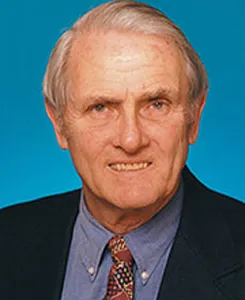
James R. Lilley
Human Design Chart
Biography
Born to American parents in China, Lilley learned Mandarin at a young age before his family moved back to the United States at the outbreak of World War II. He also spoke French fluently, in addition to English. He served in the United States Army before earning an undergraduate degree from Yale University and a master's in international relations from George Washington University. He then joined the Central Intelligence Agency, where he would work for nearly 30 years in a variety of Asian countries prior to becoming a diplomat.
Before being appointed ambassador to China in 1989, he was director of the American Institute in Taiwan, Washington's de facto embassy on the island, and ambassador to South Korea. After the suppression of the Tiananmen Square protests, Lilley was critical of the Chinese crackdown and harboured a prominent dissident in the embassy, but worked to prevent long-term damage to United States–China relations. After his retirement, he published a memoir, China Hands (2004), and worked as a fellow at the American Enterprise Institute.
In 1954, he married Sally Booth, with whom he had three sons. James R. Lilley died on 12 November 2009, aged 81, at Sibley Hospital in Washington, D.C., from complications of prostate cancer.
James R. Lilley as a Generator 3/5 in Human Design
Generator 3/5 — Design at a Glance
James R. Lilley was someone with immense inner endurance and strength, comparable to a workhorse ready to go as long as there was a task that truly mattered to him. His Generator design shaped him through an abundance of sacral energy, but this wasn't meant for spontaneous initiation of actions. Instead, his power worked most effectively when he responded to signals from his environment and followed his gut feeling. The motto of his character was: don’t push, wait, then respond with strength once the inner center gave a clear “yes”.
This mechanism held two specific dangers for him. Acting against his inner interest or being prevented from pursuing his heart project despite still having energy could lead to frustration or exhaustion. Conversely, constantly taking initiative without external cause often led to a lack of energy and deep dissatisfaction. However, when James R. Lilley lived in harmony with this strategy of responding to impulses, his design rewarded him with profound satisfaction. His strength lay in authentically answering life signals through consistent action, allowing him to unleash an unwavering energy that propelled him forward as long as he didn’t go against his own rhythm.
Sacral Authority
James R. Lilley responded to external stimuli through a direct physical reaction that served as the basis for his decisions. As a Generator, his strategy of waiting for the call was inseparably linked with this sacral authority, simplifying his decision-making process. This connection allowed him not to plan or analyze but to wait for what spoke to him internally.
His inner guidance manifested in the form of a “gut feeling” – often as grunting, humming, or a soft hmm – signaling whether something generated energy. When his sacral motor was engaged, he felt vital and possessed inexhaustible strength along with enthusiasm for the task at hand. He lived to immerse himself joyfully in his tasks without them needing an external purpose.
Additionally, an active spleen center acted as a supportive instance. Perhaps directly connected to the sacral center, this allowed James R. Lilley quick and spontaneous reactions. He had immediate access to his instinctive perception and physical well-being. This combination of sacral confirmation and spleen-supported intuition enabled him to reliably listen to his inner signal and trust it rather than being guided by external expectations.
The 3/5 Profile — Martyr / Heretic
James R. Lilley was someone who gained knowledge not from books but through personal, often risky experimentation. His design (Profile 3/5) shaped him into an experimenter: he believed nothing until he had experienced it himself. This attitude created a wealth of practical experiences that he later offered to others as solutions to their problems. Line 3 drove him to learn through trial and error; line 5 transformed these personal insights into a kind of heroic example for his environment.
This dynamic was, however, ambivalent. Lilley learned through instability and the constant change in relationships, which helped him grasp his inner truth rationally. He sought mutual dependence to understand himself better. At the same time, he had to fight the danger of failing before others when his experiments didn’t work – a painful aspect of the hero role. His adaptability (line 5 from Gate 32) allowed him to respond flexibly to changes and adjust effortlessly. This stood in contrast to an immature urge to resist conformity through direct opposition. Lilley used his energy to balance these tensions: he did not simply sacrifice others but sought the support needed to realize and make clear his individual truths.
Single Definition — Defined & Open Centers
James R. Lilley was someone driven by a profound inner vitality. His defined Sacral Center generated a constant energy source that he utilized through reactions to life rather than initiating action. This power connected with his defined Root Center, providing a steady physical pressure to move forward and master existential challenges.
At the same time, James R. Lilley was open to external influences in several areas. His open Head Center made him vulnerable to mental confusion; he tended to be swayed by others' doubts or seek inspirations that were not his own. Similarly, his open Ajna Center meant that he absorbed concepts and opinions from his environment rather than possessing a firm intellectual truth. This required an attitude of detached observation instead of getting entangled in endless questions.
His open G Center led to James R. Lilley lacking a fixed identity. He often adapted himself to the environment and sought directions through others, which could make him vulnerable to false relationships or places. The wisdom lay in recognizing that he would automatically meet the right people at the right place. His open Heart Center protected him from the pressure of having to prove his worth. He was not designed to be willfully competitive but learned to avoid making promises to prevent frustration. His open Solar Plexus absorbed the emotions of his surroundings; he had to learn not to personalize these feelings to remain emotionally stable. Finally, his open Spleen Center made him susceptible to survival fears and spontaneous decisions that often resulted from conditioned pressure. The health lay in not immediately following these impulses but trusting a clear inner authority.
Channels for the natural process of growth and maturation.
James R. Lilley understood human experience as a cyclical process that needed to be fully traversed and reflected upon. His design carried the energy of Channel 53-42, connecting the Root Center with the Sacral Center. This channel emphasized that true wisdom only arises when an experience is accompanied until its end and then reviewed to extract the lesson. For him, it was essential to enter new situations without rigid expectations to avoid frustration and utilize the depth of the experience. This attitude allowed him to translate individual insights into collective knowledge.
Additionally, Gate 61 shaped his pursuit of inner truth and silence as an opposite pole to mental noise, while Gate 62 endowed him with patience and logical precision to organize details and recognize patterns. His personality was further influenced by Gate 30, which sought continuity and allowed radical changes only when necessary, and by Gate 60, which saw the acceptance of limitations as a prerequisite for transformation. In his design, Gate 5, focusing on natural rhythms and habits, worked together with Gate 34, harboring strong individual energy that required guidance to not act aimlessly. Gate 29 rounded this off by placing emphasis on persistence and saying the right 'yes', which was crucial for his long-term endurance.
Collective Circuitry — Circuit Signature
James R. Lilley showed an energetic connection between Sacral and Root Centers, indicating a deep rooting in one's own life energy. This configuration marked him as someone whose inner strength was directly linked to his ability to cope with stress and survive.
This interconnection formed the core of the sense-making circuit. While other areas often looked towards the future, this energy focused on emotions and experiences from the past. Perception ran in waves: feelings rose, peaked, and ebbed again, following a natural cycle of beginning, middle, and end. This emotional wave was often hard to explain logically but carried important insights.
Central to this mechanism was reflecting upon the past to find meaning behind occurred events. The insights gained served not only for personal processing but were meant to be shared with others. Through this exchange, the collective could learn together from past experiences. James R. Lilley lived this cyclical nature of understanding where emotional maturity and sharing of insights went hand in hand to draw new significance for the community from the past.
Right Angle Cross of Maya 4
James R. Lilley exhibited a fundamental disposition rooted in the search for hidden truths and carried within him the need to convey these insights in such a way that others could truly absorb them. This configuration described his life task: uncovering connected patterns and passing them on to others. His design inclined towards recognizing deeper structures and translating them into understandable forms, thus acting as a bridge between complex knowledge and practical application. The mechanics of his chart promoted an inner orientation toward the essential while simultaneously possessing the ability to clearly and accessibly present this externally. This shaped his way of handling information – not just as passive reception but as active dissemination of insights relevant to his environment. Through this alignment, there emerged a natural flow between exploring the hidden and sharing the found answers, making him a figure who both rested within himself and acted outwardly.
Saturn Return · Uranus Opposition · Chiron Return · 2nd Saturn Return — Life Cycles
James R. Lilley was someone whose professional career was shaped by clear structuring and long-term commitment. His design inclined towards disciplined building, which became particularly evident during Saturn Returns. The second Saturn Return often marks a point where years of groundwork transform into stable positions. In 1986, at the age of 58, James R. Lilley was appointed Ambassador to South Korea. This aligned with the mechanics of this cycle: confirmation of one's authority and assuming a responsible role based on prior experience.
Prior to this, he had already experienced an intense phase of change. The Uranus Opposition often brings unexpected turns or the urge for new freedom and expansion of horizons. In 1971, at the age of 43, James R. Lilley completed his postgraduate studies at George Washington University with a Master of Arts degree. This step matched the characteristic impulse of this configuration: insisting on personal growth and expanding knowledge boundaries, even if it meant breaking from previous routines. Both events underscore how James R. Lilley utilized life phases to strengthen and further develop his professional identity.
Generator · Sacral Authority — Synthesis
James R. Lilley was a Generator whose life was marked by deeply rooted sacral energy (Sacral Center defined). This power source manifested in an unflagging drive to approach tasks with enthusiasm and find joy in work – as long as it aligned with his inner response (sacral authority). His Profile of Experimenter/Hero (3/5) reinforced this aspect by motivating him to learn through personal experiences and make this knowledge accessible to others. The Channel of Maturity suggests that he had to fully experience situations to gain wisdom from them and provide it for the collective – a cyclical process that shaped his life path.
Simultaneously, his design revealed a paradox between the need for activity and the cyclic nature of his energy (Purpose Circuit). While his sacral authority pushed him to respond to external stimuli with yes or no, the right cross indicated he was in a kind of detachment process. The documented events – completing a degree (1971) and being appointed Ambassador (1986) – coincided with Uranus Oppositions and Saturn Returns respectively, hinting at phases of upheaval and reevaluation where he had to continually realign himself.
1 Defined Channel
Incarnation Cross - Right Angle Cross of Maya 4
Solar Return
The Solar Return shows the moment when the sun returns to its exact birth position - your personal solar year.
Life Cycles
Discover the life cycles with a detailed triple view (birth chart, cycle chart, composite).
Human Design Profile
- Type
- Generator
- Strategy
- To respond - wait for something to respond to
- Authority
- Sacral Authority
- Profile
- 3/5 - Martyr / Heretic
- Definition
- Single Definition
- Incarnation Cross
- Right Angle Cross of Maya 4
- Date of Birth
- 15.01.1928 02:00
- Place of Birth
- Qingdao (Shandong), China
Frequently Asked Questions
What was James R. Lilley's Human Design type?
Which Profile did James R. Lilley have?
What Authority guided James R. Lilley?
What incarnation cross did James R. Lilley have?
When was James R. Lilley born?
Discover your own Human Design
Are you also a Generator? Find out in a personal reading how to use your sacral energy correctly and discover deep satisfaction.
More Personalities
Back to overviewAaliyah

Alexia

Angèle

Anne-Marie

Arcángel

Arno