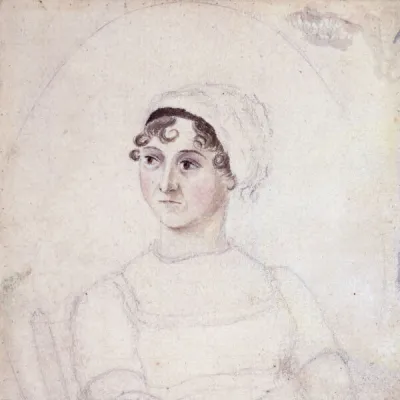
Jane Austen
Human Design Chart
Biography
Austen's plots often explore the dependence of women on marriage for the pursuit of favourable social standing and economic security. Her works are implicit critiques of the novels of sensibility of the second half of the 18th century and are part of the transition to 19th-century literary realism. Her use of social commentary, realism, wit, and irony have earned her acclaim amongst critics and scholars.
Austen wrote major novels before the age of 22, but she was not published until she was 35. The anonymously published Sense and Sensibility (1811), Pride and Prejudice (1813), Mansfield Park (1814), and Emma (1816) were moderate successes, but they did not bring her public fame in her lifetime. (She was privately known to be the author of these novels, including by notable people such as the Prince Regent.) She wrote two other novels—Northanger Abbey and Persuasion, both published posthumously in 1817—and began another, eventually titled Sanditon, but it was left unfinished on her death. She also left behind three volumes of juvenile writings in manuscript, the short epistolary novel Lady Susan, and the unfinished novel The Watsons.
Since her death Austen's novels have rarely been out of print.
Human Design Analysis: Jane Austen as Manifestor 3/5
Manifestor 3/5 — Design at a Glance
Jane Austen's Human Design endowed her with the role of a pioneer with a clear vision aimed at steering her environment in new directions. Her character embodied the dynamics of a Manifestor: she had the power to set impulses into motion without needing to take every step herself. Much like an emperor sending his soldiers off to conquer, rather than leading battles personally, Jane Austen delegated her energy and let others implement her ideas.
This superior perspective inevitably led to misunderstandings and polarization. As she often thought ahead of her surroundings, she was loved and followed by some for her big dreams, while others rejected or even hated her because of them. To minimize resistance and find the right followership, it was crucial for Jane Austen to communicate her intentions and visions early and precisely. Informing served as a strategy to reduce friction.
When she adhered to this strategy, she was rewarded with a deep sense of inner peace. However, when she lived against her design and failed to communicate her intentions adequately, it resulted in persistent, deep anger. This conflict between the necessity of giving information for maintaining peace and experiencing misunderstanding due to its absence shaped her energetic landscape significantly.
Emotional Authority
Jane Austen's Human Design inclined her towards cautious deliberation before important decisions. She was someone who avoided spontaneous reactions and instead needed time to find inner clarity. This stance stemmed from her emotional authority, carried by the defined Solar Plexus Center. In Human Design mechanics, this means that this center always took precedence over all other defined centers, regardless of further configurations in the chart.
Her internal compass followed an emotional wave with constant ups and downs. The world appeared to her colored by her current mood; what was exciting at one moment could seem negative the next. Since immediate feelings were only a snapshot and not necessarily the deeper truth, quick, impulsive judgments were risky. Instead, her system required patience. Through repeated reflection and conscious waiting until 'sleeping on it', intense emotions gradually subsided. Only then did she gain the necessary emotional distance leading to calmness and true decision-making ability. This process of maturation was particularly crucial for long-term life decisions as it prevented impulsive misjudgments and enabled a well-founded, clear perspective.
The 3/5 Profile — Martyr / Heretic
Jane Austen's Human Design established a fundamental stance: she had to try everything herself first before believing in it. As an experimenter along the third line, she learned through trial and error. This process was necessary because she saw ideas as transient and could only confirm their validity through practical tests. From these personal experiences, she accumulated a rich treasure of practical knowledge.
This self-acquired understanding later enabled her to step into the role of a Hero on the fifth line. She used her insights to offer practical solutions to others in times of crisis. Her wealth of life experience was highly attractive; people sought her advice because she had learned from her mistakes. This role of helper and storyteller naturally suited her design very well.
At the same time, this configuration contained a specific vulnerability. Since her knowledge was based on public experiments, failure before others was always possible. A failure while trying out new ideas could be particularly painful as it directly questioned her status as an adept problem solver. The tension between the need for adaptation through personal experience and the expectations of her environment shaped her dynamics. She thus did not present herself as a theoretical authority but rather as someone who attracts and supports others through lived practice and resulting wisdom.
Single Definition — Defined & Open Centers
Jane Austen's design inclines towards clear, authentic communication that stems from a deep sense of her own identity and direction. Her defined Throat Center ensures a consistent voice; she does not speak impulsively but allows information to flow through her inner self before manifesting it in the world. This expression power is rooted in her defined G Center, which gives her a firm self-image and a feeling of lovability. She knows her mission and shows others natural directions without needing to control their paths.
As an internal authority, her defined Solar Plexus guides decisions with patience: she waits for the emotional wave to pass until clarity emerges. This lends depth and sensitivity to her judgments while protecting against impulsive reactions in emotional highs or lows. Complementing this is her defined Spleen Center, offering spontaneous intuition and existential awareness in the 'now'. She trusts these intuitive signals for health and well-being without needing to rationalize them.
At the same time, Jane Austen was exposed to certain conditioning patterns. Her open Head and Ajna Centers allow flexible intake of ideas but can lead to getting caught up in mental pressure or seeking answers for others. She tends to take on doubts that are not her own problem. The open Heart Center relieves her from the pressure to prove value; she does not need to make promises she cannot keep. However, her open Sacral and Root Centers require mindfulness: they absorb energy and stress from the environment, which can lead to exhaustion if boundaries are neglected or foreign adrenaline is mistaken for personal drive.
Channels for intuitive clarity, reflection, experimentation and emotional change.
Jane Austen's design sets a foundational stance of patient reflection paired with a strong desire for emotional experience. The Lost Son Channel 13-33 connects her G Center with her Throat Center; Gate 13 listens and gathers memories while Gate 33 withdraws to process them. This creates the ability to store life stories and reveal deeper truths only after careful consideration.
Simultaneously, there is an intense focus on perfecting skills through the Wave Channel 48-16. Here, Gate 48 in her Spleen Center seeks intuitive depth while Gate 16 in her Throat Center refines dexterity through repetition and experimentation. This mechanism fosters the development of a unique talent based on the connection between inner intelligence and technical mastery.
Intuitive insight emerges through the Lightning-Stroke Channel 57-20. Gate 57 delivers spontaneous knowledge from her Spleen Center, which Gate 20 in her Throat Center communicates directly in the present moment. This allows for existential truths and self-awareness to be expressed suddenly and clearly, often faster than others can process them.
The emotional landscape is shaped by the Transience Channel 36-35. Gate 36 in her Solar Plexus Center seeks new experiences sometimes through crisis creation to instigate movement. Gate 35 in her Throat Center manifests this change. Jane Austen's design drives her to explore the depth of emotions and gain wisdom from these fleeting yet intense experiences.
Additionally, prioritized Gates like Gate 11 with visual recall and assessment as well as Gate 6 as a friction element support an approach that integrates both pattern observation (Gate 11) and experiencing emotional tensions (Gate 6), to develop a comprehensive understanding of human nature.
Collective Circuitry — Circuit Signature
Jane Austen's design combines rational future orientation with emotional past reflection and individual creativity. This integrated expression flows through her Throat Center, which serves as the central node.
The Knowledge Circuit activates Channel 20-57 (Lightning Stroke), connecting Spleen to Throat. This promotes innovative, creative impulses from intuition directly into unique expressions – an energy of 'now' that paves new paths.
Parallelly, the Understanding Circuit works through Channel 16-48 (The Wave), also linking Spleen to Throat. Here, logical structure and strategic thinking are forefronted towards future improvements. This rational clarity is shared free from emotional coloring, creating a focused visual projection.
The Meaning Circuit connects Throat with Solar Plexus (Emotion) and Identity via Channels 33-13 (The Lost Son) as well as 35-36 (Transience). This configuration reflects past experiences in wave patterns. Emotional cycles from the past are processed and translated into deeper significance to then share with others.
Though all three circuits utilize her Throat Center, Spleen connections (Knowledge/Understanding) form a separate energetic group from Solar Plexus/Identity connections (Meaning). Jane Austen's expression is thus a synthesis: cool logic and hot emotion, intuition and reflection, all converging in a pulsating, cyclical language. Her simple definition creates a clear, coherent flow of these forces without internal fragmentation between the groups.
Right Angle Cross of Eden 4
Jane Austen's design placed a deep rooting in the question of moral correctness. She was someone whose identity was closely tied to the concept of 'right' and inner integrity. Her focus lay on recognizing and living ethically correct actions, independent of external constraints or societal conventions.
This attitude stems from the mechanics of the right cross at Eden 4. This configuration emphasized internal authority for morality and justice as a central life aspect. It was not an abstract philosophical exercise but a concrete orientation in everyday life: What is the true, fair solution here? How do I act with an integral conscience?
For Jane Austen, this meant that her actions and thoughts were always filtered through this lens of ethical correctness. She sought truth in interpersonal dynamics and aimed to align her behavior with these internal standards. It was a continuous process of self-examination and balancing personal desires with the demands of justice.
This aspect of her design shaped how she saw the world: not as a neutral space but as a field where moral decisions must be made. The search for integrity was an ongoing companion, shaping her perspective on relationships and situations. She lived with the constant task of identifying what is right and translating it into action.
Saturn Return · Uranus Opposition — Life Cycles
Jane Austen's design indicated a tendency towards profound existential turning points catalyzed by planetary cycles. Her first Saturn return around age 27 marked a moment of condensation and maturity. During this period, specifically in 1802, she rejected the marriage proposal from Harrison Bigg-Wither. This decision illustrates the mechanics of the Saturn return: A phase where years of internal development condense into a clear, sustainable position and old bonds or expectations are questioned. It was a point at which she placed her own authority over others' expectations.
Later, the Uranus opposition cycle, often associated with sudden breaks or the completion of life's work, came into play. In 1816, at age 41, Jane Austen completed the novel 'Persuasion'. A few months later she passed away. This sequence underscores the transformative power of this configuration: It can signal the end of a great creative or existential cycle where the essential is brought to closure. The Uranus opposition here acted as a catalyst for her final act of creation and life, not as tragic failure but as natural completion of an energetic movement. Both cycles shaped her biography through clear, irreversible decisions and conclusions.
Manifestor · Emotional Authority — Synthesis
Jane Austen's design reveals a central continuity in the dynamic interaction between inner depth and the urge to express this through communication (Channel 13-33, 20-57). Her defined Throat Center and emotional authority pointed towards a strong self-understanding and ability to process experiences into authentic expressions. This internal world was channeled by her defined Throat Center, giving her talent for precise and resonant communication – a process always colored by the emotional wave (Solar Plexus). The repeated emphasis on experimenting and adapting (Profile 3/5, Gate 11) underscores a lifestyle marked by trying out, reflecting, and passing on insights.
A central paradox in Jane Austen's design lies in the tension between the need for inner clarity and inherent transience (Channel 35-36). Her emotional center required time for decision-making while the connection to her Throat Center implied a desire to share these insights with others. Simultaneously, open Sacral and Root Centers pointed towards vulnerability to external influences and a constant flow of energy that could create inner imbalance. This dynamic between striving for authentic expression and adapting to the outer world shaped her creative process and how she dealt with life's challenges.
4 Defined Channels
Incarnation Cross - Right Angle Cross of Eden 4
Solar Return
The Solar Return shows the moment when the sun returns to its exact birth position - your personal solar year.
Life Cycles
Discover the life cycles with a detailed triple view (birth chart, cycle chart, composite).
Human Design Profile
- Type
- Manifestor
- Strategy
- To inform others before acting
- Authority
- Emotional Authority
- Profile
- 3/5 - Martyr / Heretic
- Definition
- Single Definition
- Incarnation Cross
- Right Angle Cross of Eden 4
- Date of Birth
- 16.12.1775 23:45
- Place of Birth
- Steveston, United Kingdom
Frequently Asked Questions
What was Jane Austen's Human Design type?
What Profile did Jane Austen have in Human Design?
What Authority guided Jane Austen?
What incarnation cross did Jane Austen have?
When was Jane Austen born?
Discover your own Human Design
Are you also a Manifestor? Find out in a personal reading how to use your initiation power peacefully and dissolve resistance.
More Personalities
Back to overviewAlain-Fournier

Angeli

Christian-Jaque

Juninho

Kesha

Lucebert