
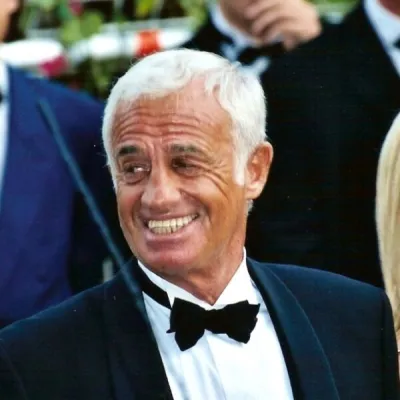
Jean-Paul Belmondo
Human Design Chart
Biography
Born into an aristocratic family and the son of a well known sculptor, Belmondo attended fancy private schools and studied drama at the Paris Conservatory, where he met with early success.
He dangled from a helicopter over Paris, crawled across the roof of a moving subway car in pursuit of a murderer and frolicked with a Bengal tiger. He felt that none of these feats compared to his return to the stage in 1987 for causing sheer terror. On 3 March 1987, Kean, a five-act play, opened in Paris. "I could have died with my legend," he said, "but I wanted to take a risk, prove myself, hear my own fears and conquer them."
In later years, Belmondo's reputation suffered due to taking more commercially successful, high-paying action roles in such films as Cop or Holligan (1979) and Champion of Champions (1982). His theater comeback was therefore the biggest cultural event of the season, covered voluminously by the media. He suffered a stroke in 2001 and was absent from the stage and the screen until 2009 when he appeared in Un homme et son chien (A man and his dog).
In 1953, Belmondo married Élodie Constantin, with whom he had three children: Patricia (1958), Florence (1960) and Paul (1963). Paul became a Formula One driver; his eldest daughter Patricia was killed in a fire in 1994.
Human Design Analysis: Jean-Paul Belmondo as Generator 5/1
Generator 5/1 — Design at a Glance
Jean-Paul Belmondo had immense endurance and the ability to bring things into reality with great force. His Generator design was based on a high sacral energy that drove him like a strong workhorse—provided he had the right motivation. This energy, however, was not released through self-initiative but exclusively in response to external signals. The central mechanics of his design required him to respond to impulses from the environment and act only when an internal signal gave a clear "yes."
This logic of reacting rather than initiating was crucial for his well-being. When he followed life's signals and acted accordingly, it led to deep satisfaction and a sense of fulfillment. Deviating from this strategy—such as constantly inventing new projects without external cause or suppressing inner impulses—resulted in frustration and energy loss. It was particularly dangerous for him to be held back from his true passion while still full of strength, or conversely, doing things where he lacked internal approval. In such cases, burnout threatened because his enormous capacity would be wasted. His success therefore depended on reacting instinctively to life rather than fighting against the current of his own nature.
Emotional Authority
Jean-Paul Belmondo's design indicated a tendency towards emotional swings that influenced his decision-making process. He was someone whose inner truth did not lie in the first impulse but rather in the calm after the storm. Emotional Authority carried this responsibility; the defined Solar Plexus Center always determined the process, independent of other defined centers. This priority was a central mechanism of his design.
His feelings were subject to constant ups and downs. At one moment he could be completely enthusiastic about something, only to see it negatively in the next. However, this first impression was merely a snapshot colored by the current mood, not his deeper truth. Spontaneous reactions were often misleading and could have negative consequences.
The mechanics required patience. Jean-Paul Belmondo needed time for decisions to mature. "Sleeping on" important questions was essential. Over time, intense feelings subsided, and he gained emotional distance. Only then did clarity and calmness set in. This process through the emotional wave was necessary to reach his true inner authority rather than reacting solely to fleeting first impressions. Long-term decisions required this cycle to have a positive impact on his life path.
The 5/1 Profile — Heretic / Investigator
Jean-Paul Belmondo's design set a tendency to attract others through a nearly magnetic presence, drawing in those seeking solutions. As Hero/Researcher (Profile 5/1), he utilized his deep, often isolated knowledge base of Line 1 to provide it to others. Line 5 gave him this attractiveness; people felt drawn to his potential and sought answers from him. This created, however, a risk: external expectations could overwhelm him if clear boundaries were not set. Similar to a scientist who is exhausted after long conferences because he constantly answered questions, Jean-Paul Belmondo faced the danger of being drained by the constant questioning of those around him. His Line 1 promoted withdrawal and deepening into occult or hidden knowledge, which gave him security but also brought isolation with it. The pressure to know everything conflicted with his need for ascetic retreat. To maintain a balance between public heroism and private research drive, it was essential for him to be able to say no. Only in this way could he preserve the beneficial equilibrium: researching for himself and problem-solving for others without neglecting his own energy or being destabilized by shocks of expectation pressure.
Split Definition — Defined & Open Centers
Jean-Paul Belmondo's design indicated a tendency towards an extremely powerful internal engine composed of willpower (defined Heart Center), generative vitality (defined Sacral Center) and emotional depth (defined Solar Plexus Center). This drive was fueled by a constant mental process (defined Head and Ajna Centers) as well as existential pressure (defined Root Center). As a Generator with emotional authority, he possessed immense, consistent inner energy that could only be correctly utilized through reactions to external stimuli. The mental pressure provided inspiration and concepts but lacked direct implementation power; this had to occur via the Sacral Center in response. The emotional wave of the Solar Plexus required patience for clarity before making decisions.
At the same time, centers related to communication (open Throat Center), identity and direction (open G Center) as well as health and instinct (open Spleen Center) were open. This meant that expression, identity, and spontaneous intuition were not constant but situational, requiring acceptance from the environment. Instead of actively seeking or forcing these aspects, the mechanics required waiting for the right environment and invitation. The open Throat Center tended to feel pressured to draw attention through speaking, although its openness naturally attracts attention when one waits. The open G Center led to undefined identity and direction; Belmondo was dependent on being placed in correct environments to unfold rather than actively seeking a fixed self-image. The open Spleen Center made him vulnerable to survival fears and conditioning by others, making spontaneous decisions risky. The challenge lay in enduring the inner pressure of defined centers without falling into the traps of open centers: not speaking or acting impulsively but waiting for the correct invitation to safely take on energy and identity.
Channels for intimacy, community, maturation and mental clarity.
Jean-Paul Belmondo's interpersonal dynamics were marked by a deep urge towards fusion, regulated through emotional waves and the need for clear community structures. His design inclined him to cultivate intimacy not spontaneously but through patience and nurturing over time.
This process was determined by the Channel of Union 59-6, linking sacral sexuality with emotional friction. Here, the inner authority of his Solar Plexus Center required Belmondo to wait until the emotional wave clarified before entering deep bonds; otherwise confusion threatened. The intensity of this connection needed time to condense and enable fertility in creative endeavors.
Parallel to this, he sought his place within the whole through the Channel of Community 37-40. This linked the need for affection with the will to provide but demanded fair agreements. A 'good deal' could not be spontaneously closed but had to be carefully considered and formulated over time to benefit both sides. This ensured stability in groups through clear contractual foundations rather than hierarchy.
His life experience followed the Channel of Maturity 42-53. Each cycle had to be fully traversed and reflected upon to generate wisdom. Belmondo learned to let go of expectations and enter experiences for their own sake; only then could he share lessons and build new cycles on old knowledge.
Mentally, he was under the pressure of the Channel of Abstraction 64-47. His mind filtered every experience through a kaleidoscope of mental images, often leading to confusion. Clarity did not come from logical pondering but through patience and sharing stories with others. Only over time did points condense into an inspiring perspective he could pass on to the collective.
Collective Circuitry — Circuit Signature
Jean-Paul Belmondo's design indicated a tendency towards situational energy uptake: He draws his strength significantly through interaction with the environment; in isolation, he appeared energetically incomplete. This 'Shared Definition' manifested as two parallel, not directly connected groups.
The first group linked Heart, Solar Plexus, Sacral and Root Centers. Here, three circuits were active. The Meaning-Finding Circuit connected the Sacral to the Root Center (Channel 'Maturity') in this context, enabling a wave-like, cyclical processing of past experiences on a physical level. Parallel to this, the Ego Circuit linked Heart and Solar Plexus (Channel 'Community'). This created dynamic give-and-take in relationships, steered by emotional waves without constant life force – requiring rest periods. The Protector Circuit also connected Sacral and Solar Plexus (Channel 'Union'). This drove instinctive energies towards preserving genetics and survival.
The second, separate group included Head and Ajna Centers. Here too, the Meaning-Finding Circuit was active this time over the Channel 'Abstraction'. This generated visual, often inexplicable impulses from the subconscious (Head) processed in the mental center (Ajna).
Belmondo oscillated between these poles: on one side, emotional, cyclical meaning-making and resource-building within a collective or family; on the other, abstract, visual intuition. Without constant sun, this energy appeared situational. He reflected waves of the past to draw collective meaning and functioned in relationships as a supporter and protector of genetic lineage. His strength lay in cooperation and emotional resonance with others to create and preserve resources.
Left Angle Cross of the Clarion 1
Jean-Paul Belmondo's design carried the signature of the left cross of Fanfare 1. This configuration established a specific inner dynamics characterized by the drive to bring one’s own discoveries or truths emphatically into the world. It was not merely about self-expression but rather a deep impulse to reveal something new or unknown and make this insight actively accessible to others.
The mechanics of this cross often connect the energy of discovery with the power of dissemination. Jean-Paul Belmondo lived in a structure that guided him to act as a herald – someone who did not just learn or experience for himself but whose nature was geared towards raising these experiences to fanfare, meaning declaring them loudly and clearly. This created a lifestyle where silence or reserve fought against the natural flow of his energy. Instead, there was a tendency towards public presence and sharing perspectives that stemmed from his individual viewpoint. The Fanfare symbolizes here the signal being sent: a clear, often unexpected message that demands attention. For Jean-Paul Belmondo, this was not optional behavior but a central expression of his design, significantly shaping his interaction with the environment and leading him to not keep his insights to himself but to bring them as a leitmotif into his surroundings.
Saturn Return · Uranus Opposition · Chiron Return · 2nd Saturn Return — Life Cycles
Jean-Paul Belmondo's design indicated a tendency towards significant turning points in his professional development, structured by planetary transits. He was someone whose career paths aligned with these cyclical rhythms. His first Saturn return, a transit that often condenses years of groundwork into solid achievements, occurred at the age of 28. This was reflected in 1961 when he starred in "Eva and the Priest" under Jean-Pierre Melville's direction – a moment when his artistic positioning became firmly established. Ten years later came the Uranus opposition, a time often associated with sudden changes or breakthroughs. This transit manifested in 1971 when, at the age of 38, he achieved great success with the action thriller "The Heist." These events illustrate how the mechanical cycles in his design shaped concrete professional milestones: first consolidation through Saturn, followed by an expansive breakthrough through Uranus. His path was thus not random but followed the inner logic of his astrological constellations, which release specific energies and empower action during certain life phases.
Generator · Emotional Authority — Synthesis
Jean-Paul Belmondo lived a life marked by a deep inner tension between creative energy and the need for emotional maturity. As a Generator, he possessed immense work capacity (Sacral Center), which was activated only in response to external impulses. This ability to flow with life’s current corresponded with his talent for taking on complex roles and portraying them authentically – a process that challenged both his emotional depth (emotional center) and his intellect (defined Head and Ajna Centers). The cyclical nature of his creative process, characterized by phases of intense work followed by reflection (Reifung Channel), suggests a search for meaning and understanding of his own experiences.
Belmondo’s design revealed a central paradox: the combination of strong willpower (defined Heart Center) and an open G Center, which made him vulnerable to external influences. He was capable of acting with determination and mobilizing resources while simultaneously searching for identity and direction that were not internally provided. This tension may have manifested in a tendency to lose himself in different roles and projects as he sought an authentic expression of his true self. His open Spleen Center amplified his sensitivity to his environment and the needs of others, making him intuitive and empathetic.
4 Defined Channels
Incarnation Cross - Left Angle Cross of the Clarion 1
Solar Return
The Solar Return shows the moment when the sun returns to its exact birth position - your personal solar year.
Life Cycles
Discover the life cycles with a detailed triple view (birth chart, cycle chart, composite).
Human Design Profile
- Type
- Generator
- Strategy
- To respond - wait for something to respond to
- Authority
- Emotional Authority
- Profile
- 5/1 - Heretic / Investigator
- Definition
- Split Definition
- Incarnation Cross
- Left Angle Cross of the Clarion 1
- Date of Birth
- 09.04.1933 09:00
- Place of Birth
- Neuilly sur Seine, France
Frequently Asked Questions
What was Jean-Paul Belmondo's Human Design type?
Which Profile did Jean-Paul Belmondo have?
Which Authority guided Jean-Paul Belmondo?
What incarnation cross did Jean-Paul Belmondo have?
When was Jean-Paul Belmondo born?
Discover your own Human Design
Are you also a Generator? Find out in a personal reading how to use your sacral energy correctly and discover deep satisfaction.
More Personalities
Back to overviewSissy Spacek

Aaliyah

Alexia

Anémone

Angèle

Ann-Margret
