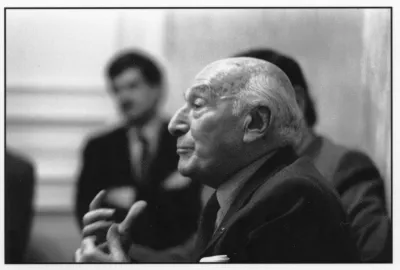
Jean Pierre-Bloch
Human Design Chart
Biography
He died on 17 March 1999.
The Human Design of Jean Pierre-Bloch: Generator 4/6
Generator 4/6 — Design at a Glance
Jean Pierre-Bloch revealed himself as someone with immense inner endurance and strength, comparable to a robust workhorse. His design indicated that his energy was not released through constant initiation of projects but rather by responding to impulses from his environment. As a Generator, he had abundant sacral energy, which flowed freely and effectively only when he responded to signals from life. The clear motto for him was: do not initiate, but react.
This mechanism carried two specific risks. If Jean Pierre-Bloch continuously performed tasks that did not ignite his inner passion, he would waste his strength senselessly and tend towards exhaustion states. Conversely, he suffered when prevented from working on his heart projects despite still having an internal drive. Living in harmony with his strategy – waiting for external signals and then acting upon a clear 'yes' feeling in his gut – rewarded him with profound feelings of fulfillment. If he constantly initiated independently without such impulses, sooner or later he would encounter persistent frustration and a noticeable lack of energy. His path to contentment thus lay in the patient expectation and powerful response to what came from outside.
Emotional Authority
Jean Pierre-Bloch demonstrated an inner decision-making structure that was characterized by an emotional wave. His internal authority resided in his defined Emotional Center, meaning that his perception of the world was always colored by his current mood; the same thing could be totally inspiring at one moment and negative the next. His immediate feeling represented only a snapshot, not necessarily the deeper truth. Quick, spontaneous decisions from such an emotional state could therefore prove disadvantageous.
The mechanics of his emotional authority demanded patience and time. The longer Jean Pierre-Bloch let a decision mature, the more comprehensively he could perceive the situation. This process required conscious hesitation, repeatedly sleeping on important questions, and enduring through initial emotional storms. Over time, intense emotions subsided, emotional distance gained strength, and clarity and calm eventually set in. Only then was he considered to have been guided by the process. This strategy was especially crucial for long-term decisions, as they could significantly impact his life course. Emotional authority always took precedence over other defined centers in his design, regardless of which additional aspects were active.
The 4/6 Profile — Opportunist / Role Model
Jean Pierre-Bloch revealed himself as someone who maintained an experimental attitude during the first three decades of his life. His Profile 4/6 functioned similarly to a 3er-Profile during this phase: he actively sought connections, tried out relationships and friendships, and learned through direct experience. This early stage served the collection of material for later development.
With maturation, particularly around the first Saturn Return, an internal conflict emerged. The Profile 4/6 split between a deep need for belonging and community (Line 4) and a growing urge to withdraw to contemplate the meaning of life (Line 6). This contradiction between heart and head shaped his inner dynamics. Line 4 demanded pragmatic mediation and promotion of collective processes through cooperation, while Line 6 required critical review of knowledge and solutions to determine their viability for the collective or whether they should be discarded.
In later years, Jean Pierre-Bloch became a role model. It was expected that he would not only use his accumulated insights privately but also pass them on as a wise mentor. His task involved transferring transformative knowledge into societal consciousness. However, his large heart remained cautious; he opened up only to those who had passed his test to avoid being hurt by false connections. He mediated between the individual need for security and the collective necessity of growth and maturity.
Triple Split Definition — Defined & Open Centers
Jean Pierre-Bloch appeared as a person marked by a constant internal mental pressure to ask questions and understand connections. His defined Head and Ajna Centers created a specific kind of thinking; he was constantly inspired to understand things but lacked the energy to directly turn these thoughts into action. This state could lead to mental worry when he tried to relieve the pressure through hasty actions instead of using it as a source for others.
At the same time, Jean Pierre-Bloch possessed a powerful will and vital energy. His defined Heart Center gave him the need to determine his own life and keep promises, while his defined Sacral Center provided an enormous source of generative power. As a Generator, his strategy was to wait and react to stimuli to use this energy efficiently. Additionally, he went through emotional waves in making decisions; his defined Solar Plexus required patience until emotional clarity arrived before acting. His defined Spleen Center ensured intuitive protection in the here and now.
Challenges arose from his open centers. The open G Center meant a lack of fixed identity; Jean Pierre-Bloch tended to blend with his environment and sought direction through external initiation rather than asserting it himself. His open Throat Center led to an inability to speak consistently; he often felt the pressure to demand attention or interrupt, which only resulted in unpredictable expression and stress. Instead, the open throat naturally attracted attention when he waited. Finally, his open Root Center absorbed external stress from the environment. This could drive him into a cycle of hyperactivity to get rid of this foreign pressure, often ending in exhaustion as he tried to complete tasks that did not require his own energy.
Channels for clarity, care and communal bonding.
Jean Pierre-Bloch revealed himself through a mental configuration that favoured spontaneous insight over logical deduction. The Channel of Awareness 61-24 connected his Head Center with the Ajna Center. This did not produce controlled thinking but rather a state of waiting for inspiration from Gate 61 (Secrets), which ripened into sudden "knowledge" in the Ajna through Gate 24 (Rationalizing). He did not actively seek answers, but let himself be guided by this inner truth when it emerged.
His actions were also shaped by the Channel of Preservation 27-50, linking Sacral and Spleen. Through Gate 27 (Care) and Gate 50 (Values), he had a natural ability to provide for and protect his surroundings. This energy served primarily not for creating new things but for maintaining what already existed—whether through caring for the weak or defending shared values. He attracted trust and took on responsibility, yet needed to learn to uphold his own limits to avoid exhaustion.
Social bonds were formed via the Channel of Community 37-40 between Solar Plexus and Heart. Gate 37 (Friendship) sought belonging, while Gate 40 (Solitude) emphasized the need for pauses and individual dignity. Relationships did not arise spontaneously but through carefully weighed agreements based on mutual benefit and emotional clarity.
Additionally, priority gates like Gate 32 (Continuity) and Gate 62 (Logic/Details) promoted a desire for stability and precise pattern recognition. Gate 42 (Experience/Closure) in the Sacral Center underscored the importance of completing processes before taking on new commitments. Personal aspects such as Gate 43 (Breakthrough/Insight) and Gate 30 (Feelings/Fate) pointed to an inner dynamic that fluctuated between a drive for individual insight and acceptance of emotional limitations.
Tribal Circuitry — Circuit Signature
Jean Pierre-Bloch was marked by three distinct, parallel energetic streams. The Knowledge Circuit connected his Head and Ajna Centers through the Awareness Channel (24-61). This promoted innovative flashes of insight and the ability to transform new knowledge without emotional or identity-forming energies directly flowing into this process. A second stream formed from the Ego Circuit, linking Heart and Solar Plexus Centers via the Community Channel (37-40). Here it was about mutual support and a balanced relationship between giving and receiving within the tribe, separate from his intellectual or instinctive sides. The third stream came from the Protector Circuit, connecting Sacral and Spleen Centers through the Preservation Channel (27-50). This connection emphasized primal survival energies, care, and the preservation of family as well as personal genetics. As Jean Pierre-Bloch had a Triple Definition, these three areas existed as independent energy fields alongside each other; they did not flow into one another but formed separate focal points in his design: intellectual innovation, social cooperation, and instinctive protection.
Right Angle Cross of Maya 1
Jean Pierre-Bloch's Human Design profile was characterized by the configuration of the right Maya cross. This structure established a specific energetic alignment that relied less on individual self-discovery and more on a collective mission. It was a pattern that integrated the individual into a larger historical or spiritual context.
The right Maya cross described a life dynamic where one's existence was understood as part of a broader process. The energy of this configuration often worked in the background, influencing decisions through a profound sense of the greater whole. It wasn't about personal glory or isolated achievements but rather embodying a message or state that transcended individual biography.
For Jean Pierre-Bloch, this meant his actions and presence were guided by this collective impulse. The mechanics of this cross promoted an understanding of how the individual is connected to the universal. It was an energy of integration aimed at building bridges between different levels of being. Jean Pierre-Bloch lived this connection not as a theoretical concept but as a lived reality of his design. His way of being in the world reflected this deep alignment with the whole without completely dissolving his own identity. Instead, he merged the personal with the collective into a coherent expression.
Saturn Return · Uranus Opposition · Chiron Return · 2nd Saturn Return — Life Cycles
Jean Pierre-Bloch demonstrated himself to be someone who took structural responsibility during phases of maturation and made his intellectual insights public. His design indicated a tendency to condense in certain cycles. In 1934, at age 29, he was elected as the General Councilor of Canton Marle. This marked his first Saturn return: a time when years of groundwork often lead to solid results and societal anchoring.
In 1945, at age 40, Jean Pierre-Bloch served on the jury in the trial against Marshal Pétain. This fell during the Uranus opposition, a phase often marked by sudden turns or questioning established structures. Here he showed his willingness to engage in critical societal moments and render judgments.
In 1954, he published 'Sept ans à la SNEP'. At age 49, his Chiron return began. This cycle is not one of wound healing but a blooming period: the incarnation cross unfolds increasingly in life if lived according to strategy and authority. Meaning and purpose become experiential; publication was an expression of this inner fulfillment.
Finally, 'Algérie – Terre des occasions perdues' appeared in 1961. At age 56, he found himself in his second Saturn return. This cycle deepens the structure of the first return further, often through a stronger focus on essentials and rejection of superfluous elements. His career as an author and political actor condensed during these phases of maturity and reflection.
Generator · Emotional Authority — Synthesis
Jean Pierre-Bloch lived a life marked by profound inner dynamics. As a Generator, he possessed immense endurance and the ability to generate energy as long as he was engaged in tasks that truly fulfilled him (sacral energy). However, this energetic power was modulated by his emotional authority; decisions required a lengthy maturation period to derive clear direction from initial feelings. The profile of a Networker and role model suggests that throughout his life, he experienced an ongoing oscillation between the desire for community and the longing for independent thought – an internal conflict between heart and head (Line 4/6).
A central paradox in his design lay in the connection of a defined mental center, which pushed him towards inspiration and questions (Channel Awareness), with the emotional circuitry that subjected these impulses to slow, emotional processing. This may have led to a tension field between the need to develop and express new ideas and the necessity to first filter and mature them emotionally. The recurring Saturn returns during key moments of his career showed he continually grappled with expectations and demands on his role.
3 Defined Channels
Incarnation Cross - Right Angle Cross of Maya 1
Solar Return
The Solar Return shows the moment when the sun returns to its exact birth position - your personal solar year.
Life Cycles
Discover the life cycles with a detailed triple view (birth chart, cycle chart, composite).
Human Design Profile
- Type
- Generator
- Strategy
- To respond - wait for something to respond to
- Authority
- Emotional Authority
- Profile
- 4/6 - Opportunist / Role Model
- Definition
- Triple Split
- Incarnation Cross
- Right Angle Cross of Maya 1
- Date of Birth
- 14.04.1905 12:00
- Place of Birth
- Paris, France
Frequently Asked Questions
What was Jean Pierre-Bloch's Human Design type?
What profile did Jean Pierre-Bloch have?
What authority did Jean Pierre-Bloch have?
What incarnation cross did Jean Pierre-Bloch have?
When was Jean Pierre-Bloch born?
Discover your own Human Design
Are you also a Generator? Find out in a personal reading how to use your sacral energy correctly and discover deep satisfaction.
More Personalities
Back to overviewAaliyah

Alexia

Angèle

Anne-Marie

Arcángel

Arno