
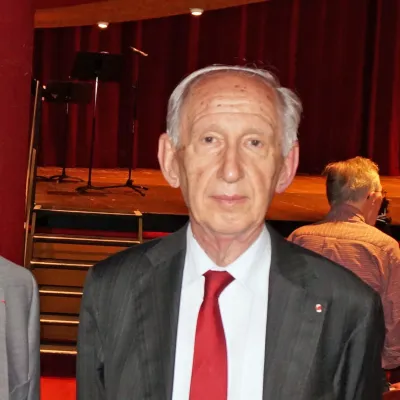
Jean Tulard
Human Design Chart
Biography
The Human Design of Jean Tulard: Generator 2/4
Generator 2/4 — Design at a Glance
Jean Tulard's design indicates a tendency towards great endurance and inner drive, provided he responds to external signals. As a Generator, he possesses a lot of sacral energy, which makes him extremely strong and enduring like a workhorse when he has energy for his task. This power, however, is not released through self-initiation but rather through reacting to impulses from life. His motto was clear: do not initiate, but react.
His design presented two specific pitfalls. One was doing things persistently that he actually had no desire to do, leading to a waste of his energy and potentially to burnout, despite his high potential for productivity. The other danger lay in being prevented from working on his heart project, even though he still wanted to continue working with full power.
The most successful strategy for Jean Tulard was to wait for a signal from life and then, when his sacral center gave a clear "yes", to respond with action. If he lived by this principle, he was rewarded with a feeling of deep fulfillment and could not be stopped. If, on the other hand, he constantly initiated himself, he would eventually encounter persistent frustration and a lack of energy. His path to satisfaction therefore lay in responding from the gut to what life offered him, rather than fighting against the current or blocking himself.
Emotional Authority
Jean Tulard's inner authority carried the defined Solar Plexus Center. This meant that his decision-making was always influenced by an emotional wave, showing a constant rise and fall of his feelings. He saw the world colored by his current mood: in one moment totally excited, in the next moment the same thing negatively evaluated. His feeling in the moment, however, was only a snapshot, a first impression that did not necessarily represent his truth yet. Therefore, quick, spontaneous decisions based on emotion could have very negative consequences.
The mechanics of his emotional authority required patience and reconsidering decisions multiple times. The more time he took to let a decision mature, the deeper and more comprehensive he could understand something. He should take his time and ask himself multiple times. Over time, the intense feelings subsided, he gained emotional distance, and clarity and calmness set in. Then he was through the process. This rule applied regardless of what else was defined in his chart: Whenever the Emotional Center is activated, it is also the inner authority. This was primarily important for long-term decisions that could have a significant impact on his life course.
The 2/4 Profile — Hermit / Opportunist
Jean Tulard revealed himself through a constant alternation between a deep desire for withdrawal and the wish for close connection with a chosen group. His design inclined him to periodically retreat into a "cave" along Line 2 to gain clarity in solitude and isolate himself from external influences. This withdrawal served to establish inner order and protect his independence, often accompanied by the necessity to break conditioning.
Once this inner peace was achieved, the desire of Line 4 emerged: the wish for community and influence within a familiar network. Here he sought recognition and social connection to share and evaluate what he had gained in isolation. The challenge lay in living these two poles not as a contradiction but as a rhythmic process.
For Jean Tulard, it was crucial to clearly communicate these needs: when he sought company and when he needed to remain undisturbed. Only in this way could he effectively utilize the knowledge of his network without endangering his inner integrity. Line 4 brought the potential for success and influence, while Line 2 provided the necessary distance and mental depth to develop brilliant ideas through reflection. This Profile demanded a conscious balance between the "hermit" and the "networker".
Split Definition — Defined & Open Centers
Jean Tulard's Human Design reveals a tendency towards a fixed, reliable self-identity paired with a clear inner direction. His defined G-Center gave him a sense of his own mission and the ability to show others new paths or perspectives without being dependent on them. This inner security in self-love allowed him to comfort others and understand the nature of human evolution.
At the same time, he possessed a strong willpower and material control through his defined Heart Center. He liked to determine his life himself, kept promises reliably, and sought recognition for his contribution. His energy source came from his defined Sacral Center, which provided him with a constant vital force. Here lay his key to satisfaction: not to initiate but to respond to questions to use his energy correctly and avoid frustration.
Emotionally and existentially, he was deeply rooted. His defined Solar Plexus Center required patience to achieve emotional clarity before making decisions. His defined Spleen Center protected him through spontaneous intuition in the present, while his defined Root Center provided him with the necessary pressure to move forward and process stress.
In contrast, his open Head Center revealed a vulnerability to mental confusion and the pressure to find answers to foreign questions. He tended to engage with doubts that were not his own and had to learn to ignore this mental noise. His open Ajna Center made him flexible in thinking but vulnerable to adopting other people's concepts as his own truth. Finally, his open Throat Center showed a tendency to seek attention or try to control communication rather than waiting for an invitation to speak. These open centers challenged him not to be led by conditioned mental or communicative pressure but to trust his defined inner authorities.
Channels for intuitive completion, rhythm, synthesis, discovery and community.
Jean Tulard showed a fundamental disposition shaped by a deep, biological rhythm that effortlessly carried him through the flow of life. This inner conductor, described by the Channel of Rhythm 5-15, connected his fixed habits with a universal attraction that synchronized him with the greater whole. He did not act through forced effort but through a natural, magnetic presence that drew others into his stable energy flow. Parallel to this, he possessed the ability to move intuitively and spontaneously in his environment without being burdened by future anxieties. The Channel of Perfect Form 57-10 allowed him a form of survival based on acute perception and self-determined behavior; he acted from a deep, momentary clarity that secured his well-being and simultaneously brought an aesthetic quality to his interactions.
In interpersonal dynamics, Jean Tulard sought connections based on mutual benefit and emotional clarity. The Channel of Community 37-40 drove him to build bridges and make agreements that were fair and sustainable for all involved. He understood the necessity of integrating into groups while maintaining the ability to preserve his own boundaries and needs. At the same time, he was sensitive to the principles that hold a community together. The Channel of Synthesis 19-49 connected the pressure for belonging with the emotional ability to accept or reject what promoted or endangered the tribal spirit. This gave him a fine sense of loyalty and the balance between individual autonomy and collective responsibility.
Additionally, his design showed a tendency towards discovery through persistent affirmation. The Channel of Discovery 29-46 allowed him to lose himself in experiences to ultimately gain new insights that he could then share. This combination of rhythmic stability, intuitive adaptability, and the pursuit of meaningful community structures shaped his way of moving in the world: always in the flow, yet clear in his connections and principles.
Collective Circuitry — Circuit Signature
Jean Tulard's Human Design reveals a tendency towards separate, parallel functioning energetic fields. As a person with split definition, he had two independent power centers that did not flow directly into each other. The first group connected the Identity, Sacral, and Spleen Centers. Here, the Understanding Circuit operated through the Rhythm Channel, which linked logical structure and future-oriented clarity with the cyclical life force. Parallel to this, the Meaning Circuit acted through the Discovery Channel, which infused emotional waves from the past into the identity. Both circuits shared the Identity and Sacral Centers but did not form a continuous bridge to the second group. This consisted of Heart, Solar Plexus, and Root Centers. Here, the Ego Circuit dominated, which linked giving and taking through the Community Channel and emotional processing with willpower through the Synthesis Channel. This area was separated from the rational identity, leading to an internal split between what Jean Tulard logically knew and what he emotionally or willfully felt. The Integration Circuit also connected Identity and Spleen through the Channel of Perfect Form, fostering a strong intuition for the essential in the present. The separation of the groups meant that Jean Tulard often relied on external resonance to bring these two worlds—the rational identity and the emotional willpower—into a coherent whole.
Right Angle Cross of the Vessel of Love 4
Jean Tulard's Human Design suggests a tendency towards deep, often unspoken devotion, which is less about superficial romance and more about a near-fated connection. This configuration, the right cross of the Love Vessel 4, describes a specific kind of emotional anchoring where the ability to love and be loved is closely tied to a sense of destiny and protection. It's not about actively seeking partnership but rather a passive yet intense readiness to open up in relationships that carry a certain weight and depth.
For Jean Tulard, this meant that emotional bonds were often felt as fulfilling but also as a kind of burden or responsibility. The 'Love Vessel' in this context is not a light game but a container that needs to be filled to give meaning. The number 4 points to a structure that seeks stability and durability, yet is often shaken by internal insecurities or the feeling of not being enough. Jean Tulard thus showed himself as someone who sought a safe harbor in love that would protect him from the outside world, while at the same time risking losing himself in this devotion. This dynamic shaped his interpersonal relationships through a mix of intense care and the fear of being left behind, which profoundly shaped his emotional landscape.
Saturn Return · Uranus Opposition · Chiron Return · 2nd Saturn Return — Life Cycles
Jean Tulard's Human Design suggests a tendency towards structured excellence that was evident early on through clear performance indicators. This became concrete in 1958, at the age of 25, when he passed the Agrégation as the top of his class. For his Human Design, this marked the first Saturn Return. During this phase, years of groundwork and inner discipline often coalesce into a solid external result. The Saturn Return acts as a maturing process that solidifies the foundation for further life structure. Jean Tulard used this cycle to translate his intellectual capacity into a recognized position. The fact that he emerged as the best of his class underscores the effectiveness of his inner structure at this age. It was not a coincidence but the natural result of a consistent alignment with his strengths. The Saturn Return often confirms the path one is on by transforming early efforts into visible achievements. For Jean Tulard, this was the moment when his potential became social reality. This experience shaped his further work, as it showed him that structured effort leads to clear results. His design promoted an attitude that values precision and recognition through performance. The first Saturn Return served here as a catalyst that carried his inner order outward.
Generator · Emotional Authority — Synthesis
Jean Tulard seems to be guided by a deep inner rhythm that manifests in the connection of sacral energy and a firm direction (Channel Rhythm). This combination points to a natural ability to dive into the flow of life while maintaining inner stability. Emotional authority reinforces this aspect by emphasizing the need for decision maturation, which hints at a deep inner wisdom that needs time to unfold. The line 2/4 in the Profile underscores the importance of phases of withdrawal and exchange, suggesting that energy is gained both through solo work and community.
A central paradox in Jean Tulard's design lies in the tension between the need for inner clarity and the emotional wave. The defined Identity Center suggests a firm inner compass, while emotional authority brings a cyclical experience of feelings that can cloud this clarity. This dynamic requires a conscious engagement with one's emotions to recognize inner truth and act authentically – a constant navigation between inner security and the flowing nature of feelings.
5 Defined Channels
Incarnation Cross - Right Angle Cross of the Vessel of Love 4
Solar Return
The Solar Return shows the moment when the sun returns to its exact birth position - your personal solar year.
Life Cycles
Discover the life cycles with a detailed triple view (birth chart, cycle chart, composite).
Human Design Profile
- Type
- Generator
- Strategy
- To respond - wait for something to respond to
- Authority
- Emotional Authority
- Profile
- 2/4 - Hermit / Opportunist
- Definition
- Split Definition
- Incarnation Cross
- Right Angle Cross of the Vessel of Love 4
- Date of Birth
- 22.12.1933 03:00
- Place of Birth
- Paris, France
Frequently Asked Questions
What is Jean Tulard's Human Design type?
What Profile does Jean Tulard have in Human Design?
What Authority guides Jean Tulard?
Which incarnation cross is active for Jean Tulard?
When was Jean Tulard born?
Discover your own Human Design
Are you also a Generator? Find out in a personal reading how to use your sacral energy correctly and discover deep satisfaction.
More Personalities
Back to overviewAaliyah

Alexia

Angèle

Anne-Marie

Arcángel

Arno
