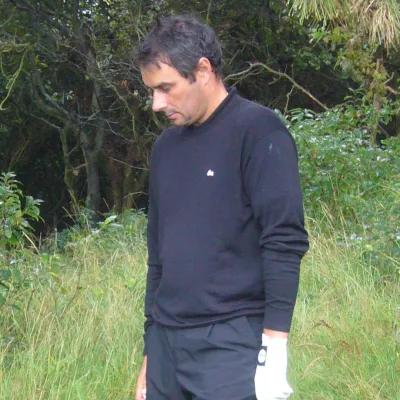
Jean Van de Velde
Human Design Chart
Biography
He turned professional in 1987 and his rookie season on the European Tour was 1989. His first European Tour win was the 1993 Roma Masters. He has twice finished in the top twenty of the Order of Merit. He played on the PGA Tour in 2000 and 2001.
Human Design Analysis: Jean Van de Velde as Generator 2/4
Generator 2/4 — Design at a Glance
Jean Van de Veldes design points to a tendency towards great endurance and energy, comparable to a workhorse that provides strength when it is fueled by its task. As a Generator, he had a lot of sacral energy, which was, however, specifically released: not through independent initiative, but through reacting to signals from life. The motto was clear – not to initiate, but to react. When an impulse came and his sacral center responded with an inner “yes”, he could respond with action and thus make things in his life effective.
This mechanism contained two essential pitfalls. If he spent his energy on tasks that did not interest him, exhaustion threatened. If, on the other hand, he was prevented from working on his heart project, even though he wanted to continue working with full power, a tension arose. If he lived in harmony with this design, that is, by waiting and reacting to inner confirmation, it rewarded him with a feeling of deep fulfillment. If he, however, constantly initiated himself without waiting for the signal, he likely encountered persistent frustration or a lack of energy. His strength lay in acting from the gut as soon as life spoke to him.
Emotional Authority
Jean Van de Velde showed an inner decision-making structure that did not rely on immediate clarity, but on the penetration of emotional waves. His inner authority was the Emotional Authority, carried by a defined Solar Plexus Center. A central mechanism of his design was that this emotional authority always took precedence, regardless of which other centers were also defined.
This meant that Jean Van de Velde was subject to a permanent fluctuation of emotions. The world appeared to him always colored by his current mood: In one moment, he could be enthusiastic about something, in the next, he could negatively evaluate the same thing. His immediate feeling was, however, only a snapshot, not a final judgment. Quick, spontaneous decisions that directly emerged from this emotional heat carried the risk of being proven wrong, as the first impression did not yet reflect the deeper truth.
The strategy of his design required patience and time. By not making decisions immediately, but letting them ripen – often through multiple nights of reflection –, he could let the intense feelings subside. With this distance, he gained emotional distance. Only then did the real clarity and calmness set in. This process was particularly crucial for long-term, life-defining decisions, as it allowed him to act beyond the temporary mood fluctuations.
The 2/4 Profile — Hermit / Opportunist
Jean Van de Velde showed himself as someone who oscillated between a deep need for withdrawal and the desire to connect with a close group. His design points to a tendency to first retreat into a safe “cave” to clarify internal processes before opening up to the outside world again. This dynamic arises from the Profile 2/4, which connects Line 2 of the Hermit with Line 4 of the Community. For Jean Van de Velde, it was crucial to clearly communicate when he sought company and when he wanted to be undisturbed. During his alone time, he reflected the knowledge of his network and developed new ideas from it.
This process was marked by specific energetic patterns. Line 2, influenced by Gate 16, gave him a selective attitude and craftsmanship. He wanted to be called and judged objectively about the feasibility of ideas. Without sufficient energy, however, this side could appear cynical. At the same time, Line 4 worked through Gate 37, which defines leadership through exemplary behavior. Here, it was about providing resources for the family and living the highest principles in everyday life. Jean Van de Velde thus moved in the tension between traditional hierarchy and the need to serve as an example. When his need for peace was fulfilled, he re-entered his network as a connecting element, where he brought in his reflected insights. This interaction between isolated clarification and communal responsibility shaped his way of positioning himself in relationships and roles.
Triple Split Definition — Defined & Open Centers
Jean Van de Velde's Human Design shows a tendency towards constant mental pressure, paired with a strong willpower and an enormous source of vitality. He was someone who constantly asked questions and formed concepts, driven by a defined Head and Ajna Centers. This configuration creates a permanent inner drive to understand and comprehend things, often experienced as inspiration or mental concern. Since Head and Ajna are not directly connected to energy sources, the attempt to immediately turn these thoughts into actions often leads to frustration. Instead, this mental pressure serves to inspire others or to provoke thought.
Additionally, Jean Van de Velde had a defined Heart Center, which gave him a clear willpower and the desire to control his life and resources himself. He tended to make promises and keep them, which strengthened his self-esteem. His defined Sacral Center provided the necessary energy for his personal expression and work. Here, his strength lay in responding to questions and waiting for life to present the right opportunities, rather than initiating them himself. This allowed him to use his energy effectively and satisfyingly.
On the other hand, Jean Van de Velde had an open Throat Center, meaning he did not have a fixed communication style. He was prone to feeling the pressure to get attention or speak when he was near people with defined Throat. This could lead him to try to move into the center through spontaneous talking or acting, which often resulted in unpredictable outcomes. His open G Center left him without a fixed identity or direction, making him prone to adapting to his environment and other people. He sought love and direction through interaction with others, rather than determining them himself.
Finally, he had an open Spleen Center, which made him vulnerable to fears and uncertainties. He might tend to hold onto things that were not good for him just to get a sense of security. This sometimes led him to make impulsive decisions to push away these fears, rather than listening to his inner authority. Overall, his design shows a complex interplay between strong mental and willful pressure as well as openness to external influences in areas such as communication, identity, and health.
Channels for focus, change, community and abstract comprehension.
Jean Van de Velde's fundamental disposition oscillated between sudden, evolutionary impulses and the necessity of logical precision. His design featured two Profile Channels that determined his entire energy quality. The Channel of Mutation 60-3 connected the Root Center with the Sacral Center. This channel brought a potential for unexpected change, but it depended on the ability to accept limitation and to endure the confusion of a new beginning. The associated melancholy was not a deficit but a sign of an underground development that required patience until the new mutation became apparent. Parallel to this, the Channel of Concentration 52-9, also between Root and Sacral, promoted a quiet pressure to remain still and focus on details to perfect patterns. This combination created a tension between the drive for innovation and the discipline of logical analysis.
In the interpersonal realm, the Channel of Community 37-40 shaped his actions. It connected Solar Plexus and Heart and emphasized the importance of fair agreements and emotional trust. Jean Van de Velde sought his place in the group, where real connections could only arise through direct, personal contact and time. Mentally, he was influenced by the Channel of Abstraction 64-47, which linked Head and Ajna Centers. This led to an active mind that filtered experiences through a kaleidoscope of images to find an underlying story or perspective. The resulting confusion was part of the process until clarity set in.
Additionally, individual Gates were at work: Gate 16 promoted experimental mastery, Gate 22 brought social ease, Gate 14 ensured skillful navigation, Gate 36 used crises for development, and Gate 43 enabled breakthroughs of individual insights. These elements together formed a person who brought change through patience, logic, and genuine community connections into the world.
Collective Circuitry — Circuit Signature
Jean Van de Velde's design reveals three separate, parallel operating energetic poles that were never experienced as a continuous flow. This triple definition caused an internal fragmentation of forces.
One pole connected the Sacral with the Root Center. Here, the Knowledge Circuit operated through the Channel of Mutation. This generated a pulsating, acoustic energy that urged to follow one's unique path and transform new knowledge through deviation from the known. Parallel to this, the Understanding Circuit operated through the Channel of Concentration in the same energetic space. It brought focused, visual energy aimed at structuring logical and rational insights free from conditioning and projecting them into the future. Both streams shared the life force of the Sacral Center, on the one hand creatively mutating, on the other strategically analytical.
A second, isolated pole consisted of the connection between Head and Ajna Centers. Here, the Meaning Circuit operated through the Channel of Abstraction. This energy was cyclical and visual, directed towards the past. It served to reflect on past experiences, find the meaning behind them, and share these emotional insights with the collective to learn from them.
The third, completely separate pole connected the Heart with the Solar Plexus Center. The Ego Circuit operated here through the Channel of Community. Without a direct connection to the Sacral life force, this energy was based on timeless, conservative patterns of giving and taking. It promoted cooperation and the joint creation of resources through mutual support, but required necessary pauses for regeneration.
Jean Van de Velde thus appeared as someone who had to face these three different tasks – innovative transformation, rational strategy, and emotional meaning-making as well as cooperative resource creation – as separate, non-fusing realities.
Right Angle Cross of Planning 2
Jean Van de Velde revealed himself as someone who needed inner clarity before he could project outward. His design featured the right cross structure of Planning 2. This configuration means that the energy of the self-expression centers must first be organized through a phase of inner collection and reflection. Without this preparatory period, the energy tends to become scattered or incoherent.
For Jean Van de Velde, it was characteristic that he did not act impulsively but first went inward. He sought the right alignment before sharing his ideas or plans with others. This process of inner planning was not an obstacle but the necessary foundation for his effectiveness. Only when the inner structure was in place could he communicate clearly and convincingly.
The mechanics of this cross require patience with oneself. Jean Van de Velde learned that his strength did not lie in speed but in the depth of preparation. By following this inner logic, a stable and solid basis for his actions emerged from planning. His design thus promoted a stance of conscious forethought that helped him apply his energy purposefully and effectively, rather than losing it in unguided impulses.
Saturn Return · Uranus Opposition · Chiron Return · 2nd Saturn Return — Life Cycles
Jean Van de Velde showed a life structure in which external validation and structural milestones significantly shaped his inner alignment. His design tended to anchor itself through concrete, visible successes, typical for configurations that rely on resonance and recognition to feel their own validity.
This mechanism became clearly effective in 1993, at the age of 27, when he won his first victory at the Roma Masters on the European Tour, marking his first Saturn return. Often, years of groundwork condense into a solid, public result that stabilizes personal identity during this phase. The success here was not only sporting but served to structurally anchor his self-image.
Another dynamic emerged in 2006 when he won the Madeira Island Open at the age of 40. This fell into the phase of the Uranus opposition, a cycle that often forces sudden breaks or new perspectives to resolve old patterns. The victory marked a moment of liberation from previous expectations and confirmed his ability to find new paths under pressure. Both events underscore how Jean Van de Velde channeled his energy through external validation to achieve inner clarity and stability.
Generator · Emotional Authority — Synthesis
Jean Van de Velde's design is marked by a deep, pulsating energy that manifests through the sacral definition (Generator type) and the channel of Mutation (3-60). This combination generates a powerful but unpredictable dynamic that drives him to constantly explore new things and push boundaries. The emotional authority, coupled with the defined mental center, points to a process where inspiration and questions play a central role, yet always require emotional maturation. The profile as a natural talent and networker amplifies this inner rhythm by emphasizing phases of introspective deepening as well as exchange with others – a give-and-take that feeds and shapes creative energy.
Central to Jean Van de Velde's design is the tension field between the need for inner clarity and the ability to initiate change. The knowledge circuit, channeled through Mutation, implies a constant search for new insights and forms of expression, while the emotional wave requires careful consideration. Successes correlated with Saturn and Uranus cycles suggest that the realization of this potential often goes hand in hand with phases of transformation and letting go – a dynamic process between the desire for innovation and the necessity to emotionally center oneself.
4 Defined Channels
Incarnation Cross - Right Angle Cross of Planning 2
Solar Return
The Solar Return shows the moment when the sun returns to its exact birth position - your personal solar year.
Life Cycles
Discover the life cycles with a detailed triple view (birth chart, cycle chart, composite).
Human Design Profile
- Type
- Generator
- Strategy
- To respond - wait for something to respond to
- Authority
- Emotional Authority
- Profile
- 2/4 - Hermit / Opportunist
- Definition
- Triple Split
- Incarnation Cross
- Right Angle Cross of Planning 2
- Date of Birth
- 29.05.1966 00:45
- Place of Birth
- Mont de Marsan, France
Frequently Asked Questions
What is Jean Van de Velde's Human Design type?
What Profile does Jean Van de Velde have in Human Design?
What authority determines Jean Van de Velde's decision-making?
What incarnation cross does Jean Van de Velde have?
When was Jean Van de Velde born?
Discover your own Human Design
Are you also a Generator? Find out in a personal reading how to use your sacral energy correctly and discover deep satisfaction.
More Personalities
Back to overviewAaliyah

Aldair

Alexia

Angèle

Anne-Marie

Arcángel