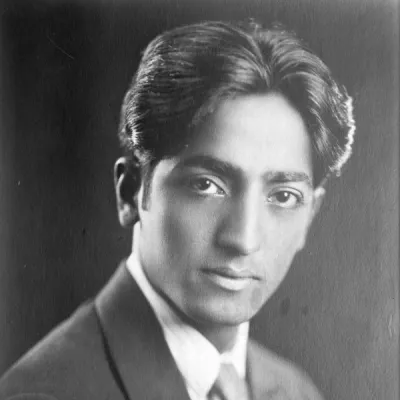
Jiddu Krishnamurti
Human Design Chart
Biography
Krishnamurti asserted that "truth is a pathless land" and advised against following any doctrine, discipline, teacher, guru, or authority, including himself. Nonetheless, during his life he tried to share his insights in 'the teachings', urging for a state without conceptual deliberations and thought. In Krishnamurti's perception, such a righteousness was only possible through the practice of passive or choiceless awareness, which he called the essence of "true meditation" in contrast to contrived techniques. He gained a wider recognition in the 1950s, after Aldous Huxley had introduced him to his mainstream publisher and the publication of The First and Last Freedom (1954).
What does Manifestor 3/5 mean for Jiddu Krishnamurti?
Manifestor 3/5 — Design at a Glance
Jiddu Krishnamurti's design established him as a pioneer and visionary. He was a Manifestor configuration designed to lead the world in new directions, much like an emperor in ancient Rome who had visions of grandeur but did not personally wage wars for them. Instead, he sent his energy out to conquer foreign territories for these ideas. This mode of operation inevitably polarized: His great dreams were loved and followed by some, while others rejected or even hated them because of their magnitude. A central pain point in this design was the feeling of being misunderstood due to his thinking often surpassing that of those around him. To attract the right followers, it was crucial for him to inform others about his intentions early and precisely. This strategy of information was key to his inner state: Following it rewarded him with a deep sense of peace; living against his design led to persistent, deep-seated anger. His path involved attracting the right people through clear communication, thereby resolving the internal conflict between his vision and the outside world.
Emotional Authority
Jiddu Krishnamurti showed himself as someone who never made decisions from momentary impulses. His design placed a defined Solar Plexus Center at the core of inner authority. In Human Design mechanics, this means that once this center is colored, one is subject to an emotional wave with constant ups and downs. The current mood tinted his perception – something might excite him entirely one moment, only to seem negative in the next. Yet, this feeling was merely a snapshot, a first impression not necessarily reflecting deeper truth.
Quick, spontaneous decisions from this emotional heat would have been detrimental to his system. Instead, his configuration required patience and conscious delay. He took time for a decision to mature, often over several nights. Only when the intense feelings subsided and emotional distance was gained did clarity and calm set in. This process of 'sleeping on it' was essential, especially with long-term questions heavily influencing his life path. Only then could he reach true insight through this process.
The 3/5 Profile — Martyr / Heretic
Jiddu Krishnamurti showed himself as someone who first had to try everything personally before sharing insights. His design as Profile 3/5 set a tendency towards learning from personal experiments and mistakes – the line of the adventurer. From practical experience, he later solved problems for others, earning him the role of hero or savior (line 5). This configuration created an allure: Others wanted to learn from his accumulated experiences. Yet, this expectation could be painful when public attempts failed.
The third line boldly expresses individuality and sometimes provokes envy or suspicion through its trial-and-error path without harming others. It only explains when absolutely necessary. The fifth line, however, brings practical solutions in crises, addressing power and resource distribution. In revolutionary times, this organizational ability was projected onto him. Jiddu Krishnamurti's design thus combined personal experimentation with the later task of serving as an example for others – a dynamic containing both attraction and the pressure of failing before others' eyes.
Single Definition — Defined & Open Centers
Jiddu Krishnamurti's Human Design profile indicated a tendency towards consequent, conceptual clarity paired with profound emotional authority. His defined Ajna Center ensured constant mental functions; he thought continuously and processed data and creativity in a trustworthy manner. This mental structure flowed directly into his defined Throat Center, allowing him to articulate what his mind conceptualized. Thus, his communication was not an impulse but the expression of a well-thought-out truth.
Simultaneously, his defined G Center shaped a firm self-identity and clear sense of direction. He had a reliable feeling of being loved without needing others for support. This enabled him to comfort or show new paths to others without restricting their freedom – provided he trusted his inner authority and did not try to direct them against their will.
His defined Solar Plexus Center functioned as an internal authority. He was designed to wait for emotional clarity before making decisions. Emotional clarity only emerged over time; spontaneous reactions to the highs or lows of his feelings would have led to chaos. Patience was essential to recognize what was correct, since 'now' did not offer absolute truth but revealed itself through the course of the emotional wave.
In contrast, his open Head Center lacked a consistent way to process mental information and tended to be overwhelmed by doubts or others' questions. He was prone to getting caught up in thoughts that were not his own. His open Heart Center meant he was not designed to assert willpower or make promises. Trying to prove his worth would have led him into a cycle of self-disapproval; he had to learn not to need to prove anything.
Similarly, his open Sacral Center made him sensitive to the energy of others. He could amplify this energy but lacked a consistent personal flow. Overexertion was a risk as he used borrowed energy and did not know when enough was enough. His open Spleen Center harbored fundamental fears about survival; spontaneous decisions were risky, often driven by conditioned impulses to dispel uncertainty. Finally, his open Root Center absorbed external stress, making him vulnerable to hyperactivity or burnout if he did not recognize this pressure as foreign and release it.
Channels for inspiration, emotional openness and clear structure.
Jiddu Krishnamurti's presence and individual style attracted attention through the Channel of Inspiration 1-8, connecting his G Center with his Throat Center. He was designed to express a mutative perspective creatively; simply being present served as an example inspiring others to live their unique essence. His impact did not arise from rational explanation but by demonstrating his personal direction and thereby drawing public attention.
Simultaneously, the Channel of Openness 22-12 defined his social approach. This channel linked his Solar Plexus Center with his Throat Center, subjecting his articulation to emotional waves. His ability to touch or mutate others depended on his mood; he acted socially open only when he felt like it. Emotional authority ensured that his words had a catalytic effect at the right moment, while compulsion could lead to misunderstandings.
His intellectual structure was shaped by the Channel of Structuring 23-43 and specific Gates. The channel connected his Ajna Center with his Throat Center, enabling him to clearly express spontaneous insights (Gate 43) through assimilation (Gate 23). His thinking often felt ahead of its time; he had to learn to explain his innovative knowledge simply for it to be accepted by the collective. Additionally, Gate 49, focused on transformation and principles, as well as Gate 4 with its logical formulation, contributed to clarifying suspicious patterns. Gate 11 supported visual assessment of situations before acting, while Gate 15 mirrored the natural rhythm of collective organization. This configuration required patience and waiting for the right timing to effectively communicate his unique perspectives.
Individual Circuitry — Circuit Signature
Jiddu Krishnamurti's Human Design profile indicated a tendency towards pulsating, acoustic creativity. He was someone who pioneered new paths and invited change. This attitude stemmed from the Knowledge Circuit, which brings energy around one's own path, new knowledge, and transformation through personal identity. For Jiddu Krishnamurti, this circuit connected Ajna, Throat, Solar Plexus, and Identity Centers into a single cohesive flow.
Structuring (Gates 43–23) formed this energy while Inspiration (Gates 8–1) encouraged it. Openness (Gates 12–22) rounded out the picture. Through this flow, entirely new knowledge could emerge and be expressed through the Throat Center via the Solar Plexus with the right emotions. This served to initiate transformation for others as well. Mutations from Channel 3-60 reinforced unique individuality diverging from convention. Innovative flashes of insight from Channels 20-57 and 24-61, along with inspiration from Channel 1-8, furthered this process. As a simple definition, this connection was clear and directly effective.
Right Angle Cross of Explanation 2
Jiddu Krishnamurti's Human Design profile carried the signature of the right cross. This configuration shaped a fundamental attitude in which life was not seen as a static state but rather as a dynamic process of constant redefinition. For this profile, identity and role were not defined by rigid constraints but emerged through the willingness to dissolve old structures. The mechanics of this cross demand continuous adaptation to new circumstances; resistance against these changes led to internal tensions, while acceptance of fluidity created clarity.
Krishnamurti was characterized by his orientation towards questioning answers as final truths and instead examining them in the context of the moment, releasing them when necessary. This aligned with the energetic logic of the right cross: the power lies in deconstructing the old to make space for a more authentic existence that corresponds to the current state. It was not about destruction in a negative sense but rather an essential cleansing so that what is essential could come to light. His tendency towards explanation – revealing what truly is by stripping away layers of the superfluous – defined how he engaged with his environment and his own thoughts. Stability did not lie in clinging, but in the ability to surrender to change.
Saturn Return · Uranus Opposition · Chiron Return · 2nd Saturn Return — Life Cycles
Jiddu Krishnamurti was someone whose inner structure was profoundly shaken by the first Saturn Return. In 1925, at age 30, his brother Nitya passed away – an event that was more than a biographical occurrence but marked the mechanical effect of this astrological cycle. The first Saturn Return represents a phase of consolidation and seriousness where previously lived structures are tested for their durability. For Jiddu Krishnamurti, this process did not manifest as calm reinforcement but rather as an acute crisis. The mechanics of the Saturn Return often require confronting the limits of self and responsibility; here, these demands sharpened through sudden loss. It was no moment of easy confirmation but one of painful realignment where previous life designs were scrutinized for their sustainability. This experience profoundly shaped his further development, showing how fragile external support can be and how necessary inner independence is when foundations are shaken. The crisis of 1925 thus became the catalytic point where the theoretical task of the Saturn Return – to create or destroy structure – was most acutely felt, forcing Jiddu Krishnamurti to grapple with the finiteness and weight of existence.
Manifestor · Emotional Authority — Synthesis
He was a Manifestor who walked through life pointing out new paths. This pioneering impulse (Manifestor type) was strengthened by his defined mental clarity (defined Ajna Center) – he developed concepts, inspired others, and shaped the thinking of his time. His profile as an Explorer/Hero (3/5 Profile) suggests that he himself experimented extensively before sharing knowledge and helping others. The process of personal experience followed by sharing was central to his impact, especially through the channel of inspiration (1-8), which placed him in a role model position.
A fundamental paradox marked his path: emotional authority required time for decision-making, while his Manifestor design tended towards initiating action. The necessity of allowing emotions to mature stood in tension with the urge to bring about change. This was particularly evident during crisis phases (Saturn Return around 1925), where weighing emotions against the need for action played a role.
3 Defined Channels
Incarnation Cross - Right Angle Cross of Explanation 2
Solar Return
The Solar Return shows the moment when the sun returns to its exact birth position - your personal solar year.
Life Cycles
Discover the life cycles with a detailed triple view (birth chart, cycle chart, composite).
Human Design Profile
- Type
- Manifestor
- Strategy
- To inform others before acting
- Authority
- Emotional Authority
- Profile
- 3/5 - Martyr / Heretic
- Definition
- Single Definition
- Incarnation Cross
- Right Angle Cross of Explanation 2
- Date of Birth
- 12.05.1895 06:00
- Place of Birth
- Madanapalle, India
Frequently Asked Questions
What was Jiddu Krishnamurti's Human Design type?
What Profile did Jiddu Krishnamurti have in Human Design?
What Authority governed Jiddu Krishnamurti?
What incarnation cross did Jiddu Krishnamurti have?
When was Jiddu Krishnamurti born?
Discover your own Human Design
Are you also a Manifestor? Find out in a personal reading how to use your initiation power peacefully and dissolve resistance.
More Personalities
Back to overviewChristian-Jaque
Kesha

Lucebert
Masaccio

Papus
Petrarch