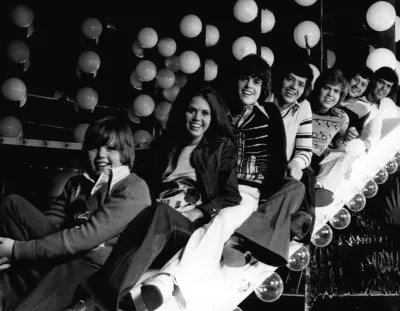
Jimmy Osmond
Human Design Chart
Biography
On 28 January 1979, Jimmy appeared on a TV variety show, "The Osmond Family Show," that ran weekly until 27 May 1979. He made an acting debut on 5 May 1984 in an episode of the series, "Love Boat."
Osmond welcomed his third child, son Arthur, 16 February 2000 in Branson, Missouri, by his wife Michelle. They have two other children, Sophia and Zachary.
His mother Olive Osmond died of complications from a stroke on 9 May 2004 in Provo, Utah. The entertainer’s father died on 6 November 2007. George Osmond was the patriarch of a talented family and manager of his sons’ group. He died in Provo, Utah at age 90.
Jimmy Osmond — Projector with Profile 6/2
Projector 6/2 — Design at a Glance
Jimmy Osmond's design had a tendency towards focused perception. As a projector, his aura acted like a bright flashlight, directing itself precisely towards weaknesses in the environment. He had the ability to immediately recognize where systems or people were not functioning optimally. However, this direct diagnosis could be perceived as unpleasant if it was done uninvited.
The mechanics of his design show that projectors do not draw constant, intrinsic life energy from the undefined Sacral Center. Instead, they experience phases of high intensity followed by necessary rest phases for regeneration. A constant work rhythm, as common in many societal structures, would therefore endanger his energy balance and lead to exhaustion.
The optimal strategy for Jimmy Osmond was to wait for an honest and appreciative invitation. Instead of actively announcing his insights, he was most effective by setting a harmonious example himself. This 'pleasant glow' attracted others who then actively sought his advice. If this strategy was followed, his path led to success and recognition. If he ignored the necessity of the invitation and the pauses, his design tended to express itself in bitterness, the typical non-self theme of this type. His chart thus described a path of selective leadership through attraction rather than imposition.
Emotional Authority
Jimmy Osmond's inner compass was marked by an emotional wave that filtered his perception of the world through the lens of his current mood. His design provided that the defined Solar Plexus Center functioned as an inner authority – a mechanism that takes precedence over all other defined centers in every type except the reflector, regardless of further configurations. This meant that his feelings were subject to constant ups and downs: What appeared as exciting in one moment could be perceived as negative in the next. This emotional dynamism made immediate decisions risky, as the first impression was often only a fleeting snapshot and not the deeper truth. Quick reactions from the emotion could therefore have negative consequences. The strategy of his design required patience: decisions should rest, ideally overnight, to give the intense feelings time to settle. Only when emotional distance was gained and the waves had subsided did the necessary clarity and calmness set in. This process of delay was essential to distinguish the actual inner truth from fleeting moods, especially in long-term life decisions that could significantly influence his path.
The 6/2 Profile — Role Model / Hermit
Jimmy Osmond's design is characterized by a clear developmental line: In his youth, experimentation dominated, marked by trial and error. This phase served to collect numerous personal life experiences, with retreats after failures acting as a driving principle.
This pattern results from the 6/2 line, which acts as a 3-line before the age of 30. Only with the return of Saturn, around age 30, does the sixth line become active. Then a change occurs: The tendency towards intense retreat and distancing from the past becomes effective. This time of reflection serves for healing and deep self-knowledge.
The sixth line allows for an overview of the process and asks who can conclude processes. It's about abstracting from experiences and learning to trust the process. At the same time, the second generation brings the ability to share in others' growth process. Those who refuse this sharing risk alienation and aggression.
The line two also radiates limitations and shows a high adaptability to constraints, even if they no longer exist. This can lead to habits that are maintained even after the original necessity has disappeared – similar to a routine that persists despite changed circumstances.
When the introspective 'cave' phase is completed, Jimmy Osmond emerges as a wise person. Others recognize this life wisdom and come to him to learn from his deep introspection and share in the gained knowledge.
Split Definition — Defined & Open Centers
Jimmy Osmond's design tends towards a constant mental pressure to question and develop concepts, coupled with a deep emotional sensitivity. His defined Head and Ajna Centers created a trustworthy, specific mental function, but lacked energy for direct implementation. This led him to form inspirations as questions to avoid frustration, rather than acting on them immediately. Simultaneously, his defined Solar Plexus acted as an inner authority, requiring him to wait for an emotional wave before making decisions. His defined Spleen and defined Root Center supported him through spontaneous intuition and a firm handling of stress, nourishing existential awareness.
In contrast, his openness in other areas was evident. His open Throat Center made him vulnerable to the pressure to demand attention rather than waiting for natural invitations. The open G Center meant he did not carry a fixed identity but needed to be initiated through relationships and places, making him vulnerable to false environments. His open Heart Center led him to not be designed to prove willpower or make promises, causing him to spiral into self-proving cycles when conditioned. Finally, his open Sacral Center lacked consistent generative energy, making him vulnerable to exhaustion from borrowed energy from others rather than setting boundaries. This configuration marked him as someone seeking mental clarity and emotional depth while learning to conserve energy and trust external initiations.
Channels for clear mind, ambition and mystical principles.
Jimmy Osmond's design tends towards a critical, pattern-oriented way of thinking, paired with a deep emotional need for tribal belonging. The Logic Channel 63-4 connects the Head Center with the Ajna Center, creating a mind that constantly filters patterns to check their consistency. Doubt was essential here; skepticism led to the necessary proof, as unfounded belief found little room. An answer was valid only until a consistent, verifiable pattern emerged from it. Parallel to this, the Synthesis Channel 19-49, connecting the Root Center with the Solar Plexus, created a sensitive awareness of one's position in the whole and the need to be needed. The emotional frequency of this connection determined who belonged to the family and who did not, based on loyalty and the protection of resources.
In addition to this logical-emotional foundation, a mutative, intuitive side was shown through the Awareness Channel 61-24. It connected inspiration from the Head Center with rationalization in the Ajna Center, leading to sudden insights or 'Satori'. This knowledge happened spontaneously, not through logical deduction, breaking old cycles. Furthermore, the Transformation Channel 54-32, connecting the Root and Spleen Centers, drove ambition motivated by the desire for recognition and social ascent. Instincts here recognized when support was available to use talents and improve one's position in life, always in service to the tribe.
Additional influences came from prioritized Gates: Gate 42 emphasized the importance of experience and completing processes for new commitments. Gate 60 brought the acceptance of limitations as a prerequisite for transcendence, connected with genetic pressure. Gate 56 enabled the abstraction of mental processes into figurative narratives. Gate 22 promoted openness and calm listening for social mutations. Gate 28 stood for decisions in the here and now, taking risks. Gate 64 processed past experiences to gain clarity in the abstract mind.
Tribal Circuitry — Circuit Signature
Jimmy Osmond's design tends towards impulsive, creative flashes of insight that find their way into a clear, logical structure. This connection between Head and Ajna Centers, carried by the Knowledge Circuit (Channel 24-61, Awareness) and the Understanding Circuit (Channel 63-4, Logic), creates a dynamic interaction: innovative ideas from the Head Center are focused and rationally processed in the Ajna Center. It's about transforming new insights through the mind, free from emotional coloring, fostering precise, future-oriented thinking.
Parallel to this, an independent energy group operated separately: Spleen, Root, and Solar Plexus Centers were connected in the Ego Circuit. Here, the Transformation Channel (32-54) and Synthesis Channel (49-19) flowed, creating a rhythmic, instinctive power that responded to emotional waves and inner values. Since this group was not connected to the Head-Ajna flow, two parallel systems existed: one that thought and structured, the other that felt and acted instinctively. In Jimmy Osmond, these two areas appeared as adjacent, non-directly communicating forces – the rational idea and the emotional, physical resonance remained separate, leading to a characteristic tension between clear thinking and deep, often melancholic feeling.
Left Angle Cross of Limitation 1
Jimmy Osmond's design showed a tendency towards a clear, often abrupt delineation. He was someone who not only protected his personal boundaries but actively used them to define his own identity. This attitude was less about rejection and more about the necessity to maintain his integrity in a world that often demanded too much of him.
The left cross of the Limitation 1 describes this dynamic precisely. It is a configuration where the individual learns that saying 'No' is not a failure but an act of self-assertion. For Jimmy Osmond, this meant defining himself through clear lines. Where others might have sought compromises to maintain harmony, he sought clarity. This mechanism acts like a filter: anything that did not fit into his values and space was excluded. This is not about stubbornness but about the essential ability to limit oneself to not dissolve.
This limitation was his protective shield. It allowed him to survive in an environment that would otherwise have absorbed him. By setting these boundaries, he created a space where he could be authentic. It was a lifelong lesson: only by defining what he was not could he clearly see who he truly was. This protective layer was thus the key to his inner stability and self-understanding.
Saturn Return · Uranus Opposition · Chiron Return · 2nd Saturn Return — Life Cycles
Jimmy Osmond's design showed a tendency towards sudden, profound fractures that shook the foundation of his previous life. This configuration describes not a gradual development but a moment when old structures irrevocably collapse to make way for a new, often uncertain reality. The Uranus aspect acts here like an electric shock, breaking the status quo and forcing one to embrace the unpredictable.
This mechanism was concretely evident in 2004 when Jimmy Osmond, at the age of 41, lost his mother, Olive Osmond. This loss marked a severe crisis embodying the characteristic Uranus effect: an abrupt end that left no time for gentle adaptation. Instead of a gradual change, a sudden rift appeared, dissolving the previous order of things. For his design, this was a typical trigger, highlighting the need to not cling to outdated securities but to use the energy of the break to reorient oneself. The experience underscored the fragility of external circumstances and the inner necessity to maintain one's stability despite such shocks, without clinging to the past.
Projector · Emotional Authority — Synthesis
A central red thread runs through the design: the ability to recognize patterns and bring light to the dark (Projector Type, Channel 63-4). This ability, however, is always accompanied by an inner pressure (defined Head Center), leading to questions and doubts. Emotional authority intensifies this process by delaying decisions until the underlying patterns are fully grasped. The line 6 in the Profile points to a development from initial experiments to profound wisdom later in life, which is then made accessible to others – a process fueled by repeated confrontation with patterns and their analysis.
The design reveals a central paradox between the need to recognize and correct patterns (Channel 63-4) and the accompanying emotional wave (emotional authority). Recognizing mistakes leads to immediate, potentially unsettling reactions, while the process of emotional authority requires time and maturation. This creates a tension between the drive for clarity and the necessity to navigate one's emotions to gain a grounded perspective. The Uranus opposition cycle, marked by a significant event, underscores the transformative power of this inner tension.
4 Defined Channels
Incarnation Cross - Left Angle Cross of Limitation 1
Solar Return
The Solar Return shows the moment when the sun returns to its exact birth position - your personal solar year.
Life Cycles
Discover the life cycles with a detailed triple view (birth chart, cycle chart, composite).
Human Design Profile
- Type
- Projector
- Strategy
- Wait for the respectful invitation
- Authority
- Emotional Authority
- Profile
- 6/2 - Role Model / Hermit
- Definition
- Split Definition
- Incarnation Cross
- Left Angle Cross of Limitation 1
- Date of Birth
- 16.04.1963 06:23
- Place of Birth
- Canoga Park, CA, United States
Frequently Asked Questions
What is Jimmy Osmond's Human Design type?
What profile does Jimmy Osmond have in Human Design?
What authority does Jimmy Osmond have?
What incarnation cross does Jimmy Osmond have?
When was Jimmy Osmond born?
Discover your own Human Design
Are you also a Projector? Find out in a personal reading how to unfold your leadership qualities and recognize the right invitations.
More Personalities
Back to overviewSissy Spacek

Alain-Fournier

Anémone

Ann-Margret

Arletty

Arno