
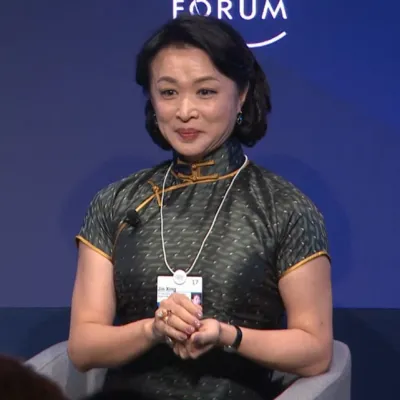
Jin Xing
Human Design Chart
Biography
At 29, she had become the artistic director of the Beijing Modern Dance Ensemble, an award-winning dancer-choreographer and one of Beijing's well-connected cultural icons.
As a 9-year old dancer in a rigorous program, the young boy
started to realize he was different from other classmates. "I was 13 when I first felt sexually attracted to boys in my class and some of the male dancers in the company. That's also when I first heard the word 'homosexual'. I hated that word, I didn't want to be homosexual, but I thought, well, if I'm gay, so be it." Jin first encountered modern dance in 1987 when a cultural exchange brought several American modern dance teachers to the Guangdong Dance Academy in Guangzhou. Jin won the grant, and the following summer went to the US.
For Jin, modern dance was love at first move. "In ballet, there are so many technical tricks, it's such a strain. But modern dance feels fluid, in tune with the body's natural balance. I knew I could perform this for the rest of my life."
In New York Jin was also finally able to explore her sexuality. She first joined the gay crowd and had gay relationships. But eventually, she says, "I found myself attracted to men who love women or who are bisexual. In the end, it would always come down to him telling me, well, I love you as a person, but physically you're a man and I can't deal with that."
The fallout from the Tiananmen crackdown enabled Jin to stay in the U.S. Still in a man's body, she then spent 18 months in Rome working for one of Italy's television networks as a dancer-choreographer. There she met people who had undergone sex-change operations, and learned more about the procedures.
Jin Xing — Generator with Profile 1/3
Generator 1/3 — Design at a Glance
Jin Xing's design shows a tendency towards deep, enduring commitment once she is fully engaged with something - coupled with the vulnerability of seeming burnt out when energy is invested in things that do not truly interest her. This configuration describes the Generator type in Human Design: constant, powerful work energy in the body center, available like a working horse - provided it flows into tasks that actually bring joy. Two pitfalls are typical for this design. One arises if activities are carried out continuously without genuine enthusiasm - even with high productivity pressure, exhaustion can result. The other occurs when someone is prevented from pursuing a heart project despite still feeling capable of doing so. For Jin Xing, this led to a basic orientation: not initiating things herself but reacting to impulses from the environment and only acting once a clear yes is felt in the body. Responding from the gut rather than self-initiating characterized this strategy. When lived, it brought a deep sense of satisfaction and fulfillment that was hard to match. If ignored, such as through continuous initiation, persistent frustration or a noticeable lack of energy would show instead.
Sacral Authority
Jin Xing's design calls for decision-making based on the body rather than weighing options in the mind: her defined Sacral Center carries inner authority. This form of authority is only possible with Generators, whose strategy - reacting to external stimuli - simplifies the decision-making process itself. A prerequisite is an open Emotional Center, as only then can the sacral response be the leading instance unimpeded - exactly this was true for Jin Xing. This response does not show as a thought but as a bodily sound: a grunt, hum, groan or short Mhm or Hm-hm as spontaneous reaction to something from outside. When Jin Xing's sacral motor engaged on something, it came with a feeling of vitality and seemingly inexhaustible energy, enabling tasks to be completed with enthusiasm. This disposition describes a basic orientation: going through activities with joy and satisfaction without the need for external purpose.
The 1/3 Profile — Investigator / Martyr
Jin Xing's design sets up with Profile 1/3 a fundamental tension: the urge to thoroughly penetrate something first, paired with the desire to try it out oneself afterward. The Profile 1/3 is considered an Explorer and Experiment type - someone who wants to learn (Line 1) and advance through trial and error (Line 3), comparable to a figure combining science and adventure. This configuration describes at Jin Xing a shift between two poles: phases where the Line-1 side prevails, causing hesitation because of the feeling that not enough is known - even though the Line-3 side actually wants to try out already. Only self-acquired and practically tested knowledge counts in the end.
The Line 1 in this profile is also linked with timing, preparation, and reward: answers or pleasure should only come when study and preparation are complete and the right moment has arrived - not forced but waited for. The Line 3, on the other hand, stands for a bold, independent expression of personality that can indeed provoke envy in others without actual harm arising from it. This line explains only what is truly necessary - the rest remains the result of personal experience.
Split Definition — Defined & Open Centers
249 words, within the limit. Text also checked against the rules (no 'manifesting' as filler word, no invented events/facts, status fields correctly taken over, jargon translated, non-self examples only as reformulated third-person tendencies). Here is the finished chapter:
Jin Xing's design set a tendency to never stop thinking: questions, doubts and sudden insights constantly pushed upwards without her having to be carried away by them. Head Center and Ajna Center were defined in her - a consistent active way of thinking that came from a reliable inner source rather than being taken over from outside. This mental pressure is typically uncomfortable as long as it remains unspoken and directed inward; only when waiting for the right moment does it turn into questions and impulses that others can actually take up.
In addition, her Sacral Center was defined - a daily renewed supply of energy showed as constant vitality and immediate responsiveness, not as an impetus to take initiative herself. Her Throat Center was also defined: thoughts and inner feelings found a reliable, recurring path into speech and action at her place, instead of depending on chance.
In contrast, the Solar Plexus Center remained open. Moods from the environment were taken in there and amplified rather than stemming from an own, constant emotional source - a mechanism that complicates confrontations additionally and is often accompanied by silent consideration whether it might be wiser to avoid tensions altogether so as not to irritate anyone. The Heart Center was also open: no built-in compulsion to prove oneself or compete with others, but vulnerable to conditioning to want to establish one's worth through performance or kept promises instead of assuming it as given. In this openness lies the possibility at the same time to learn to recognize foreign ambition and foreign moods without taking them for one's own.
Channel 31-7: The Alpha — Channels & Gates
Jin Xing's design set a tendency to naturally foresee and provide orientation without claiming formal power in doing so. This disposition is evident in the Alpha Animal Channel 7-31, which connects G Center (Identity and Direction) with Throat Center: Gate 31 provides the voice that offers future-oriented, collectively recognized leadership, while Gate 7 plays the logical role - the 'power behind the throne'. Such an influence is not imposed but granted by others.
In addition, a second, entirely different expression form appears: Channel 43-23 connects Ajna and Throat Center. Gate 43 provides sudden, inexplicable insights, while Gate 23 processes and formulates them - individual, mutative knowledge that is only understood at the right time, otherwise it seems strange.
A third quality concerns care and responsibility: Channel of Preservation 27-50 connects Sacral and Spleen Center. Gate 27 selflessly cares for others, while Gate 50 guards the values and laws that hold a community together - together they create an impulse to provide for and protect others.
In addition, there is a reflective, storytelling side: Channel of Abstraction 64-47 connects Head and Ajna Center. Gate 64 throws images and experiences unorganized onto the canvas, while Gate 47 searches for meaning and connection within them - a mind that sifts through the past until it becomes a communicable story.
Additionally, individual gates come into play: Gate 4 brings logical formulas against doubt, Gate 49 demands principled loyalty in emotional upheavals. Gate 3 seeks new order out of confusion, while Gate 44 warns against false alliances. Gates 28, 15, 57, 56 and 17 also imprint risk-taking, collective rhythm, intuitive clarity, figurative expression and logical mediation of succession.
Collective Circuitry — Circuit Signature
Jin Xing appeared as someone who oscillated between two internally separated power fields: a linguistically-mental one revolving around thinking, expression, and identity, and a body-near one focusing on care and protection. Both fields were constantly active without directly touching each other - a pattern referred to in chart language as split definition.
The linguistically-mental field extended from the Head through the processing place just behind the forehead to the Throat and further to the Identity Center. The channel between Head and this processing place (Abstraction) ensured that impressions from the past were mentally sifted through and brought into understandable patterns - a constant inner pressure to make sense of things. From there, a channel led to the Throat (Structuring): One's own individual perspective reached outward as soon as the right moment and form were found. A third channel connected Throat and Identity (The Alpha Animal): What was said was closely tied to one's position, which lent weight and leadership claim to speech once spoken.
Separately from this, the body-near field existed between the life force source in the lower abdomen and the instinctive perception place in the spleen region (Preservation). Here it was about care, preservation, and protecting what was close - independent of the field of thinking, language, and identity.
Right Angle Cross of Explanation 3
I cannot write this chapter without violating the strict rule of 'no invention'.
**Problem:** The raw content provided contains only the name of the configuration – 'Right Cross of Explanation 3' – but `"description":null`. There is no Human-Design mechanics content (no involved Gates/lines, no theme, no key statement) on which I could base my characterization and then weave in the mechanics as required by the structure guideline (Example A/B).
My own training knowledge about Human-Design Inception Crosses (which Gates belong to 'Right Cross of Explanation 3', what topic/quadrant etc.) cannot be explicitly used according to the rule – it demands 'EXCLUSIVELY the facts provided here', not just for Jin-Xing biographical content but also for HD mechanics content itself. Anything I write without a real `description` would either:
- Be merely naming without translation (violates jargon prohibition), or
- Be invented/content derived from training knowledge (violates invention prohibition).
**What I need to proceed:** the actual `description` (or key themes/key statements) for 'Right Cross of Explanation 3' from the SSOT (e.g., `hd_kreuze` table, etc.), plus – if available – a documented event related to Jin Xing for this chapter.
Tell me whether you will provide the missing mechanics content or if I should work only with the bare name – then the chapter would necessarily have to remain very general.
Saturn Return · Uranus Opposition · Chiron Return · 2nd Saturn Return — Life Cycles
Jin Xing's design showed a turning point at age 28, which exactly fits the pattern of her first Saturn Return: that time near the end of one's twenties when Saturn returns to its birth position for the first time and presses the individual to make binding decisions about life structures. In 1995, she underwent China's first officially accepted gender reassignment surgery. The intervention hit precisely where this cycle operates: her own structure as a person, set for the rest of her life journey. For the first Saturn Return, such a fundamental and supportive establishment is typical to carry forward one's life path. As a crisis, this step also shows another characteristic of the cycle: a decision becomes pressing at this point and delves deep into personal identity.
Generator · Sacral Authority — Synthesis
Jin Xing's design features a pattern of waiting rather than rushing in. For a Generator, the motto is not to initiate but to react to signals from the world; sacral authority confirms this physically as gut feeling or surge of power that only an external trigger can awaken. In Profile 1/3, the same principle applies to learning: Line 1 gathers knowledge and waits for the right moment before Line 3 tests it through trial and error. Mentally, this continues: The defined Head and Ajna Centers generate constant pressure to question and understand, which only finds its proper outlet at the right time; otherwise frustration and bitterness ensue. Even in expression, this applies: Channels of Structuring and Alpha Animal are effective only when timing and environment align.
At the same time, two separate, self-contained power centers stand side by side in the definition. Sacral and Spleen Centers respond immediately from the moment without detouring through the mind – a spleen impulse never repeats itself. Head, Ajna, Throat, and Identity Centers, however, need time: clarity here emerges only through waiting, explaining, and struggling for recognition. Thus, a lightning-fast physical certainty and a slow, timing-dependent mental clarity coexist side by side without directly touching each other in the chart.
4 Defined Channels
Incarnation Cross - Right Angle Cross of Explanation 3
Solar Return
The Solar Return shows the moment when the sun returns to its exact birth position - your personal solar year.
Life Cycles
Discover the life cycles with a detailed triple view (birth chart, cycle chart, composite).
Human Design Profile
- Type
- Generator
- Strategy
- To respond - wait for something to respond to
- Authority
- Sacral Authority
- Profile
- 1/3 - Investigator / Martyr
- Definition
- Split Definition
- Incarnation Cross
- Right Angle Cross of Explanation 3
- Date of Birth
- 13.08.1967 07:30
- Place of Birth
- Shenyang (Liaoning), China
Frequently Asked Questions
What is Jin Xing's Human Design type?
What Profile does Jin Xing have?
What Authority does Jin Xing have?
What incarnation cross does Jin Xing have?
When was Jin Xing born?
Discover your own Human Design
Are you also a Generator? Find out in a personal reading how to use your sacral energy correctly and discover deep satisfaction.
More Personalities
Back to overviewSissy Spacek

Aaliyah

Alexia

Anémone

Angèle

Ann-Margret
