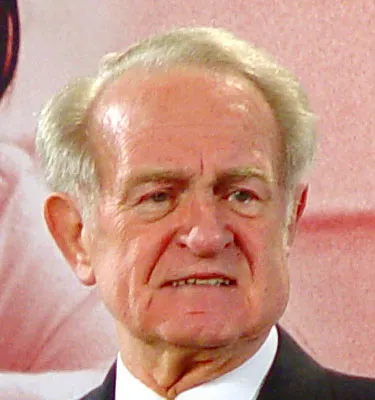
Johannes Rau
Human Design Chart
Biography
Johannes Rau as a Generator 5/1 in Human Design
Generator 5/1 — Design at a Glance
Johannes Rau was someone with immense stamina and a fundamental tendency not to take the initiative himself but rather to wait for signals from his environment. His design indicated a high capacity of sacral energy, which was only activated through reaction. The successful strategy involved waiting for impulses and then responding with action – in short: „reacting from the gut.“
This mechanism fundamentally differed from initiating. Rau had plenty of energy to bring things into his life, but this power primarily ignited by reacting to external occasions. Two specific pitfalls characterized this profile: On one hand, a burnout threatened if he continuously carried out tasks for which he lacked inner enthusiasm and thus wasted his energy. On the other hand, suppressing the urge to work on his heart project – such as prematurely ending despite full power – led to frustration and loss of energy.
In harmony with this reactive principle, his efforts experienced deep satisfaction and a sense of fulfillment. If he did not live according to this design, especially when continuously initiating instead of reacting, he encountered persistent frustration or a lack of energy. His strength therefore lay in listening to the „yes“ of his sacral center and then persisting in what truly mattered to him rather than getting sidetracked into unloved obligations.
Sacral Authority
Johannes Rau showed decision-making joy based on direct inner resonance. His design suggested that he responded to external stimuli with a clear physical signal – the so-called sacral authority. This mechanism was specific to his type, the Generator, whose strategy and internal authority were identical, simplifying his decision-making process.
Rau did not react through abstract thinking but rather through an immediate gut feeling or surge of energy. These physical signals, such as a spontaneous „Hmm“ or „Hm-hm“, served as reliable guideposts. When this inner response occurred, he felt vital and alive; it seemed that inexhaustible energy was at his disposal. He could engage in his tasks with great enthusiasm, fully immersed without needing compulsive purposefulness. His life was characterized by the possibility of going through things with joy and satisfaction.
Additionally, his activated spleen center supported this dynamic. It enabled quick, spontaneous reactions based on his physical well-being. This connection gave him immediate access to his instinctive perception. He could reliably guide himself from this bodily knowledge, emphasizing his ability for rapid and accurate reaction. The combination of the deep energy of the sacral center and the intuitive speed of the spleen defined his way of interacting with the world: directly, energetically, and focused on essentials.
The 5/1 Profile — Heretic / Investigator
Johannes Rau appeared externally as an authority offering solutions while internally undergoing a laborious process of knowledge building. His design as Hero/Researcher (5/1) created a magnetic attraction: Others projected wisdom and competence onto him, often more than he could provide at the moment. This external expectation stood in tension with his internal need for isolated research and foundational building.
Line 5, the Hero, conveyed an impression of a master whose influence fascinated others. Yet this projection required clear boundaries. Without them, exhaustion loomed as he was constantly asked for advice – similar to an expert drained after long conferences and still having dozens of questions to answer. Line 1, the Researcher, demanded time for awareness expansion and building stable structures. It worked with elemental forces refined through patience.
Rau's challenge lay in balancing these two poles: The gift of sharing (Line 5) without self-exploitation, protected by the discipline of research (Line 1). Learning to say no allowed him to preserve his energy and offer sustainable solutions. His design indicated that true effectiveness did not lie in constant availability but in maintaining personal boundaries to serve as a reliable source.
Split Definition — Defined & Open Centers
Johannes Rau was someone with a consistent, trustworthy way of thinking and the ability to articulate concepts coherently. His defined Ajna Center provided a clear, independent mental structure; he always thought in specific patterns that were hard for others to influence. These thoughts flowed directly into his defined Throat Center, making his communication reliable and well-thought-out – he spoke what he had conceptually processed.
The driving force behind this was his defined Sacral Center. As a Generator, Johannes Rau possessed an enormous vital energy base that, however, worked reactively. He needed invitations or questions to correctly apply his energy and find deep satisfaction; initiatives without prior inquiry would quickly lead to frustration. His decisions were not based on willpower or emotional swings but on his defined Spleen Authority: a momentary intuition in the present, telling him what was existentially healthy and correct. This process was grounded by his defined Root Center, which provided a steady pressure to survive materially and move forward.
At the same time, his design revealed specific vulnerabilities. His open Head Center made him susceptible to external mental pressure; he tended to identify with questions or doubts of others rather than recognizing them as not his own. Similarly, his open G Center: without a firm inner identity or direction, he often adapted to the environment and sought a „borrowed“ identity in relationships or places. His open Heart Center lacked consistent willpower; he was not designed to keep promises or prove his worth through competition, making him vulnerable to self-doubt. Additionally, his open Solar Plexus absorbed emotions from his surroundings like a sponge. He often mirrored moods that were not his own and had to learn not to personalize these emotional waves as personal instability but let them go to maintain inner clarity.
Channels for curiosity, ambition, intuition and maturation.
Johannes Rau was someone who conveyed complex connections not through dry data, but through captivating narratives. His design tended to transform information into narrative parables that prompted the collective for reflection – less through logical facts than through the illustrative power of story.
This attitude rooted in the Channel of Curiosity 19-56, connecting Ajna Center with Throat Center. Through Gate of Ideas (11) and Gate of Inspiration (56), he constantly sought new perspectives. His creativity worked magically when he linked philosophical contemplations with personal experiences; his stories served as social commentary that taught or entertained others. He was less interested in pure discovery than sharing: „Look what I found,“ was the driving force behind his communication.
Parallel to this, the Channel of Transformation 54-32 shaped his actions. This channel connected Root Center with Spleen Center via Gate of Ambition (54) and Gate of Continuity (32). It spoke of persistent effort to improve life's position and be seen. His ambition arose from recognizing the fragility of the clan; he worked hard to prove worth and meaning, often becoming a workaholic. This served not only individual ascent but also collective support through loyalty and self-sacrifice.
The intuitive basis for this was provided by the Channel of Power 34-57 between Sacral and Spleen Centers. Through Gate of Intuitive Insight (57) and Gate of Power (34), he reacted spontaneously to his environment. This energy kept him acoustically attentive and physically fit, supported by a defensive intelligence securing survival. It enabled quick decisions in fractions of seconds, independent of mental deliberation.
Additionally, the Channel of Maturation 42-53 between Root and Sacral Centers promoted a cyclical experiential process. Through Gate of Beginnings (53) and Gate of Growth (42), he entered new cycles to complete them fully and gain wisdom from them. Each experience had to be brought to a satisfying resolution before a new beginning was possible.
Individual Gates like 61 (Inner Truth), 50 (Protective Reflex) or 3 (Mutation) supported these dynamics: They promoted the search for individual insight, protection of values, and the ability to create new orders from confusion.
Collective Circuitry — Circuit Signature
Johannes Rau showed a split definition, meaning that circuit energies did not act as constant inner sources but were situationally available. He reflected more collective patterns than his own unchanging drives. The Meaning Circuit in him connected two separate segments: on one hand Ajna with Throat Center (Curiosity), and on the other Sacral with Root Center (Maturation). This allowed for wave-like processing of past experiences and sharing visual or verbal insights with others to learn collectively from history.
The Ego Circuit worked through the channel between Spleen and Root Centers (Transformation). Here it was not about individual self-awareness but resource-oriented cooperation within the clan. Without a connection to Sacral Center, rest periods were necessary to build up energy for this support function.
The Integration Circuit connected Sacral with Spleen Center (Power). This configuration helped to draw strength from reacting to life and act effectively through intuitive knowledge in the here and now. Together these circuits formed tools for interacting with the environment: emotional reflection of the past, traditional resource care, and intuitive self-reinforcement in the moment – always as a response to external dynamics, not as autonomous continuous emanation.
Left Angle Cross of Obscuration 2
Johannes Rau had the left cross of veiling in his Human Design. This configuration laid a foundational structure where one's perception and identity were often hidden behind a veil or did not immediately reveal themselves. It was not an act of conscious hiding but rather an energetic mechanism aimed at protecting the essence from hasty judgments and superficial categorizations by the outside world.
The design promoted a stance of restraint and inner observation. Instead of fully revealing himself right away, Johannes Rau operated from a position where only after recognizing the depth and true intentions could an authentic connection form. This veiling served as a filter: it prevented him from being defined too early or in inappropriate contexts.
For those around him, this meant that Johannes Rau might initially appear distant or hard to grasp. The real substance of his personality became apparent over time and through familiar encounters. Thus, the left cross of veiling marked him as someone whose true nature was not immediately evident but required patience and a deeper commitment to truly understand. This structure created a protected space for his inner development, independent of external expectations or projections.
Saturn Return · Uranus Opposition · Chiron Return · 2nd Saturn Return — Life Cycles
Johannes Rau's design set a tendency towards cyclical maturation that manifested in clear steps of public responsibility. In 1970 at the age of 39, he became Minister of Science in North Rhine-Westphalia. This coincided with his Uranus Return cycle: a time when internal tensions often lead to new roles challenging or expanding the status quo.
Three years later, in 1978 at the age of 47, he took over as Minister-President of North Rhine-Westphalia. This fell during his Chiron Return. In Human Design mechanics, this cycle marks not a healing of old wounds but a blooming phase: one's incarnation cross unfolds increasingly in life if strategy and authority are observed. Purpose and meaning become experiential; the inner mission becomes an outer reality.
In 1986 at age 55, he was the first German to visit Haifa University in Israel. This occurred during his second Saturn Return cycle. This period condenses years of groundwork into sustainable results and strengthens structures. It stands for maturity, responsibility, and integrating earlier experiences into a larger, stable context.
Rau's career steps thus did not follow random patterns but reflected the rhythmic dynamics of his constellations: from disruptive realignment through central purpose unfolding to structural anchoring and international recognition. Each step was an expression of this deeply rooted cyclical logic.
Generator · Sacral Authority — Synthesis
Johannes Rau was a Generator, marked by his sacral energy and endurance. His profile as Hero and Researcher (5/1) points to a deep knowledge base he made available to others – always driven by a learning process and the desire for new challenges. The defined Mental Center enabled him consistent concepts and clear thinking, while the Channel of Curiosity (Gate 11-56) turned him into an indefatigable seeker who shared his insights and prompted reflection. This combination of energy, thirst for knowledge, and communication skills shaped his work and was evident in professional stations ranging from research to mediation.
A central paradox lay in the tension between his sacral drive and the need for deep exploration. As a Generator, he needed external stimuli to activate his energy, yet the defined Ajna Center and curiosity drove him simultaneously to develop concepts independently and generate knowledge. This interplay of reaction and self-initiative led to a cyclical pattern of engagement, reflection, and sharing insights – a process that gave him energy as well as served for self-actualization.
4 Defined Channels
Incarnation Cross - Left Angle Cross of Obscuration 2
Solar Return
The Solar Return shows the moment when the sun returns to its exact birth position - your personal solar year.
Life Cycles
Discover the life cycles with a detailed triple view (birth chart, cycle chart, composite).
Human Design Profile
- Type
- Generator
- Strategy
- To respond - wait for something to respond to
- Authority
- Sacral Authority
- Profile
- 5/1 - Heretic / Investigator
- Definition
- Split Definition
- Incarnation Cross
- Left Angle Cross of Obscuration 2
- Date of Birth
- 16.01.1931 05:00
- Place of Birth
- Wuppertal, GER
Frequently Asked Questions
What is the Human Design type of Johannes Rau?
Which Profile did Johannes Rau have?
What Authority did Johannes Rau have?
What incarnation cross did Johannes Rau have?
When was Johannes Rau born?
Discover your own Human Design
Are you also a Generator? Find out in a personal reading how to use your sacral energy correctly and discover deep satisfaction.
More Personalities
Back to overviewAaliyah

Alexia

Angèle

Anne-Marie

Arcángel

Arno