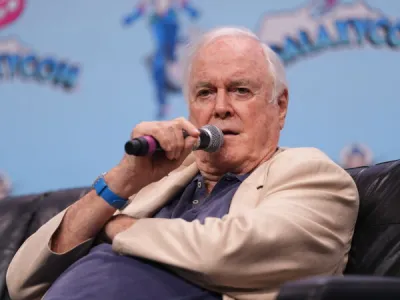
John Cleese
Human Design Chart
Biography
In the mid-1970s, Cleese and first wife Connie Booth cowrote the sitcom Fawlty Towers, in which he starred as hotel owner Basil Fawlty, for which he won the 1980 British Academy Television Award for Best Entertainment Performance. In 2000, the show topped the British Film Institute's list of the 100 Greatest British Television Programmes, and in a 2001 Channel 4 poll, Basil was ranked second on its list of the 100 Greatest TV Characters.
Cleese starred in and wrote the comedy film A Fish Called Wanda (1988), for which he received Academy Award, BAFTA Award, and Golden Globe Award nominations, and its quasi-sequel Fierce Creatures (1997).
The Human Design of John Cleese: Generator 1/3
Generator 1/3 — Design at a Glance
John Cleese had a massive sacral energy foundation that made him an extremely enduring figure – comparable to a workhorse. This power was not freely available for spontaneous initiatives but ignited exclusively by responding to impulses from the outside world. His design required waiting for a signal before he acted.
The central mechanics of his Generator type lay in this distinction: Not initiating, but reacting. When John Cleese responded to an inquiry or opportunity and felt his inner "yes" – the clear impulse from the gut – he could work with unmatched power. This led to deep satisfaction and a sense of true fulfillment.
Two main pitfalls shaped his dynamics. First, energy waste: If he did things that he had no internal desire for, he burned himself out until exhaustion, despite his high potential. Second, being interrupted: When he was prevented from working on his heart project while the energy still flowed, frustration arose.
If John Cleese lived against this principle and tried to initiate instead of waiting for signals, he eventually encountered persistent frustration and energy deficiency. His success depended on whether he used this sacral response to materialize life rather than trying to force it through his own drives.
Sacral Authority
John Cleese's Human Design profile indicates a tendency towards decision-making based on reactions that arise not from cognitive analysis but from immediate physical signals. As a Generator, he possesses sacral authority, and his strategy of reacting is identical to this inner instance. This fundamentally simplifies his decision-making process: He needs to wait until an external stimulus triggers a response in his Sacral Center. This reaction manifests as gut feelings, bursts of energy, or sounds like grunts and hmm-hmms.
As long as his Emotional Center remains open – a necessary prerequisite for this authority – he can trust these signals. Once his sacral motor engages, a state of vital energy and inexhaustible power emerges. John Cleese is driven by great enthusiasm and deep satisfaction in his actions. This energy is not goal-oriented; it arises simply from being immersed in the activity itself. His life becomes vibrant through this inner resonance because he was born to act with joy without an external purpose justifying the action. The waiting period for this physical response is not a delay but the essential prerequisite for correct, energy-rich decisions.
The 1/3 Profile — Investigator / Martyr
John Cleese's Human Design profile sets a tendency to oscillate between meticulous theoretical preparation and the urge for practical experimentation. His Profile 1/3, the Researcher and Experimenter, defines this life task as a synthesis of learning and doing. Line 1, influenced by Gate 28, brings a need for risk assessment and detail work. This could lead to delays in implementation until there was a feeling of not knowing enough or the plan not being aesthetically and practically perfect.
At the same time, Line 3, connected with Gate 31, drives the process of trial and error. Here, the focus is on discernment regarding external influences; it is less about the number of followers than their quality. This dynamic creates a characteristic reliability: when John Cleese makes a judgment or deems something good, this assessment is not arbitrary. It is based on double-checking – theoretically through the planning Line 1 and practically through the experimenting Line 3. The combination of necessary planning before action and readiness to learn from mistakes shapes an attitude where insights are only considered valid if they stand up to real-world testing.
Triple Split Definition — Defined & Open Centers
John Cleese's Human Design shows a massive energetic density: seven defined centers created an extremely stable, constant presence in thinking, communication, identity, willpower, energy production, intuition, and stress processing. This architecture revealed someone whose mental process was continuous – the defined Ajna Center generated consistent conceptual thinking that was directly translated into speech through the defined Throat. He spoke reliably what his mind conceptualized, supported by a strong independent identity (defined G Center) and clear willpower (defined Heart). His energy source was enormous and reactive (defined Sacral), while spontaneous intuition (defined Spleen) and constant action pressure (defined Root) underpinned his actions.
In contrast, Head and Solar Plexus were open. These areas were not internally driven but reflected the environment. John Cleese was exposed to the confusion of the open Head, tending to wonder whether he must find inspiring answers or felt the pressure to answer others' questions. Simultaneously, his open Solar Plexus absorbed emotional waves; he risked personalizing foreign moods and avoiding confrontation out of fear of rejection. The challenge lay in using his massive internal structure as authority to not succumb to mental unrest or emotional fluctuations but to maintain the clarity of his defined centers.
Channels for breakthrough, change, logic, structure and care.
John Cleese exhibited a tendency towards pulsing, on/off energy that connected phases of silence with unexpected breakthroughs. This dynamic was significantly shaped by Channel Mutation 60-3. This connects the Root Center (Gate 60, Limitation) with the Sacral Center (Gate 3, Order). The mechanics create mechanical moodiness: Between pulses, internal tension and melancholy arise that are not seen as defects but necessary developmental phases in the background. Change occurs suddenly, like music in the gaps, forcing innovation once the pressure of not knowing is accepted.
Alongside this mutative force, Channel Acceptance 17-62 was at work. It connects Ajna Center (Gate 17, Opinions) with Throat Center (Gate 62, Details). Here, the mind permanently organizes visual patterns into speech and logic. John Cleese had the gift of making complex connections understandable through detailed translation, provided he waited for the right timing to express them.
Channel Structuring 43-23 added: Gate 43 (Insight) in Ajna Center received spontaneous breakthroughs that were processed by Gate 23 (Assimilation) in Throat Center. This allowed expressing innovative perspectives efficiently and metaphorically, making his thinking often feel light-years ahead.
Channel Initiation 51-25 connected Heart Center (Gate 51, Shock) with the Self Spirit Gate (25). This promoted natural competitiveness and the ability to lead to individuation through 'shocks'. Initiation here occurred as a mystical process in the heart of mutation.
Finally, Channel Preservation 27-50 ensured stability. The Sacral Center (Gate 27, Care) worked with Spleen Center (Gate 50, Values) to preserve kin and community through selfless support and protection of traditional values.
Additionally, Gates like Gate 41 (evolutionary development), Gate 28 (risks in the here and now), and Gate 1 (uniqueness) supported readiness for creative mutation without restrictions.
Individual Circuitry — Circuit Signature
John Cleese's design showed a clear separation between rational analysis and emotional distance. His Mind Circuit connected Ajna with Throat Center, enabling logical, strategic structuring and expression of 'emotionless ratio' – insights were clearly communicated free from impulsive emotional coloring. Parallel to this, the Knowledge Circuit worked: Here too, a channel connected Ajna with Throat Center (Structuring), while another bundled Sacral and Root energy (Mutation). This underscored the drive to generate new knowledge and implement changes without direct emotional resonance from Solar Plexus in the Mind circuit.
Internal stability came from two further separate areas. The Centering Circuit linked Identity and Heart Centers, creating firm self-worth and strong individual convictions – yet without connection to Throat Center, these often remained internally held or hard to express directly. Simultaneously, the Protector Circuit through linking Sacral and Spleen Centers provided instinctive protection, care, and preservation of one's genetics.
As a Triple Definition, these three energy blocks were not internally fused. John Cleese therefore needed external validation or suitable environments to activate each respective energy. The rational impulses of Mind and Knowledge stood alongside internal stability and protective instincts as parallel but separate forces that only became effective through external interaction.
Right Angle Cross of the Unexpected 3
John Cleese's Human Design shows a tendency towards unexpected turns and surprising solutions that often come out of nowhere. This configuration describes the Right Cross of the Unexpected 3, a structure that promotes spontaneous creativity and the ability to quickly adopt new perspectives in dynamic situations. It is not about planned strategy but rather an intuitive response to the moment, which is often perceived as surprising or unconventional.
This mechanism acts like an inner compass for the unforeseen: When daily life becomes repetitive and rigid, this cross activates the energy of the New. It allows one to break out of fixed patterns by relying on the next impulse instead of analyzing it. For John Cleese, this meant a natural affinity for improvisation and playing with expectations. The strength lies in the ease with which the unexpected is accepted rather than rejected as an interruption.
It is not a conscious decision but an automatic process of design: Life presents the situation, and the Unexpected 3 Cross delivers the surprising starting point. This creates a dynamic where innovation does not have to be forced but arises naturally from openness to the new. John Cleese thus showed himself to be someone whose work was often marked by this specific kind of spontaneous creative surprise that breaks through structure and opens space for fresh ideas.
Saturn Return · Uranus Opposition · Chiron Return · 2nd Saturn Return — Life Cycles
John Cleese's Human Design shows a clear structure in which inner maturation and outer confirmation condense into specific life points. In 1969, at the age of 30, the first broadcast of Monty Python's Flying Circus aired. This marks his first Saturn Return, a cycle where long-term discipline and structural groundwork often culminate in tangible, stable results. For his design, this was the moment when years of inner shaping manifested into a public, stable structure – not as a sudden coincidence but as a logical consequence of a long-term build-up.
Another crucial chapter began in 1988 with the huge success of the film A Fish Called Wanda. At age 49, John Cleese entered his Chiron Return. In Human Design mechanics, this is not a process of wound healing but a fulfillment cycle: The time of bloom, where one's incarnation cross – if lived according to strategy and authority – increasingly unfolds. The success of the film was here more than just career advancement; it was a tangible experience of meaning and purposeful expression form. Life showed him that his specific way of working precisely hit where it belonged. Both events underscore how his design translates inner cycles into concrete, public milestones: Structure through Saturn, fulfillment through Chiron.
Generator · Sacral Authority — Synthesis
A central red thread in this design is the dynamic connection between energy and gaining insight. The sacral authority (Sacral Center) drives an unrelenting engagement with the world, a constant reaction to external impulses and testing of new paths (Profile 1/3). This energetic foundation is reinforced by the defined Mental Center, which develops concepts and filters experiences – a continuous loop of action, observation, and understanding. The Channel of Mutation (Gate 3-60) emphasizes this tendency towards change and breaking conventional patterns, always in search of new possibilities and formats.
The central paradox lies in the tension between the need for deep, sacral connection with the current task and the constant urge to gain new insights through experiments (Line 3). While energy from the Sacral Center flows best when focused on fulfilling tasks, the Profile challenges the researcher to constantly try new things and push boundaries – which can potentially lead to an energetic up-and-down. The Right Cross of the Unexpected intensifies this ambivalence by integrating unexpected turns and challenges into the learning process.
5 Defined Channels
Incarnation Cross - Right Angle Cross of the Unexpected 3
Solar Return
The Solar Return shows the moment when the sun returns to its exact birth position - your personal solar year.
Life Cycles
Discover the life cycles with a detailed triple view (birth chart, cycle chart, composite).
Human Design Profile
- Type
- Generator
- Strategy
- To respond - wait for something to respond to
- Authority
- Sacral Authority
- Profile
- 1/3 - Investigator / Martyr
- Definition
- Triple Split
- Incarnation Cross
- Right Angle Cross of the Unexpected 3
- Date of Birth
- 27.10.1939 03:15
- Place of Birth
- Weston-super-Mare, England, United Kingdom
Frequently Asked Questions
What is John Cleese's Human Design type?
What profile does John Cleese have in Human Design?
What authority guides John Cleese?
What is John Cleese's incarnation cross?
When was John Cleese born?
Discover your own Human Design
Are you also a Generator? Find out in a personal reading how to use your sacral energy correctly and discover deep satisfaction.
More Personalities
Back to overviewAaliyah

Alain-Fournier

Alexia

Angèle

Angeli

Anne-Marie