
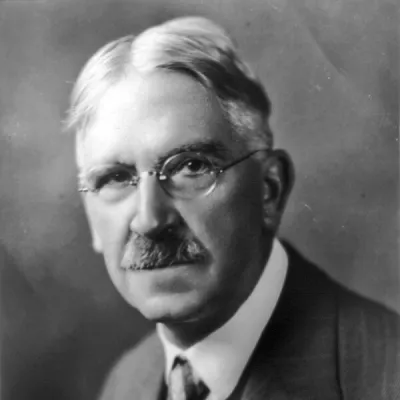
John Dewey
Human Design Chart
Biography
The overriding theme of Dewey's works was his profound belief in democracy, be it in politics, education, or communication and journalism. As Dewey himself stated in 1888, while still at the University of Michigan, "Democracy and the one, ultimate, ethical ideal of humanity are to my mind synonymous." Dewey considered two fundamental elements—schools and civil society—to be major topics needing attention and reconstruction to encourage experimental intelligence and plurality. He asserted that complete democracy was to be obtained not just by extending voting rights but also by ensuring that there exists a fully formed public opinion, accomplished by communication among citizens, experts, and politicians.
Dewey was one of the primary figures associated with the philosophy of pragmatism and is considered one of the founding thinkers of functional psychology. His paper "The Reflex Arc Concept in Psychology", published in 1896, is regarded as the first major work in the (Chicago) functionalist school of psychology. A Review of General Psychology survey, published in 2002, ranked Dewey as the 93rd-most-cited psychologist of the 20th century.
Dewey was also a major educational reformer for the 20th century.
John Dewey as a Generator 1/3 in Human Design
Generator 1/3 — Design at a Glance
John Dewey had enormous stamina and the ability to generate energy for his tasks. As a Generator, he possessed abundant sacral energy, making him seem like a strong workhorse – provided he dedicated himself to things that truly mattered to him. His design suggested that he was most successful when he did not initiate actions but instead responded to signals from his environment. The motto for him was: wait until the sacral center gave a clear 'yes', and then respond with action.
This strategy of reacting rather than initiating was crucial. When John Dewey followed this inner guidance and reacted to impulses from life, he was rewarded with a sense of deep fulfillment. Conversely, frustration and energy depletion loomed if he acted against his design – for instance, by doing things that did not interest him or being hindered in working on his heart projects. His strength lay in acting intuitively and focusing his energy precisely when an appropriate impulse came along. This way, he could unleash his intrinsic creative power without exhausting himself or falling into burnout symptoms.
Sacral Authority
John Dewey demonstrated decision-making directly from the physical reaction to external stimuli. As a Generator, his strategy was identical to his inner authority: sacral authority. This greatly simplified his process as he did not need to weigh different levels but could listen to one clear impulse. A prerequisite for this was his open emotional center, ensuring that he did not mistake premature emotional waves for truth but waited for the immediate physical response.
This response manifested as a gut feeling or an energy surge – often audible as grunting, humming, or a confirming 'mm-hm'. When his sacral motor kicked in, he felt vital and alive. He then had inexhaustible energy and tackled tasks with great enthusiasm, fully immersed in the activity itself without needing external purposefulness. This configuration predisposed him to go through life with joy.
Additionally, his active spleen center acted as a supportive authority. It endowed him with the ability to react especially quickly and spontaneously. Through direct access to his instinctive perception and physical well-being, he could reliably guide himself. This combination enabled him to make decisions in the moment of encountering life, supported by a deeply rooted, bodily intuition that always took precedence over intellectual deliberation.
The 1/3 Profile — Investigator / Martyr
John Dewey's design indicated a tendency towards exploratory experimentation. As someone with Profile 1/3, he showed a preference for gathering knowledge not just theoretically but through practical application. This configuration describes a path of trial and error: Line 1 sought fundamental understanding and expanded awareness, while Line 3 carried the need to actively test ideas. Often, an inner tension arose between the desire for complete planning and the urge to act. But precisely in this tension lay his strength: self-discovered insights were particularly trustworthy as they had been rigorously tested both intellectually and empirically. The mechanics of Line 1 promoted building a foundation through patience and refinement, while the third line from Gate 56 taught adaptability through direct experience. Mistakes were not defeats but essential steps towards wisdom. Through this process of constant review – theoretical and practical alike – John Dewey developed judgments that could be relied upon. His path was marked by the necessity to adapt to new circumstances and take on or let go of connections or ideas, thereby achieving a deep self-sufficiency grown through experience.
Single Definition — Defined & Open Centers
John Dewey's Human Design profile suggests a tendency towards constant, vital energy that is released in response to life. His defined Sacral Center acts as the motor for fertility and availability; he has a daily energy source that feels like a constant hum driving him to be active. However, this power is only available when responding to external questions or situations – his inner confirmation decides whether there's energy for a task. Initiating actions without this validation often leads to frustration since sacral energy cannot be mobilized at will.
Additionally, his defined Root Center shapes how he deals with stress and pressure. It provides a physical impulse to move forward in the world and master existential challenges. This internal drive serves to rise materially or make corrections as long as it's guided by his strategy. Without this alignment, he tends to obsessively project this stress or fall into unhealthy exertion.
In contrast, several undefined centers reveal his vulnerabilities. His open Head Center prevents him from maintaining a constant mental focus; he is prone to confusion and the pressure of finding answers for others' questions rather than relying on his inner authority. The open Ajna Center means that his conceptual thinking is flexible but not reliable as a decision-making tool – he takes in ideas without holding them as personal truth. His open Throat Center shows a tendency to seek attention or feel compelled to speak when there's no invitation to do so. The open G Center lacks a fixed identity; he adapts to the people and places around him, making him vulnerable to false directions unless he is in the right place. His open Heart Center drives him to prove his worth by giving promises that he often cannot keep due to a lack of consistent willpower. The open Solar Plexus Center absorbs emotions from the environment, making him susceptible to emotional conditioning and a desire to avoid conflict. Finally, the undefined Spleen Center reveals a fundamental survival fear; he tends to cling to things that give him a false sense of security instead of acting spontaneously, which is often risky.
Channels for radical change through accepted limits.
John Dewey appears deeply rooted in the rhythms of change and stillness. His design suggests a tendency towards unexpected, mutative impulses guided not by logical planning but by inner resonance. This is most evident through Channel 60-3 of Mutation. This channel connects the Root Center with the Sacral Center, bringing forth a pulsing, adrenaline-driven energy that oscillates between chaos and order. Gate 60, the Gate of Limitation, functions as a fulcrum for evolutionary possibilities while Gate 3, the Gate of Order, attempts to realize new values. For John Dewey, this means learning to accept the limitations of his own unpredictability and not arguing against melancholic phases when the pulse stops. In these quiet moments, development continues beneath the surface until a new mutation is ready to express itself through him.
Additionally, other gates influence his experience. Gate 50 brings a conservative protective reflex and awareness for traditions and values, giving him some inner stability. In contrast, Gate 56 enables inspiration and abstraction of mental processes into figurative narratives. Finally, Gate 39 contributes as fuel for mutation; it involves provocation and selective analysis to activate the mind through adrenaline and bring about change. This combination creates a profile that unites both the depth of tradition (Gate 50) and the urgency of transformation (Channel 60-3, Gate 39), with the ability for narrative abstraction (Gate 56) helping articulate these complex inner movements. John Dewey lived in the tension between waiting for the right impulse and actively provoking re-evaluation.
Individual Circuitry — Circuit Signature
John Dewey's design suggests a tendency towards continuous renewal and deviation from the status quo. As a simply defined type, he has a clear, coherent energetic flow between his Sacral and Root Centers. This connection forms the basis of his ability to act: The Sacral Center provides sustained life energy while the Root Center supplies the necessary impulse and urgency. Within this framework, the Knowledge Circuit is specifically activated by Channel 3-60 in John Dewey's case. This channel represents mutation – conscious deviation from earlier patterns and structures. The energy of this connection pulses in the here and now, driven by an acoustic quality that brings forth new knowledge. It’s not about static preservation but continuous change through individuality. John Dewey used this configuration to bring transformation into the world by leaving established paths behind and forming innovative solutions. The emotional wave of his Solar Plexus Center remains outside these defined groups; instead, he focuses on directly implementing mutations through the convergence of Sacral and Root energy. His design thus promotes an attitude of ongoing transformation where the new always emerges from a break with the old.
Right Angle Cross of Laws 3
John Dewey exhibited a fundamental orientation based on the maintenance of internal and external order structures. His design suggested that he felt most comfortable in contexts where clear rules and laws prevailed—not as limitations, but as stabilizing foundations for his actions. This alignment stemmed from the right cross of Laws 3: a configuration focusing on "right" in terms of order, structure, and legitimate frameworks.
It was important to him to understand which norms applied in a given situation and how they could be respected. This did not mean blind adherence but rather a deep need for clarity about what was allowed or required. His energy flowed where he could move within defined boundaries; outside these structures, he often lost direction.
This mechanism shaped his way of interacting: he sought the "right" in terms of appropriateness and conformity with existing systems. Whether in social groups or institutional settings—John Dewey always oriented himself toward how he could behave correctly to maintain harmony and stability. His strength lay in recognizing order and using it as a foundation for constructive interaction.
Saturn Return · Uranus Opposition · Chiron Return · 2nd Saturn Return — Life Cycles
John Dewey's Human Design profile indicated a tendency towards structured, long-term developments that crystallized into clear milestones. His life path was characterized by cycles of maturation and expansion, which can be traced back to his inner mechanics. In 1884, at the age of 25, he earned his doctorate from Johns Hopkins University. This coincided with his first Saturn Return, a time when years of groundwork often culminate in a solid achievement that lays the foundation for future responsibility.
Another turning point occurred in 1896 when Dewey, at the age of 37, founded the Laboratory School in Chicago. This event corresponded to his Uranus Opposition, a phase that often requires new structures and breaks old patterns to enable innovative solutions. The founding was thus no coincidence but an expression of this dynamic energy seeking renewal.
In 1911, Dewey reached the position of President of the American Philosophical Association. At age 52, he was in his Chiron Return cycle, a period of bloom and fulfillment. During this phase, one's incarnation cross unfolds increasingly so that meaning and purpose become experiential, provided the individual has followed their strategy. This peak underscored the effectiveness of his path.
Finally, in 1916 at age 57, he published "Democracy and Education." This happened during his second Saturn Return, marking another deepening and consolidation of previous accomplishments. This sequence shows how Dewey translated the archetypal rhythms of his design into concrete professional successes, with each cycle offering specific challenges and opportunities that he utilized.
Generator · Sacral Authority — Synthesis
John Dewey lived a process of continuous, sacral-driven exploration. His design as a Generator with a defined Sacral Base (Sacral Center) indicated immense endurance and the necessity to generate energy through action. This power was amplified by the Profile of Researcher/Experimentor (1/3) – an unceasing urge to try things out himself and gain knowledge through direct experience. The Channel of Mutation (3-60) underscored this tendency towards change and acceptance of limitations as part of the learning process, which was evident in documented career events where new paths were taken. Repeated cycles emphasized the need for constant development and the expression of his individuality.
A central paradox lay in the combination of this insatiable curiosity and the pulsating energy format of the Knowledge Circuit with the potential stumbling block of getting lost in activities that did not truly fulfill him. Although Dewey’s sacral authority enabled him to intuitively recognize which activities would feed his energy, his open Emotional Center indicated a vulnerability to external influences and possible difficulties in distancing himself from things that appeared interesting but did not serve his true purpose.
1 Defined Channel
Incarnation Cross - Right Angle Cross of Laws 3
Solar Return
The Solar Return shows the moment when the sun returns to its exact birth position - your personal solar year.
Life Cycles
Discover the life cycles with a detailed triple view (birth chart, cycle chart, composite).
Human Design Profile
- Type
- Generator
- Strategy
- To respond - wait for something to respond to
- Authority
- Sacral Authority
- Profile
- 1/3 - Investigator / Martyr
- Definition
- Single Definition
- Incarnation Cross
- Right Angle Cross of Laws 3
- Date of Birth
- 20.10.1859 09:52
- Place of Birth
- Burlington, Vermont, United States
Frequently Asked Questions
What is John Dewey's Human Design type?
What Profile did John Dewey have in Human Design?
Which Authority guided John Dewey?
What incarnation cross did John Dewey have?
When was John Dewey born?
Discover your own Human Design
Are you also a Generator? Find out in a personal reading how to use your sacral energy correctly and discover deep satisfaction.
More Personalities
Back to overviewAaliyah

Alexia

Angèle

Anne-Marie

Arcángel

Arno
