John F. Kennedy
Human Design Chart
Biography
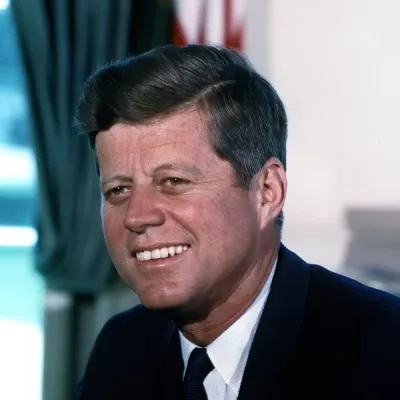
Born into the prominent Kennedy family in Brookline, Massachusetts, Kennedy graduated from Harvard University in 1940, joining the U.S. Naval Reserve the following year. During World War II, he commanded PT boats in the Pacific theater. Kennedy's survival following the sinking of PT-109 and his rescue of his fellow sailors made him a war hero and earned the Navy and Marine Corps Medal, but left him with serious injuries. After a brief stint in journalism, Kennedy represented a working-class Boston district in the U.S. House of Representatives from 1947 to 1953. He was subsequently elected to the U.S. Senate, serving as the junior senator from Massachusetts from 1953 to 1960. While in the Senate, Kennedy published his book Profiles in Courage, which won a Pulitzer Prize. Kennedy ran in the 1960 presidential election.
Human Design Analysis: John F. Kennedy as Projector 3/5
Projector 3/5 — Design at a Glance
John F. Kennedy revealed himself as someone with a focusing aura, quickly identifying system errors. His Human Design type was the Projector, whose energy can be likened to a bright flashlight. This light was directed towards areas that were still in darkness or not functioning properly in his environment. Kennedy saw rapidly what was wrong and could identify the error in the system.
However, this design's mechanics required patience. A direct confrontation with these insights would often have been perceived as unpleasant, similar to shining bright light directly into someone's face. The more effective strategy involved waiting for a respectful and sincere invitation. Through this approach, he avoided bitterness, which is the non-self theme of Projectors, and attracted others through his role model function.
Since Projectors do not possess a defined Sacral Center, they lack constant intrinsic life energy. Instead, there were phases of high activity followed by the need for rest periods to prevent burnout. This self-regulation was essential as the social environment often did not accommodate this rhythmic requirement. Living according to this design rewarded him with success; ignoring the strategy of waiting for an invitation led to bitterness. His role involved bringing light into darkness for others and illuminating their path by sharing his insights only when actively sought.
Emotional Authority
John F. Kennedy demonstrated a decision-making stance that required time and emotional distance. His inner authority lay in his defined Solar Plexus Center, subjecting him to a constant wave of emotions. This emotional dynamism created a permanent up-and-down of his moods; the world appeared colored by the current affect. In one moment he could be enthusiastic about something, in the next view the same situation as negative. His immediate feeling was merely a snapshot, not a guaranteed truth claim. Spontaneous decisions made from this emotional heat often proved misleading and could have negative consequences.
The mechanics of his authority demanded patience: He had to let decisions mature. By repeatedly 'sleeping on it', he gained the necessary distance for intense feelings to subside. Only then did clarity and calm set in – the state where a well-founded choice was possible. This process was particularly crucial for long-term, life-defining steps. Kennedy learned to hesitate and be asked multiple times rather than reacting to the first impulse. Emotional authority always took precedence over other defined centers in his design; it significantly determined his access to truth. Through this conscious delay, he transformed fleeting impressions into durable insights that profoundly shaped his actions.
The 3/5 Profile — Martyr / Heretic
John F. Kennedy emerged as someone who learned through personal experimentation, often painful, and then presented this practical knowledge attractively for others' solutions. His design inclined him to initially verify everything himself before accepting it – a stance stemming from his Line 3 of the Experiencer. This line connected with a strong desire for independence and validation by others, which also nurtured doubts if necessary timing or energy was lacking.
At the same time, he acted as an heroic storyteller (Line 5), whose appeal lay in passing on insights gained from personal mistakes. This role flattered his self-image but became painful when public attempts failed. Especially in private life, emotional waves shaped his relationships. His configuration around Gate 37 promoted a natural devotion to family yet risked dependency and unfulfilled expectations if projections of enduring love fell short. The tension between the public hero image and private vulnerability due to failures defined his essence.
Single Definition — Defined & Open Centers
John F. Kennedy was someone whose actions were characterized by a clear willpower and control over his own resources. His defined Heart Center gave him the ability to make promises and keep them, which strengthened his self-esteem. He preferred to follow his own internal mechanisms to balance work and rest rather than being guided by external expectations.
Parallel to this, his defined Solar Plexus Center determined his emotional authority. Kennedy was not designed to make decisions in the moment; instead, he had to wait for the wave dynamics of his feelings to clarify before making an emotional decision. This patience allowed him to recognize deeper truths because truth revealed itself to him over time.
In contrast, John F. Kennedy's Head, Ajna, Throat, G, Sacral, Spleen and Root Centers were open. This made him vulnerable to mental confusion and the pressure of having to find answers for others (open Head and Ajna Centers). He tended to seek attention or speak impulsively to get it (open Throat Center), rather than waiting for the right invitation. His open G Center left him acting without a fixed identity; he often sought direction or love through adaptation to his environment, instead of asserting his own path.
The open Sacral and Root Centers exposed Kennedy to energy absorption from his surroundings. He could easily become exhausted as he was not designed to continuously produce generative energy or sustain adrenalized pressure over the long term. Instead, he reflected the energies around him, making him vulnerable to conditioning if he did not trust in his inner authority from Heart and Solar Plexus.
Channel 40-37: Community — Channels & Gates
John F. Kennedy understood social contracts not as spontaneous gestures but as carefully negotiated agreements. His design inclined him to enter into commitments only when emotional clarity was achieved and mutual support was clearly defined. This resulted from Channel 37-40, which connects the Solar Plexus Center with the Heart. This configuration linked the emotional wave of the Solar Plexus with the willpower of the Heart. Gate 37 sought recognition and his place in the whole, while Gate 40 was ready to work to provide for loved ones but needed reward and breaks. The mechanics of this channel required time for the emotional pressure wave to clarify; a good deal or commitment could not be impulsively closed. Instead, it needed direct, personal “touch” rather than impersonal contacts to build trust. The goal was harmonious coexistence without hierarchy based on loyalty to the group and exchange of practical support. Kennedy sought an honorable place in a community where everyone voluntarily contributed their share. This channel's energy emphasized that agreements had to be correctly formulated so they were beneficial for both sides. It was about transitioning from survival struggle to liberation through correct, mutual agreements: “I do this for you if you do that for me.” This structure shaped his approach to relationships and organizations by ensuring connections rested on a basis of mutual respect and clear expectations. The individual Gates 16, 9, 30, and 49 complemented this picture with aspects of experimenting, detail work, emotional longing, and principled transformation, which remained subordinate to the central dynamics of the Community Channel.
Tribal Circuitry — Circuit Signature
John F. Kennedy was someone who set a dynamic balance between giving and taking in relationships. His design inclined him to see cooperation and mutual support as the foundation for creating resources together. This aligned with Channel 37-40, called “Community,” embodying the dynamics “I give you today, you give me tomorrow.”
This mechanism directly connected his Heart Center with his Solar Plexus Center. The Heart stood for identity and willpower, while the Solar Plexus controlled emotional waves and reactions. Through this connection, he could use emotional intelligence to strengthen social bonds and mobilize resources within a group. It was not about narrow individual ego interests but rather clan dynamics where the welfare of the community took precedence.
Since his design did not connect with the Sacral Center, he lacked its constant self-regenerating life force. Instead, it was essential for him to take sufficient rest breaks. Only through these pauses could he regenerate the necessary energies to continue effectively cooperating and providing resources for his clan. Without these recovery phases, the delicate balance between giving and taking would have been disrupted, impairing his ability for mutual support. His path involved acknowledging these rhythmic pauses as a necessary part of the process rather than interpreting them as weakness.
Right Angle Cross of Planning 2
John F. Kennedy's design was marked by the Right Authority, a configuration that profoundly shaped his identity and life path. This formed the deepest layer of his Human Design with a presence of 95 percent, independent of situational influences. His essence lay in strategic planning and preparation. The life path was designed to achieve a specific vision or goal through careful groundwork and structuring of possibilities. It was less about the pure 'what' of action and more about the precise 'how' and 'when'. This mechanism described a focus on organizing potential before it was put into practice. The constant presence of this cross meant that planning was not just an option but the constant backdrop to his being. John F. Kennedy thus emerged as someone whose actions were always guided by this deeply rooted need for preparation and strategic alignment.
Saturn Return · Uranus Opposition — Life Cycles
John F. Kennedy's development was marked by two prominent planetary cycles, structuring his transition from youth to societal responsibility and later into a new phase of life. His first Saturn Return occurred at the age of 27, marking the end of his youthful period and the beginning of serious commitments. This coincided with his honorable discharge from military service in 1944. This step marked the entry into a new stage of independence and public role as this cycle typically demands: taking on structure and responsibility after completion of training and learning phases.
Later, around age 40, the Uranus Opposition impacted his life. This configuration signaled a phase of radical reorientation and the pursuit of individual autonomy, often accompanied by a break from old patterns. In 1957, exactly at this age, his first daughter Caroline was born. This event underscored the dynamic change in his personal identity and priorities. The Uranus Opposition not only facilitated political or career shifts but also deep personal realignments, where John F. Kennedy embarked on new paths of self-determination. Both cycles shaped his life path through clear phase transitions: from taking on external responsibility to inner detachment and reorientation in middle age.
Projector · Emotional Authority — Synthesis
John F. Kennedy was a Projector distinguished by the ability to recognize potential and weaknesses in others (Gate 11). This gift combined with a defined Heart Center, driving him to use his own resources and keep promises – a tendency that earned him trust. His Profile as an Explorer/Hero/Savior (3/5) suggests he learned through experimentation and shared this knowledge; actively seeking experiences to offer solutions. This dynamic was evident in events marking career advancement and personal success.
At the core of his design lay a paradox between the need for recognition (Gate 37 in the Community Channel) and the emotional wave of his authority. He sought connection and validation through offering help but needed time to process emotions before gaining clarity. This tension between the desire for immediate impact as a Projector and the necessity of emotional maturity shaped his approach – a constant balancing act between bringing light into darkness and following his inner compass.
1 Defined Channel
Incarnation Cross - Right Angle Cross of Planning 2
Solar Return
The Solar Return shows the moment when the sun returns to its exact birth position - your personal solar year.
Life Cycles
Discover the life cycles with a detailed triple view (birth chart, cycle chart, composite).
Human Design Profile
- Type
- Projector
- Strategy
- Wait for the respectful invitation
- Authority
- Emotional Authority
- Profile
- 3/5 - Martyr / Heretic
- Definition
- Single Definition
- Incarnation Cross
- Right Angle Cross of Planning 2
- Date of Birth
- 29.05.1917 15:00
- Place of Birth
- Brookline, United States
Frequently Asked Questions
What was John F. Kennedy's Human Design type?
Which Profile did John F. Kennedy have?
What Authority guided John F. Kennedy?
What incarnation cross did John F. Kennedy have?
When was John F. Kennedy born?
Discover your own Human Design
Are you also a Projector? Find out in a personal reading how to unfold your leadership qualities and recognize the right invitations.
More Personalities
Back to overviewSissy Spacek

Alain-Fournier

Anémone

Ann-Margret

Bourvil

Hergé