
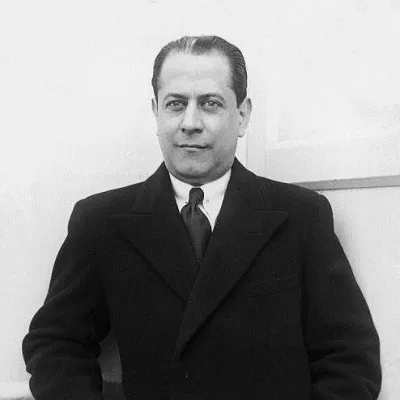
José Raul Capablanca
Human Design Chart
Biography
He died on 8 March 1942 at age 53, in Manhattan, New York, the day after a stroke
The Human Design of José Raul Capablanca: Projector 4/6
Projector 4/6 — Design at a Glance
José Raul Capablanca's Human Design revealed a tendency towards focused perception. As a Projector, he did not have a constant intrinsic source of life energy due to an undefined Sacral Center. Instead, he experienced phases of high activity that had to be balanced with periods of rest to avoid exhaustion. His character was marked by a dense, focusing aura, comparable to a bright flashlight directed at weaknesses in his surroundings. He immediately recognized flaws in systems or relationships. However, directly addressing these issues often led to defensive reactions from others because the intense light was perceived as unpleasant. The most effective way for him to express himself was to embody harmonious patterns himself, attracting people who felt drawn to his radiant influence and actively sought his advice. His strategy involved waiting for respectful invitations from his environment. If he wasn't invited or ignored this principle, the non-self theme of 'Bitterness' would surface. Living according to his design, however, brought him success.
Splenic Authority
José Raul Capablanca exhibited a decision-making approach based on subtle, immediate inner signals. His design placed authority in the Spleen Center, meaning that his health and alarm system served as a compass for life. With both Emotional and Sacral Centers open, he was either a Projector or Manifestor; only these types can utilize this specific internal guidance.
His intuition acted as a reliable indicator of whether a situation, environment, or society supported him. The first spontaneous impulse was considered the right path and protected him directly from harmful influences. This allowed him to set strict boundaries and effectively take care of himself. However, this signal was very subtle and appeared only once at each moment. There was a risk that external voices or considerations could overshadow this quiet impulse. Therefore, his decision-making required high vigilance; a brief retreat could help him hear the Spleen's voice clearly.
Since knowledge of what is right was always available only in the moment, plans often changed spontaneously. Long-term commitments hindered this flexibility. His design thus demanded much freedom and spontaneity rather than rigid obligations. This mechanism shaped his life through constant adaptability to immediate presence.
The 4/6 Profile — Opportunist / Role Model
José Raul Capablanca demonstrated throughout his life a balance between the deep need for belonging and the call to isolated wisdom. In his first thirty years, he appeared experimental, especially in friendships and relationships, as his sixth profile line still functioned like a third one. He actively sought connections and tested various social roles.
With maturity, however, an internal conflict emerged: while the Heart yearned for community, the Head demanded withdrawal to reflect on the meaning of existence. This contradiction between the desire for cooperation and the need for contemplative distance shaped his later development. It was expected that he would act as a wise role model distinguished through collaboration with others.
His inner architecture conveyed a specific stance towards security: Through Gate 14, he sought stability by creating solid foundations and practical intelligence. He aimed to control power to ensure financial security; opportunism showed in waiting for the right moment before acting. At the same time, Gate 29 brought some confusion in choosing commitments. He carefully examined whether an engagement contributed to personal growth or was merely due to blind luck. This caution served to protect his open heart from false people and ensured that he only entered into obligations he could uphold - even if they initially made no obvious sense.
Single Definition — Defined & Open Centers
José Raul Capablanca's Human Design shows a tendency towards clear, identity-based communication supported by spontaneous intuition. His defined G Center gave him a firm sense of self-identity and a reliable compass for his life direction; he knew who he was and spoke from this inner security. The also defined Spleen Center ensured that these expressions were not only from the ego but also from an intuitive, momentary body consciousness - a form of spontaneous judgment in the 'now', prioritizing health and well-being. Thus, his voice was a reliable expression of both sources: identity and instinct.
At the same time, José Raul Capablanca showed through several open centers as a sensitive receiver of external fields, making him vulnerable to conditioning. His open Head Center and Ajna Center meant that he did not generate constant mental pressure or his own conceptual answers; instead, he tended to absorb intellectual questions and confusion from his environment without identifying them as his own. This could lead to feelings of mental overload when trying to find solutions to problems that were not his.
His open Heart Center lacked consistent willpower; he was not designed to make promises or prove his worth through competition. Instead, he risked getting caught in a cycle of self-doubt if he tried to meet expectations he could not keep. The open Sacral Center left him without constant vital energy; he absorbed the generative power of his environment and amplified it, leading to exhaustion when ignoring boundaries and working on 'borrowed' energy. Additionally, his open Solar Plexus absorbed foreign emotions, causing him to be tossed between others' moods without recognizing them as his own. Finally, his open Root Center took in external stress; the attempt to escape this adrenalized pressure through overactivity often led into an endless cycle of tension and burnout since he did not generate this pressure himself but merely reflected it.
Channels for intuitive fulfillment, inspiration and precise action.
José Raul Capablanca appeared as someone who worked through authentic presence and intuitive clarity. His design connected the art of individual expression with a deep survival instinct. The Channel of Inspiration 1-8 linked the G Center to the Throat Center via Gate 1 (Self-expression) and Gate 8 (Contributing). This created an effect that did not come from words but through exemplary living; he inspired others to live their unique qualities. Parallel to this, the Channel of Awakening 10-20 also between G and Throat Centers, over Gate 10 (Presence) and Gate 20 (Now), spoke the truth of the moment: 'I am here', serving as a foundation for his survival based on self-confidence and acceptance.
These two channels shared the G Center-Gate 10, creating the Channel of Perfect Form 57-10. This connected the Spleen (Gate 57, intuitive insight) with the G Center. Capablanca acted spontaneously and appropriately, guided by an acute sensitivity to his environment, ensuring his physical well-being. Additionally, the Channel of Frequency 48-16 between Spleen (Gate 48, depth) and Throat Center (Gate 16, skillfulness). Here he united intuitive intelligence with perfecting skills through repetition, allowing talent to emerge from skillfulness. Finally, the Channel of Aha! 57-20 directly connected the Spleen with the Throat Center. This allowed him to clearly articulate intuitive insights in the moment and awaken others' inner survival intelligence.
Furthermore, priority gates shaped his approach: Gate 29 (Sacral) demanded persistence and correct saying 'yes', while Gate 30 controlled emotions and recognizing illusions. Gate 14 facilitated skillful power application and direction finding. On a personality level, Gate 62 supported logical detail work and pattern recognition, while Gate 44 promoted alertness and resource management in dealing with others. In the design, Gates 56 (mental abstraction) and 33 (reflection) helped process experiences and translate them into images or memories.
Individual Circuitry — Circuit Signature
José Raul Capablancas' Human Design points towards an innovative, individual expression power tendency. As a simple definition, his energy showed as a continuous flow between Throat, Identity, and Spleen Centers. This connected the ability for creative insight (Channel 20-57) with inspiring impulses (Channel 1-8). The Knowledge Circuit promoted transforming new knowledge through emotional waves while sharing it. Parallel to this, the Understanding Circuit worked over 'Frequency' (Channel 16-48), also between Throat and Spleen Centers. Here stood the focus on sharing logical, rational insights free from conditioning to carry structure into the future. Integration completed this picture through Awakening Channels (20-10) and Perfect Form (10-57). These connected intuitive Spleen energy with identity and expression, making power effective from reacting to life in the moment. Capablancas' design thus united creative inspiration, rational strategy, and individual empowerment into one pulsating stream. No separate groups interrupted this flow; instead, all three circuits worked harmoniously together to bring unique identity through logic and creativity into the world.
Right Angle Cross of Contagion 4
José Raul Capablancas Human-Design legged a tendency towards a deep, almost physical connection with the immediate environment. Through what is called the right infection cross, he acted like a sensitive receiver for the energies and moods of other people. This configuration did not describe an active search for answers but rather a passive readiness to accept: He unconsciously took up the emotional states and psychological tensions of his surroundings as if breathing them through his pores.
For his system, this meant that external influences directly entered his inner rhythm. What others only perceived superficially was processed by him into personal experiences. This mechanism shaped him as someone who did not observe the atmosphere of a room or group neutrally but rather internalized it. The boundary between what came from outside and what he felt himself was particularly permeable through this structure. He lived in constant resonance with what was happening around him, without this always being a conscious decision. This receptivity formed the basis for how he behaved in social or energetic fields - not as a detached analyst but as part of the fabric he entered.
Saturn Return · Uranus Opposition · Chiron Return — Life Cycles
José Raul Capablancas Human-Design shaped a phase of profound upheavals that crystallized in 1927 at the age of 39. The Uranus opposition marked a point where old structures often had to break down to make room for new developments. This was evident in his crisis: he lost the world champion title to Alexander Alekhine. This loss was not just a failure but a necessary rupture in life's course, challenging his previous self-understanding and forcing a reorientation.
From this tearing apart emerged, however, a new stability. The Chiron Return, the fulfillment cycle around the 49th year of life, offered the possibility to fulfill one's incarnation task if one had followed their strategy. For José Raul Capablanca, this bloom occurred in 1936. At age 48, he won tournaments in Moscow and Nottingham. These successes were not just sporting victories but expressions of his inner purpose increasingly unfolding in life. The previous crisis thus served as preparation for this phase of meaning-making and confirmation of his life direction.
Projector · Splenic Authority — Synthesis
José Raul Capablanca acted throughout his life as an observer who recognized patterns and pointed precisely to weaknesses (Projector with defined Throat Center). This ability, to recognize the potential of others - or their deficits - was central to his interactions. He lived the tension between the desire for recognition through community (Line 4 in Profile) and the inner necessity to take a unique perspective (Line 6), which led him to go his own way and offer creative solutions (Channel 1-8). The Spleen Authority strengthened this impulse towards self-care and demarcation by giving him a fine sense for the right environment and situation.
A central paradox in his design lay in the interplay of observational skill and the desire for influence. He quickly recognized what was not working, yet direct pointers could elicit rejection. Instead, he seemed to focus on an indirect path - through inspiration (Channel 1-8) and by living as a role model (4/6 Profile), to instigate change. The cycles showed that success and crisis were closely intertwined; the loss of his title was replaced by new successes, underscoring the dynamic nature of his inner tension.
5 Defined Channels
Incarnation Cross - Right Angle Cross of Contagion 4
Solar Return
The Solar Return shows the moment when the sun returns to its exact birth position - your personal solar year.
Life Cycles
Discover the life cycles with a detailed triple view (birth chart, cycle chart, composite).
Human Design Profile
- Type
- Projector
- Strategy
- Wait for the respectful invitation
- Authority
- Splenic Authority
- Profile
- 4/6 - Opportunist / Role Model
- Definition
- Single Definition
- Incarnation Cross
- Right Angle Cross of Contagion 4
- Date of Birth
- 19.11.1888 01:45
- Place of Birth
- Havana, Cuba
Frequently Asked Questions
What is the Human Design type of José Raúl Capablanca?
What Profile did José Raúl Capablanca have?
What Authority guided José Raúl Capablanca?
What incarnation cross did Jose Raul Capablanca carry?
When was Jose Raul Capablanca born?
Discover your own Human Design
Are you also a Projector? Find out in a personal reading how to unfold your leadership qualities and recognize the right invitations.
More Personalities
Back to overviewSissy Spacek

Alain-Fournier

Aldair

Anémone

Ann-Margret

Bourvil
