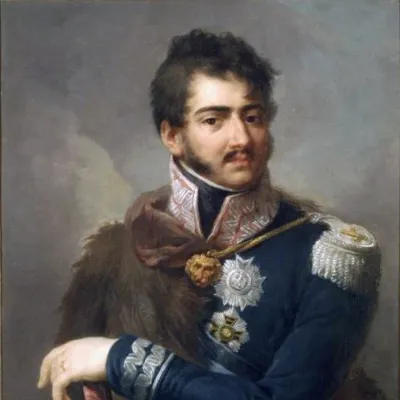
Josef Poniatowski
Human Design Chart
Biography
Human Design Analysis: Josef Poniatowski as Projector 4/6
Projector 4/6 — Design at a Glance
Josef Poniatowski appeared as someone who radiated with a dense, focused aura. His Human Design type was Projektor. This configuration suggested that he did not distribute his energy evenly but rather directed it like a bright flashlight onto weak spots in his environment. He had the ability to immediately recognize where systems or relationships were flawed – places where others still operated in the dark.
However, this direct perception carried risks within itself. If he expressed his observations abruptly, it could be perceived as unpleasant or aggressive by those around him, similar to a light beam directly into someone's eyes. The mechanics of his design indicated that an elegant approach lay in not correcting but attracting through harmonious behavior. Others should be fascinated by his clarity and seek advice from him.
Since his sacral center was undefined, Josef Poniatowski lacked a constant source of life energy. He experienced phases of high activity followed by necessary rest periods for regeneration. Ignoring this rhythm often led to exhaustion. Living according to this strategy – waiting for an honest invitation – rewarded him with success. If he deviated and tried to fight against the resistance of his environment, feelings of bitterness as a manifestation of non-self-experience developed in him.
Self-Projected Authority
Josef Poniatowski appeared as a Projektor with rare authority within himself. This design characterized extreme openness, making him vulnerable to distraction by external motoric energies. The greatest danger lay in losing oneself in this sensory overload and constantly chasing after external energy rather than trusting the inner self.
His inner truth rooted in his identity. He did not make decisions through rational deliberation but through spontaneous forms of self-expression. Either he engaged in internal or external conversations – always invited –, where listening was crucial: Spontaneous speech without thinking revealed his true nature and made his uniqueness recognizable to others. Alternatively, he followed a physical pull that guided him geographically or thematically into a specific direction.
By remaining loyal to this inner orientation, Josef Poniatowski became a guide for others. There lay his specific potential for success: not in active doing but in recognizing and following his own path, which helped others find their way. This mechanism required him to clearly distinguish between the spontaneous word of self and the thoughts of reason to appear authentic.
The 4/6 Profile — Opportunist / Role Model
Josef Poniatowski appeared as someone who acted experimentally during the first three decades of life, driven by a strong desire for connection. His Human Design Profile 4/6 worked similarly to Line 3 at that time: He sought intense relationships and friendships through cooperation to stand out. The profile 'Networker / Role Model' indicated that he learned early on to cautiously open his heart to avoid being hurt by false people.
With the return of Saturn, his orientation fundamentally changed. Line 6 became active and brought an inner conflict between the desire for community (Line 4) and the urge for spiritual distance (Line 6). Josef Poniatowski now faced the task of enduring this contradiction: On one hand, the great heart of a networker; on the other, the necessity to contemplate the meaning of life.
The mechanics of his lines promoted discretion and precise timing. The fourth line taught him that single-minded action and silence prevented conflicts before impulsive statements. Higher goals stood above the need for recognition. Simultaneously, Line 6 in Gate 13 developed an unwavering hope. What initially appeared as pessimism transformed into a belief in a better world and the necessity of every interaction for greater unity. Thus, Josef Poniatowski grew into a role model who inspired others through listening and optimistic orientation without sacrificing his own spiritual integrity.
Single Definition — Defined & Open Centers
Josef Poniatowski showed himself to be marked by a defined G Center, which gave him a firm sense of self-identity and a clear direction for his personal path. He possessed the inner security of feeling loved without needing to depend on others, and could convey this stability to those around him. Simultaneously, his defined Throat Center acted as a reliable pivot point for communication; it allowed him to translate messages from various internal sources into clear expressions or actions, always connected with a specific energy source like the Heart or Ajna. This combination created a consistent way of self-expression.
At the same time, his design was characterized by several open centers, making him vulnerable to external conditioning. His open Head Center lacked steady mental inspiration; he tended to be overwhelmed by doubts and questions from others rather than solving them as his own problems. The open Ajna Center amplified this: He absorbed concepts and opinions from his environment without necessarily taking them as his own truth, which often put him in the position of having to appear more certain than he felt.
Especially defining was his open Heart Center. Josef Poniatowski did not have consistent willpower in the sense of ego-driven assertiveness. He was vulnerable to the pressure of proving his worth through performance or promises, which could end in spirals of self-doubt if he failed. His open Sacral Center also meant that he lacked constant generative energy; he absorbed the vitality of his environment, making him prone to overexertion and exhaustion since he did not always know when it was "enough." Additionally, his open Solar Plexus Center made him a mirror for others' emotional waves, while his open Spleen Center left him vulnerable to fears about health and well-being that were often projected from the environment. His open Root Center absorbed the adrenaline-fueled stress of his surroundings, leading to an ongoing sense of pressure he had to escape to avoid burnout.
Channels for inspiring presence and creative expression.
Josef Poniatowski revealed himself as someone who drew attention through his blores existence and authentic presence. His design pointed towards a tendency for individual, creative leadership that worked not through words but through the exemplary life of his own truth. This was particularly marked by the Channel of Inspiration 1-8. This connection path between G Center and Throat Center linked Gate of Self-expression (1) with the Gate of Contribution (8). As such, he was designed to function as a role model: His unique identity served as a public outlet for creative potential. He inspired others not through explanation but by demonstrating his individual direction, thereby changing their perspective – much like a virtuoso pianist inspires listeners to play themselves. This effect required patience and waiting for the right timing, since this channel did not offer built-in social adaptability; its flourishing depended on the recognition of his uniqueness by others.
Additionally, other gates shaped his inner stance. Gate 2 conveyed fundamental receptivity and the ability to transform external changes into new evolutionary directions. Gate 13 promoted awareness of continuity and collective memory by accumulating experiences and reflecting them in a temporal context. Through Gate 7, there was an urge for leadership and projecting patterns for the future within existing hierarchies. Gate 23 supported communication through translating inner impulses into language and emphasized the need to acknowledge difference to enable mutations. Finally, Gate 10 contributed with its complex integrative ability to apply genetically fixed behavioral rules at the right time, ensuring survival through adapted action. Josef Poniatowski lived this configuration as a co-creation of individual dedication and external resonance.
Individual Circuitry — Circuit Signature
Josef Poniatowski is characterized by a clear, continuous energy between his Identity and Throat Centers. This simple definition means that his inner substance directly translates into expression without energetic breaks or separate areas. His design is not fragmented; instead, the power of self-determination flows seamlessly into communication.
This flow forms the foundation of his Knowledge Circuit. For Josef Poniatowski, this circuit specifically involves Channel of Inspiration (Gate 1–8). This channel connects the Throat Center with the Identity Center and promotes a pulsating, acoustic form of creativity. It is less about abstract theory and more about spontaneous emotional waves stemming from personal individuality. The energy of this configuration urges new insights to be expressed not just thought but immediately and authentically.
The mechanics of this circuit serve to walk one's unique path and initiate change through direct expression. Josef Poniatowski used this connection to affirm his singular identity. Inspirational impulses from Gate 1 met the shaping force of Gate 8 in the Throat Center, which facilitated a clear, often melodic or rhythmic way of communicating. This created a space where new knowledge was transformed and made experiential through personal expression. His power lay in this immediacy: what he was found its way directly into what was said.
Right Angle Cross of the Sphinx 2
Josef Poniatowski was marked by the configuration of the right Sphinx Cross, a structure often associated with a deep intuitive connection to collective patterns and historical cycles. This orientation pointed towards an inner knowledge that did not primarily stem from logical analysis but rather from a resonant perception of the whole. For his design, this was less about intellectual ability and more about an internal compass guiding him toward topics extending beyond the individual and possessing archetypal resonance.
The right Sphinx Cross connects specific energetic channels fostering understanding of hidden orders. It supported an approach where Josef Poniatowski might have sought deeper meanings without necessarily having to articulate them explicitly. The energy of this configuration worked subtly, often in the background, shaping his way of absorbing and processing information. It fostered a sense for the invisible, for structures hiding beneath the surface of everyday life. This did not necessarily mean an overt public role as teacher or prophet but rather a personal orientation towards values and truths more enduring than fleeting trends. His lifestyle could have been influenced by this inner connection to something greater, providing stability in uncertain times.
Saturn Return · Uranus Opposition · Chiron Return — Life Cycles
Josef Poniatowski was someone whose life path was marked by clear milestones of confirmation and ascent. This structure aligned with the cycles of his Human Design configuration, linking phases of experience condensation with concrete recognitions.
An early example occurred in 1792 when he turned 29 years old and experienced his first Saturn Return. During this period, he won the Battle of Zielce and became the founder of the Order Virtuti Militari. This success illustrated the typical dynamics of this cycle: years of groundwork and inner development culminated in a tangible, visible result that solidified his position.
Later, in 1813 at age 50, he went through his Chiron Return. This period marked a phase of bloom and fulfillment of his incarnation purpose, assuming he followed his strategy. His appointment as Marshal of France served as concrete evidence for this unfolding. It was not about healing but the visible realization of his life's meaning aspect; his specific contribution was recognized and integrated at the highest level. Both events underscored how his inner mechanics were effectively activated through external stations of confirmation.
Projector · Self-Projected Authority — Synthesis
Josef Poniatowski lived a path deeply marked by the need to recognize patterns and make them understandable for others. As a Projector with defined Throat (and thus associated communication ability), he always sought opportunities to share his knowledge and insights – an ability amplified by the Channel of Inspiration (Gate 1/8). The profile as Networker/Roles Model suggests that in his later years, he increasingly tended to function as a reference point for others and share his experiences. This desire for connection and influence did not stem from a need for control but from the natural flow of his projecting energy.
Simultaneously, an internal tension revealed itself between the desire for community recognition (Line 4 in the profile) and the necessity to follow an independent path – a conflict amplified by the Knowledge Circuit. The ability to develop new perspectives and initiate changes went hand in hand with a certain melancholy and awareness of his individuality. This led him often to move between the need for belonging and the calling to act as a pioneer – a tension field that shaped his decisions and expression.
1 Defined Channel
Incarnation Cross - Right Angle Cross of the Sphinx 2
Solar Return
The Solar Return shows the moment when the sun returns to its exact birth position - your personal solar year.
Life Cycles
Discover the life cycles with a detailed triple view (birth chart, cycle chart, composite).
Human Design Profile
- Type
- Projector
- Strategy
- Wait for the respectful invitation
- Authority
- Self-Projected Authority
- Profile
- 4/6 - Opportunist / Role Model
- Definition
- Single Definition
- Incarnation Cross
- Right Angle Cross of the Sphinx 2
- Date of Birth
- 07.05.1763 03:00
- Place of Birth
- Vienna, AUS
Frequently Asked Questions
What was Josef Poniatowski's Human Design type?
What Profile did Josef Poniatowski have in Human Design?
What Authority did Josef Poniatowski possess?
What incarnation cross did Josef Poniatowski have?
When was Josef Poniatowski born?
Discover your own Human Design
Are you also a Projector? Find out in a personal reading how to unfold your leadership qualities and recognize the right invitations.
More Personalities
Back to overviewSissy Spacek

Alain-Fournier

Anémone

Ann-Margret

Bourvil

Hergé