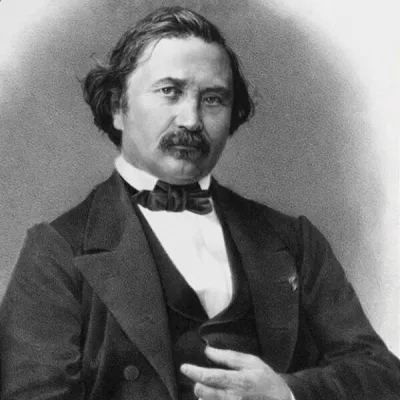
Joseph Bertrand
Human Design Chart
Biography
He conjectured, in 1845, that there is at least one prime between n and 2n − 2 for every n > 3. Chebyshev proved this conjecture, now called Bertrand's postulate, in 1850. He was also famous for a paradox in the field of probability, now known as Bertrand's Paradox. There is another paradox in game theory that is named after him, called the Bertrand Paradox.
Bertrand translated into French Carl Friedrich Gauss's work on the theory of errors and the method of least squares.
In the field of economics he reviewed the work on oligopoly theory, specifically the Cournot Competition Model (1838) of French mathematician Antoine Augustin Cournot. His Bertrand Competition Model (1883) argued that Cournot had reached a very misleading conclusion, and he reworked it using prices rather than quantities as the strategic variables, thus showing that the equilibrium price was simply the competitive price.
His book Thermodynamique points out in Chapter XII, that thermodynamic entropy and temperature are only defined for reversible processes. He was one of the first people to point this out.
He died on 5 April 1900, aged 78, in Paris.
Human Design Analysis: Joseph Bertrand as Generator 4/6
Generator 4/6 — Design at a Glance
Joseph Bertrands design laid a fundamental tendency towards high endurance, which was activated exclusively by responding to external impulses rather than through independent initiatives. As a Generator, he possessed considerable sacral energy, comparable to that of a strong workhorse that only effectively uses its strength when it receives a clear stimulus from the outside. This architecture determined his motoric foundation: The strategy consisted in waiting for signals from life and then responding as soon as his inner center confirmed that an action was meaningful.
This mechanism of reacting was the key to his deep fulfillment. When Joseph Bertrand followed this principle – not initiating but instinctively reacting to offers or situations –, nothing could stop him and he experienced a feeling of profound satisfaction. Conversely, two specific pitfalls shaped his energy balance: Either he wasted his strength on things without inner resonance, leading to burnout, or he was held back from his heart project despite the presence of energy. If he did not live according to this design and instead tried to take independent initiatives, he encountered persistent frustration and a noticeable lack of energy sooner or later. His life task therefore consisted in transforming this sacral power into materialization through reactive action rather than depleting it through false initiative.
Sacral Authority
Joseph Bertrands decision-making relied on an inner, bodily resonance rather than cognitive analysis. As a Generator, he possessed the sacral authority, a configuration where strategy and inner guidance were identical. This simplified his process significantly: He did not react by thinking but through spontaneous responses of his body.
His authority featured the defined Sacral Center. It manifested in a characteristic „gut feeling“ – as grunting, humming or a loud „Mhm“ or soft „Hmm“. These sounds were direct answers to external stimuli. As soon as his sacral motor kicked in, he felt vital and alive. A surge of energy occurred that endowed him with seemingly inexhaustible power. He tackled his work with great enthusiasm, fully immersed in the activities without obsessive purposefulness.
This mechanism allowed Joseph Bertrand to go through life with joy and satisfaction. His zest for life sprang from trust in this instinctive reaction. When the Spleen Center was activated or there was a connection to the Sacral Center, it acted as supportive authority. This enabled him particularly quick, spontaneous reactions and immediate access to his physical well-being. He relied reliably on this instinctive perception, which made his decisions swift and secure. The priority always lay with the sacral response; it took precedence over other defined centers regardless of what additional structures were present in his design.
The 4/6 Profile — Opportunist / Role Model
Joseph Bertrands design set a tendency towards a tension-filled life path that unfolded in two clearly distinguishable phases. In the first three decades of his life, he intensely experimented with relationships and friendships. This phase was shaped by Line 4, which promoted sensitivity to mood and tone as well as an informal openness. Joseph Bertrand sought here for the right moment to bring something new without relying on rigid social mechanisms.
With the activation of Line 6, an inner conflict came to light: The heart's desire for belonging now stood in contradiction to the head's need for distance and higher reflection. This contrast between community wish and the urge to withdraw to grasp meaning characterized his middle life period.
In his later years, it was expected that Joseph Bertrand would take on the role of a wise role model. Line 6 demands endurance and service to the „tribe“. His influence developed throughout his lifetime and had to benefit the community materially or structurally. Meanwhile, his large heart remained cautious; it protected itself from false people while he was simultaneously compelled to cooperate to establish his authority. This dynamic between vulnerable openness and necessary distance formed the core theme of his development.
Split Definition — Defined & Open Centers
Joseph Bertrand's design was characterized by a fundamental tension: He possessed immense inner resources but relied mechanically on external impulses to react. As a Generator with a defined Sacral Center, he had a powerful motor for vitality and endurance. This energy was available only when he responded – answering questions or invitations – rather than initiating himself. His design promoted a stance of waiting to clearly perceive the sacral yes/no response and avoid frustration through premature action.
This physical strength was supported by a stable identity (defined G Center) and pronounced willpower (defined Heart Center). He knew who he was and could keep promises as well as control resources. However, his mind worked independently: The definition between Head and Ajna Centers generated constant mental pressure. Joseph Bertrand lived in a state of continuous inspiration, questions, and conceptual structuring. This mental flow was not a motor for direct implementation; it served to inspire others or expand consciousness, not to force results through mere thinking.
The challenge lay in the open centers. The open Throat Center meant that he did not have constant control over his communication. He tended to become stressed under pressure, seek attention, or speak without a real invitation, often leading to unexpected or imprecise statements. Additionally, his open Solar Plexus absorbed the emotions of his environment. He could amplify foreign moods and feelings without recognizing them as his own, which led to inner confusion when he personalized these emotions.
The open Spleen Center made him vulnerable to survival fears and the need to cling to seemingly safe people or situations, even if they were not healthy. Spontaneous decisions from the gut were risky; wisdom here required patience and abstaining from impulsive action. Finally, his open Root Center took on external stress. He could suffer under the pressure of others and often tried to escape this adrenergic surge through hyperactivity, which made him prone to exhaustion. His strength lay in not seeing these open fields as personal deficits but as mirrors of the environment while focusing on his sacral response and mental inspiration.
Channels for logical doubt, inner authority and spiritual beauty.
Joseph Bertrand's design tended towards authentic self-determination. The Channel of Exploration 34-10 connected the Sacral Center with the G Center, giving him inner strength to love and honor himself. This energy did not impose but creatively reacted to his environment, helping him act independently of external expectations. His design thus fostered a deep acceptance of his own beliefs.
At the same time, Joseph Bertrand showed through a mind that filtered patterns with healthy skepticism. The Channel of Logic 63-4 connected the Head Center with the Ajna Center and pushed him to ask questions and seek consistent answers. This doubting mind served the collective by providing precise predictions based on verifiable data. It clearly distinguished between unfounded belief and logical proof, sharpening his analytical skills.
In the background, the Channel of Initiation 51-25 acted as a strong pressure towards individuation. This Juxta-Channel connected the Heart Center with the Shock Gate and promoted natural competitiveness that spurred him to exceed limits. Although this channel was not integrated, it exerted a mutative influence that made Joseph Bertrand distinguish himself from collective norms and live his uniqueness. The tension between his individual self-love and logical analysis significantly shaped his actions.
Individual Circuitry — Circuit Signature
Joseph Bertrand's design tended towards inner strength and strategic clarity, which formed two separate energetic strands. Through the Centering Circuit, his chart directly connected the Sacral, Heart, and Identity Centers. This configuration created a strong, individualistic energy base with deep self-worth and firm convictions. Joseph Bertrand was someone who lived his own uniqueness and confirmed it in others. However, since this circuit did not connect to the Throat Center, these inner certainties often remained unspoken or difficult to communicate externally; the power primarily worked internally.
Parallel to that, there existed a second independent group: The Understanding Circuit connected Joseph Bertrand's Head and Ajna Centers through the Channel of Logic. This provided focused, emotionless rationality and strategic future perspective. As it was a Shared Definition, these two systems – the inner courageous individuality on one hand and the cool logical analysis on the other – existed side by side without directly merging. Thus, Joseph Bertrand possessed both the deep root of self as well as the sharp instrument of reason, which he did not experience as a single stream but as separate, parallel forces in his nature.
Right Angle Cross of Rulership 1
Joseph Bertrands design featured a specific archetypal structure characterized by the presence of the 'Right Authority Cross 1'. This configuration established a fundamental orientation towards strategic authority and an inherent right to govern. It was not arbitrary but rather a deeply rooted mechanism of leadership embedded in his energetic framework. The 'Right Authority Cross 1' describes a precise arrangement of Gates and Channels in Human Design, defining the ability for sovereign decision-making and taking responsibility for others. Joseph Bertrand, through this configuration, demonstrated himself as someone destined to act in situations where clear direction and authority were required. The mechanics of this cross emphasized the necessity of acknowledging and exercising one's right to lead without falling into doubt or overstepping boundaries. It was about balancing the exercise of power with service to a greater order prescribed by this specific design constellation. Joseph Bertrands chart thus revealed a clear path towards leadership qualities grounded in this archetypal foundation, shaping his way of perceiving and exercising authority in his environment.
Saturn Return · Uranus Opposition · Chiron Return · 2nd Saturn Return — Life Cycles
Joseph Bertrands design exhibited a clear cyclical development from early professional foundations to later institutional validation. This structure was marked by two critical life phases: the first Saturn Return and the Chiron Return. The first Saturn Return around age 28 often forms a foundation for long-term professional identity. Joseph Bertrand utilized this period in 1850 when he published textbooks on arithmetic and elementary algebra, establishing his professional competence concretely and laying the groundwork for his future career.
Later, the effect of the Chiron Return, a cycle of fulfillment and blooming where an individual's inner purpose increasingly unfolds in their external life, was evident. Joseph Bertrand reached this point in 1874 at age 52 when he was appointed permanent secretary of the Paris Academy of Sciences. This step was not coincidental but rather the logical consequence of a life following its own rhythms. His appointment to France's highest scientific institution confirmed his lifelong work and anchored him in a role of great responsibility and recognition. Both events – early textbooks and later academy membership – illustrate how Joseph Bertrands design enabled movement from individual knowledge dissemination to broader institutional impact. His career thus followed a pattern where early discipline and late validation went hand in hand.
Generator · Sacral Authority — Synthesis
Joseph Bertrand was a Generator whose life was marked by deep, sacral energy. His ability for sustained work and reaction to impulses formed the foundation of his actions – a force that particularly unfolded when he was passionate about something. This natural drive was amplified by a defined Heart Center, which endowed him with strong willpower to pursue his goals consistently and take responsibility. The connection between sacral authority and defined Head/Ajna Centers created an inner compass guiding him towards authentic decisions as long as he paid attention to the physical signals of his sacral center. His profile as Networker/Role Model suggests that throughout life, he experienced a dynamic interplay between the desire for community and the need for internal reflection – a dynamic that encouraged him to share his experiences and inspire others.
A central paradox in Joseph Bertrands design lies in the tension between his sacral drive to act and open centers for emotions, root, and spleen. While the sacral center provided an inexhaustible energy source, undefined centers made him susceptible to external influences and conditioning, particularly regarding fear and emotional reactions. This led to internal conflict between the desire for self-determination and the challenge of not being overwhelmed by others' emotions or paralyzed by unfounded fears. The ability to navigate these tensions – by trusting his sacral authority while also mindfully acknowledging signals from his open centers – defined his individual path.
3 Defined Channels
Incarnation Cross - Right Angle Cross of Rulership 1
Solar Return
The Solar Return shows the moment when the sun returns to its exact birth position - your personal solar year.
Life Cycles
Discover the life cycles with a detailed triple view (birth chart, cycle chart, composite).
Human Design Profile
- Type
- Generator
- Strategy
- To respond - wait for something to respond to
- Authority
- Sacral Authority
- Profile
- 4/6 - Opportunist / Role Model
- Definition
- Split Definition
- Incarnation Cross
- Right Angle Cross of Rulership 1
- Date of Birth
- 11.03.1822 03:00
- Place of Birth
- Paris, France
Frequently Asked Questions
What is Joseph Bertrand's Human Design type?
Which Profile did Joseph Bertrand have in Human Design?
What authority did Joseph Bertrand possess?
What incarnation cross did Joseph Bertrand have?
When was Joseph Bertrand born?
Discover your own Human Design
Are you also a Generator? Find out in a personal reading how to use your sacral energy correctly and discover deep satisfaction.
More Personalities
Back to overviewAaliyah

Alexia

Angèle

Anne-Marie

Arcángel

Arno