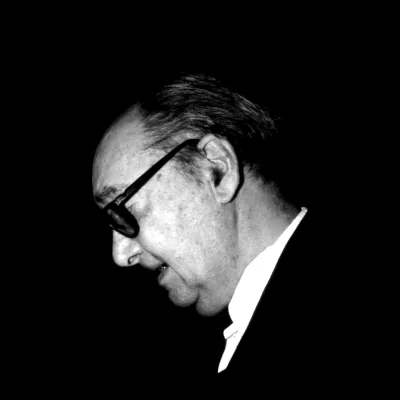
Juan Carlos Onetti
Human Design Chart
Biography
He was imprisoned in 1974 by the Uruguayan military government, but was released after 6 months as a result of a protest by international literary figures. He fled to Spain where he spent the rest of his life: he died in Madrid in 1994.
Juan Carlos Onetti as a Manifesting Generator 6/2 in Human Design
Manifesting Generator 6/2 — Design at a Glance
Juan Carlos Onetti revealed himself as a hybrid being that combined constant energy with lightning-fast execution. His Manifesting Generator design created a specific tension: He possessed the sacral power of a generator, reacting to impulses rather than initiating them, yet also had the ability to skip steps and follow parallel paths, characteristic of manifestors. This configuration created a dynamic but risky profile.
The mechanics of his design warned him of two pitfalls: First, his natural speed could lead him to miss important stages, forcing him to backtrack and fill gaps – a source of deep frustration as it shook his inner self-worth. Second, he tended to tackle multiple projects simultaneously, driven by various stimuli. Without the confirmation of his internal authority, this creative drive quickly turned into overextension.
Juan Carlos Onetti found satisfaction only when he responded to life and gave a clear 'yes' from his sacral center. In this state, focusing on one thing was counterproductive for him. Instead, he needed variety and a playful mode. Only by regularly checking his projects against inner approval and integrating the tension between reacting and quick action could he use his energy effectively without falling into frustration. His design challenged him to consciously use this speed as a tool, not a compulsion.
Emotional Authority
Juan Carlos Onetti displayed an internal architecture that compelled him to subject every decision to an emotional maturation process. His design carried emotional authority, meaning his defined Solar Plexus Center was the sole source of his inner truths – regardless of other centers in his graph being defined or not. This configuration generated a constant wave of feelings and moods coloring his view of the world. What excited him deeply at one moment could appear completely negative the next. His immediate feeling was always just a snapshot, not yet the final truth.
Quick, spontaneous reactions from this emotional heat often had negative consequences for him. The mechanics of his authority required strategic delay. Juan Carlos Onetti needed time to let the initial emotional brightness or darkness fade. Only through patience and consciously 'sleeping on' decisions could he gain the distance necessary to find clarity. The longer he waited, the deeper his insight became. This process of cooling down was not an obstacle for him but the only way to ensure that his choice aligned with his inner truth, especially regarding issues of long-term significance.
The 6/2 Profile — Role Model / Hermit
Juan Carlos Onetti's design laid out a clear developmental line: From an early phase of experimental searching to later profound wisdom. Before his thirtieth year, the six-line profile still appeared as a three-line one. This shaped his younger years through trial and error; he gathered diverse experiences but often retreated after failures, driven by the desire for inner peace associated with Gate 52.
Around thirty years in, the full six-line profile activated itself. Juan Carlos Onetti then showed a tendency to retreat into metaphorical 'caves' to look back at his past experiments from great distance. This phase of intense introspection served healing and self-knowledge, where he realized true peace only arises when the entire circuit is fulfilled. The spiritual dimension of this line went beyond mere earthly logic.
At the same time, his design had a defensive sharpness through the two-line profile. In persistent interference, he reacted with extreme, decisive measures where force overruled justice. Although these reactions were intimidating and accompanied by Neptunian regret for their harshness, they protected his necessary isolation. Ultimately, Juan Carlos Onetti emerged from his retreat as a wise person. Others sought him out to partake in his life wisdom and learn the ability of deep introspection he had developed during this second phase of life.
Split Definition — Defined & Open Centers
Juan Carlos Onetti revealed himself as someone with an enormous reactive energy source characterized by willpower and emotional depth. His design indicated a tendency towards authentic communication that flowed directly from his defined centers – Throat, Heart, Sacral, Solar Plexus, and Root – creating a mechanical foundation for manifestation and action capability, which was activated not through initiation but rather through reaction.
The strength of his willpower (defined Heart Center) allowed him to determine his life course and control the use of resources. Simultaneously, the defined Solar Plexus served as an inner authority, meaning he had to learn to wait for emotional rhythms to find clarity. This emotional wave required patience; decisions were only made correctly once the emotional charge subsided. The defined Sacral Center provided vital energy for work and activities that brought him joy, assuming he reacted to external stimuli rather than initiating on his own.
In contrast, his design revealed vulnerabilities in open centers. His open G Center meant no fixed identity or direction; these were reflected situatively by the environment. Onetti tended to question his true identity and sought safety in the right setting, as false places could lead to misfortune. The open mental centers (Head and Ajna) served as mirrors for inspiration but were not sources of consistent answers. He was susceptible to mental confusion and pressure to answer others' questions rather than develop his own concepts. His open Spleen Center required vigilance against conditioned fears and spontaneous decisions often stemming from uncertainty.
This structure shaped his life: a powerful, reactive energy channeled through emotional filtering and situational adaptation.
Channels for maturation, emotional openness and courageous responsibility.
Juan Carlos Onetti was marked by a tension between emotional volatility and the will for material control. His design inclined him to align social openness strictly with his inner mood to avoid abrupt behavior. Channel 22-12 connected Solar Plexus Center to Throat Center; here articulation depended on ebbs and flows of the emotional wave. Gate 12 fostered caution, while Gate 22 expressed passion. Only when the mood was right could he move others with his voice; otherwise isolation loomed.
Simultaneously, there existed a strong internal conflict between the need for independence and the necessity to complete cycles fully. Channel of the Money Line 21-45 linked Heart Center to Throat Center. Gate 21 (the Hunter) sought control over work and resources while Gate 45 (the Collector) demanded authoritative confirmation. This created a drive to master the material plane often through hard labor as his own boss, to avoid being controlled.
Parallel to this, Channel of Maturation 42-53 between Root and Sacral Centers required experiences to ripen without expectation. Gate 53 (Beginnings) initiated new cycles that had to be run to completion to gain wisdom; premature termination led to repetition.
His design also included gates for pattern recognition and perfection: Gate 58 in the Root Center identified incorrect patterns, Gate 62 demanded logical detail work, and Gate 48 enabled deep understanding without direct application, which could lead to frustration. In his design, Gate 39 activated Solar Plexus through provocation and analysis. This configuration described a person who had to time their emotional impact while internally balancing material will with cyclical patience.
Collective Circuitry — Circuit Signature
Juan Carlos Onetti was marked by two separate yet parallel operating energetic streams. On one hand, he was driven by a pulsating acoustic urge to express his individual identity and new knowledge; on the other hand, he processed cyclically and visually past emotions to find meaning in them. These two forces were not directly connected but existed side-by-side.
The Knowledge Circuit linked his Throat Center with Solar Plexus through Channel of Openness. This created a tendency to translate emotional waves and inner states immediately into words or actions, where creativity and the search for individuality took precedence.
Simultaneously, the Meaning Finding Circuit connected Sacral Center with Root Center via Channel of Maturation. Here it was about processing experiences from the past. The energy flowed in waves, meaning Onetti went through times of intensity and calm to learn from old events and share these insights with others.
Although his Heart Center was defined and belonged to the Ego Circuit, there was no direct channel for this chapter; instead, the structure showed a separation between main groups. Thus, the tension lay in how he aligned the impulsive expression of knowledge with the slow, reflective maturation of life experiences without these areas overlapping.
Left Angle Cross of Demands 1
Juan Carlos Onetti was characterized by a fundamental disposition marked by an archetypal dynamic of demanding and fulfilling. His design suggested that his life would always revolve around setting demands or meeting expectations. This structure framed the energetic orientation of his life.
The left cross of demands 1 defined this basic tendency. It implied a mechanism in which interactions with the world were not neutral but structured by the pressure of demands. Since no specific gates, channels, or defined centers are listed in the raw content and the description is null, the concrete expression of this energy remained abstract and unspecified. There were no detailed clues as to where these demands would be particularly strong in his life or how they would manifest.
The emphasis was therefore solely on the fundamental energetic structure of the cross as a framework for demands. Juan Carlos Onetti moved within this abstract field without the mechanism prescribing specific content or concrete patterns of action. The energy was present, but its form remained undetermined. This meant that the experience of demands and expectations was a central yet formless constant in his design, shaping his inner landscape without giving it clear biographical or character sharpness.
Saturn Return · Uranus Opposition · Chiron Return · 2nd Saturn Return — Life Cycles
Juan Carlos Onetti's life followed a clear rhythm of internal condensation and external breakthrough. His design was marked by recurring cyclical patterns indicated by planetary transits. In 1939, at the age of thirty, he published his first novel 'El pozo'. This was his first Saturn return: a phase in which years of inner work and discipline often lead to a tangible, visible result. The Saturn cycle demands structure and patience; here, the fruits of this long preparatory work were evident.
A decade later, in 1950, the Uranus opposition occurred. At forty years old, Onetti published 'La vida breve', establishing himself as a novelist. The opposition from Uranus often brings sudden insights or breaks that challenge the status quo and open new paths. This transit marked a decisive turning point towards artistic recognition.
In 1955, at the age of forty-four, Juan Carlos Onetti married Dorothea Muhr. This fell during his Chiron return phase. In Human Design mechanics, this is not a healing process in the medical sense but an achievement cycle. If a person lives according to their strategy and authority, here their incarnation cross unfolds increasingly. The meaning and purpose of the design become experiential. The marriage stood for anchoring this inner bloom in personal life, a moment of confirmation and growing awareness of his life path.
Manifesting Generator · Emotional Authority — Synthesis
He lived a creative process deeply marked by an internal emotional landscape. The connection of a manifesting generator with defined sacral energy (sacral center) points to someone who could potentially initiate things quickly but primarily waited for the world to respond – a constant weighing between the impulse to act and the need to find their own rhythm. This tendency was reinforced by the open channel 22-12, which brought emotional volatility and expressive articulation. The knowledge circuit, in which new insights were generated and transformed, points to an ongoing process of searching and formulating one's identity.
A central paradox lay in the tension between the need for deep emotional maturation (emotional authority) and the ability to initiate things quickly. Line 6 in his profile indicated a long phase of experimentation followed by withdrawal for reflection, while the manifesting component enabled quick steps that occasionally needed correction. This led to a life alternating between intense experience and detached observation – an interplay between the urge for newness and the need for wisdom.
3 Defined Channels
Incarnation Cross - Left Angle Cross of Demands 1
Solar Return
The Solar Return shows the moment when the sun returns to its exact birth position - your personal solar year.
Life Cycles
Discover the life cycles with a detailed triple view (birth chart, cycle chart, composite).
Human Design Profile
- Strategy
- To respond - wait for something to respond to
- Authority
- Emotional Authority
- Profile
- 6/2 - Role Model / Hermit
- Definition
- Split Definition
- Incarnation Cross
- Left Angle Cross of Demands 1
- Date of Birth
- 01.07.1909 06:00
- Place of Birth
- Montevideo, UR
Frequently Asked Questions
What was Juan Carlos Onetti's Human Design type?
What profile did Juan Carlos Onetti have in Human Design?
What authority did Juan Carlos Onetti have?
What incarnation cross did Juan Carlos Onetti have?
When was Juan Carlos Onetti born?
Discover your own Human Design
Are you also a Manifesting Generator? Find out in a personal reading how to unfold your multi-talents and direct your energy wisely.
More Personalities
Back to overviewAlain-Fournier

Aldair

Alizée

Angeli

Arletty

Artus