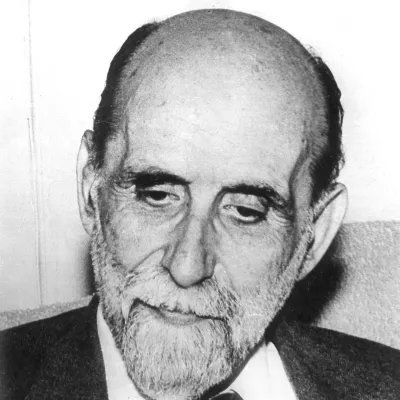
Juan Ramón Jiménez
Human Design Chart
Biography
Jimenez died on 29 May 1958, aged 76, in San Juan, Puerto Rico.
The Human Design of Juan Ramón Jiménez: Generator 6/2
Generator 6/2 — Design at a Glance
Juan Ramón Jiménez, as a Generator, possessed immense inner endurance and high potential for creative power. His design suggested that he functioned like a strong workhorse: extremely resilient as long as the energy was available to fulfill his tasks. This strength did not come from self-initiative but rather responded to signals from the outside world. The central strategy of his design involved waiting until an impulse came and then reacting from the gut when his sacral center sent a clear signal, 'Yes!'
This mechanism created two specific challenges for Juan Ramón Jiménez. On one hand, frustration and energy loss threatened if he engaged in things that did not truly interest him or acted against his inner resistance. On the other hand, he suffered when prevented from pursuing his heart's project despite having ample internal strength available. Living in harmony with this reactive strategy rewarded him with a deep sense of fulfillment and no one could stop him. However, acting against this principle—such as by constantly initiating without an internal signal—eventually led to persistent frustration and a lack of energy. His success thus depended largely on learning not to anticipate but to patiently wait for the right life impulses and respond powerfully.
Sacral Authority
Juan Ramón Jiménez showed himself as a Generator whose decision-making was marked by Sacral Authority. This inner guidance did not come from the head but reacted immediately to external stimuli. His design required an open emotional center, so he did not act impulsively but waited for physical signals. This 'gut feeling' manifested as a surge of energy or loud grunting and humming—a clear signal that his sacral motor had started.
When Juan Ramón Jiménez felt this vital energy, he was endowed with inexhaustible life force and tackled tasks with great enthusiasm. He lived to immerse himself in activities without rigid purposefulness. His strategy involved waiting for this inner impulse before acting. This simplified his process significantly as strategy and authority were identical.
Additionally, his activated spleen center acted as a supportive instance. As it was connected to the sacral center, it allowed him quick, spontaneous reactions. Juan Ramón Jiménez had immediate access to his instinctive perception and physical well-being. This combination of sacral energy and spleen-supported intuition served as a reliable compass for his life paths and daily decisions.
The 6/2 Profile — Role Model / Hermit
Juan Ramón Jiménez showed in his early life phase a tendency towards intense experimentation, marked by the principle of trial and error. As a 6/2 Profile, the line before Saturn's return behaved like a Three; he gathered numerous personal experiences, withdrew after setbacks, and reviewed his paths. This period served to build a solid foundation through direct confrontation with reality.
After around thirty years, the sixth line was fully activated. Juan Ramón Jiménez metaphorically retreated into a 'cave' on a mountain to look back at his earlier experiments from great distance. This time was marked by intense reflection, healing, and deep self-awareness. He now had an overview of his entire circuitry and integrated the collected data of his plan.
Later, he emerged as a wise person from this isolation. Others sought him out to partake in his life wisdom and learn the ability for deep introspection. His perfect behavior was no longer understood by him at fifty as a social facade but as individual survival behavior. The earlier hypocrisy of the roof phase gave way to an authentic stance.
Furthermore, he met the need for correction with the realization of the uncorrectability of certain situations. Instead of fighting against the wind, he accepted what was given and found renewal in this acceptance. This acceptance replaced futile denial and allowed him to continue living despite immutable circumstances.
Split Definition — Defined & Open Centers
Juan Ramón Jiménez appeared as someone who was constantly under mental pressure to ask questions and understand connections. This tendency stemmed from his defined Head and Ajna Centers, which created a firm style of conceptual thinking. He was always in the process of mental activity, which helped him inspire others to think deeply through his inspiration, even though he did not have direct energy to immediately turn these thoughts into action.
At the same time, Juan Ramón Jiménez had a reliable inner direction and self-identity, shaped by his defined G Center. This gave him a sense of his own mission and the ability to show others new paths without being dependent on them. His vital energy was fueled by his defined Sacral Center, which made him react to external impulses rather than initiate actions. Only when he responded to an invitation could he unleash his full power and find satisfaction; mental decisions alone often led to frustration or exhaustion.
In contrast, Juan Ramón Jiménez was open in several areas to external influences and thus vulnerable to conditioning. His open Throat Center made him prone to feeling pressured to demand attention or speak thoughtlessly rather than waiting for the right invitation to express himself. The open Heart Center drove him to prove his worth through promises and competition, which he could not generate mechanically on his own. Additionally, his open Solar Plexus absorbed the emotions of the environment, leading to inner unrest when he identified these foreign feelings as his own. Finally, his open Spleen Center tended to impulsively hold onto or let go of things out of fear of survival issues rather than trusting his inner authority. This combination of firm mental structure and emotional openness shaped his specific life dynamics.
Channels for focus, self-expression and mental clarity.
Juan Ramón Jiménez showed a deep, almost meditative ability to focus. His design inclined him to still the physical body and external senses to direct energy precisely on details. This attitude came from Channel 52-9, connecting the Root Center with the Sacral Center. Through Gate 52 emerged a passive urge for calm, while Gate 9 focused on facts and patterns. It was a formative energy that promoted logic as a step-by-step process: Juan Ramón Jiménez waited patiently until his Sacral Center reacted before acting or correcting.
Parallel to this, Channel 34-10 between the Sacral and G Centers worked. It connected the inner strength of Gate 34 with the authentic behavior of Gate 10. This enabled him to follow his own convictions and live out self-love and independence without pressuring others. His aura invited experiencing this individual note as long as he waited patiently for his reactions.
Mentally, Channel 64-47 strongly shaped his experience. It connected the Head Center with the Ajna Center and filtered every experience through a kaleidoscope of mental images. Gate 64 often brought confusion, while Gate 47 sought understanding. Juan Ramón Jiménez was under pressure to find stories that made sense, even though his mind could never become an inner authority.
Additionally, Gates like 18 (Correction), 17 (Following), and 15 (Collective Behavior) contributed to his interest in societal structures and human rights. Gate 27 added a layer of care, while Gate 24 promoted mental renewal. His design was thus characterized by focused logic, authentic self-assertion, and an ever-searching, abstract mind.
Collective Circuitry — Circuit Signature
Juan Ramón Jiménez appeared as someone with deeply rooted individual conviction. His design included the Centering Circuit, but it was only active through one channel in him: the connection between Sacral and Identity Centers (Channel 10–34). This gave his life energy a pulsating quality and strengthened his self-esteem and inner identity. Since the Heart Center was not part of this circuit in him, there was no direct energetic bridge to will; thus, his firmness primarily came from the connection between life force and essence.
Parallel to this, two other separate segments of different circuits were at work. The Understanding Circuit connected Sacral with Root Centers (Channel 9–52) in him. This created a focused, strategic energy aimed at achieving improvements through clear structure and logic – free from emotional influence.
At the same time, he had an isolated segment of the Meaning-Finding Circuit: Head and Ajna Centers were linked (Channel 64–47). Here it was about capturing visual impulses from the past and finding meaning in past events. This energy was cyclical and wave-like but did not directly exchange with other defined areas.
Since Juan Ramón Jiménez had a Shared Definition, these forces existed as two parallel systems: on one hand, the connection between Sacral, Root, and Identity Centers (through their respective channels), and on the other hand, the isolated pair of Head and Ajna. There was no continuous flow between these groups; they worked alongside each other without energetically mixing or reinforcing each other.
Left Angle Cross of Prevention 2
Juan Ramón Jiménez was marked by the design of his left cross of prevention, which deeply oriented him towards preserving and protecting what he considered essential or sacred. This configuration created an internal structure that did not primarily strive for expansion or reinvention but was focused on safeguarding existing values, traditions, or spiritual truths from decay. It was a defensive yet extremely resilient energy that drew its strength from isolating the essential and shielding it against external influences.
In Human Design, this cross describes a specific life task: identifying core values and their consequent defense or care over extended periods. Juan Ramón Jiménez thus directed his energy towards creating and maintaining an inner or outer protective space. This was not a passive retreat but an active process of preventing loss or dilution. His design challenged him to maintain the integrity of his beliefs or creative expression by selectively granting access and sorting out the non-essential. This attitude shaped his entire lifestyle as a constant balance between dedication to what is protected and necessary resistance against anything that could threaten this purity.
Saturn Return · Uranus Opposition · Chiron Return · 2nd Saturn Return — Life Cycles
In his later years, Juan Ramón Jiménez underwent profound structural changes. In 1939, at age 58, he moved to Havana and subsequently to Florida in the USA – a step characteristic of his design: The second Saturn return often marks a phase of consolidation and reorientation, where earlier life plans are questioned and fundamental decisions are made. This cycle not only promoted inner maturity but also the necessity to adapt to new circumstances. For Juan Ramón Jiménez, this meant both physical and emotional change as he left his familiar environment and had to establish himself in foreign cultures. His ability to master these challenges underscored the strength of his character and his willingness for continuous development. The second Saturn return acts like a mirror showing where one stands and where they are heading – an opportunity for self-reflection and growth. During this time, Juan Ramón Jiménez found new perspectives that profoundly shaped his life.
Generator · Sacral Authority — Synthesis
Juan Ramón Jiménez lived deeply rooted in his sacral center (Generator type with Sacral Authority). This energy source fueled a relentless search for authentic activity – he responded to external stimuli with an inner surge of power when the work aligned with his purpose. The profile as role model and natural talent suggests that this process was initially marked by experiments, which later shifted into a period of intense reflection from which he emerged as a wise advisor. The defined Head Center strengthened this internal drive through constant questioning and the need for understanding, while Channel Concentration (52/9) helped him focus on details and apply his energy purposefully.
A central paradox in his design lay in the interplay between deep engagement and the need for withdrawal. Sacral energy demanded continuous activity from him, yet the profile pointed to a later phase of intense isolation (evident in his move to Havana and Florida during Saturn return). This apparent tension between inner dynamism and outer retreat was not a contradiction but a cyclical process of experience collection, reflection, and eventual wisdom transmission.
3 Defined Channels
Incarnation Cross - Left Angle Cross of Prevention 2
Solar Return
The Solar Return shows the moment when the sun returns to its exact birth position - your personal solar year.
Life Cycles
Discover the life cycles with a detailed triple view (birth chart, cycle chart, composite).
Human Design Profile
- Type
- Generator
- Strategy
- To respond - wait for something to respond to
- Authority
- Sacral Authority
- Profile
- 6/2 - Role Model / Hermit
- Definition
- Split Definition
- Incarnation Cross
- Left Angle Cross of Prevention 2
- Date of Birth
- 24.12.1881 23:59
- Place of Birth
- Moguer, Spain
Frequently Asked Questions
What was Juan Ramón Jiménez's Human Design type?
What profile did Juan Ramón Jiménez have in Human Design?
Which authority guided Juan Ramón Jiménez?
What incarnation cross did Juan Ramón Jiménez have?
When was Juan Ramón Jiménez born?
Discover your own Human Design
Are you also a Generator? Find out in a personal reading how to use your sacral energy correctly and discover deep satisfaction.
More Personalities
Back to overviewAaliyah

Alain-Fournier
Alexia

Angèle

Angeli

Anne-Marie