
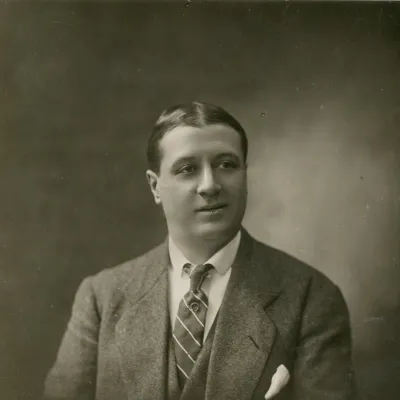
Jules Raimu
Human Design Chart
Biography
Raimu married on 28 March 1936.
He died in Neuilly sur Seine on 20 September 1946.
The Human Design of Jules Raimu: Generator 4/6
Generator 4/6 — Design at a Glance
Jules Raimu had an enormous, enduring source of energy that turned him into a powerful „workhorse“ as long as he pursued tasks that resonated with him internally. As a Generator, his design was set up to release energy not through self-initiated actions but through reactions to impulses from the environment. His strength lay in his ability to respond to signals when his Sacral Center – the inner compass – clearly signaled a „yes“. This strategy of reacting rather than initiating was crucial for his well-being.
If Jules Raimu spent his energy on things that did not bring him joy, or if he was prevented from pursuing his heart's project despite still being full of drive, frustration or energy loss was imminent. His design rewarded him with deepest satisfaction and a sense of fulfillment when he lived in harmony with this nature. The danger always lay in working against this inner rhythm; then, persistent frustration would arise. His path to effectiveness therefore did not lie in constant pushing forward, but in the patience to wait for the right signal and then respond to it with full, gut-driven energy. This protected him from burnout and ensured the endurance needed for his life's task.
Sacral Authority
Jules Raimu showed himself to be someone who did not make decisions through prolonged deliberation but through an immediate physical reaction. His design was that of a Generator, whose inner authority and strategy were identical: waiting for the right answer from the body. This greatly simplified his decision-making process, as he did not have to choose between conflicting inner voices.
Central to this was his defined Sacral Center. It functioned as his true instance for yes or no. This authority often expressed itself as a kind of gut feeling, a grunting or a spontaneous surge of strength as soon as an external stimulus hit. If this reaction was positive, Jules Raimu felt vital and energized; he could then immerse himself in activities with great enthusiasm and without compulsion. The joy in the work itself was paramount, not the result.
Especially effective was this mechanism through his also defined Spleen Center. The connection between Sacral and Spleen Center allowed him to react with lightning-fast, instinctive responses. He had a direct access to his physical well-being and could reliably be guided by this deep, spontaneous perception. This allowed him to be particularly agile and accurate in moments of activity, without having to plan or analyze extensively beforehand. His life energy thus ignited wherever he met this inner, physical confirmation.
The 4/6 Profile — Opportunist / Role Model
Jules Raimu showed himself to be someone who in his youth learned through intense experimentation in relationships and friendships. His design as a 4/6 Profile determined that Line 6 still acted like Line 3 before the return of Saturn. This led to a phase of trying out before the deeper wisdom of Line 6 could unfold.
Later, his life was shaped by the conflict between the desire for community (Line 4) and the need for distance to reflect on the meaning of life (Line 6). Jules Raimu faced the challenge of aligning heart and mind. Line 4 brought the transpersonal perspective and the ability to teach people without prior knowledge. Simultaneously, the strong stimulation of Gate 56 led others to believe in fixed ideas.
In his later years, the design of Jules Raimu expected him to take on the role of a wise role model. He should stand out through cooperation, while his big heart remained cautious to avoid being hurt by false people. The sixth line conveyed the highest form of reason and life as sacred. Jules Raimu trusted that future generations would live in a better world. He only entered into relationships if it was ensured that the resulting children would have it good. His actions were marked by justice, even if the conditions sometimes seemed unbearable. He tried to control his emotionalism and set clear conditions to bring peace and improve the world.
Split Definition — Defined & Open Centers
Jules Raimu revealed himself as a person with a clear, stable inner structure and a reliable ability to express himself. His design was characterized by defined centers that provided him with a stable mental function, a firm identity, and a powerful energy source. His defined Ajna Center ensured that he processed concepts in a specific, trustworthy way and was not easily influenced by the thoughts of others. This mental clarity flowed directly into his defined Throat Center, enabling him to consistently and reliably express what he thought. His communication was thus a direct expression of his conceptual world.
Additionally, Jules Raimu had a defined G Center, which gave him a deep sense of his own identity and direction. He knew who he was and could convey this security to others. His vital energy came from his defined Sacral Center, which provided him with a massive energy source. This energy was activated through reaction; he found satisfaction in responding to inquiries or situations rather than initiating them himself. His defined Spleen Center supported him with a strong instinct for health and well-being, while his defined Root Center provided a constant pressure that propelled him forward in the material world and helped him cope with stress.
In contrast, his Head, Heart, and Solar Plexus Centers were open. His open Head Center meant that he did not have a constant mental pressure to find answers but was open to inspiration without having to identify with confusing questions. His open Heart Center indicated that he was not inclined to prove his worth through willpower or promises; he tended not to identify with the need to be competitive or to impose control. His open Solar Plexus Center made him receptive to the emotions of his surroundings. He absorbed these feelings without owning them as his own, which made him vulnerable to emotional conditioning if he did not consciously distance himself from these foreign waves. This openness allowed him to be a barometer for the emotional climate but also challenged him to distinguish his own emotional truth from that of others.
Channels for visionary leadership, curiosity, care and transformation.
Jules Raimu revealed himself as someone who sought leadership not through authority, but through logical embedding in existing societal patterns. This attitude resulted from the Alpha Animal Channel 7-31, which connected the G Center with the Throat Center. Gate 7 provided the logical role of the "power behind the throne," while Gate 31 represented the voice of the collective leader. Raimu acted where he was invited by the majority to understand trends and provide security. His authority was based on being trustworthy and reflecting the needs of the community rather than dominating.
Parallel to this, he possessed the gift of transforming abstract ideas into captivating stories. The Channel of Curiosity 11-56 connected the Ajna Center with the Throat Center. Gate 11 brought the ideas, Gate 56 the constant search for inspiration. Raimu used this configuration to convey information not as dry facts, but as narrative parables that stimulated the imagination of his listeners. He was a storyteller who taught and entertained through his tales, without seeking final truths, but rather the magic of discovery.
Another central aspect was his deep connection to the preservation of the tribe. The Channel of Preservation 27-50 connected the Sacral Center with the Spleen Center. Gate 27 stood for selfless care, Gate 50 for traditional values and laws. Raimu naturally attracted trust and took responsibility for the provision and protection of his environment. He acted out of instinct to preserve and nourish what was created, always ensuring that his own energy was available for this purpose.
Furthermore, he was driven by a strong ambition to improve his position through competence. The Channel of Transformation 54-32 connected the Root Center with the Spleen Center. Gate 54 represented ambition, Gate 32 continuity and talent. Raimu worked hard to find recognition and prove his worth. He sought the confirmation of the tribe to realize his ambitions and establish himself socially. This channel endowed him with the ability to rise through consistent effort while also recognizing the fragility of existence, making him a stabilizing force.
His personality was further shaped by Gates that emphasized restraint, emotional depth, and the recognition of patterns. Gate 12 in the Throat Center brought a poetic, transformative quality to his communication, while Gate 36 in the Solar Plexus Center allowed for cyclical crises and emotional movements. Gate 6 in the Solar Plexus regulated biological boundaries and emotional waves. In the Root Center, Gate 58 worked with its ability to recognize and perfect patterns, supported by Gate 4, which developed formulas to clarify suspicious patterns. Gate 2 in the Sacral Center stood for receptivity and new directions, while Gate 3 for mutation and adaptation in the survival struggle. In the design, Gate 28 with its focus on the here and now and risks, Gate 53 with its pioneer spirit, Gate 16 with its experimental mastery, and Gate 23 with its multifaceted assimilation were at work. Gate 20 promoted authentic self in the present, and Gate 8 stood for individual contribution and the promotion of group goals. This combination created a complex Profile that was aligned with both collective leadership and individual transformation and emotional depth.
Collective Circuitry — Circuit Signature
Jules Raimus Design featured a split structure where two independent energy blocks existed in parallel. The first block connected the Throat Center to the Identity Center through the Understanding Circuit. This defined a capacity to articulate logical strategies and future-oriented visions clearly, free from emotional coloring. At the same time, the same block connected the Ajna Center to the Throat Center through the Meaning Circuit. Here it was about sharing emotional waves and reflecting on past experiences, fostering a cyclical, often inexplicable mode of expression. These two aspects—cool reason and emotional past—were united in the same energetic cluster but separated by different channels.
The second, completely isolated block included the Sacral Center, the Spleen Center, and the Root Center. Through the Ego Circuit, the Spleen Center connected to the Root Center, representing an instinctive transformation of resources and a conservative, traditional stance to support the environment. Simultaneously, the Archer Circuit connected the Sacral Center to the Spleen Center. This endowed a primal force for the protection and preservation of the family, supported by constant life force and instinctive care. Since these two blocks were not connected to each other, Jules Raimu experienced these forces as separate, parallel realities: on one hand, intellectual-emotional communication, and on the other, instinctive-life force care and transformation.
Right Angle Cross of Eden 4
Jules Raimus design was characterized by the presence of the right cross of Eden 4. This configuration endowed him with a specific inner dynamic, directed towards the search for deeper, often spiritual or existential truths. This was not about superficial knowledge acquisition, but rather a pressing impulse to penetrate the hidden mechanisms of life and human nature.
In Human Design, this cross represents an intense connection between individual experience and a larger, often transcendent whole. Jules Raimu thus appeared as someone constantly seeking the meaning behind things. His attention was focused on the subtle connections lying beneath the surface of everyday life. He was intent on not only keeping these insights to himself but also shaping them into a form accessible to others.
This inner orientation shaped his entire life approach. He lived in a constant confrontation with the invisible, the spiritual, and what lies beyond pure matter. The right cross of Eden 4 challenged him to integrate these deep truths into his actions and being. It was a driving force that propelled him to look beyond the obvious and grasp the complex, often contradictory aspects of human existence.
Saturn Return · Uranus Opposition · Chiron Return · 2nd Saturn Return — Life Cycles
Jules Raimu showed a development where early, inconspicuous beginnings condensed into a later clear confirmation of his own work. This corresponded to the rhythm of his energetic cycles.
In 1912, at the age of 29, Jules Raimu took on minor roles in silent films. This step coincided with his first Saturn return. During this phase, years of groundwork often condensed into a viable, first public result. It was the moment when the previous learning and experimentation culminated in a concrete, albeit small, professional position.
Then came the Chiron return, that cycle of fulfillment and bloom, which occurs between the ages of 49 and 51. Here, the unfolding of one's incarnation cross became evident, provided one had followed the inner strategy. The meaning and purpose became experiential. Jules Raimu appeared in Pagnol's film *Fanny* in 1932, exactly at the age of 49. This event marked not a healing of old wounds but the peak of unfolding. It was proof that life had been guided in the direction of the inner design. The role in *Fanny* was the visible expression of this maturity. The path from small silent film roles to this significant position illustrated the process: from the first firm step in the career to the full realization of one's destiny. The mechanics of his design were clear here: first structuring through the Saturn return, then blooming and finding meaning through the Chiron return.
Generator · Sacral Authority — Synthesis
Jules Raimu was a Generator whose life was marked by a deep, sacral energy. This energy, which manifested in a steady surge of power, constantly sought tasks in which it could be absorbed – an unrelenting drive that, however, manifested in the tension field between the desire for community and the need for independent reflection (Profile 4/6). The defined Mental Center and the channel of the Alpha Animal (Gate 7/31) pointed to a capacity for logical leadership and the need to share knowledge. This combined with an inner urge to recognize patterns and structure the world around him, which was evident in early career phases (Saturn return at the age of 29).
A central paradox in his design lay in the combination of this logical, future-oriented energy of the Understanding Circuit and the deep need for meaning and emotional depth. While the mind strove to analyze and improve the world, another part of him sought meaning and emotional depth. This led to an inner tension between the head and the heart, manifesting in a tendency to act as a role model while also seeking moments of isolation. The sacral authority challenged him to listen to his body and only take on tasks that actually released energy, while the logical structure of the mind inclined him to get lost in complex concepts.
4 Defined Channels
Incarnation Cross - Right Angle Cross of Eden 4
Solar Return
The Solar Return shows the moment when the sun returns to its exact birth position - your personal solar year.
Life Cycles
Discover the life cycles with a detailed triple view (birth chart, cycle chart, composite).
Human Design Profile
- Type
- Generator
- Strategy
- To respond - wait for something to respond to
- Authority
- Sacral Authority
- Profile
- 4/6 - Opportunist / Role Model
- Definition
- Split Definition
- Incarnation Cross
- Right Angle Cross of Eden 4
- Date of Birth
- 18.12.1883 03:00
- Place of Birth
- Toulon, France
Frequently Asked Questions
What was Jules Raimu's Human Design type?
What profile did Jules Raimu have?
Which authority guided Jules Raimu?
What incarnation cross did Jules Raimu have?
When was Jules Raimu born?
Discover your own Human Design
Are you also a Generator? Find out in a personal reading how to use your sacral energy correctly and discover deep satisfaction.
More Personalities
Back to overviewSissy Spacek

Aaliyah

Alexia

Anémone

Angèle

Ann-Margret
