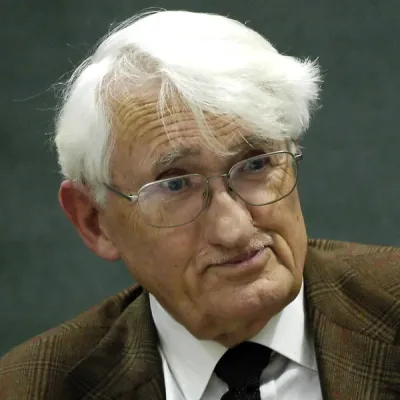
Jürgen Habermas
Human Design Chart
Biography
Associated with the Frankfurt School, Habermas's work focused on the foundations of epistemology and social theory, the analysis of advanced capitalism and democracy, the rule of law in a critical social-evolutionary context, albeit within the confines of the natural law tradition, and contemporary politics, particularly German politics. Habermas's theoretical system is devoted to revealing the possibility of reason, emancipation, and rational-critical communication latent in modern institutions and in the human capacity to deliberate and pursue rational interests. Habermas is known for his work on the phenomenon of modernity, particularly with respect to the discussions of rationalization originally set forth by Max Weber. He has been influenced by American pragmatism, action theory, and poststructuralism.
What does Manifesting Generator 5/1 mean for Jürgen Habermas?
Manifesting Generator 5/1 — Design at a Glance
Jürgen Habermas revealed himself as someone who possessed hybrid energy: the constant power of a Generator paired with the lightning-fast impact of a Manifestor. His design inclined him to quickly draw things into his life and skip steps, allowing him to push projects forward with great dynamism. However, this speed was a double-edged sword; if he did not respond to clear inner impulses, he tended to miss important stages or get lost in too many parallel undertakings. Such moments often led to frustration as the feeling of self-efficacy suffered when efficiency wasn’t supported by internal confirmation.
His strategy involved initially waiting and reacting to life before acting. Only when his Sacral Center – his energy source – sent a clear “yes,” it was advisable to proceed. This protected him from overloading through simultaneous multiple projects. If he allowed this discipline and regularly checked whether an activity still brought joy, he could dive into a productive play mode. Then he drew deep satisfaction from his work even when spinning several threads in parallel. The challenge lay always in channeling the natural urgency through the pause of reaction to achieve lasting fulfillment rather than temporary exhaustion.
Sacral Authority
Jürgen Habermas revealed himself as someone who did not make decisions through intellectual analysis but waited for direct physical resonance. His design established that sacral authority – or inner guidance via the Sacral Center – would lead the way. This was only possible because his Emotional Center remained open; this openness prevented emotional distortions and enabled a clear, unfiltered perception of gut feelings.
The mechanics worked as a reaction to external stimuli: An impulse from outside triggered a physical signal in the Sacral Center – perhaps a grunt, a hum or a soft “hm”. This immediate feedback signaled vitality and energy. When Jürgen Habermas felt this boost, he knew that an activity could be carried out with enthusiasm and satisfaction. He lived by the Generator strategy: not to initiate but wait until life force responded.
Additionally, his activated Spleen Center acted as a supporting instance. It gave him quick, instinctive perception of physical well-being and enabled spontaneous reactions. This combination of sacral confirmation and spleen-based intuition created direct access to reliable decisions. Without this inner authority, the process would have been more complex; through it, orientation in everyday life became significantly simpler since he could rely on what made him alive.
The 5/1 Profile — Heretic / Investigator
Jürgen Habermas revealed himself as someone who used his profound knowledge base to provide solutions for complex problems to other people. His design inclined him to magnetically draw others into his environment through the process of learning and tackling new challenges; others actively sought out his insights. This dynamic stemmed from his Profile 5/1: Line 5 conveyed pragmatic social skillfulness and the ability to find practical answers in crisis times through mutation, while also knowing emotional ups and downs. Jürgen Habermas learned from painful experiences with human projections, which shaped a cautious approach towards certain interactions. Parallel to this, line 1 promoted selfless communication driven by the challenge of centering and acting without pretense. However, this could lead to exhaustion if he did not set clear boundaries, as his mailbox metaphorically overflowed with questions. His path involved maintaining balance between important research for himself (line 1) and problem-solving for others (line 5). By learning to also say no, he preserved his energy and optimally utilized his gifts without being burned out by the expectations of his environment.
Single Definition — Defined & Open Centers
Jürgen Habermas was defined by a design that linked constant mental activity with a deep, reactive energy source. His defined Ajna Center ensured a steady, trustworthy form of conceptual thinking; he was always in a mental process that generated concepts and theories without being easily influenced from the outside. This mental structure flowed directly into his defined Throat Center, allowing him to reliably communicate processed thought. His voice served as a pivot point to transform information coming from the mind into clear messages and actions, enabling precise expression.
At the same time, Jürgen Habermas had a defined Sacral Center that provided him with a constant supply of vital energy. As a generator, his strategy was geared towards not initiating but waiting for stimuli to react to, ensuring that his energy was actually available for chosen tasks. This created a balance between the insatiable mental production and the need to be energetically aligned correctly to avoid frustration and exhaustion.
This stable inner life contrasted sharply with his open centers. His open Head Center made him vulnerable to mental pressure and the temptation to get entangled in other people's questions or seek inspiration where it was not needed. The open Heart Center led to a lack of designed willpower in terms of ego assertion; instead, he tended to prove his worth through performance, which could lead into a cycle of promises and disappointment. Additionally, his open Solar Plexus absorbed the emotions of the environment, causing him to oscillate between emotional clarity and taking on foreign moods. His open Root Center amplified external stress while his open Spleen Center made him sensitive to questions about health and well-being but not as a reliable source for spontaneous decisions. Jürgen Habermas thus lived in the balance between his inner authority and conditioning by surrounding emotional and stressful fields.
Channels for clarity, structure, determination and awareness.
Jürgen Habermas was someone whose thinking was geared towards logically organizing complex connections and translating them into clear language. This ability stemmed from Channel 17-62, which connected his Ajna Center with the Throat Center. Here, his mind organized mental details before articulating them verbally; only what fit into his inner image was accepted as understandable and communicated further.
Parallel to this, Channel 23-43 worked through the Gate of Assimilation in the Throat Center to process spontaneous insights from the Ajna Center. This allowed him to formulate innovative perspectives that could change others' viewpoints - provided he waited for the right invitation to speak to avoid resistance. His design also promoted a deep discovery process through Channel 29-46, which linked Sacral energy with the G Center. Here it was not about control but losing oneself in experiences and saying 'yes' at the right time and place to gain insights.
Additionally, Channel 10-20 shaped his aura: He lived in the present moment and expressed self-confidence simply by being himself, which unconsciously inspired others. Among his priority themes were visual memory (Gate 11) and restraint from temptations (Gate 12), as well as spiritual innocence (Gate 25). On a personality level, change through interaction (Gate 35) and formulating logical protective formulas for the future (Gate 4) played roles, while care (Gate 27) and collective rhythms (Gate 15) along with mental renewal (Gate 24) formed his background.
Individual Circuitry — Circuit Signature
Jürgen Habermas was someone who combined structured clarity with intuitive foresight. His design was simply defined, creating a coherent, continuous energy flow line. This unity involved the Identity, Sacral, Ajna, and Throat Centers, all of which were directly connected to each other.
The Knowledge Circuit linked his Ajna Center with the Throat Center through Channel 23-43. This allowed him to translate complex thoughts into clear, understandable language. Parallel to this, the Understanding Circuit also worked between Ajna and Throat, this time via Channel 17-62. Here it was about conveying rational insights free from emotional coloring with the aim of making logical structures comprehensible for others.
A third aspect came from the Meaning Circuit, which connected Identity with Sacral Center (Channel Discovery). This brought a cyclical, emotional depth to his existence based on experiences from the past and reflecting them. Finally, the Integration Circuit linked Throat with Identity Center via Channel Awakening. This anchored his expression and actions deeply in his individual essence and current moment.
All these circuits did not work isolated but as parts of one continuous system. The connection between logical analysis (Ajna), emotional resonance (Identity/Sacral) and clear articulation (Throat) shaped how he structured and conveyed knowledge. It was a blend of cool reason and felt experience always aiming at mutual understanding.
Left Angle Cross of Education 1
Jürgen Habermas was characterized by a profound dedication to the dissemination of knowledge and the shaping of cultural or social structures. His design featured what is known as the Left Education Cross, a configuration that emphasized teaching, mentoring, and the careful preservation of traditions or values. This wasn't merely an inclination towards didacticism but rather a structured impulse to preserve existing knowledge and pass it on to subsequent generations or communities. The energy of this cross acted as a driving force for responsibility towards the whole; it fostered a disposition of readiness to serve collective memory and established structures. Jürgen Habermas embodied this dynamic by engaging with the task of conveying complex interconnections in such a way that they could be sustainably anchored. It was less about revolutionary rupture than about conservative preservation and clarifying transmission of meaning-making. His approach was marked by the intention to stabilize order and understanding within a larger system. Through this configuration, he became a carrier of a specific authority based not on power but on the ability to distill essentials and make them teachable. This shaped his entire approach to the world: as someone who bridged established knowledge with its future viability, always aiming to preserve the integrity of the inherited while making it accessible.
Saturn Return · Uranus Opposition · Chiron Return · 2nd Saturn Return — Life Cycles
Jürgen Habermas was marked by life phases characterized by clear structural turning points. His design suggested a tendency to experience inner maturation and external validation in synchronized cycles. In 1955, at age 26, he married Ute Wesselhoeft. This marked his first Saturn Return: a time when years of personal development often condense into a binding life structure that firmly anchors one's identity.
Later came a phase of expansive change. In 1968, at the age of 39, his work “Knowledge and Interest” was published. This coincided with the Uranus Opposition, a cycle that typically challenges established patterns and brings new, often revolutionary perspectives to public attention. Here, the power to break through existing thought molds was evident.
At age 49, he reached his Chiron Return. In 1978, an important treatise about him by Thomas A. McCarthy appeared in the USA. This cycle is not a healing process in the traditional sense but rather a fulfillment cycle: one's incarnation cross unfolds increasingly, and the inner purpose becomes visible and recognized externally. It was a period of bloom when life's mission reached its full significance.
Finally, in 1984, at age 55, his lecture series ended in September. This corresponded to his second Saturn Return, a moment of consolidation and conclusion of a major developmental phase. Here, the previously lived strategy was transformed into a stable, long-term structure that profoundly shaped the subsequent life path.
Manifesting Generator · Sacral Authority — Synthesis
He was a Manifesting Generator whose life was marked by a steady flow of sacral energy (sacral authority) and a drive for knowledge acquisition. The defined Mental Center enabled him to maintain a consistent conception and develop complex ideas—a process enhanced by the Hero/Researcher Profile. He sought deep understanding (Line 1) to make this knowledge accessible to others (Line 5), offering solutions while being committed to the Knowledge Circuit. This combination of energy and intellectual depth led him to continually forge new paths and set changes in motion, as evidenced by events like the publication of a work (1968).
A central paradox lay in the tension between his ability to initiate things quickly (Manifestor aspect) and the need not to skip important steps (Generator aspect). This resulted in phases of intense activity followed by moments of reflection and adaptation—a pattern also evident in recurring cycles, such as concluding a lecture series (1984) or recognition of his work by others (1978). Thus, he lived a dynamic of swift action alongside the simultaneous need for thorough preparation.
4 Defined Channels
Incarnation Cross - Left Angle Cross of Education 1
Solar Return
The Solar Return shows the moment when the sun returns to its exact birth position - your personal solar year.
Life Cycles
Discover the life cycles with a detailed triple view (birth chart, cycle chart, composite).
Human Design Profile
- Strategy
- To respond - wait for something to respond to
- Authority
- Sacral Authority
- Profile
- 5/1 - Heretic / Investigator
- Definition
- Single Definition
- Incarnation Cross
- Left Angle Cross of Education 1
- Date of Birth
- 18.06.1929 20:00
- Place of Birth
- Düsseldorf, Germany
Frequently Asked Questions
What was Jürgen Habermas' Human Design type?
Which Profile did Jürgen Habermas have in Human Design?
Which Authority guided Jürgen Habermas?
What incarnation cross did Jürgen Habermas have?
When was Jürgen Habermas born?
Discover your own Human Design
Are you also a Manifesting Generator? Find out in a personal reading how to unfold your multi-talents and direct your energy wisely.
More Personalities
Back to overviewAldair

Alizée

Angeli
Arletty
Artus

Balthus