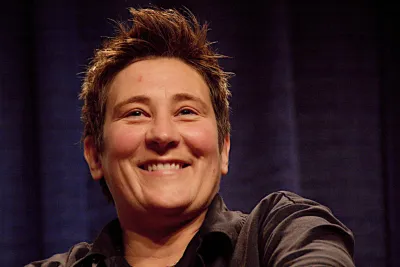
K. D. Lang
Human Design Chart
Biography
Lang was the youngest of four kids born to a teacher and a pharmacist in Consort, Alberta, a town of 650. When she was 12, her dad up and left, never to be seen again. She had been singing and tap dancing since she was five and eccentricity came naturally. In the 6th grade, she used snuff and wore leather bell-bottoms. After graduating from Red Deer College, she joined a group of performance artists who took themselves very seriously. In 1982 a play about Patsy Cline led Lang to country music and an ongoing obsession. It clicked and all came together.
She writes barroom lyrics, wears men's wide-shouldered suits or down home country dresses with boots. With her first film Salmonberries in 1991, the question of her sexual preference came up, as it had before, and she announced her lesbianism the following year, coming out in the 16 June 1992 issue of The Advocate. She's a vegetarian, teetotaller, androgynous, feminist Canadian, stridently unlike others and revelling in being the "odd one out."
The year 2000 found her as the opening act for Sting during their concert tour. She started her own solo concert tour on 9 August 2000 to promote her new CD, Invincible Summer, some of the songs penned while she was enjoying the beaches of southern California after her move from Canada.
What does Projector 3/5 mean for K. D. Lang?
Projector 3/5 — Design at a Glance
K. D. Lang's design tends towards precise, focused perception. As a Projector, her aura acts like a bright flashlight, directly pointing out weaknesses in her environment. She could immediately spot where systems or relationships were rough. However, this ability to find flaws in the system was a double-edged sword. When K. D. Lang suddenly voiced these observations, it often felt like she was shining her light directly in the face of others. The result was usually resistance or anger, as the intensity of this focus could be perceived as unpleasant by others.
The mechanics of her design show that Projectors do not have a constant, intrinsic energy source. Instead, they experience phases of high activity followed by necessary rest phases to avoid burnout. The most effective strategy for K. D. Lang was to not take the initiative herself but to wait for a respectful, honest invitation. By shining her own harmony, she became attractive, so others would naturally seek her insights. If K. D. Lang lived by this principle, she was rewarded with success. Ignoring this strategy and acting without invitation led to the non-self theme of bitterness surfacing sooner or later. Her path lay in patiently waiting for recognition, not in forcing her viewpoint.
Emotional Authority
K. D. Lang's design tends towards a deep, wave-like inner dynamics. She appeared as someone whose perception of the world was strongly colored by her current emotional mood. In one moment, she could be totally enthusiastic about something, in the next, she would view the same situation negatively. This results from her emotional authority, which is present whenever the Emotions Center is defined – regardless of which other centers are also defined. This configuration is subject to a permanent emotional wave of ups and downs. The feeling in the moment is just a snapshot, a first impression, which does not necessarily represent the truth. Quick, spontaneous decisions made directly from this emotion could therefore have negative consequences. The mechanics here require patience and multiple 'sleeping on' of a decision. The more time K. D. Lang took to let a choice mature, the deeper and more comprehensive she could understand the situation. Through waiting, the intense feelings subsided, emotional distance was gained, and eventually clarity and calmness set in. This process was especially important for long-term decisions that could have a significant impact on the life course. Only through this hesitation and waiting for the emotional wave could she reliably grasp her inner truth.
The 3/5 Profile — Martyr / Heretic
K. D. Lang's design tends towards an experimental, yet challenging lifestyle. As a 3/5 Profile ("Explorer/Leader"), a basic attitude emerged that knowledge was generated only through personal experimentation and even failure, to offer it later as a solution to others. This path is characterized by the necessity to see through illusions and projections before binding or pushing through. Line 3 requires here that awareness alone is not enough; it needs the support of the tribe and real assertiveness to recognize and avoid the danger of hindrance.
At the same time, Line 5 acts in crisis times with practical solutions with a strong focus on timing. Here, withdrawal and privacy are crucial to keep one's intentions until complete reflection secret. Premature sharing of these inner processes easily leads to confusion in others. K. D. Lang's structure thus describes someone who acts from personal advantage – which ultimately serves the collective – but learns when to withdraw to avoid failing prematurely or being misunderstood. The attractiveness of this profile precisely arises from this wealth of practical experience, which can be painful when experiments fail publicly.
Split Definition — Defined & Open Centers
K. D. Lang's design predisposes a tendency towards constant mental pressure, coupled with the ability to carry this inspiration into the world through a defined throat. The connection between the Head Center and Ajna Center generated a continuous stream of questions and concepts, but lacked the direct energy to implement them. Instead, the defined throat served as a transmission organ, transforming these mental impulses into communication and action. This created a structure where thinking and the ability to express were closely linked, without the mind alone dictating action.
Simultaneously, the defined Solar Plexus Center established an emotional authority that required patience. K. D. Lang was inclined to make decisions not in the moment but to wait for the emotional wave to clear, lending depth and sensitivity to their reactions as they acted only after cycling through the emotional phase. The defined Root Center provided a firm, adrenalized foundation, sustaining the life impulse and converting stress into forward motion.
In contrast, the open centers made K. D. Lang susceptible to external influences. The open G Center meant identity and direction were not set but initiated by the environment and relationships. This could lead to uncertainty when she tried to actively construct her own identity rather than waiting for the right environment. The open Heart Center lacked consistent willpower, tending to prove itself through promises and competition, often resulting in frustration as the energy for this was not present. The open Sacral Center made her vulnerable to taking on the energy of others, potentially leading to exhaustion if she did not learn to set boundaries and respect her own rhythms. Finally, the open Spleen Center was responsible for intuitive fears and absorbing well-being from the environment, making spontaneous decisions risky.
Channels for mysticism, spontaneous insight and inspired truth.
K. D. Lang's design predisposes a tendency towards deep emotional connection, paired with a unique, often perceived as 'forward-thinking', way of processing and expressing knowledge. This configuration created a person who felt the need for tribal loyalty and was called to bring new perspectives into the world – often only when the timing was right.
Central to this was the Synthesis Channel 19-49, connecting the Root Center with the Solar Plexus and based on tribal logic of 'Love, Honor, and Obedience'. Gate 19 urged towards closeness and cohesion, while Gate 49 rejected anything not meeting the highest ideals. This created an emotional frequency determining who belonged to the 'family' and who did not. K. D. Lang was shown here as someone finely attuned to their position in the whole, experiencing loyalty and the protection of resources and territory as fundamental needs. The gift lay in finding a balance between feasibility and fairness, governed by an emotional wave, not logic.
Parallel to this, the Channel of Structuring 23-43 connected the Ajna Center with the Throat Center, enabling inspired knowledge (Gate 43, insight) to be clearly and efficiently expressed through assimilation (Gate 23). This was not deliberate thinking but a mutative process: spontaneous breakthroughs changing how others saw and thought. K. D. Lang's challenge was to let go of control and allow her mind to process knowledge in its own time. When the timing was right, unique knowledge was recognized; otherwise, rejection and the feeling of being an outsider threatened.
Supporting this was the Channel of Awareness 24-61, linking inspiration (Gate 61) with rational mind (Gate 24). This created an individual thinker not seeking discoveries but waiting for Satori moments where knowledge simply 'happened'. K. D. Lang's mind was constantly engaged with this 'white noise', fostering a search for stillness to bear the mental load.
Additionally, prioritized gates like Gate 33 (Reflection, Retreat) and Gate 44 (Awareness, Transformation) shaped the attitude: experience needed quiet for processing, and transformation happened through unconditional acceptance. Gate 4 (Formulation) helped clarify suspicious patterns, while gates like 30 (Longing), 56 (Narration), and 47 (Context) enriched emotional and narrative depth. Gate 60 reminded that limitations must be accepted to achieve transcendence.
Individual Circuitry — Circuit Signature
K. D. Lang's design predisposes a tendency towards pulsating, acoustic creativity, manifesting in the search for the unique path. The Knowledge Circuit connected her Head, Ajna, and Throat Centers directly, enabling innovative flashes of insight (Channel 24-61) and structured awareness (Channel 43-23) to be expressed through the Throat Center. Emotional waves from the Solar Plexus flowed into this expression, potentially transforming new identities.
Parallel to this, an independent energetic group existed: the Solar Plexus Center was connected to the Root Center (Ego Circuit, Channel 49-19). This synthesis promoted cooperation and the joint creation of resources. As there was no connection to the Sacral Center, space was given for necessary rest periods to regenerate energy for the tribe.
The Split Definition meant that these two systems – the creative, individual expression and the cooperative, tribal resource building – did not directly overlap but existed as separate, parallel forces. K. D. Lang thus showed herself as someone who, on one hand, walked new, individual paths and, on the other, was capable of stabilizing stable structures in the collective through synthesis and mutual support.
Right Angle Cross of the Four Ways 3
K. D. Lang's design points to a tendency towards a deep, often painful confrontation with one's essence. This is the core energy of the Right Cross of the Four Paths, a configuration that arises from the absence of any definition in the emotional, motoric, and logical centers. Without these inner anchor points, there is no immediate, intuitive orientation in the world or in one's body. Instead, attention is directed inward, into a zone of uncertainty and not-knowing.
This structure forces a confrontation with one's darkness and the unconscious parts of the psyche. It is not about superficial self-optimization, but about a radical, often solitary journey into the depths of the self. The path leads through confusion and suffering, as the usual human strategies of adaptation or rational control fail here. The challenge is to not interpret this emptiness as a lack, but as a space for an authentic, unadulterated existence. K. D. Lang was marked by this necessity to find her own identity not through external validation, but through the integration of her inner shadows. It is a process of letting go of all illusions to ultimately establish a pure, unmediated connection to her own truth, free from the masks others wear for social navigation.
Saturn Return · Uranus Opposition · Chiron Return · 2nd Saturn Return — Life Cycles
K. D. Lang's design was characterized by a clear structuring of success moments that correlated with planetary cycles. In 1989, at the age of 28, she received a Grammy in the category of best country singer. This coincided with her first Saturn return, a phase in which years of groundwork often condenses into a solid, recognized result.
The dynamics of her development were further evident in 2001. At 40 years old, she received a Grammy for the album 'Best Traditional Pop Vocal Album' in collaboration with Tony Bennett. This marked the Uranus opposition, an aspect that often leads to unexpected turns or the confirmation of a new, expanded identity.
Another peak occurred in 2010, when K. D. Lang, at 49 years old, sang 'Hallelujah' by Leonard Cohen at the opening ceremony of the XXI Winter Olympics. This aligned with her Chiron return, a fulfillment cycle in which one's incarnation cross unfolds and the life purpose becomes experiential.
Finally, she received the Alberta Order of Excellence in 2018, at the age of 57. This coincided with her second Saturn return, often symbolizing the final consolidation of a life's work and societal recognition of the lived strategy. These events reinforce the mechanical logic of her design: cycles of condensation, transformation, and fulfillment shaped the course of her career.
Projector · Emotional Authority — Synthesis
A central red thread runs through the chart: the ability to recognize patterns and shed light into the dark (Projector type, defined Head Center). This gift is accompanied by a deep understanding of the needs of others (Channel of Synthesis), leading to a strong connection to tribal consciousness. The repeated recognitions through awards (charted cycles) indicate that this ability to perceive and address needs is noticed and valued in the world – a continuous pattern of recognition, understanding, and then experiencing the results in the form of recognition.
The design reveals a central paradox between the need for recognition and the way this recognition is sought. As a Projector, waiting for the invitation is essential, yet the Profile of the Explorer/Hero (3/5) implies an active experimentation and accumulation of experiences. This creates a tension: the necessity to show oneself and offer one's knowledge collides with the knowledge that imposing one's perspective generates resistance. Emotional authority intensifies this, as decisions require time, while the Explorer is driven to direct action.
3 Defined Channels
Incarnation Cross - Right Angle Cross of the Four Ways 3
Solar Return
The Solar Return shows the moment when the sun returns to its exact birth position - your personal solar year.
Life Cycles
Discover the life cycles with a detailed triple view (birth chart, cycle chart, composite).
Human Design Profile
- Type
- Projector
- Strategy
- Wait for the respectful invitation
- Authority
- Emotional Authority
- Profile
- 3/5 - Martyr / Heretic
- Definition
- Split Definition
- Incarnation Cross
- Right Angle Cross of the Four Ways 3
- Date of Birth
- 02.11.1961 02:03
- Place of Birth
- Edmonton, Canada
Frequently Asked Questions
What is K. D. Lang's Human Design type?
What Profile does K. D. Lang have?
What Authority does K. D. Lang have?
What incarnation cross does K. D. Lang have?
When was K. D. Lang born?
Discover your own Human Design
Are you also a Projector? Find out in a personal reading how to unfold your leadership qualities and recognize the right invitations.
More Personalities
Back to overviewSissy Spacek
Aaliyah
Alain-Fournier
Alexia
Alizée

Anémone