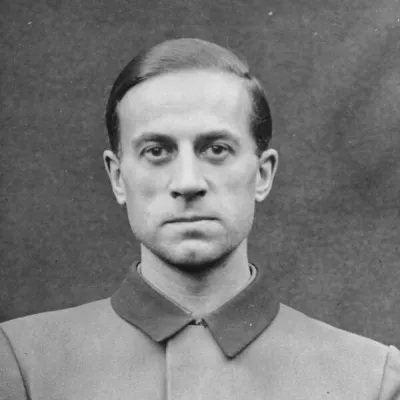
Karl Brandt
Human Design Chart
Biography
The Human Design of Karl Brandt: Generator 3/5
Generator 3/5 — Design at a Glance
Karl Brandt's design showed a tendency towards great endurance and inner strength. As a Generator, he had plenty of sacral energy that carried him like a strong workhorse – provided this energy was used for tasks that truly mattered to him. His human nature revealed the potential to sustainably implement things into reality; however, this process only worked smoothly when he responded to signals from his environment rather than initiating himself. The motto of his design was 'react', not 'anticipate'. When his sacral center gave a clear 'yes', he could respond with full power and would be rewarded with deep satisfaction. If he lived against this strategy, for example by constantly initiating or doing things without inner desire, he fell into stumbling blocks. Then frustration and energy depletion threatened as intrinsic creative force was wasted. His design challenged him to decide from the gut and only act when an external invitation existed. This way no one could stop him; if he ignored this rhythm of reaction, sooner or later persistent exhaustion would meet him.
Emotional Authority
Karl Brandt displayed a decision-making stance characterized by emotional wave movements: his inner authority lay in the defined Emotional Center. This meant that he was always under the influence of an emotional wave showing permanent ups and downs of his feelings. He saw the world colored by his current mood; at one moment, he could be totally enthusiastic about something, only to completely negate it in the next.
His feeling in the moment was merely a snapshot, a first impression that did not necessarily represent his truth yet. Therefore, quick, spontaneous decisions based on emotion could have very negative consequences. The more time he took to let a decision mature, the deeper and more comprehensive he could understand something. This required patience and multiple reconsiderations of a decision. He should take pride in this process and ask himself several times. Over time, intense feelings subsided, emotional distance was gained, clarity and calmness set in. Only then had he gone through the process. This was especially true for long-term decisions that could have a significant impact on his life course. Regardless of what else was defined in his chart, this emotional authority always took precedence in decision-making.
The 3/5 Profile — Martyr / Heretic
Karl Brandt revealed himself as someone who learned by personal experimentation to offer solutions later for others. His Human Design Profile 3/5, the Experimenting and Heroic profile, established this tendency: The line of the Adventurer required practical experience before knowledge was shared. This self-acquired expertise worked attractively on his environment; others sought his advice, which flattered him in the role of helper. If he failed publicly in his attempts, however, it was particularly painful for him.
His design also contained specific dynamics of secret interaction and experimentation under pressure. The energy of Gate 54 promoted ambition through hidden paths and persistent circumvention of obstacles when official channels were blocked. Simultaneously, Gate 57 drove further development during crisis times. Here it was about creating individual mutations to fend off new threats and secure the collective's survival capability. This mechanism described a capacity to build new forms under stress and test them. Karl Brandt thus lived in a tension between the need to establish authority through personal experience and the task of developing innovative, life-saving structures during critical moments – often through unofficial means or intuitive leaps when established ways failed.
Triple Split Definition — Defined & Open Centers
Karl Brandt's design inclined towards a fixed identity and personal will, paired with a strong inner energy source. His defined G Center endowed him with a reliable self-image and a sense of his own direction, allowing him to naturally guide others into new paths without seeking their approval. This magnetic presence worked in conjunction with his defined Heart Center: He possessed permanent willpower to keep promises and determine resources for himself, giving him the ability to actively shape his life and take responsibility for his community.
As a Generator with a defined Sacral Center, Karl Brandt had an enormous vital energy source that manifested as constant humming or restlessness. His strategy involved reacting to questions of life rather than initiating them; only through this reactive agreement did he have access to the full power needed to pursue tasks to mastery and avoid frustration. His defined Solar Plexus Center served as emotional authority: He had to wait for waves of his feelings until clarity emerged before making decisions, as spontaneous impulses often led to chaos on emotional highs or lows. Additionally, his defined Spleen Center with its intuitive, momentary survival sense and the defined Root Center with its fixed handling of stress and pressure shaped his existence.
In contrast, his vulnerability was revealed through the undefined Centers Head, Ajna, and Throat. His open Head Center tended to be overwhelmed by mental confusion or others' questions, pulling him into a vortex of doubts if he did not trust his inner authority. The open Ajna Center made his mind flexible for new ideas but also put him at risk of identifying with foreign opinions or pretending uncertainty. His open Throat Center brought the fear of not being heard; instead of speaking spontaneously and invitingly, he might try to force unnecessary attention or feel silence as a threat, leading to unpredictable communication patterns. This combination of strong inner substance and open mental and communicative receptivity formed his specific dynamics in dealing with the world.
Channels for synthesis, pioneering spirit and individual power.
Karl Brandt's design inclined towards emotional bonding and tribal loyalty, paired with a strong will for individualization. This configuration showed someone standing between the need for belonging and the drive for personal distinction. The Synthesis Channel 19-49 connected the Root Center to the Solar Plexus through the Gates of Claims (19) and Principles (49). This created an emotional frequency that formed the 'glue' for communities: Acceptance or rejection was based not on logic but on a deep, instinctive test whether someone belonged to the tribe. Loyalty and the protection of shared resources were central here; those who did not fit into this emotional wave were rejected.
Simultaneously, the Initiation Channel 51-25 connected the Heart Center through the Gates of Shock (51) and Self Spirit (25). This channel drove a natural competitive edge aimed at being first or winning. It linked an egoistic drive with the ability to recognize potential in others and spur them towards individualization through 'shocks'. Here was the art of initiation: guiding people from collective 'we' to individual 'I', often through transformative forces that were uncontrollable but showed as mystical processes at the heart of mutation.
The Power Channel 34-57 rounded this profile by connecting the Sacral Center (Gate 34) with the Spleen Center (Gate 57). This endowed an intuitive survival intelligence: the ability to react spontaneously and without mental delay to dangers or vibrations in the environment. This defensive intuition served to protect his comfort mode and enabled quick decisions for self-assertion.
Additional Gates like 54 (worldly success as a prerequisite for spirituality) and 53 (pioneer spirit, new cycles) underscored the drive for recognition and innovation. Gate 26 in his design pointed towards the ability to integrate innovations into conservative structures, while Gate 18 emphasized the need to correct collective processes without taking it personally. The combination of tribal bonding, competitive initiation, and intuitive self-defense shaped Karl Brandt's behavioral patterns: he sought ways to hold communities together through clear principles while simultaneously securing individual distinction and survival security through intuitive reactions.
Individual Circuitry — Circuit Signature
Karl Brandt's design was characterized by three separate, parallel energy flows that never communicated directly with each other. The Centering Circuit in him connected Identity and Heart Centers. This promoted a strong self-worth and inner convictions; however, lacking connection to the Throat Center, these firm principles often remained hard to express verbally. Parallel to this, the Ego Circuit linked Solar Plexus and Root Centers. This configuration generated emotional waves that were translated into physical action impulses – a mechanism of communal resource creation, but one that required regular rest periods without Sacral energy. The third flow, the Integration Circuit, connected Sacral and Spleen Centers. Here it was about securing his survival through intuitive decisions in the present; the power from reacting to life was guided by proper behavior. These three separate systems – inner affirmation, emotional resource building, and intuitive survival – existed alongside each other without direct energetic exchange. Karl Brandt thus appeared as someone with a solid individuality whose inner strength did not automatically flow into external communication while emotional tensions directly translated into physical tension and daily action was shaped by immediate, intuitive assessment of the situation.
Right Angle Cross of Penetration 4
Karl Brandt's design indicated a tendency towards deep, often painful confrontations with the meaning of suffering. He was someone who could not avoid delving into the darker aspects of human existence and constructing his own, often isolated truth from it. This attitude stems from the configuration 'The right cross of penetration 4'. This mechanism describes a specific energetic focus: the drive to endure pain not just as a burden but to understand and illuminate it as a central element of life. It involves an energy that tends to push into the deepest depths of human psychology in search for answers to the question of why suffering exists. For Karl Brandt, this meant his inner world was profoundly marked by this penetrating gaze. He did not seek superficial comfort but rather aimed to understand and utilize the structure of pain itself. This configuration created an intense, often solitary perspective where suffering was seen as a necessary path towards knowledge or the assertion of one's own will. It was not passive acceptance but an active, penetrating exploration of the boundaries between pain and power, which significantly shaped his entire orientation.
Saturn Return · Uranus Opposition — Life Cycles
Karl Brandt's design indicated a tendency toward structural breaks when external authorities blocked his plans. This became evident in 1932 at age 28: His plan to work as a doctor at the Tropical Hospital failed due to lack of approval from French authorities. This first Saturn return often marks the moment where years of groundwork meets harsh realities and either solidifies or shatters. For Brandt, this was an early signal that his path would be defined not by conformist adaptation but by breaking existing structures.
Later in 1945 at age 41, the Uranus opposition came into effect. Brandt appeared in Flensburg and was arrested by allied troops. This configuration describes a profound upheaval where old identities and power structures inevitably collapse. The arrest was not a random event but an external reflection of this inner pressure for radical change. His design showed him as someone who did not stabilize during crises, but questioned the status quo – even to the point of losing his previous position entirely. This mechanism underscores that Brandt's life path was marked by disruptive phases which pulled him out of established roles and forced new, often painful realities.
Generator · Emotional Authority — Synthesis
Karl Brandt was a Generator whose life was deeply influenced by sacral energy (Generator type). However, this power always unfolded in the context of his emotional wave (Emotional Authority), forcing him to make decisions not spontaneously but over an extended period. His profile as an experimenter and hero (3/5 Profile) suggests that he learned through personal experiences and then provided this knowledge to others – a pattern evident in his willingness to embark on new paths, even if it meant making mistakes. The Channel of Synthesis (Gate 19/49) amplified his drive for belonging and the necessity to defend principles, making him sensitive to the needs of others.
A central paradox in Karl Brandt's design lay in the tension between his enduring energy and the need to apply this at his heart project (Generator Pitfalls). His defined G Center gave him a strong identity and direction, yet emotional authority required patience – an inner conflict that manifested during turning points in his life, such as the failure of a plan in 1932 and arrest in 1945. Thus, he lived a dynamic of powerful action and necessary waiting for clear internal approval.
3 Defined Channels
Incarnation Cross - Right Angle Cross of Penetration 4
Solar Return
The Solar Return shows the moment when the sun returns to its exact birth position - your personal solar year.
Life Cycles
Discover the life cycles with a detailed triple view (birth chart, cycle chart, composite).
Human Design Profile
- Type
- Generator
- Strategy
- To respond - wait for something to respond to
- Authority
- Emotional Authority
- Profile
- 3/5 - Martyr / Heretic
- Definition
- Triple Split
- Incarnation Cross
- Right Angle Cross of Penetration 4
- Date of Birth
- 08.01.1904 22:45
- Place of Birth
- Mülhausen, France
Frequently Asked Questions
What was Karl Brandt's Human Design type?
What profile did Karl Brandt have in Human Design?
What authority did Karl Brandt possess?
What incarnation cross did Karl Brandt have?
When was Karl Brandt born?
Discover your own Human Design
Are you also a Generator? Find out in a personal reading how to use your sacral energy correctly and discover deep satisfaction.
More Personalities
Back to overviewAaliyah

Alexia

Angèle

Anne-Marie

Arcángel

Arno