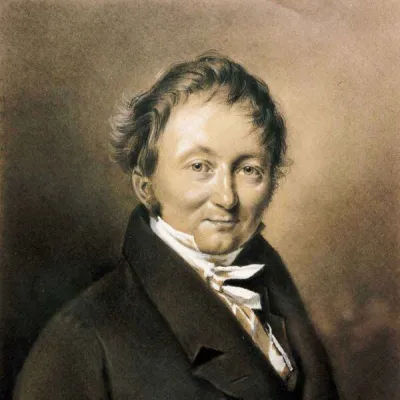
Karl Drais
Human Design Chart
Biography
Human Design Analysis: Karl Drais as Projector 2/5
Projector 2/5 — Design at a Glance
Karl Drais appeared as someone with a dense, focused aura – comparable to a bright flashlight that directed itself precisely towards weaknesses in the environment. His design inclined him to immediately recognize where systems or individuals were not functioning optimally. This ability to quickly identify flaws in the system was characteristic of his Projector type.
Since Projectors do not have a defined Sacral Center, Karl Drais lacked a constant internal source of life energy. Instead, he experienced phases of high activity and rapid productivity followed by necessary rest periods for regeneration. This rhythmic up-and-down contrasted with the demands of a continuous, steady work pace prescribed by many societal structures.
The optimal strategy for his design was to wait for an appreciative and sincerely meant invitation from the environment rather than taking initiative himself. Through this approach, he could effectively contribute his insights without his direct criticism being perceived as unpleasant. If Karl Drais lived in accordance with this strategy, he was rewarded with success. Deviations led to experiences of bitterness, his specific Non-Self theme that arose when his light struck others uninvited and thus offensively.
Emotional Authority
Karl Drais exhibited a decision-making structure that did not follow spontaneous impulses but rather required an essential emotional maturation period. His inner authority resided in the defined Emotional Center – the emotional authority. This mechanism followed a wave dynamics: feelings rose and fell in perpetual cycles, coloring the momentary perception with the current mood. What appeared inspiring at one moment could seem negative in the next; this first impression was merely a snapshot, not yet the deep truth.
Quick decisions based on acute emotions often proved problematic for his design. The mechanism required patience: Drais had to give himself time for decisions to mature. Only through multiple “sleeping over” and waiting out emotional highs and lows did intense feelings gain distance. Over time, clarity and calmness set in – only then was the process complete and a well-founded decision possible. This necessity of taking one’s time and asking oneself repeatedly served to make long-term life decisions on a stable basis rather than fleeting whims.
The 2/5 Profile — Hermit / Heretic
Karl Drais appeared as someone caught between the urge for withdrawal and the expectation of others to help him. His Profile 2/5, known as “Natural Talent” or “Hero and Saviour,” defined this tension: Line 5 attracted people seeking solutions while Line 2, the Hermit Line, required intensive phases of isolation. Drais had to carefully dose his energy; he could not immediately help everyone without forgetting himself. Instead, he used his withdrawal periods to gain inner clarity and decide what he would truly commit to.
This dynamic was reinforced by specific Gates. Gate 24 on Line 2 projected new things often without internal reflection, leading to spontaneous adaptation but also conflicts if these projections were not aligned with internal standards. On the other hand, Gate 19 on Line 5 emphasized readiness to sacrifice in crisis times. Here lay the danger of appearing condescending or blindly sacrificing oneself, especially when emotional instability prevailed. Drais had to learn that such sacrifices only made sense if they followed his strategy and did not arise from impulsive pressure. His path was to align these external expectations with the necessary inner work of Line 2 to avoid failing as a mere saviour and instead act authentically.
Triple Split Definition — Defined & Open Centers
Karl Drais revealed himself as someone who was constantly under mental pressure to ask questions and understand connections. His defined Head Center and Ajna Center created a continuous source of inspiration and conceptual clarity, but lacked the direct energy for implementation. This inner drive required patience; hasty actions from the mind only led to frustration, while waiting for the right moment allowed his ideas to become effective.
His defined Throat Center enabled him to reliably translate these mental concepts into language and communication. He did not speak impulsively but articulated what his mind had already structured. This was complemented by a defined G Center, which gave him a firm sense of self-identity and clarity about his own direction. Drais knew who he was and could show others new perspectives without being dependent on their expectations.
At the same time, his design revealed specific vulnerabilities. His open Heart Center made him sensitive to the pressure of proving his worth through willpower or promises. Without a consistent energy for enforcement, he tended to put himself in situations to prove his competence, often leading to exhaustion when he exceeded his own limits.
Similarly, his open Sacral Center lacked a constant source of generative life force. Drais was prone to absorbing the energy of his environment and overloading as a result. He tended to take on more responsibility than available to him and lost sight of his own energy balance. A healthy approach to this openness required taking breaks and not relying on borrowed energy.
Additionally, his open Spleen Center acted as a mirror for external health and safety frequencies. Without an inner, spontaneous intuition, he had to learn not to be guided by conditioned fears or false feelings of security from others. Spontaneous decisions were risky for him; instead, he developed wisdom in distinguishing between his own needs and absorbed vibrations to sustainably protect his health and well-being.
Channels for logic, presence, reflection and mystical synthesis.
Karl Drais revealed himself as someone whose thinking was characterized by healthy skepticism. His design inclined towards analytical scrutiny: the Logic Channel 63-4 connected the Head Center with the Ajna Center, creating a mind that permanently filtered patterns to test their consistency. Doubt here was not an obstacle but essential for logic; only through logical experimentation and proving consistent, verifiable patterns could an answer be accepted as true. Unfounded belief found no place in this configuration.
Parallel to this, the Awakening Channel 10-20 between G Center and Throat Center expressed the wisdom of loving and trusting oneself to survive. This manifested not as abstract philosophy but concrete action here and now. By simply being himself, he radiated a clarity that inspired others to embrace their own nature.
The Lost Son Channel 13-33 connected G Center with Throat Center through Listener Gate and Withdrawal Gate. Here he gathered life stories and secrets before withdrawing to reflect on these experiences. Only after this patient sorting did he share the insights gained, thereby contributing continuity to collective development.
Emotionally, the Synthesis Channel 19-49 between Root Center and Solar Plexus Center ensured cohesion. It determined through emotional waves of acceptance or rejection who belonged to the group. Loyalty and a sense of being needed were driving forces; he sought balance between feasibility and fairness within his social structures.
Additionally, Gates like 24 (mental mutation), 44 (transformation through interaction) and 7 (hierarchical leadership) contributed to complexity. Gate 58 in the Root Center promoted process perfectionization while Gate 35 aimed at change through new experiences. These configurations shaped his work as someone who tested patterns, remained true to himself, and learned from experience.
Collective Circuitry — Circuit Signature
Karl Drais revealed himself through a Triple Definition that formed three separate, parallel operating energetic systems. This structure characterized his work as the interplay of independent forces without direct exchange between groups.
The Understanding Circuit in him connected Head Center and Ajna Center via the Logic Channel (63-4), fostering an ability for focused, rational analysis and strategic planning aimed at future solutions.
Parallel to this, the Meaning-Finding Circuit operated through the channel 'The Lost Son' (13-33) connecting Throat and Identity Centers. This was about sharing emotional experiences from the past to learn together. A second part of this system, also in the realm of Throat and Identity, came from the Integration Circuit (channel 20-10 'Awakening'). This channel supported securing one's survival through intuitive knowledge and proper behavior in the present moment. Both channels used the same centers but created different qualities: emotional reflection versus immediate self-affirmation.
The third system was the Ego Circuit, connecting Solar Plexus Center with Root Center via the Synthesis Channel (49-19). This generated a cyclical energy for cooperation and resource creation within a group, marked by phases of activity and necessary rest as there was no direct connection to the Sacral Center.
These three isolated blocks – rational strategy, emotional/intuitive communication, and group-oriented resource creation – existed alongside each other without influencing one another or forming a continuous flow.
Right Angle Cross of the Four Ways 1
Karl Drais exhibited a fundamental disposition marked by the 'Right Cross of Four Paths'. This Human-Design configuration points to an intense inner tension between the desire for secure ground and the urge for limitless freedom. It was a dynamic process of letting go of fixed structures while simultaneously reaching new horizons. For Drais, this meant often standing at the threshold: on one hand feeling the need for support and reliability, on the other following the impulse to leave established paths behind. This inner conflict was not a disturbance but a driving force. It fostered the ability to act creatively in uncertain situations without binding oneself to rigid rules. The energy of this cross worked like a constant oscillation between anchoring and expansion. Drais lived out this dynamic by repeatedly challenging himself with new tasks, without losing touch with reality. It was always about finding balance between the known, which offered security, and the unknown, which held potential for growth. This specific mechanism shaped his way of making decisions and dealing with changes, encouraging him to redefine what stability meant time and again.
Saturn Return · Uranus Opposition · Chiron Return · 2nd Saturn Return — Life Cycles
Karl Drais’ design showed a tendency towards structural liberation that manifested in clear life phases. In 1810, at the age of 25, he experienced his first Saturn Return. This cycle often condensed years of groundwork into solid results. Drais became a Baden forest master without office and was released from duty to pursue his work as an inventor – a success that confirmed the mechanical maturity of this point in time.
Later, his design presented itself through a drive for change. In 1827, at age 42, he faced the Uranus Opposition. This phase often demands a reassessment of bonds and structures. Drais returned to Mannheim after undertaking an expedition to Brazil. This event marked the end of a relationship with foreign spaces and his return to home base.
The Chiron Return around the age of 50 is a fulfillment cycle where one’s incarnation cross unfolds, making sense if strategy and authority are respected. In 1835, at the age of 50, Drais had to return his chamberlain key due to a tavern brawl in Mannheim. This crisis did not appear as healing old wounds but rather as a confrontational test of one’s life task and personal purpose amidst external turmoil.
Projector · Emotional Authority — Synthesis
He was a projector who, through the defined connection between Head Center and Ajna Center (Logic Channel), felt constant mental pressure to question and understand patterns. His persistent drive for clarity and recognition of flaws in the system (Gate 63) shaped his perception, making him appear as someone who quickly identified others' shortcomings. Emotional authority required time to let decisions mature, contrasting with an immediate need to share knowledge. He lived a tension between the inner desire for withdrawal (Line 2) and the expectation to offer solutions as a hero and savior (Line 5).
This interplay of focused perception and emotional maturity led to a central paradox: he was geared towards bringing 'light into darkness' for others, yet how he did this was often marked by doubt and critical analysis. Documented events showed both successes – recognizing potential (Saturn Return) – as well as crises resulting from directly addressing problems (Chiron Return). He thus always acted at the intersection of inspiring insight and potentially irritating honesty.
4 Defined Channels
Incarnation Cross - Right Angle Cross of the Four Ways 1
Solar Return
The Solar Return shows the moment when the sun returns to its exact birth position - your personal solar year.
Life Cycles
Discover the life cycles with a detailed triple view (birth chart, cycle chart, composite).
Human Design Profile
- Type
- Projector
- Strategy
- Wait for the respectful invitation
- Authority
- Emotional Authority
- Profile
- 2/5 - Hermit / Heretic
- Definition
- Triple Split
- Incarnation Cross
- Right Angle Cross of the Four Ways 1
- Date of Birth
- 29.04.1785 11:30
- Place of Birth
- Karlsruhe, Germany
Frequently Asked Questions
What was Karl Drais' Human Design type?
Which Profile did Karl Drais have?
What Authority did Karl Drais have?
What incarnation cross did Karl Drais have?
When was Karl Drais born?
Discover your own Human Design
Are you also a Projector? Find out in a personal reading how to unfold your leadership qualities and recognize the right invitations.
More Personalities
Back to overviewSissy Spacek

Alain-Fournier

Anémone

Ann-Margret

Bourvil
Hergé