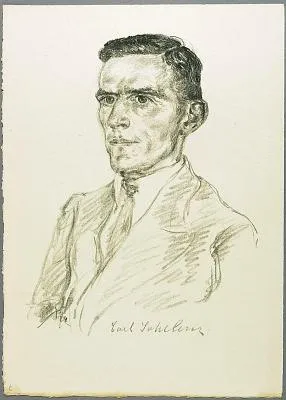
Karl Schelenz
Human Design Chart
Biography
What does Manifesting Generator 5/1 mean for Karl Schelenz?
Manifesting Generator 5/1 — Design at a Glance
Karl Schelenz revealed himself as a person with a hybrid energy structure: He had the constant power of a Generator and also possessed the ability of a Manifestor to skip steps and quickly draw results into his life. This configuration fundamentally shaped his work style. With his defined Sacral Center, he had access to a steady energy source, which required the same strategic imperative as pure Generators: Not initiating himself but reacting to external impulses. Only when his inner 'yes' of the Sacral resonated should he act.
This speed entailed specific risks. Often Karl Schelenz tended to pursue multiple projects simultaneously in response to various impulses at once. If strategy and internal authority did not work hand-in-hand, his natural creative enthusiasm quickly turned into frustration – his characteristic non-self theme. Occasionally skipping steps led him to have to catch up on missing steps, which could slow him down.
However, when the strategy was adhered to and he only reacted to confirming impulses, Karl Schelenz drew deep satisfaction from his work. In this state, parallel working was not a hindrance but an advantage. He entered a 'play mode' where variety and fun fueled his energy. The advice to focus strictly on one thing would have harmed him more than helped; his strength lay in the fluid switching between different tasks as long as inner resonance remained.
Sacral Authority
Karl Schelenz lived as a Generator whose strategy and internal authority were identical: Sacral Authority. This configuration greatly simplified his decision-making process, as he did not need to choose between various inner voices. A prerequisite for this was his open Emotional Center, ensuring that no emotional waves overlapped or distorted his physical signals.
His decisions arose from a direct reaction to external stimuli. Karl Schelenz showed himself through an 'inner voice' – perceivable energy surges or sounds like grunts and hums – signaling whether an offer appealed to his energy. When his sacral motor was activated, he felt vital and alive. He then had inexhaustible energy and tackled tasks with great enthusiasm. His life was characterized by the joy of doing itself without a need for external purpose.
Additionally, his active Spleen Center acted as supporting authority. As it was directly connected to the Sacral Center, this allowed him quick, spontaneous reactions. Karl Schelenz had direct access to his instinctive perception and physical well-being. He reliably followed these deep body impulses, further strengthening his ability for swift and accurate decision-making.
The 5/1 Profile — Heretic / Investigator
Karl Schelenz revealed himself through his 5/1 profile as someone who gathered profound insights to offer others for problem-solving. Line 1 conveyed him patience and introspection, necessary time investment for learning new projects, while line 5 possessed a nearly magnetic aura: Others actively sought out his solutions. This worked similarly to a scientific expert answering questions but risked being exhausted without clear boundaries.
His configuration emphasized listening and spiritual guidance (Gate 13), often perceiving him as a savior figure helping avoid mistakes through shared experiences. Simultaneously, Pluto in its position demanded a deep reevaluation of every newly acquired knowledge; without this depth, there was the risk of appearing superficial. The impatience to pick fruit before it ripened (Venus fall) contrasted with the necessary endurance of line 1.
Karl Schelenz learned to say no to maintain balance between private research and public consultation. This way, he could optimally utilize his gifts: He managed his knowledge skillfully (Jupiter in Fall) and expanded it deliberately rather than being overwhelmed by others' projections. This structure shaped his path as a researcher gaining security through depth and then purposefully sharing it.
Single Definition — Defined & Open Centers
Karl Schelenz revealed himself as someone whose internal structure was marked by a clear identity and persistent energy. His defined G Center gave him a reliable self-perception and a firm sense of direction in life; he instinctively knew where he belonged and could convey this orientation to others. This inner security was supported by his defined Sacral Center, which functioned as a powerful engine: Karl Schelenz had a constant source of vitality that only became effectively mobilized through reactions to external stimuli. His strategy involved not initiating himself but waiting for life to present questions or offers to which his Sacral Center could respond with a clear yes-or-no tone.
His defined Ajna Center ensured continuous mental activity; he thought consistently and processed information in a specific, unchanging way. These mental concepts flowed into his defined Throat Center, allowing him to articulate his thoughts and theories directly and reliably. He expressed what he had conceptually grasped, making communication for him a natural expression of his inner logic.
At the same time, his design revealed specific vulnerabilities through several open centers. His open Head Center made him susceptible to mental pressure and confusion; he tended to engage with questions that were not his own or sought external inspiration to fill internal voids. The open Heart Center led to a lack of persistent willpower; Karl Schelenz was not inclined to make promises or prove his worth through competition, making him vulnerable in situations of expectation. Additionally, his open Solar Plexus absorbed the emotions of his environment, causing him to fluctuate between foreign moods and his own feelings while the open Spleen Center promoted a deep survival fear pattern that led him to cling to things for a sense of security. The open Root Center amplified external stress, leading to periodic restlessness when he succumbed to environmental pressure rather than trusting his inner authority.
Channels for presence, insight and persistent discovery.
Karl Schelenz exhibited a fundamental attitude of being awake in the present moment and radiating self-confidence through authentic behavior. This quality resulted from Channel 10-20, which connected his G Center with his Throat Center. He lived the wisdom that survival and flourishing depend on accepting and loving oneself; by simply being himself, he unconsciously inspired others to live their own nature.
His thinking often worked faster than collective understanding. The Channel of Structuring 23-43 linked his Ajna Center with his Throat Center and enabled spontaneous insights (Gate 43), which he expressed through assimilative language (Gate 23). These innovative perspectives could make entire organizational structures more efficient but required patience: His unique knowledge was only accepted when communicated at the right time; otherwise, he felt like an outsider waiting for an invitation.
The foundation of his persistence was the Channel of Discovery 29-46 between Sacral and G Centers. Here, positive life energy (Gate 29) connected with self-determination (Gate 46). Karl Schelenz had to let go of expectations to fully immerse himself in experiences; only at the end of long cycles did the meaning reveal itself. His success depended on trusting his inner authority and not following mental decisions that often led to failure.
Additionally, prioritized gates shaped his profile: Gate 13 promoted reflection within the context of time and cooperation for collective memory. Gate 7 projected leadership patterns and future hierarchies through experiments. Gate 16 advanced mutative processes where identification with skills led to mastery. Gate 15 established logical flows in societies by adapting to natural rhythms. Finally, Gate 59 contributed a genetic strategy for binding and unification that overcame barriers for relationships regardless of personal feelings.
Individual Circuitry — Circuit Signature
Karl Schelenz revealed himself as someone whose inner compass was marked by a clear connection between mind and expression. His design linked the Ajna Center with the Throat Center through Channel 43-23, creating a direct flow from mental structuring to verbal or creative implementation. Thoughts were not only thought but immediately took form.
Parallel to this, there existed a separate energy path between Identity and Sacral Centers (Channel 46-29). Here it was about discovering one's essence and using life force for authentic action. These two areas – mental formulation and emotional exploration – were not directly merged in him but formed two independent pillars of his experiential world.
A third aspect connected the Throat Center with the Identity Center (Channel 20-10). This Awakening Channel emphasized the need to express inner intuition and proper behavior here and now. Since Karl Schelenz had a Simple Definition, these channels formed a cohesive whole: Mind, voice, and identity worked in a closed system. Energy flowed from mental structuring through expression to self-affirmation. This gave him a clear, structured presence where internal clarity was directly carried outward without generating inner conflicts or divided definitions.
Left Angle Cross of Masks 1
Karl Schelenz carried the design of the left cross of masks. This configuration set a specific life direction characterized by deep engagement with spiritual or creative ideals. In Human Design, this cross describes the path of someone who carries their inner truth and authenticity outwardly, often aiming to serve as an example for others or to make hidden aspects of human consciousness visible.
For Karl Schelenz, this meant that his life was guided by an internal compass aimed at revealing deeper meanings. He did not present himself as someone merely taking on superficial roles but rather strove to express his true nature and inspire or teach others in the process. The energy of this cross promoted a dedication to what is felt as sacred or essential.
His way of interacting with the world was marked by the desire to shed the 'mask' of everyday life and reveal the underlying essence beneath it. This often required great courage and clear vision. Karl Schelenz lived out this dynamic by using his personal experiences and insights to contribute to spiritual or cultural development in his environment. His path was thus one of continuous self-revelation in service of a higher purpose.
Saturn Return · Uranus Opposition · Chiron Return · 2nd Saturn Return — Life Cycles
In his late twenties, Karl Schelenz emerged as someone who established structural clarity and reordered existing rules. This attitude aligned with the first Saturn Return, a cycle that marks the phase in Human Design where years of internal work condense into a stable, enduring external form. It is a moment of consolidation when the individual learns to use their energy efficiently and sustainably rather than acting impulsively.
In 1919 at age 29, Karl Schelenz decisively shaped the game of handball and has been known as its father ever since. This event was not coincidental but a concrete manifestation of the Saturn Return: The previously gathered experiences and ideas were translated into a solid set of rules that stood the test of time. The Saturn cycle demands discipline and the ability to pour visions into tangible structures. Karl Schelenz used this energetic phase to turn a chaotic game into an organized sport. His authority did not rest on mere inspiration but on creating a system others could adopt and apply. This step from idea to institution is characteristic of the first Saturn Return when life's mission begins to anchor itself in the material world.
Manifesting Generator · Sacral Authority — Synthesis
Karl Schelenz lived a life marked by dynamic interaction between inner knowledge generation and the urge for immediate implementation. As an Manifesting Generator with sacral authority, he responded to impulses from his environment, where his defined sacral energy signaled constant readiness for action (sacral center). His profile as Hero/Researcher (5/1) reinforced this trait, driving him to accumulate deep knowledge and make it available to others – a process facilitated by his defined mental consciousness. The connection between throat and sacral centers allowed him to quickly turn ideas into action (Channel Awakening), which was evident in the decisive shaping of a game that made him famous.
However, Schelenz’s design contained a central paradox: the tension between the need for quick action and the necessity not to skip important steps. While the Manifestor component in his Manifesting Generator enabled lightning-fast initiatives, the knowledge from his defined Ajna center and his role as a knowledge transmitter (cross of masks) required careful deliberation and preparation simultaneously. This internal tension between impulsivity and thorough analysis shaped his path and constantly challenged him to find balance.
3 Defined Channels
Incarnation Cross - Left Angle Cross of Masks 1
Solar Return
The Solar Return shows the moment when the sun returns to its exact birth position - your personal solar year.
Life Cycles
Discover the life cycles with a detailed triple view (birth chart, cycle chart, composite).
Human Design Profile
- Strategy
- To respond - wait for something to respond to
- Authority
- Sacral Authority
- Profile
- 5/1 - Heretic / Investigator
- Definition
- Single Definition
- Incarnation Cross
- Left Angle Cross of Masks 1
- Date of Birth
- 06.02.1890 00:45
- Place of Birth
- Berlin, GER
Frequently Asked Questions
What was Karl Schelenz's Human Design type?
What profile did Karl Schelenz have in Human Design?
What authority guided Karl Schelenz?
What incarnation cross was active for Karl Schelenz?
When was Karl Schelenz born?
Discover your own Human Design
Are you also a Manifesting Generator? Find out in a personal reading how to unfold your multi-talents and direct your energy wisely.
More Personalities
Back to overviewAldair

Alizée

Angeli

Arletty

Artus

Balthus